
3.7 / 5 ★★★★☆
 TESTED WITH REAL MONEY
 Apex Trader Funding
Apex Trader Funding Review 2026: EOD vs Intraday, PA Payouts and My Experience
My first-hand Apex record spans more than two years and up to ten legacy 50K PAs
See pricing at Apex Trader FundingAffiliate link. It never changes my rating or verdict.
Review at a glance
4.2 20.3k reviews
 TESTED WITH MY OWN MONEY 2+ years tested · up to 10 legacy 50K PAs
Compare Apex Trader Funding accounts and rules.
Choose the setup you want to check. Prices, drawdown and payout rules update to match it. SELECTED ACCOUNT
EOD Drawdown 50K
Simulated evaluation
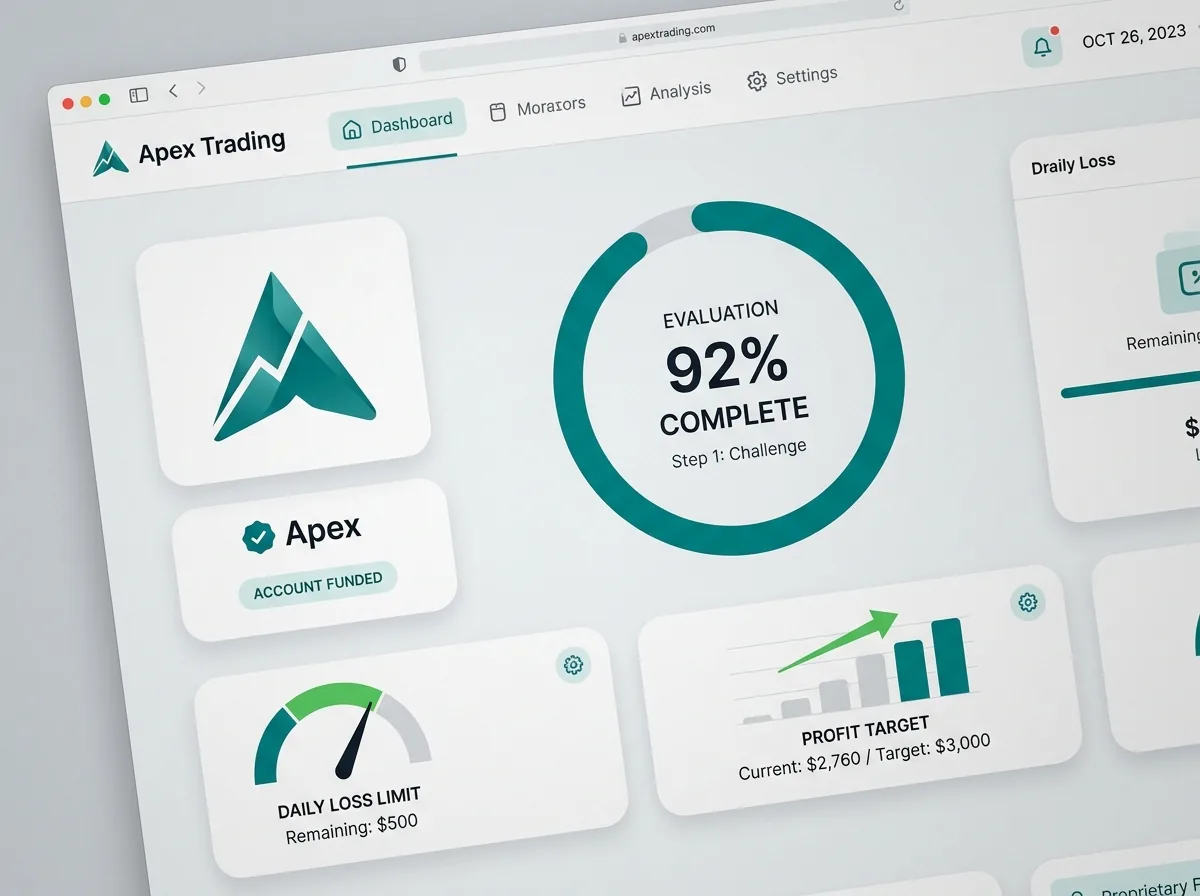
$3,000
Profit needed to pass this evaluation.
$2,000
Lose this amount and the account fails.
RULE TO CHECK
Drawdown mode
End-of-day trailing; recalculated after market close and enforced during the next session
All rules for this account13 rules
Reset feeNo reset available
Activation feeNot confirmed for this setup
Account access period30 consecutive calendar days; no extension
Profit target$3,000
Minimum trading daysNo minimum trading days
Best Day RuleNo Best Day Rule
Maximum loss limit$2,000
Daily loss limit$1,000
Daily loss modeFixed for the session; reaching it flattens positions and pauses trading until the next session
Drawdown modeEnd-of-day trailing; recalculated after market close and enforced during the next session
Funded drawdown lockRithmic and WealthCharts evaluation threshold stops at the profit-target balance
Maximum contracts6
Activation window7 calendar days after the evaluation is marked passed
Additional rule sources: EOD Drawdown Explained and Daily Loss Limit Explained .
In this review
What I like / could be better
What I like
- My first-hand Apex record spans more than two years and up to ten legacy 50K PAs
- Current EOD and Intraday paths let traders choose when the drawdown floor moves
- Up to 20 active PAs provides an unusually high account-scale ceiling
- Current evaluations use one-time access instead of recurring billing
- The new PA payout owners publish size and request-specific eligibility tables
What could be better
- My personal record does not cover a current EOD or Intraday PA payout cycle
- The exact 50% consistency boundary is internally contradictory
- PA payouts combine qualifying days, a lifetime safety net, consistency and ordinal caps
- Platform choice changes when the evaluation drawdown can stop trailing
- Legacy promotions and bundle availability are not aligned across current official surfaces
Is Apex Trader Funding worth it in 2026?
Apex Trader Funding is worth considering when the goal is to scale one futures process across several accounts. The current program allows up to 20 active Performance Accounts across EOD, Intraday and eligible Legacy accounts. That capacity is the real Apex advantage. It is also the reason a weak copier setup or loose risk process becomes expensive quickly.
I traded Apex for more than two years and ran up to ten legacy 50K Performance Accounts at the same time. That record gives me direct experience with the older Apex environment, multi-account execution and the operational pressure created by scale. It does not mean I personally completed the current EOD or Intraday PA path, which replaced the previous products on March 1, 2026.
The new lineup separates two drawdown models. EOD Drawdown updates from the highest closing balance and enforces the resulting floor during the next session. Intraday Trailing follows the highest balance in real time, including unrealized profit. Both routes lead to a simulated Performance Account after a pass, and Apex may later invite a trader into a separate live program.
My short verdict: Apex remains a serious futures firm and a strong scaling tool for an experienced trader. It sits behind Funded Futures Family in my current personal futures order because the newer Apex structure has not yet earned the same first-hand weight in my own account history. I would use Apex again, but I would begin with a small account group and choose the funded-stage drawdown before looking at the evaluation discount.
What changed at Apex after March 1, 2026?
March 1, 2026 is the product boundary that makes old Apex reviews dangerous. Apex retired the previous Evaluation and Performance Account lineup and introduced current EOD and Intraday products. Existing pre-boundary accounts remain under Legacy rules.
New evaluations are one-time purchases
The current evaluation provides 30 consecutive calendar days of access and does not renew. There are no resets or extensions. A failed or expired account is replaced by a new purchase. This differs from Legacy subscriptions, which continue until cancelled and can retain reset options.
Passing opens a seven-day activation window
A current evaluation is reviewed after market close. Once marked passed, the trader has seven calendar days to activate the matching PA. A Standard account requires the current one-time activation payment. A No Activation Fee account shows zero at that step. Missing the window means passing a new evaluation.
Legacy still exists as an account cohort
Legacy accounts purchased before the boundary retain their rules and can coexist with current accounts under the combined 20-PA household cap. Apex also displays a limited Legacy promotion on the homepage today, even though the stable Legacy owner says prior products are retired for new purchase. That campaign is not a safe default for evergreen content.
What I personally tested at Apex Trader Funding
My Apex record covers more than two years and up to ten legacy 50K Performance Accounts in parallel. My direct experience is with that older multi-account setup.
Working with several accounts
Copying one order across several accounts reduces manual entry, but it also repeats the exposure. The displayed 50K balance is not the amount available to lose. Each account has its own remaining drawdown room.
Checking the account group
Check every follower's connection, symbol and quantity before trading. After a flatten command, check the position on each account. A disconnected follower or a rejected order can leave the group out of sync.
Where my experience stops
I have not completed a payout cycle on the current EOD or Intraday PAs. Their access periods, drawdown, payout requirements and live transition are covered here from Apex's published rules.
EOD vs Intraday: which drawdown fits your trading?
EOD and Intraday can share the same displayed loss amount while behaving very differently. The deciding input is what happens to unrealized profit during a normal trade.
EOD gives open profit more room
The EOD floor moves only after the session closes at a new high. An open winner can retrace without raising the floor during that same session. The established floor is still enforced intraday, so EOD is not a license to ignore open loss.
Intraday reacts to every equity peak
Intraday uses peak balance including unrealized P&L. If a trade reaches a new high and then gives profit back, the floor does not move down. That makes the route less forgiving for runners, scaling out and strategies with wide profit retracement.
The platform can change when trailing stops
Rithmic and WealthCharts evaluations stop their threshold at a defined profit-target level. Tradovate evaluations continue trailing. PAs stop at starting balance plus $100. A route comparison that omits platform and stage is incomplete.
Replay recent trades against both drawdown models. If normal retracements in open profit repeatedly reach the Intraday floor, EOD gives those trades more room during the session.
How do Apex PA payouts work?
Current EOD and Intraday PAs can become eligible after five qualifying profit days. The days do not need to be consecutive and there is no deadline to finish them, but the separate rolling inactivity rule remains active.
Each size has a qualifying-day threshold
EOD and Intraday use different daily profit tables. The account tool shows the value for the selected route and size. A profitable day below that value does not count toward the required five, even though the money remains part of net profit.
The safety net stays for the account life
Only profit above starting balance plus drawdown plus $100 is eligible. The minimum request is $500. This is why the balance needed to request is higher than the safety net itself. The buffer does not disappear after the first payout.
Payout caps rise by request number
Each PA can complete up to six approved payouts. The maximum per request changes by size, route and payout ordinal. After the sixth payout, the PA closes and another evaluation is required for a new PA. Do not apply the sixth-request cap to the first request.
Consistency resets after approval
The largest profitable day is divided by net profit since account inception for the first request and since the last approved payout afterward. Losing days reduce the denominator. Apex's consistency page still gives conflicting answers at exactly 50%: its rule text requires less than 50%, while an example accepts 50%. Dividing the largest day by 0.5 gives the boundary, so leave room below it.
Apex allows trading after a payout request. Its payout instructions say to treat the requested amount as already removed from the balance. Falling below the required threshold triggers an automatic denial.
Which Apex platform should you use?
Apex currently separates Rithmic and WealthCharts from Tradovate in the evaluation selector. The connection is not cosmetic because the evaluation drawdown can stop trailing differently. Choose the route only after checking both the trading interface and the rule behavior attached to it.
Tradovate
Tradovate is the practical choice for a browser-based workflow and compatible TradingView execution. The main limitation is the current evaluation drawdown behavior: Apex says the threshold keeps trailing instead of locking at the profit-target balance. A platform preference should not hide that product difference.
Rithmic and WealthCharts
Rithmic supports established desktop futures workflows and copier tools. WealthCharts provides another interface on the current route. Apex groups them together for the evaluation threshold lock, but the operational setup still differs. Test login order, order routing, quantity and flatten behavior before copying normal size.
The copier is part of risk management
Before copying trades, check connected followers, symbol mapping, contract ratios, supported order types and rejected-order handling. After flattening, inspect each account's position in the broker or platform view as well as the copier status.
Level 1 market data is included with the current evaluation fee. Optional depth-of-market subscriptions can have separate billing behavior depending on the connection. A platform that looks cheaper can create a recurring data cost if optional feeds are enabled and not managed correctly.
A familiar platform reduces the setup work, provided its drawdown rules fit the strategy. Check that trade-off before changing the platform, copier and drawdown model together.
Risk limits for an account group
Set the group's risk budget before choosing the quantity on each follower. Copying the same position across several accounts repeats the planned loss on every account that receives it.
A personal daily stop inside the account floor and any applicable DLL leaves room for slippage or an execution error. Add accounts only while you can still check every connection, quantity and open position each session.
What happens if Apex moves you to Live?
Apex Live is an invitation, not an automatic reward after a fixed number of payouts. Apex may review trading style, risk, P&L, account count, simulated payouts and the speed of profit accumulation. Its published monitoring examples are not guaranteed thresholds.
Simulated accounts close at the transition
A trader cannot keep Apex Live and normal Apex simulated accounts at the same time. Active evaluations are closed, PAs are deactivated and eligible simulated balances can be tracked in the Bonus Vault. The vault is a ledger, not live cash or a trader-owned account balance.
Live starts with a different account model
The first live account starts from a zero profit balance with a $3,000 EOD drawdown. The floor locks at $100 after profit reaches $3,100. Level 1 has no DLL, no consistency rule and a 10-mini contract ceiling. Higher profit levels can change contract and DLL limits.
Live payouts use a separate process
Live requests can be made daily from eligible profit above the safety net, with a $500 minimum and a 90/10 split. The simulated PA payout-day rules and six-request caps do not carry into Live. Current compliance, account status and available profit still control approval.
I have no first-hand Apex Live test to report. The rules in this section come from Apex's documentation.
Is Apex Trader Funding legitimate?
Yes, I consider Apex Trader Funding a legitimate futures prop firm based on my Legacy experience. I have not tested a payout cycle under the current EOD or Intraday rules.
Apex publishes separate rules for evaluations, PAs, drawdown, Daily Loss Limits, payouts, inactivity and Live. The PA is simulated; Apex Live requires an invitation.
What still needs caution
The exact 50% consistency boundary remains internally inconsistent. The homepage simultaneously says Legacy accounts are unavailable and promotes a limited return of Legacy evaluations. One help page lists selected 5-Packs while the homepage says bulk checkout is coming soon. These are not reasons to call the firm illegitimate, but they are reasons to record the exact checkout and cohort.
Save the product page, receipt, agreement, platform route and dashboard limits when opening an account. A Legacy rule can be valid for an older account and inapplicable to a current EOD or Intraday purchase.
Apex vs other futures prop firms
Apex is the account-scale specialist in this comparison. Its current ceiling of 20 PAs is the strongest reason to choose it. That advantage matters only when the trading and copier process are already stable.
Apex vs Lucid Trading
Lucid Trading sits higher in my current order because I have a much deeper recent payout-cycle record there and prefer its current account choices. Apex offers more account-scale capacity. Lucid is the stronger fit for me when payout mechanics and current first-hand confidence matter more than the size of the account fleet.
Apex vs Tradeify
Tradeify ranks ahead of Apex in my current list. My Tradeify record includes every Futures account type, many passed challenges and 23 payouts. Apex remains attractive for a trader who specifically wants the higher PA ceiling and already has a copier setup that stays synchronized across the account group.
Apex vs Top One Futures and Funded Futures Family
Top One Futures and Funded Futures Family also sit ahead of Apex in my current personal order. FFF is fourth and Apex fifth. That ranking reflects my own account and payout history, not a claim that one firm is universally better for every strategy.
Apex vs Topstep
Topstep is the cleaner comparison when operating history, a more controlled platform environment and fewer parallel accounts matter more than maximum scale. Apex is the more flexible choice for a trader whose edge depends on replicating one proven execution process.
Compare the funded-stage floor, payout requirements, platform and account limit before sale prices. Apex's capacity is useful when the strategy and copier already work across a group.
Who should avoid Apex Trader Funding?
Avoid Apex if the main attraction is running as many accounts as possible before the copier and risk process are stable. Scale magnifies process quality in both directions.
Skip the Intraday route if the strategy regularly gives back unrealized profit. The floor can move while the trade is open. EOD may fit better, but a trader who cannot track an enforced floor and a separate DLL should not buy either route yet.
Look elsewhere if a 50% consistency calculation, five qualifying-day thresholds and ordinal payout caps would cause constant strategy changes. A payout rule that forces bad trades is a product mismatch.
Apex is also a poor fit when the trader expects every funded label to mean live capital. The PA is simulated. Live is a separate invitation and accepting it ends access to the normal simulated environment.
Finally, avoid buying from a promotional Legacy page without confirming the exact cohort. Apex currently displays campaign language that does not fully align with its stable Legacy owner. Save the checkout state and agreement before treating any campaign rule as durable.
Apex fits an experienced futures trader with a repeatable strategy, a tested platform workflow and the discipline to grow account quantity slowly. It is not the place to learn trading, copying and drawdown management at the same time.
Key details
- Asset classes
- Futures
- Platforms
- Tradovate, TradingView
- Profit split
- 100%
- Payout frequency
- 5 Days
- Drawdown
- Trailing-eod-or-intraday
- Max funding
- $3,000,000
- Restricted countries
- 11 (Cuba, Iran, North Korea, Sudan…)
What to check next
Focused guides for the next decision about Apex Trader Funding.
- Next step Apex Trader Funding rules Current evaluation and payout-account constraints.
- Next step Apex Trader Funding accounts Compare current account paths and sizes.
- Next step Apex Trader Funding payout rules Eligibility and withdrawal requirements.
- Next step Apex EOD vs intraday drawdown Choose the risk model you can operate.
- Next step Apex pricing Compare the current one-time evaluation and activation-fee paths.
Reviewed by PaulFounder & Full-Time Funded Trader · 50+ firms tested with real money
Risk note. You can lose evaluation and reset fees without ever receiving a payout. Check whether your account phase uses simulated or live capital and which payout rules apply. Firm terms can change, and a firm may stop operating. Only pay fees you can afford to lose.
I may earn a commission if you sign up through my link. It never changes my rating or verdict. I tested this firm with my own money.
PTV 74 100% split · 5 Days payouts
See pricing at Apex Trader Funding