

 TESTED WITH REAL MONEY
 Breakout
80% standard; verify checkout upgrades split · Requests available weekdays and weekends when eligible payouts
Visit firmAffiliate link. It never changes my rating or verdict.
⌄Inside the platform
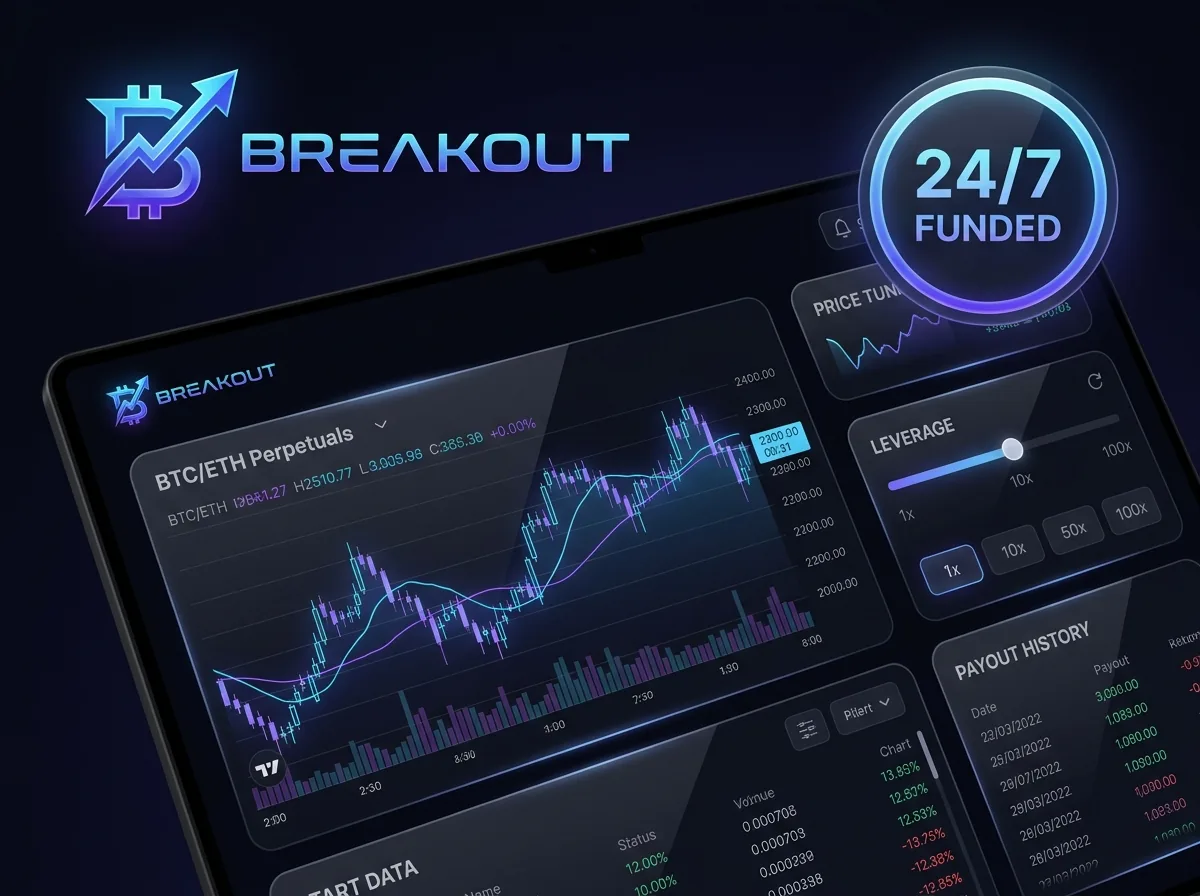
My Breakout test covers an earlier Classic 1-Step account and the legacy 2-Step route. Current Classic, Pro and Turbo rules are checked separately and are not presented as personally tested outcomes.

Rules checked on
Ratings & Reviews
One-time evaluation pricing with no published activation fee
What is structurally useful?
Static maximum drawdown makes the total-loss floor easier to model, and the official leverage owner gives an exact symbol table.
What needs extra care?
The daily-loss budget is tight, fees apply to turnover and the terminal remains the owner for the individual account setting.
What I personally tested at Breakout
My personal Breakout experience belongs to an earlier product generation. I tested Classic 1-Step and the legacy 2-Step route before the 2026 lineup settled around Classic, Pro and Turbo. That distinction matters because a firm can remain the same while the account a trader buys changes materially.
What my test tells me
I completed the checkout, received the account, traded inside Breakout’s environment and dealt with the firm as a customer. That is enough for me to say this is not a research-only review. It also gives me a practical reference for the platform, order handling and the way the loss rules feel while positions are open.
I did not record a personal Breakout payout in the first-hand records used for this review. I therefore do not use the company’s aggregate payout claim as a substitute for my own result. The review can support a firm-level experience and still be honest about where the first-hand chain stops.
What changed after my test
The former 2-Step account is not a current checkout option. Classic remains as a current one-step route, while Pro and Turbo introduce different target-to-loss ratios and lower prices. Breakout also added the permanent 90/10 split upgrade. Current accounts are governed by current sources, not by the rule sheet attached to my older account.
The biggest practical change is the need to compare three different risk budgets. A 50K Classic account has a $5,000 target and $3,000 maximum loss. Pro has a $6,000 target and $2,500 maximum loss. Turbo has a $4,500 target and $1,500 maximum loss. The same nominal account size produces three very different jobs.
How I separate experience from research
My older test supports the statements that I used Breakout and understand its customer workflow. It does not verify today’s Pro or Turbo account, the current 90/10 upgrade, the post-pass transition or an on-demand payout. Those are sourced from the official owners linked below the account tool.
I would retest Breakout by starting with one current Classic account. I would save the checkout and agreement, trade small enough to watch the 00:30 UTC reset without pressure and request the first eligible payout before adding another account. A positive earlier experience earns a place on the shortlist, not an exemption from current due diligence.
Which Breakout account should you choose?
Breakout’s three current products are all one-step evaluations, but they are not interchangeable. The useful comparison is the profit target divided by the maximum loss, then the daily loss behavior and total trading cost.
Classic: pay more for the widest loss budget
Classic offers 5K, 10K, 25K, 50K and 100K sizes. The target is 10%, the static maximum loss is 6% and the daily loss reference begins at 3%. A 50K account currently costs $400 with the standard 80/20 split. The 90/10 checkout version costs $480.
The target is about 1.67 times the maximum loss. That is the most forgiving target-to-loss ratio of the current plans. Classic still requires discipline, but the account gives a strategy more room to absorb normal variance than Pro or Turbo.
Pro: lower fee, harder recovery math
Pro runs from 5K to 200K. It uses a 12% target, 5% maximum loss and the same 3% daily-loss mechanism. The 50K standard account is $280; the 90/10 version is $336. Pro’s target is 2.4 times the maximum loss.
That ratio matters after a losing day. A trader has less total room than Classic but must produce a larger percentage gain. Pro is not automatically the middle-risk choice just because it sits between Classic and Turbo in the menu.
Turbo: cheapest, with the smallest margin for error
Turbo also runs from 5K to 200K. The target is 9%, maximum loss is 3% and the daily loss reference is 3%. At 50K, the standard fee is $180 and the 90/10 version is $216. The target is three times the maximum loss.
On the first day, the total loss budget and daily-loss reference are both $1,500 on a 50K account. As balance changes, the daily threshold is recalculated. Turbo fits a trader whose normal drawdown, costs and overnight exposure are already small. It is a poor place to discover that they are not.
The 90/10 upgrade is a break-even decision
Breakout charges 20% more at checkout for ten extra percentage points of payout share. On a $400 Classic account, the upgrade costs $80. The additional share recovers that $80 after $800 of gross eligible profit has been paid. On a $180 Turbo account, the $36 upgrade reaches the same break-even point at $360.
That simple math does not mean the upgrade is always better. The evaluation fee is paid before the trader knows whether a funded payout will happen. I would choose 90/10 only when the account already fits and the added fee does not change risk behavior.
Choose size from loss dollars, not the label
A 200K Pro or Turbo account looks large, but the useful figures are $10,000 or $6,000 of maximum loss and the 3% daily reference. Breakout publishes a combined active allocation ceiling of $200,000. Buying several nominal balances does not create unlimited risk capacity.
Use the selector above for the current price, target and loss dollars at each size. Promotional prices can change. The standard table is a comparison baseline, not a promise about a future checkout.
Which Breakout rules matter most?
The daily loss calculation is the rule I would learn first. At 00:30 UTC, Breakout records the account balance without open positions and calculates a 3% limit from that balance. Equity, including floating profit and loss, is then tested against the threshold. The floor can therefore change from one day to the next.
Daily loss is dynamic even though maximum loss is static
The maximum drawdown starts at 6% for Classic, 5% for Pro and 3% for Turbo and remains tied to the initial account balance. That is the static part. The daily threshold is not a permanent dollar value. A profitable balance can increase the next day’s reference, while a lower balance can reduce the available daily dollars.
Open P&L counts when Breakout checks both limits. An unrealized loss can breach the account before the position closes. I would keep a personal stop inside both the daily floor and the total floor and include fees and financing in the remaining room.
No minimum days does not make rushing sensible
Breakout publishes no minimum trading days and no evaluation deadline. A trader can pass quickly, but there is no structural reward for taking a larger position to finish today. With no time limit, the rational use of the account is to wait for setups that fit the loss budget.
News and weekend positions are allowed
Breakout does not publish a general news-trading restriction and allows weekend holding. Permission is not protection. Crypto can gap between liquid periods, and the 0.033% daily financing charge continues to matter while a position stays open.
Hedging is allowed only inside a defined boundary
Hedge Mode can be used within one account. Opposing positions across accounts or across traders are prohibited. Breakout also prohibits copying between different users, third-party signal or strategy services, account sharing, latency exploitation and patterns the firm cannot reasonably replicate.
A trader may use a copier across personally owned accounts when the method remains inside the published rules, but the same strategy must remain attributable to that trader. I would keep one master, document every linked account and avoid any arrangement that can look like coordinated opposite-side trading.
Strategy continuity matters after evaluation
The prohibited-practices owner says a trader cannot pass with one approach and then switch to a materially different third-party or exploitative method in the funded account. The funded stage should be tradable with the same basic risk and execution pattern used to qualify.
Partial fills are not a safety assumption
Breakout states that partial fills are not supported. Thin instruments and large orders can behave differently from a liquid BTC or index position. I would test the smallest size on the selected platform and never build a risk plan that depends on part of an order filling.
Which Breakout platform should you use?
Breakout currently supports Breakout Terminal and DXtrade. The firm’s symbols page is the useful owner because platform availability and instrument availability are not identical. Check the market on the actual platform before buying for one specific symbol.
Breakout Terminal
Breakout Terminal is the firm’s native route. It splits the daily financing charge across four-hour intervals. That schedule can make carrying cost appear in smaller steps rather than one daily event. I would test bracket orders, reduce-only behavior, stop execution and the account floor with the smallest position first.
DXtrade
DXtrade applies the published financing charge around 00:25 each day. That is close to the 00:30 UTC daily-loss reset. A position held through that window can experience a financing debit and a new daily-loss calculation within minutes. The sequence should be part of an overnight checklist.
Market choice changes leverage and cost
Breakout’s current table assigns different exposure by symbol. BTC, XYZ100 and S&P 500 are shown up to 10x. ETH and several liquid markets are 5x, other products are 3x or 2x. The platform applies the value automatically, so a trader cannot use one notional-risk assumption for every market.
The firm lists more than sixty crypto, index and commodity markets. Breadth is useful, but it increases the chance of trading an unfamiliar contract. Tick behavior, spread, financing and platform availability should be checked per symbol.
How I would choose
I would use the platform whose order state I can verify most reliably. Then I would trade one liquid instrument, close it, reconnect and confirm that position, stop and balance state agree. A platform decision is operational, not aesthetic.
If a specific symbol or execution feature is the reason for choosing Breakout, I would ask support to confirm it for the exact platform and account before checkout. A generic platform logo does not own that promise.
How would I approach Breakout today?
I would start with Classic 50K unless my own trade log clearly supports a tighter plan. It gives $3,000 of total loss room and a $1,500 initial daily reference. Pro and Turbo save money, but neither improves the relationship between target and loss budget.
1. Replay the strategy against both floors
For every historical trade, I would calculate remaining distance to the daily threshold and the static maximum-loss floor. Open P&L, entry and exit fees and overnight financing belong in the calculation. The account fails on equity, not on a simplified closed-trade spreadsheet.
2. Keep the first account simple
I would trade one account, one platform and one or two liquid symbols. BTC or a major index is easier to audit than a basket of smaller altcoins with different leverage and spreads. The goal of the first account is to learn the mechanics without adding execution noise.
3. Set a smaller personal daily stop
The 3% daily-loss rule is a failure boundary. My trading stop would be meaningfully smaller. A buffer protects against commissions, financing, slippage and a position whose stop does not fill at the expected level.
4. Treat 00:25 to 00:30 UTC as an event
On DXtrade, the financing debit and daily reset happen close together. I would either close before that window or know the exact balance, floating P&L and next threshold. “Weekend holding allowed” does not mean “overnight state irrelevant.”
5. Pass with the strategy intended for funded trading
I would not use oversized evaluation trades and then switch systems after passing. The current conduct rules expect replicable behavior and continuity. A slower pass with normal size creates a better test of whether the funded account can survive.
6. Complete KYC before planning a payout date
After passing, Breakout requires identity checks, the funded agreement and account approval. The firm says this usually takes 12 to 24 hours. I would not promise myself a funded start or payout date until the dashboard shows the stage.
7. Request the first eligible payout before scaling
Breakout allows on-demand requests with at least $50 after the split, no open positions and no active breach. The payout method is USDC on Ethereum. I would verify the wallet network, submit a small eligible request and wait for completion before adding more accounts.
This sequence is deliberately conservative. Breakout removes the subscription clock, minimum-day pressure and fixed payout calendar. I would use that flexibility rather than manufacture urgency.
Is Breakout legitimate?
Yes, I consider Breakout a legitimate crypto prop firm. I traded earlier Breakout products myself, the company publishes detailed current rule owners and Kraken acquired the business in September 2025. Those points support legitimacy. They do not turn a simulated account into insured client capital or guarantee a future payout.
Who operates the account
The current evaluation agreement identifies Breakout Trading Group LLC. The funded agreement is issued through Payward Oceanic Ltd. Breakout’s Kraken page explains the ownership relationship. A trader should keep the agreement attached to the purchased cohort because company structure and contracting entity are different facts.
The funded account is simulated
+Breakout’s official help owner states that the funded environment is simulated. Traders can receive real payouts based on results, but they are not controlling a brokerage account funded with the displayed nominal balance. Marketing words such as “funded” and “allocation” should be read through that disclosed capital mode.
How I read the payout claims
Breakout currently promotes more than $60 million in company-paid rewards. I treat that as a firm-reported aggregate, not audited proof of a particular trader’s eligibility. I do not have a personal Breakout payout event in the record used here, so I do not convert that headline into first-hand evidence.
How I use Trustpilot
The review header carries Breakout’s Trustpilot rating as a separate external signal. Breakout’s homepage currently advertises 4.7 from more than 1,000 reviews. Review count and sentiment can help identify recurring support themes, but neither replaces the agreement, account state or payout owner.
What still creates risk
Rules can change between cohorts. Crypto positions can move continuously, costs accumulate while positions stay open and prohibited-practice reviews involve judgment. The payout rail is USDC on Ethereum, so wallet and network errors are another user-controlled risk.
Kraken ownership improves the background check, but I would still start with one account, preserve the purchase state and verify a current payout before scaling. Legitimate is the starting question. Product fit and execution discipline decide whether the account is useful.
How does Breakout compare with other crypto prop firms?
Breakout is one of the clearer crypto-focused choices because its current lineup is limited to three one-step plans and its rule owners state the simulated capital model. The comparison should stay product-specific. I do not rank firms by competitor Trustpilot scores inside this review.
Breakout versus HyroTrader
HyroTrader is another crypto-native option with its own platform, target, loss and payout structure. Breakout stands out for one-time pricing, a static maximum drawdown and its Kraken ownership. HyroTrader can fit a trader whose preferred exchange-style workflow and account rules align better.
Breakout versus FundedNext crypto routes
FundedNext is a broader multi-asset brand rather than a crypto-only firm. That can suit someone who wants several asset classes under one brand. Breakout is easier to evaluate as a focused crypto product, but its market list and leverage remain platform-specific.
Breakout versus a futures prop firm
A futures evaluation often uses fixed contract limits and exchange sessions. Breakout uses symbol-specific notional exposure, percentage transaction fees and daily financing. A trader moving from futures must rebuild the risk model instead of translating “50K” directly.
Where Breakout is stronger
- One-time evaluation pricing with no monthly subscription or activation fee.
- No minimum trading days and no evaluation time limit.
- Static maximum drawdown rather than a trailing total-loss floor.
- On-demand payout requests with no published consistency rule.
- Current ownership and operator disclosures are easy to find.
Where Breakout is weaker
- The daily-loss value resets from balance and can be misunderstood.
- Round-trip fees and overnight financing reduce usable risk.
- The current funded stage is simulated rather than live capital.
- USDC on Ethereum is the only documented payout method.
- My direct test belongs to earlier products, not the complete current lineup.
I would shortlist Breakout when a crypto trader wants no subscription clock, accepts the payout rail and can model equity-based limits. I would choose another firm when the strategy needs a platform or instrument Breakout does not support, when overnight financing dominates the edge or when live capital is a requirement.
What remains account-specific?
Checkout price, any optional upgrade and the dashboard leverage for the exact symbol remain account-level facts. Save those values before paying and before opening a position.
Key details
- Founded
- 2023
- Asset classes
- Crypto
- Platforms
- DXtrade
- Profit split
- 80% standard; verify checkout upgrades
- Payout frequency
- Requests available weekdays and weekends when eligible
- Drawdown
- Static drawdown
- Max funding
- $200,000
I may earn a commission if you sign up through my link. It never changes my rating or verdict. I tested this firm with my own money.