

 TESTED WITH REAL MONEY
 FTMO
80%–90% by product split · CFD day 14; Futures 4–5 qualifying days payouts
Visit firmAffiliate link. It never changes my rating or verdict.
⌄Inside the platform
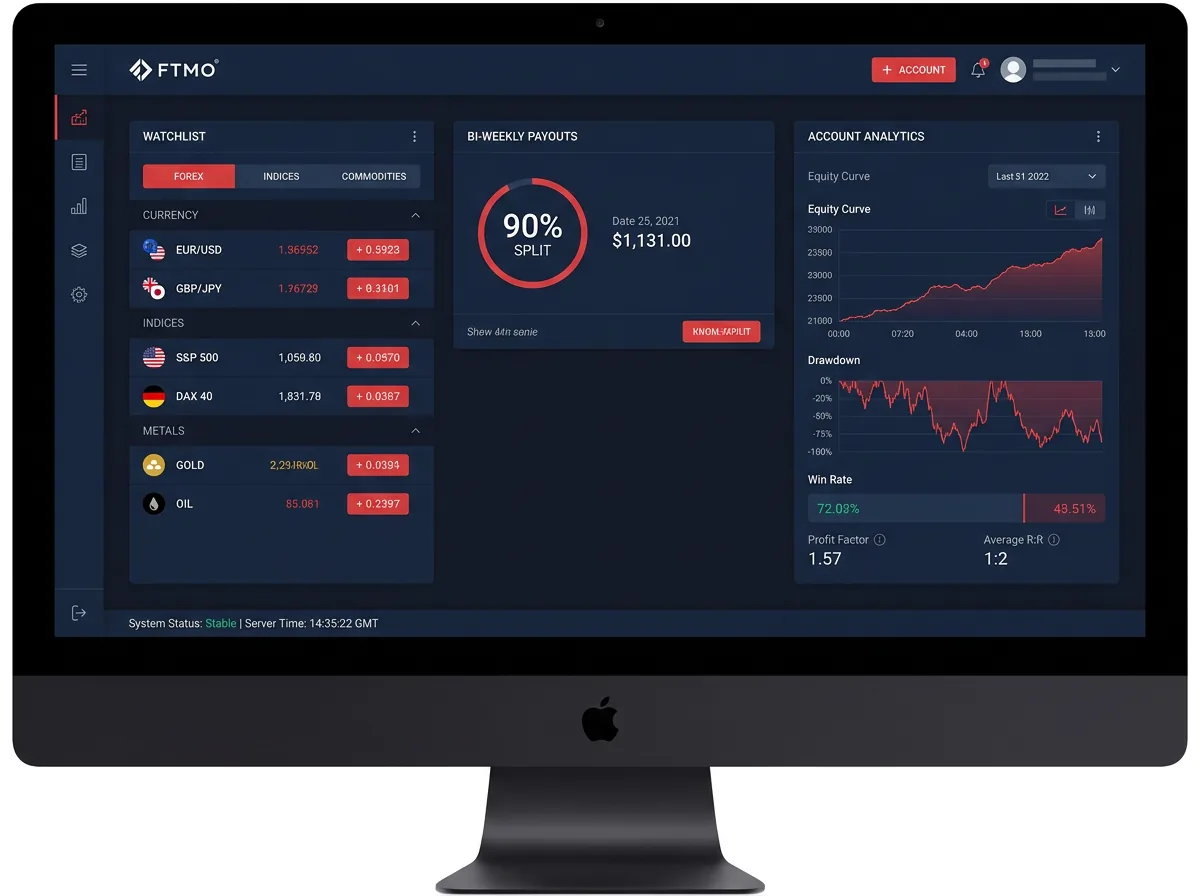
My FTMO evidence covers about four years on multiple $50K and $100K Standard CFD accounts with recurring payouts. Current product rules are checked separately. FTMO Futures remains research-only for me.

Pricing checked against FTMO current process owner on
Ratings & Reviews
About four years of first-hand CFD experience with recurring payouts
What are the real FTMO pros and cons?
FTMO now offers distinct CFD and Futures products. The strength is product choice backed by a long-running operator; the limitation is that the new Futures Beta has not yet earned the same PTV first-hand evidence as the CFD line.
| Pros | Cons |
|---|---|
| Established CFD operator record | Futures line is still Beta |
| Static CFD 2-Step option | CFD and Futures rules are easy to mix up |
| Futures Growth and Pro choices | Futures Evaluation is a monthly subscription |
| Futures has no activation fee | No FTMO Futures Free Trial |
| Detailed official rule owners | Futures lacks Level 2 DOM with provided credentials |
What have I personally tested at FTMO?
I have used FTMO for about four years. My own account history is on the CFD side, primarily multiple $50K and $100K Standard accounts. I have passed evaluations, traded FTMO Accounts and received recurring CFD payouts. I have returned to the firm through more than one account cycle, so my view is not based on a single pass or a single support interaction.
The experience has been consistent. Account access arrived as expected, the dashboard made the current objectives visible, and the payout workflow was predictable enough that I kept using it. I also found FTMO easier to handle in my own bookkeeping and tax setup than several US-based firms. That last point is personal to my situation as a German trader living in Spain and is not tax advice.
What held up over four years
FTMO's strongest quality is operational discipline. The product has changed, but the firm has not felt improvised. Rules are published in dedicated help pages, account metrics are easy to inspect and support has generally matched the documented process. That lowers the amount of interpretation required before a trade.
The Standard 2-Step path also matched the way I traded at the time. The 10% Challenge target and 5% Verification target are not fast, but the static 10% maximum-loss boundary is easier for me to plan around than a trailing floor. I knew the dollar risk before the session and did not have to recalculate a moving account failure line after every profitable day.
What recurring payouts prove
My payouts prove that I completed the CFD process beyond evaluation and that FTMO paid approved rewards to me. They do not prove that every future request will be approved, that every trader will have the same experience or that the new Futures Beta works identically. I do not publish an invented payout count or amount to make the evidence sound larger.
What I have not personally tested
I have not traded FTMO Futures Growth or Pro. I have not tested the current NinjaTrader, Tradovate or TradingView Futures credentials, completed a Futures payout or received a discretionary Live Funded offer. All Futures conclusions in this review come from the current official rules, not from my CFD history.
I also do not treat every current CFD variant as personally tested. My strongest evidence is Standard CFD on $50K and $100K accounts. The account tool above can resolve current 1-Step, Swing and other size-specific rules, but a correct data point is not the same thing as my own trade record.
How that changes my recommendation
I am comfortable calling FTMO legitimate and recommending it for consideration. I am more specific about the product. My first-hand confidence is high on established CFD operations and provisional on Futures. A trader should use the part of my evidence that matches the account being considered.
Which FTMO account should you choose?
Start with the asset class. If you trade forex, indices, commodities, stocks or crypto CFDs, compare CFD 1-Step with CFD 2-Step. If you trade listed futures, compare Futures Growth with Futures Pro. Do not compare a CFD entry fee with a Futures monthly subscription as if they buy the same contract.
CFD 1-Step
1-Step removes the Verification phase. The evaluation target is 10%, maximum daily loss is 3% and maximum loss is 10% with an end-of-day trailing calculation. The 50% Best Day condition applies in the Challenge and continues on the later FTMO Account when a reward is requested. The reward share is 90%.
This route can suit a trader who wants one evaluation and produces returns across several positive days. It is less attractive when one large day is a normal part of the strategy or when a moving end-of-day maximum-loss line would reduce room after profitable progress.
CFD 2-Step Standard
2-Step requires 10% in the Challenge and 5% in Verification, with at least four trading days in each phase. Maximum daily loss is 5% and maximum loss is a static 10%. Standard accounts can hold overnight during the evaluation, but the funded FTMO Account has targeted-news and weekend restrictions.
This is the FTMO path I know best. I prefer the static maximum-loss structure because it separates the account boundary from recent profit. The cost is a second evaluation phase and an initial 80% reward share, which can increase to 90% through Scaling or Premium conditions.
CFD 2-Step Swing
Swing uses the same two evaluation targets and loss percentages as Standard. Its practical value appears after funding: Swing permits overnight and weekend holding and removes the normal FTMO news-release restriction. It is not available on 1-Step.
Choose Swing because the strategy needs those permissions, not because the label sounds more flexible. A day trader who is always flat before events may gain nothing. A position trader can destroy the strategy by choosing Standard and then closing only to satisfy an account rule.
Futures Growth
Growth is the lower-cost Futures route in $50K, $100K and $150K sizes. The evaluation has no daily-loss limit, uses a 40% consistency condition and applies end-of-day trailing maximum drawdown. In Sim-Funded, a soft daily-loss limit appears. Payout eligibility uses four qualifying days and only part of available profit can be requested.
Futures Pro
Pro costs more but provides larger maximum-drawdown amounts. It uses a hard daily-loss limit in both Evaluation and Sim-Funded, a 50% evaluation consistency condition, five qualifying payout days and higher payout caps. Pro allows up to 100% of available profit to be requested, while Growth limits the request share to 50%.
I would choose size from the actual loss amount, not the nominal balance. Use the selector above to compare the exact program, size and stage. The right account is the smallest one that supports the normal strategy with enough room for fees, slippage and a losing sequence.
Which FTMO rules matter most?
The rule that matters most depends on the selected path. FTMO does not have one universal drawdown model, one consistency rule or one payout schedule. The account tool above is the source for the exact combination. The review explains where traders most often carry the wrong assumption from one product into another.
1-Step Best Day is not an account breach
On CFD 1-Step, the best day must be 50% or less of total positive-days profit. If the ratio is too high, FTMO does not fail the account. The trader keeps trading until enough additional positive-day profit reduces the ratio. The condition also applies when requesting rewards from a 1-Step FTMO Account.
That distinction matters. A trader who treats the threshold as a hard breach can stop unnecessarily. A trader who ignores it can reach the nominal target and still be ineligible. I would track the ratio daily and stop pushing once one session becomes too large relative to the rest.
CFD 1-Step maximum loss trails end of day
The 1-Step maximum-loss line follows the highest balance recorded at midnight CE(S)T and does not move down after a losing day. Once it reaches the specified lock point, it stops trailing. Open profit during the day does not instantly lift the line, but closed progress can reduce future room.
CFD 2-Step maximum loss is static
2-Step uses a fixed maximum-loss amount based on initial simulated capital. Daily loss resets at midnight CE(S)T and includes closed results, floating P&L, commissions and swaps. The reset is not permission to hold an oversized losing position through midnight. The account must stay above both limits at all times.
Standard and Swing diverge after passing
Evaluation accounts can generally trade news and hold positions overnight. On a funded Standard CFD account, selected macro events restrict opening or closing targeted instruments from two minutes before until two minutes after release. Standard positions must also close before the weekend or a market break longer than two hours. Swing removes those restrictions.
Futures drawdown is end-of-day trailing
Growth and Pro both calculate maximum drawdown from the highest prior end-of-day balance and lock at the initial simulated balance. Growth has no separate daily-loss limit in Evaluation, then uses a soft limit in Sim-Funded. Pro uses hard daily-loss limits. A soft limit can interrupt or reduce trading without being identical to a permanent account breach; the exact consequence still matters.
Futures consistency is evaluation-only
Growth uses a 40% consistency threshold and Pro uses 50% during Evaluation. The Sim-Funded payout stage has no percentage consistency rule, but it does require qualifying profitable days, a minimum new-profit share and size-specific payout caps. Passing one filter does not remove the later payout gates.
My rule is to trade inside a personal limit far smaller than the firm's breach line. A published maximum is an account termination boundary, not a daily risk recommendation.
Which FTMO platform should you use?
FTMO's platform choice is split by product line. CFD accounts currently support MetaTrader 4, MetaTrader 5, cTrader and TradingView. FTMO Futures supports NinjaTrader, Tradovate and TradingView. The same TradingView name appears on both sides, but the account, instruments and connection are different.
MetaTrader 4 and MetaTrader 5
MetaTrader remains the familiar option for many FX traders. MT5 has broader instrument and order-model support, while MT4 can still fit an established workflow with existing templates or indicators. I would not choose MT4 only because it is familiar if the strategy needs a feature that is cleaner in MT5 or cTrader.
cTrader
cTrader can suit traders who prefer a modern order ticket, clear position handling and its own automation environment. Any automated approach still has to comply with FTMO's trading-practice rules. Platform support is not automatic approval of every execution method.
TradingView
TradingView is useful for chart-led execution and appears in both current product lines. Confirm that the login belongs to the correct CFD or Futures environment before trading. A familiar chart does not make the underlying contract interchangeable.
NinjaTrader and Tradovate for Futures
FTMO says all three Futures platforms are available automatically under shared credentials. Tradovate is the simpler browser-based starting point for many traders. NinjaTrader can fit a desktop or tool-heavy workflow. I have not personally tested either with FTMO, so I would begin with the smallest possible order and verify fills, stops, account equity and daily reset behavior.
Choose the platform from execution needs, not from the longest feature list. Before normal size, test login recovery, bracket orders, position flattening, reconnect behavior and whether the dashboard matches the trading front end.
How would I approach FTMO today?
I would begin with the product I can explain without checking a marketing page. For CFD, that is still 2-Step Standard for me. For Futures, I would start with one Growth account as a research test only if the smaller maximum drawdown matched my normal stops. I would move to Pro only when the larger drawdown and request share justified the higher recurring cost and hard daily-loss rule.
1. Translate every percentage into dollars
On a $100K CFD 2-Step account, 5% daily loss is $5,000 and 10% maximum loss is $10,000. Those are failure limits, not position sizes. I would set my own daily stop and maximum open risk well inside them. The same conversion applies to every Futures size.
2. Size for the funded stage
A 1-Step trader must keep the Best Day ratio under control after passing. A Futures Growth trader gains a soft daily-loss limit in Sim-Funded. A Futures Pro trader keeps a hard daily limit and then needs qualifying payout days. I would build the evaluation plan around the later stage instead of changing behavior after the target.
3. Use a calendar for resets and events
CFD daily loss resets at midnight CE(S)T, which is not the same moment for every trader's local clock throughout the year. Standard funded accounts also have event windows and weekend rules. Futures defines its trading day separately. I would put the relevant reset and prohibited windows in the same calendar as the trading session.
4. Keep the first account simple
I would not begin with several products, sizes and platforms at once. One account should prove order routing, rule tracking and the full reward path. Adding a second account before completing that loop multiplies operational risk without adding useful evidence.
5. Plan the payout before the profit arrives
For CFD, I would choose the intended reward date, know the split and decide whether a 2-Step rollover improves the buffer. For Futures, I would track qualifying days, minimum new profit, request share and payout cap. A trader should know what remains in the account after withdrawal, not just what can be requested.
6. Treat a live invitation as optional
FTMO Futures can move selected traders from Sim-Funded to Live Funded, but the Trading Department controls the decision. I would not alter risk to chase an invitation and would not include live capital in purchase economics. If FTMO contacts me, I would review the new agreement and rules as a separate decision.
This process is less exciting than a fast-pass plan. It is also closer to the way I have kept using FTMO across several years: understand the contract, trade below the limits and preserve enough room to make the next decision calmly.
Is FTMO legitimate?
Yes. I consider FTMO legitimate. I have traded its CFD products for about four years and received recurring payouts. The company has operated since 2015, publishes detailed product documentation and has a large public customer footprint. My own account and payout history is the most relevant evidence for my verdict.
Legitimate does not mean risk-free. FTMO provides simulated trading and educational services, not a brokerage deposit account. CFD FTMO Accounts use simulated capital. Futures Evaluation and Sim-Funded accounts are also simulated. A discretionary Futures Live Funded account is a separate later state, not the default result of passing.
What the company claims
FTMO currently reports more than 4.5 million customers and more than $650 million in rewards worldwide. Those are company-published figures. I use them as scale context, not as audited proof that a particular trader will be paid.
What Trustpilot can and cannot show
Trustpilot shows 4.8 from 51,298 reviews at this check. That is useful as a broad sentiment signal and the sample is large. It cannot verify a drawdown formula, a payout ratio or the result of an individual account review. Official rules and my own records remain separate evidence types.
Why the operating record matters
FTMO has survived several market cycles and regulatory shifts while continuing to document and sell a recognisable core product. Longevity does not guarantee the future, but it reduces the uncertainty that comes with a firm whose rules and legal setup have never been tested over time.
Where the contract still matters
FTMO can reject activity that breaches prohibited trading practices even when a dashboard number looks compliant. Traders should understand the account agreement, identity requirements, jurisdiction restrictions and platform rules before paying. A high public rating does not override those terms.
The Futures live transition needs restraint
FTMO now says selected Futures traders may receive a Live Funded offer. There is no application and no guaranteed performance threshold. Some countries can use Sim-Funded accounts and receive payouts but are excluded from live progression. Until the offer exists in writing for a specific trader, the account should be valued as simulated.
My conclusion is positive but bounded. I trust FTMO enough to keep using its established CFD product. I still want a complete personal Futures cycle before giving the Beta the same confidence.
How does FTMO compare with other prop firms?
FTMO's main advantage is not the cheapest checkout. It is the combination of operating history, mature CFD infrastructure, clear documentation and a product I have used over several years. The useful comparison is therefore not one headline fee. It is whether another firm offers a better matched account for the same asset, stage and trading style.
For CFD traders
Compare FTMO 2-Step Standard with another static-loss two-step evaluation. Match the target, daily loss, maximum loss, funded-stage restrictions, initial reward share, platform and total cost. FTMO can be stronger on operating history and documentation. A competitor can be cheaper or offer a faster first reward.
Compare 1-Step only with another one-step product that also exposes its funded-stage consistency and drawdown. A one-phase route is not automatically easier when it adds a Best Day condition and a trailing maximum-loss line.
For swing traders, compare permissions rather than brand names. FTMO Swing can hold through weekends and selected news, but it is tied to 2-Step. A competing product may offer the same freedom in one phase or may impose a different loss model.
For futures traders
FTMO Futures enters a market with specialist firms such as Topstep, Tradeify, Lucid Trading, MyFundedFutures and TakeProfitTrader. FTMO brings company-level history, but its Futures product is newer than those specialists' core programs. I would compare Growth or Pro against the exact size and payout stage elsewhere.
Growth competes on lower subscription cost, no evaluation daily-loss limit and a softer Sim-Funded daily rule. Pro competes on drawdown room, higher payout caps and the ability to request all available profit. Both use qualifying-day thresholds and end-of-day trailing maximum drawdown. Another firm may offer faster eligibility, a different trail or a tested platform workflow.
How I break a tie
I rank the later account stage first. If two evaluations look similar, I compare the funded drawdown, payout eligibility, split, withdrawal cap, platform and whether live capital is automatic, discretionary or unavailable. Then I add total expected cost and operating confidence.
FTMO wins for me when mature operations and documentation are worth more than the lowest fee. It loses when the exact strategy needs a different funded-stage rule or when a futures specialist offers a product I have already tested more deeply.
Frequently Asked Questions
Is FTMO legit?
FTMO is one of the longest-running modern prop evaluation operators. I have traded FTMO for about four years across multiple Standard accounts with recurring payouts. The accounts themselves are simulated.
Do I still recommend FTMO?
Yes for traders who deliberately choose between 1-Step speed and 2-Step static risk. The recommendation is conditional on strategy fit, not the brand name alone.
Have I tested FTMO 1-Step for four years?
No. I have about four years of FTMO operator experience, but that history predates the current 1-Step product. Current 1-Step coverage is based on FTMO documentation.
What FTMO account sizes Have I traded?
I have traded multiple $50K and $100K Standard accounts with a scalping style. No personal payout dollar total is published.
What is the easiest FTMO challenge?
There is no universal easiest route. 1-Step has one phase but tighter daily loss, trailing maximum loss and Best Day. 2-Step has another target but static maximum loss and more daily room.
How much does FTMO cost?
Current global Standard base prices start at €79 for 1-Step and €89 for 2-Step. Prices rise through the $200K size and checkout controls the final amount.
Does FTMO refund the fee?
FTMO reimburses the 2-Step fee with the first Reward. The 1-Step fee is non-refundable.
What is the FTMO payout split?
FTMO CFD 1-Step pays 90%, while CFD 2-Step starts at 80% and can reach 90%. FTMO Futures uses a 90/10 payout ratio after Growth or Pro request conditions and caps are applied.
Can US traders join FTMO?
Yes, through two product-specific routes. FTMO/OANDA handles US CFD access. FTMO Futures is separate and excludes residents of Arkansas, Delaware, Louisiana, Montana and South Carolina.
Does FTMO allow weekend holding?
Evaluation accounts can hold. Funded Standard accounts have weekend and long-rollover restrictions; 2-Step Swing does not.
What platforms does FTMO use?
FTMO CFDs document MT4, MT5, TradingView and cTrader, with regional variation. FTMO Futures uses NinjaTrader, Tradovate and TradingView. Platform lists are not interchangeable across products.
Are FTMO accounts simulated?
Yes. FTMO describes Challenge and FTMO Account trading as simulated. Eligible traders can receive real monetary Rewards based on performance.
Does FTMO offer futures trading?
Yes. FTMO Futures is a separate Beta product with Growth and Pro Evaluations in $50K, $100K and $150K sizes. I have not personally tested this product; current coverage is based on official FTMO documentation checked September 1, 2026.
Key details
- Asset classes
- Forex, Indices, Commodities, Metals, Crypto, Futures
- Platforms
- Tradovate, NinjaTrader, TradingView, cTrader, MetaTrader 5, MetaTrader 4
- Profit split
- 80%–90% by product
- Payout frequency
- CFD day 14; Futures 4–5 qualifying days
- Max funding
- CFD $200K; Futures up to 3 × $150K simulated
I may earn a commission if you sign up through my link. It never changes my rating or verdict. I tested this firm with my own money.