
 RESEARCHED
 Goat Funded Futures
Daily Payouts 90%; other plans 80%, optional 90%, or first $10K at 100% by plan split · Daily Payouts: every 24 hours; other current plans: 5th–8th and 20th–23rd windows payouts
Read review ⌄Inside the platform
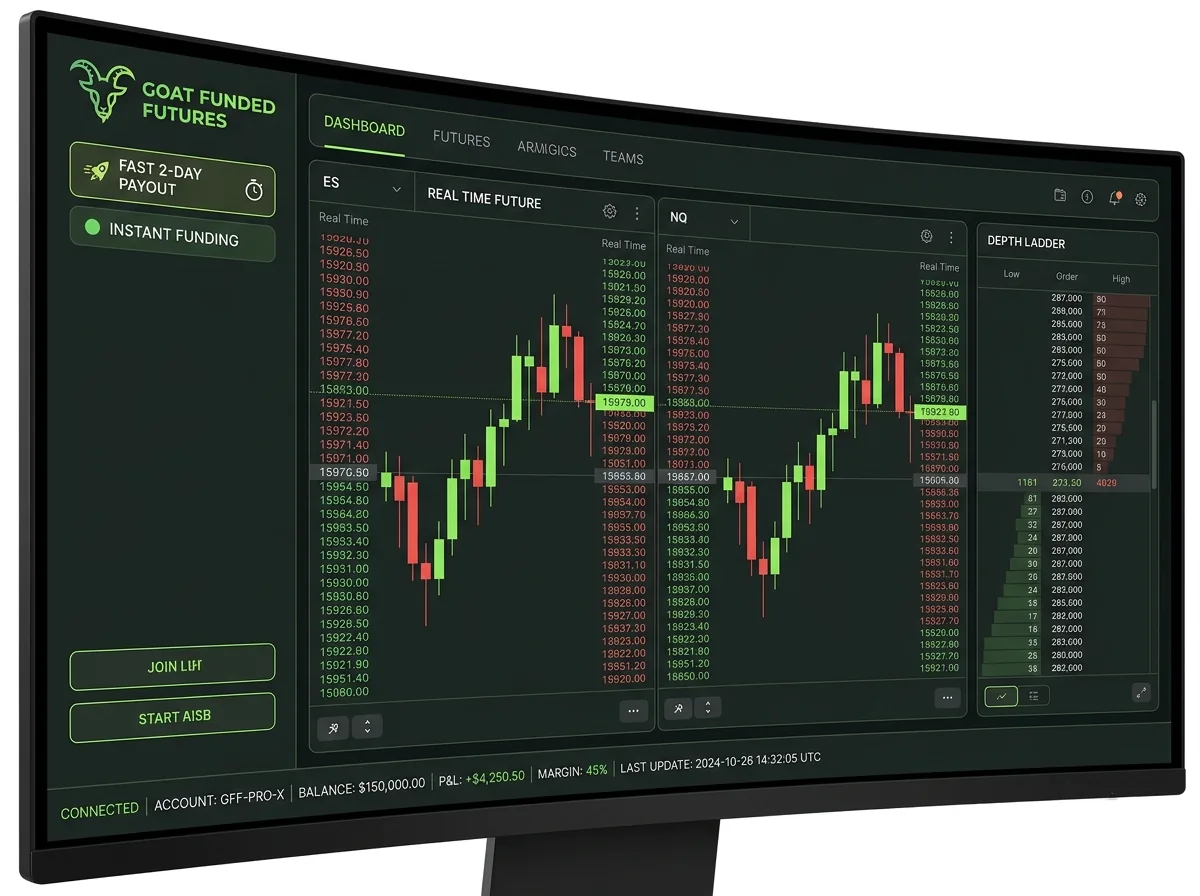
I traded multiple Goat Funded Futures accounts, reached funded status on multiple accounts and received payouts in H1 2026. The current product decision is between EOD, 1-Day-Pass, Instant Classic, Flex and Daily Payouts; retired Sprint, Static and Blitz framing and MT5 claims belonged to an older or different product generation.
🔍Payout terms checked against Goat Funded Futures current payout owners on
Ratings & Reviews
Five distinct routes spanning EOD, fast evaluation, instant funding and Daily Payouts.
What I personally tested at Goat Funded Futures
I bought and traded multiple Goat Funded Futures accounts. I reached funded status on multiple accounts and received payouts during the first half of 2026. I am intentionally not publishing an exact account count, payout count or personal amount because those details are not needed to judge the product and would create a stronger claim than the record supports.
The useful part of my experience is the sequence. Passing the evaluation was not the end of the decision. Once funded, the payout calendar, qualifying-day requirement and consistency math became more important than the original target. That is the point at which a plan that looked fast at checkout could become slower in practice.
What held up for me
I was able to move through the account process, reach funded status and complete withdrawals. I did not encounter a reason to classify GFF as a firm that only works on paper. The platform choice also made it possible to keep a familiar futures workflow instead of rebuilding everything around one proprietary terminal.
What my result does not prove
I have not personally tested every current plan, size, add-on, platform or account cohort. My payouts do not guarantee that another trader will qualify, pass review or receive the same timing. The current rules have also changed since older account generations, so I do not use an old result as authority for a new purchase.
The lesson I would carry into a new account
I would map the funded-stage withdrawal rules before choosing the evaluation. I would also avoid building the first cycle around one unusually large day. Even where a consistency breach does not close an account, it can extend the amount of trading needed before a request becomes eligible.
Which Goat Funded Futures plans are current?
The current catalog is EOD, 1-Day-Pass, Instant Classic, Flex and Daily Payouts. Sprint, Static and Blitz are not used as current product owners in this review. Daily Payouts has verified payout terms here, but checkout remains the owner for its purchase price.
The official account specification lists current sizes, prices, targets, drawdown, daily limits and funded-account terms. The current exact Flex owner and current specification matrix list $109/$169/$309. A generic profit-split article still contains older $95/$149/$289 add-on examples; source hierarchy assigns the product-specific owner to current Flex pricing, with checkout as final commercial confirmation.
What must be checked before a payout?
Winning-day eligibility is plan-specific: seven for EOD, five for 1-Day-Pass, seven for Instant Classic, five for Flex and none for Daily Payouts. The four standard plans use monthly request windows. Daily Payouts opens the first request 24 hours after the first funded trade and later requests 24 hours after the previous one. The $500 minimum applies to all five plans.
For accounts created after August 7, 2026, the recurring-payout owner requires new profit after a payout before the next request. The current processing owner names Rise, a 2% fee, processing within two business days for standard requests and within 48 hours for Daily Payouts.
Which GFF platform should you use?
GFF currently documents a broad futures stack that includes familiar retail platforms and more specialized order-flow tools. That breadth is useful, but the best choice is usually the platform you already know and can risk-manage without hesitation.
For a browser-first workflow, Tradovate and TradingView through Tradovate are the obvious starting points. NinjaTrader suits traders who depend on desktop templates, local indicators or ATM-style order management. Quantower, ATAS, Volumetrica and the other specialist routes make more sense when order flow is part of the strategy rather than a feature you plan to learn while paying for an evaluation.
Check the connection behind the interface
A platform logo does not tell you which data feed, credentials or account limitations apply. Confirm the exact route shown for the selected product, then test contract quantity, bracket orders, session templates and flatten controls at minimum size. If you copy trades, verify both the firm's rule and the platform's behavior before connecting multiple accounts.
Platform availability can change faster than the editorial body. The Data Core and source register own the current list; this section explains how to choose among it.
Which Goat Funded Futures account should you choose?
Start with the funded account you want to operate. The evaluation target is temporary; the drawdown behavior, payout calendar and consistency condition shape every cycle after you pass.
EOD Challenge
Use EOD when you prefer the risk floor to update from the end-of-day result rather than chase unrealized intraday peaks.
1-Day-Pass
The fast route is attractive only if its funded consistency and qualifying-day rules fit your normal distribution of winning days.
Instant Classic
Instant access removes the evaluation, not the need for risk control. Price it against the usable loss room and first realistic withdrawal.
Flex
Flex is worth checking when its evaluation and payout conditions match your pace. Use the product-specific price owner and final checkout rather than an isolated generic article.
Daily Payouts
Daily Payouts fits a trader who values request frequency and can keep the required profit buffer intact. The 24-hour cadence does not override the size-based cap or the requirement that at least half of each request is new profit.
My selection checklist
- Can my normal trading produce the required pattern of profitable days?
- Will one strong day delay the payout calculation?
- Do I want fixed monthly windows or Daily Payouts' buffer-and-cap model?
- Does the funded drawdown behave the way I expect after profit and after a withdrawal?
- Does the intended platform and data-feed route exist for this exact product?
If any answer is unclear, pause at checkout. A promotion does not compensate for an account whose funded-stage mechanics fight the strategy.
Is Goat Funded Futures legitimate?
My own record includes multiple funded outcomes and payouts, so GFF clears the most important first-hand threshold for me: the process worked beyond the evaluation. I still do not turn that into a blanket guarantee. A personal payout proves that a specific eligible account was paid; it does not audit every denial, every cohort or the firm's balance sheet.
The more useful trust test is whether the firm gives a trader enough information to predict the result. GFF documents the main plan mechanics and platform routes, but its product library has changed and at least one generic article has preserved older Flex price examples. That is a documentation-quality issue, even when the product-specific page is clear.
What I would save before paying
- The exact product name, size, price and add-ons from checkout.
- The funded-stage payout and consistency rules for the purchase cohort.
- The platform and data-feed route.
- The agreement and dashboard values after the account is issued.
If two official pages disagree, I use the most specific current product owner and ask support to confirm the account in writing. That evidence is more useful than a generic review score.
How does GFF compare with other futures firms?
GFF's strongest differentiator is the combination of several entry routes and a broad platform stack. That makes it more flexible than a firm built around one evaluation and one terminal. The cost of that flexibility is more rule selection: the trader has to understand which payout logic belongs to which route.
Tradeify is the better comparison when you want several futures products and a large operating brand. TradeDay is useful when the main question is how evaluation drawdown changes after funding. Topstep is the reference point when operating history and a tightly controlled platform ecosystem matter more than maximum choice.
I would choose GFF when I already know the plan and platform combination I want. I would choose a simpler rival when I want fewer moving parts, a different payout cadence or a longer public operating record. The right comparison is the exact account you will trade, not the largest advertised balance.
Key details
- Asset classes
- Futures
- Platforms
- Tradovate, NinjaTrader, TradingView, Quantower, ATAS, Volumetrica, Deepchart
- Profit split
- Daily Payouts 90%; other plans 80%, optional 90%, or first $10K at 100% by plan
- Payout frequency
- Daily Payouts: every 24 hours; other current plans: 5th–8th and 20th–23rd windows
- Drawdown
- Eod-or-intraday

I may earn a commission if you sign up through my link. It never changes my rating or verdict. I researched this firm but have not personally tested it yet.