

 TESTED WITH REAL MONEY
 Lucid Trading
90% split · Daily to 10-Day Cycles payouts
Save 40%Affiliate link. It never changes my rating or verdict.
⌄Inside the platform
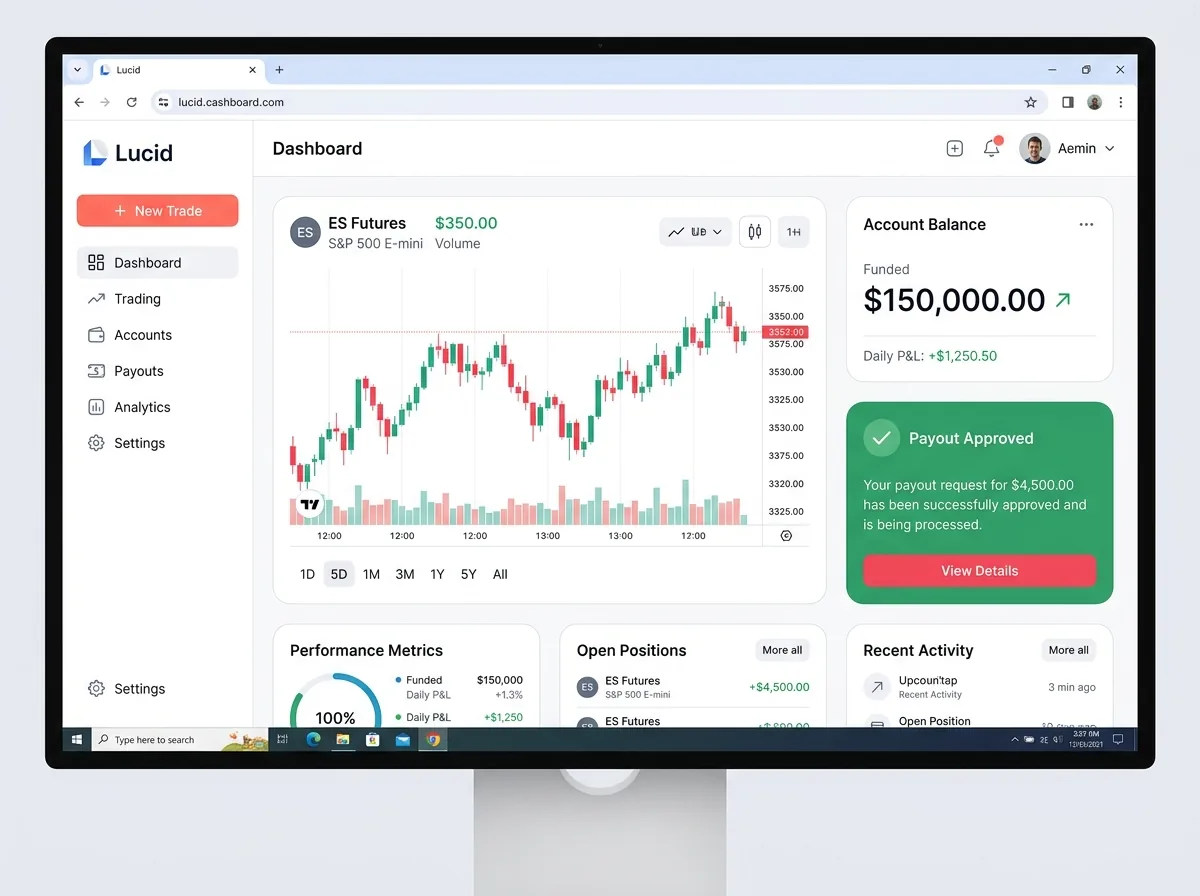
Lucid Trading is a US-based futures prop firm founded in 2025 by AJ Campanella, offering five funding programs, four purchasable plus the invite-only LucidMaxx, with a 90/10 profit split (LucidPro accounts opened before November 28, 2025 are grandfathered at 100% of the first $10K) and an EOD trailing drawdown on Pro, Flex and Direct that locks at your starting balance plus $100 once reached (funded LucidDaily is the exception and trails intraday). In my personal testing since the firm launched I have completed 30+ payout cycles across LucidFlex and LucidPro, with average processing under 15 minutes. My current rating is 4.2 out of 5, re-scored July 2026 under my stricter 5-criteria rubric, and Lucid stays my top pick for futures traders who want clean rules, always backed by exclusive code VIBES.

Payout terms checked against Lucid CEO Discord notice + current Help Center on
Ratings & Reviews
More than 30 payout cycles completed in my own LucidFlex and LucidPro accounts
What I like / could be better
- One-time evaluation fees across all plans, no monthly subscriptions eating into your bankroll while you trade
- LucidFlex has an optional daily loss limit AND zero funded consistency rule, the most forgiving combination in futures prop trading
- Payout processing averages under 15 minutes, with US Plaid ACH arriving same-day (international routes run 2 to 4 business days, PayPal up to eight)
- LucidPro's 1-day pass evaluation and 3-day payout cycles give aggressive traders the fastest path to consistent withdrawals
- Five distinct funding paths (Pro, Flex, Daily, Direct, plus invite-only Maxx) mean every trading style has a purpose-built account type
- LucidDaily (July 2026) adds daily payout requests with a $500 minimum and no per-request cap, plus a customizable evaluation
- The Live overhaul eliminated the confusing escrow system and replaced it with a clean $0 start plus a profit-gated one-time bonus
- Payout caps on LucidFlex are lower than competitors (50% of profit up to $1,000-$3,000 per cycle, $2,000 on the 50K, vs uncapped at some firms), limiting short-term income potential
- Founded in 2025, making Lucid the youngest firm in the competitive landscape (Topstep has the longest operating record in the category)
- No overnight or weekend holds on any account, LucidLive included, so swing strategies do not fit anywhere in the lineup
- LucidMaxx status is granted at the risk team's discretion and the qualification criteria are not published, so proven traders cannot apply or plan for it
- LucidDaily funded accounts trail intraday and treat red folder news trading as a hard breach, with the evaluation undocumented rather than exempt, stricter than the EOD forgiveness Flex and Pro traders are used to
What I personally tested at Lucid Trading
I started with a 50K LucidFlex evaluation and traded NQ during the US morning session. I passed it, received the simulated-funded account and completed the payout process. Since then I have passed multiple LucidFlex and LucidPro evaluations and completed more than 30 payout cycles across several account generations.
I currently use a LucidFlex 50K and a LucidPro 50K. Most of my cycles came from Flex. Pro is the more aggressive account in my setup because the funded-stage consistency requirement leaves less room for one oversized day.
What actually held up
The positive part is not just that Lucid approved one withdrawal. I repeated the process. I have had no rejected withdrawal, no payout dispute and no unexplained review hold in my recorded Lucid history. Six redacted Lucid payout certificates from March through June 2026 are published in the proof tour on this page. Those six files are the public artifacts; the 30-plus figure is my wider cycle record.
Approvals in my own accounts have usually arrived in about 15 minutes. Lucid's current written commitment is broader: an approved payout is sent to the selected payment method within two business days. I separate those two facts because my fastest result is not a promise to every trader or payment rail.
Not every account survived
I have also breached accounts. One of the most useful lessons came from trading too aggressively around FOMC volatility. An end-of-day trailing drawdown does not protect an account from a loss-limit breach during the session. It only defines when the floor moves. A fast NQ move can still end the account before the close.
That changed how I use Lucid. I no longer start with the profit target or the marketing line about payout speed. I start with the funded-stage drawdown, the daily-loss configuration and the payout condition that will shape my next week of trading.
Where my first-hand coverage stops
I personally tested LucidFlex and LucidPro. I have not traded LucidDaily, LucidDirect or LucidMaxx. I cover those products from Lucid's current documentation and label them as researched rather than stretching my Flex and Pro history across the whole lineup.
I have also not personally completed the current LucidLive path. Flex, Pro, Daily and Direct normally begin with simulated trading and can move to live capital only after a discretionary call-up. LucidMaxx is the separate path that can lead from its evaluation to a live account. The selector makes that capital mode visible for each stage.
What I would do again
I would buy Flex again when I want the more forgiving payout structure. I would use Pro only when I am willing to build several balanced days rather than rely on one large session. I would still keep Lucid alongside another firm instead of treating any single prop company as my only counterparty.
The five current Lucid programs and what they cost
The Five Current Programs (Pro, Flex, Daily, Direct, Maxx)
Lucid offers five distinct funding paths: four you can buy directly, plus the invite-only LucidMaxx. LucidDaily joined the lineup in July 2026. LucidBlack is no longer sold, and its rule pages stay in a collection Lucid labels LucidBlack (Legacy). Here's how each one works.
LucidFlex is the forgiving option. Daily loss limit optional at checkout. No funded consistency rule. 5 profitable days per payout cycle, and a day only counts if it clears the minimum daily profit for the size ($100 on a 25K, $150 on a 50K, $200 on a 100K, $250 on a 150K). 90/10 profit split. EOD trailing drawdown. Most traders should start here. The rules give you room to breathe, and the one-time fee means you're not bleeding money while you learn the structure. Five payouts per account is the sim ceiling. Lucid's LucidFlex payout article words this as automatic: five payouts per account, after which the trader is moved live. Lucid's live-structure article words it differently: payout 5 is the maximum payout level rather than a guaranteed route, and every live transition happens at the discretion of the risk team. The two articles do not agree, so plan for a review after payout 5, not for a guaranteed live account.
LucidPro is the aggressive option. 1-day pass evaluation (yes, you can get funded in a single trading day). 3-day payout cycles per Lucid's pricing page (the help center documents only a minimum profit goal per cycle: $250, $500, $750 or $1,000 by size). DLL active. Per-cycle consistency rule. 90/10 from day one (accounts before Nov 28, 2025 received 100% on first $10K, grandfathered only). Payout 5 ends the sim account and opens the live review. This is for traders who already know their edge and want the fastest possible withdrawal cadence.
LucidDaily is the daily payout option, added July 2026. Request a payout any day you are eligible: $500 minimum, no per-request cap, positive net profit since your last payout, and profits above a buffer of your starting balance plus the initial Max Loss Limit plus $100. No consistency rule in funded. The evaluation carries a 50% consistency check with a built-in cushion, and you customize the account at checkout: EOD or intraday evaluation drawdown, daily loss limit on or off. Funded Daily accounts always trail intraday, and red folder news trading in funded is a hard breach, with the evaluation undocumented rather than exempt. That news rule is the one caveat worth knowing before you buy.
LucidDirect skips the evaluation entirely: there is nothing to pass, you start in the funded phase on day one. That funded phase is still simulated like every other Lucid funded stage. Real capital only comes later through LucidLive, where payout 5 ends the sim account and opens the live review. 20% consistency rule per payout cycle, resetting after each payout. 90/10 from day one. DLL from 50K up ($1,200 / $2,100 / $3,000), none at 25K, always a soft breach. A later update added a 100K account size. Lucid's help center documents no minimum number of trading days for Direct, and Lucid's pricing page lists a 5-day minimum. The 20% consistency rule sets a floor arithmetically: no single day may carry more than a fifth of the cycle, so a payout needs at least five contributing days.
LucidMaxx is the earned tier. Daily payouts. No caps. No DLL. EOD drawdown. Up to 5 accounts. 90/10 from the first payout. There is no sim-funded stage: you clear the Maxx evaluation and go straight to live capital. The status itself is awarded by Lucid's risk team, not sold. Once you hold it you are cleared to purchase the LucidMaxx evaluation, which has a profit target, a 40% consistency rule and a 5 trading day minimum before you go straight to live. That evaluation is priced publicly and runs $110 to $680 depending on account size and how many live accounts you have blown without clearing drawdown. No discounts apply and a reset costs the same as the first attempt. What Lucid does not publish is the qualification bar.
What the lineup does not advertise
Three rules sit in the help center rather than on the sales pages, and each one changes how an account actually trades. The LucidFlex evaluation carries a 50% consistency requirement: your largest single day may not exceed half your total profit when you pass, which is why the Flex eval takes two days at minimum in practice, per Lucid's LucidFlex consistency article. On LucidPro the payout gate is not only the cycle profit goal: your balance has to clear a buffer of your starting balance plus the initial Max Loss Limit plus $100, which is $52,100 on the 50K, and that buffer is not withdrawable, per Lucid's LucidPro payouts article. And the funded LucidFlex scaling plan starts you at 2 minis on a 50K rather than the 4 minis the evaluation allows, with full size restored only once simulated profits pass $2,000, per Lucid's LucidFlex scaling plan article.
Full Pricing Table (All Sizes, All Types)
1 LucidDaily list price depends on the configuration you pick at checkout: intraday evaluation drawdown with daily loss limit on is the cheapest, EOD drawdown with daily loss limit off the most expensive. code VIBES takes 30% off at checkout. 2 LucidMaxx evaluations can only be bought once Lucid's risk team grants you the status. The range covers the four pricing tiers, which move up with the number of live accounts blown without clearing drawdown. No discount codes apply and resets cost the same.
Fee structure: Every account type uses one-time fees. No monthly subscriptions. Pay once, trade until you pass or breach. Topstep charges $49-$199/month. TakeProfitTrader charges $170/month for a 50K. Tradeify currently uses one-time prices; the 50K costs $145 Growth, $165 Select or $492 Lightning. The Topstep comparison only works with both halves of its price in it, and the Lucid side has two halves too, so every Lucid figure below carries the VIBES price with the list price in brackets. Pass fast and Topstep's 50K costs $49 for the first month plus the $149 activation fee on the funded account, so $198 to get funded, against $115.20 for a LucidPro 50K ($192 at list) or $87.60 for a LucidFlex 50K ($146 at list). Never pass and no activation is due, so Topstep stays at $49 a month: it undercuts the VIBES price in month one only, and against Lucid's list prices the crossover lands in month three on Flex ($147 versus $146) and month four on Pro ($196 versus $192). Every month after that widens the gap, because the Lucid fee never repeats.
Activation fees: $0 across all Lucid account types. TakeProfitTrader charges $130 activation. Topstep charges $0-$149 depending on the plan, and on the $49 50K plan it is $149.
Why I Trade the 50K LucidFlex (and Sometimes Pro)
The 50K is the sweet spot. The drawdown at $2,000 gives enough room to trade NQ and ES with reasonable position sizes without constantly worrying about a single bad candle killing your account. Smaller accounts (25K with $1,000 drawdown) are too tight for NQ in my experience. Larger accounts (100K, 150K) are more expensive and the drawdown doesn't scale proportionally enough to justify the extra cost for most traders.
I keep LucidFlex as my primary because an optional DLL and no funded consistency rule mean I can trade my way. Bad day? Walk away. With DLL OFF there is no daily cap to breach; with DLL ON the firm adds the boundary I deliberately selected. I only switch to Pro when I want to stack fast payouts using the 3-day cycle.
The Lucid rules that end accounts
What Gets Your Account Killed
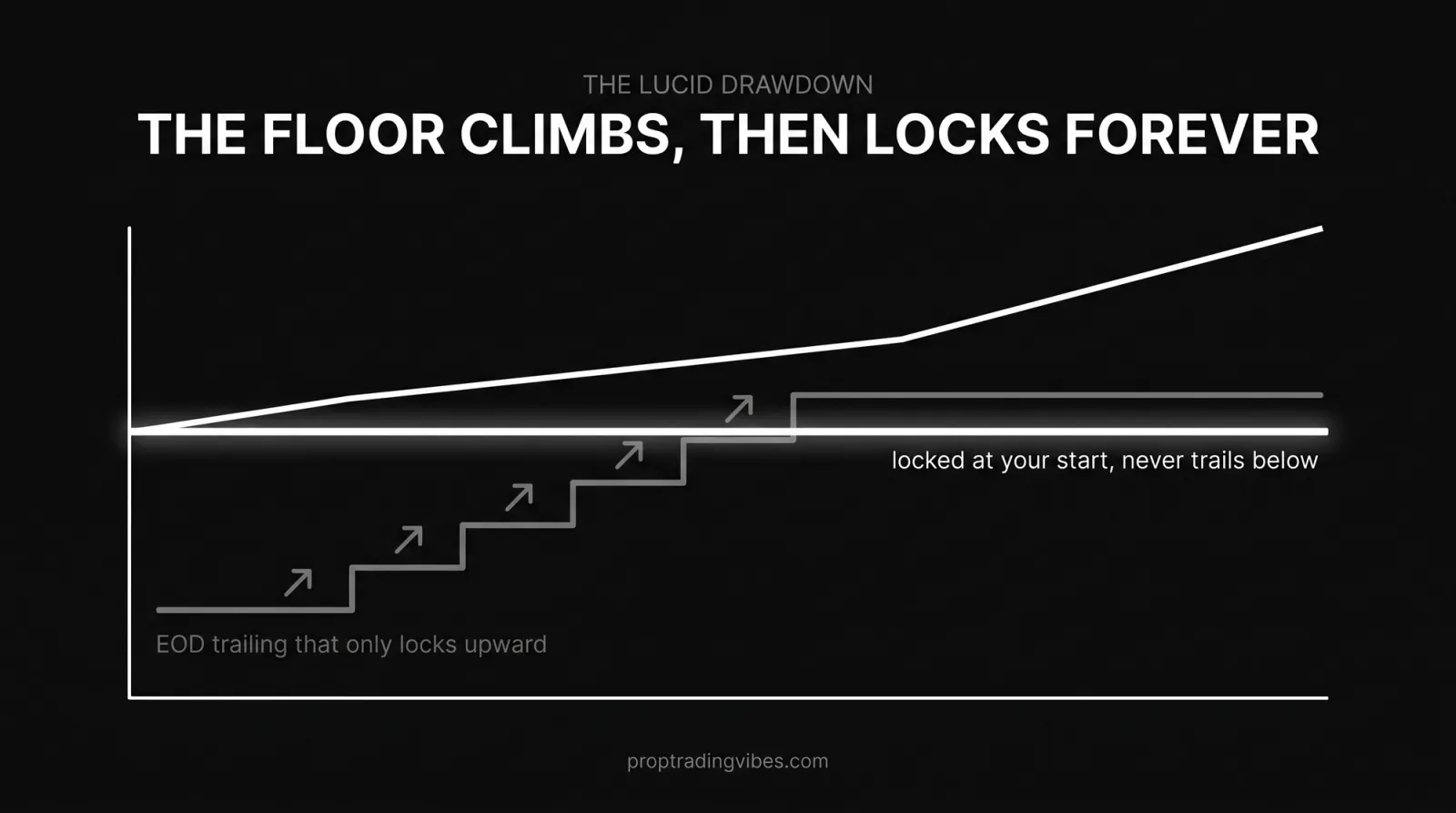
Exceeding the Maximum Loss Limit (MLL). Your account balance reaches the MLL and it is over. Instant breach. On a 50K account, the MLL starts $2,000 below your starting balance. This is an EOD trailing drawdown, so it only updates at market close, not intraday. (LucidDaily is the exception in the lineup: funded Daily accounts trail intraday, and the evaluation lets you choose EOD or intraday at checkout.) Huge difference from a funded TakeProfitTrader PRO account, which trails intraday on the peak including unrealized P&L (their Test phase settles at the close, like Lucid).
Hitting the Daily Loss Limit (DLL) when enabled. LucidFlex lets you choose DLL ON or DLL OFF at checkout. That's a feature. LucidPro and LucidFlex let you switch the DLL ON or OFF at checkout; LucidDirect has a fixed DLL. Every Lucid DLL is a soft breach: the account pauses rather than terminates, and you are locked out until the next session opens. When DLL ON is selected, LucidPro uses a fixed DLL in both phases: $600 (25K), $1,200 (50K), $1,800 (100K), and $2,700 (150K). Once a funded Pro account closes above its Initial Trail Balance, that fixed DLL is replaced by the LucidScale DLL, which is 60% of your highest end-of-day profit and never moves back down. LucidDirect's fixed DLL by size: none on the 25K, then $1,200 (50K), $2,100 (100K), $3,000 (150K). LucidDaily makes the DLL a checkout choice: on or off for both evaluation and funded, fixed at $600 (25K), $1,200 (50K), $1,800 (100K), $2,700 (150K), always a soft breach.
Trading products outside the approved list (no published sanction). Lucid publishes an approved-products article on its help center: 34 futures contracts, each with a per-side commission. That article is a product and commission table and nothing else. It names no penalty, no breach and no consequence for trading something that is not on it. Stick to the approved contracts, but do not file this next to the MLL as a documented account-killer, because Lucid has not written it as one.
Holding through market close (this one does not kill the account). All positions must be flat before the session closes, 4:45 PM ET on LucidPro, LucidFlex and LucidDirect, and Lucid closes anything still open automatically. The help center is explicit that holding past this time does not result in a failed account, so treat it as a forced flatten rather than a breach. LucidDaily is not named on that page and Lucid publishes no separate cutoff for it, so plan around the same close until it does. Trading resumes at 6:00 PM ET Sunday through Thursday, and on holidays with an early close the earlier close applies. On LucidLive the cutoff is 4:45 PM ET on Tradovate and 4:15 PM ET on Rithmic, with an optional auto-liquidate setting, and swing trading is not allowed there either.
The Rules That Actually Help You
EOD trailing drawdown is the single best rule at Lucid for traders who experience intraday volatility. Here's why: if you're up $1,500 during the session but close the day up $300, your MLL only trails based on the $300 close, not the $1,500 high. On a funded TakeProfitTrader PRO account, which trails intraday, that $1,500 peak would have moved your drawdown permanently. EOD trailing protects you from the psychological mistake of watching profits evaporate and having your drawdown lock in at the worst moment.
No funded consistency rule on LucidFlex. Most firms cap how much of your total profit can come from a single day. Topstep's funded Consistency Path enforces 40% (the Standard Path has no consistency rule). Tradeify uses 35% on Growth Sim Funded, none on Select Flex and Daily, and 20%/25%/30% on current Lightning. LucidFlex: 0%. If you make $3,000 on Monday and $50 on Tuesday, that's a valid payout.
One-time fees with free resets during promos. When you breach an evaluation, you don't restart a monthly subscription. You buy a new one, often at a discount during Lucid's frequent promos. Some periods include free resets.
EOD Trailing Drawdown: How It Really Works (with math)
Let me walk through a real scenario on a 50K LucidFlex.
Day 0: Starting balance $50,000. MLL = $48,000 ($2,000 below).
Day 1: You trade NQ and close the day at $50,800. MLL trails up to $48,800.
Day 2: Bad day. You close at $50,200 (down $600 from yesterday's close). MLL stays at $48,800. It only trails UP, never down.
Day 3: Great session. You hit $52,000 intraday but close at $51,400. MLL trails to $49,400 (based on the $51,400 close, NOT the $52,000 high).
Day 4: You close at $51,500. MLL trails to $49,500.
Lock point: Once your closing balance exceeds the Initial Trail Balance ($52,100 on the 50K), the MLL locks at $50,100, your starting balance plus $100 (per Lucid's help center, checked July 2026). Requesting a payout gets you there sooner and not for free: the LucidFlex drawdown page states that once you request a payout, the MLL adjusts automatically to the Locked MLL Balance. On a sim-funded account still trailing below that level, the snap tightens your buffer rather than widening it. From here you trade with a locked floor. The trailing drawdown can no longer chase you (a breach lands the moment the balance reaches $50,100).
The key insight: the MLL locks at break-even plus $100, not at some arbitrary level. Once locked, you have permanent downside protection. It takes about $2,100 in accumulated end-of-day closing profit to get there.
Compare this to the intraday trailing on a funded TakeProfitTrader PRO account. Same scenario on Day 3: your MLL would trail to $50,000 based on the $52,000 intraday high, not the $51,400 close. That $600 difference in drawdown protection matters on volatile instruments like NQ.
Which Lucid Trading platforms fit your setup?
I use Tradovate for execution and TradingView for charts. That is the Lucid platform combination I can judge from real use. The connection has been straightforward for my NQ and MNQ workflow, and it avoids forcing a Mac user into a desktop-only Rithmic setup.
Lucid documents two wider platform routes. CQG covers Tradovate, TradingView and NinjaTrader. Rithmic opens the specialist ecosystem, including Quantower, Sierra Chart, Bookmap, ATAS, MotiveWave and R|Trader Pro. A long platform list is useful only when the selected account is issued on the feed you need.
Check the data feed, not just the logo
The platform name and the data feed are separate decisions. TradingView through Tradovate is a CQG route. A platform such as Bookmap or Sierra Chart normally points to Rithmic. Your dashboard credentials show the route assigned to the account, and Lucid does not document a self-service way to switch feeds after purchase.
LucidDaily is the edge case I would verify with support. Lucid's general platform page says the published list works across its accounts, while the Daily checkout path has been documented on Rithmic. I would not assume that a CQG platform is available on Daily until Lucid confirms the exact setup.
Mobile access is useful, but it is not mobile execution
Lucid has its own iOS and Android app for account metrics, payout requests, certificates, notifications and support. It is a dashboard companion. Trades still run through the connected trading platform. Tradovate and TradingView can cover mobile monitoring and order management; a NinjaTrader desktop workflow does not become mobile because the Lucid dashboard has an app.
What I would confirm before paying
- The exact platform and feed issued for the selected product.
- Whether the intended indicator, copier or automated tool is permitted.
- Any separate market-data or platform charge outside the Lucid purchase.
- The session close and forced-flatten time for the account.
Lucid does not offer swing-style overnight holding on its standard futures paths. If keeping positions through the close is part of the strategy, the number of supported platforms does not solve the underlying mismatch.
Which Lucid Trading account should you choose?
Choose from the stage you ultimately want to trade, not from the easiest-looking evaluation. Lucid's products can share an account size while behaving differently once a payout is the goal.
LucidFlex: my default for most traders
Flex is the first account I would compare. It uses an end-of-day trailing drawdown and lets you choose whether to add a daily loss limit. In the simulated-funded stage there is no payout consistency percentage. Instead, the account asks for five qualifying profitable days and positive net profit in the current cycle.
That structure works well when daily results are uneven. One strong day does not create a consistency problem, but it also does not finish the cycle by itself. The request is limited by both a share of profit and an account-size cap, so I do not keep trading solely to chase the maximum withdrawal.
Flex fits a trader who values breathing room and is comfortable building several profitable days. The tradeoff is time: it is not the shortest path from evaluation to the next eligible payout.
LucidPro: faster, but less forgiving
Pro removes the evaluation best-day rule and can be passed after one trading day. The simulated-funded stage then introduces a 40% payout consistency rule, a fresh-profit goal and a required buffer. A trader who makes most of the cycle profit in one session must keep trading until the distribution is compliant.
That is why I treat Pro as the aggressive account. The short evaluation is attractive, but the funded-stage math is the real product. I use smaller size and plan several contributing days instead of trying to force the whole cycle on day one.
Pro fits an experienced intraday trader who already knows the shape of their P&L. It is a poor shortcut for someone who keeps failing because of oversized trades.
LucidDaily: frequent access after a protected buffer
Daily is built around payout requests on any eligible day. The simulated-funded account has no payout consistency rule, but profit has to sit above the protected buffer and there must be new profit after the last approved request. Evaluation drawdown and daily-loss options also change with the selected configuration.
I have not personally traded Daily. I would compare it when frequent withdrawals matter more than the simpler Flex cycle, then use the selector to inspect the exact evaluation and funded-stage combination before buying.
LucidDirect: no evaluation does not mean live capital
Direct skips the evaluation and begins in a simulated-funded stage. That distinction matters. The purchase is not a live brokerage allocation. Direct uses its own profit goal, payout caps and a 20% consistency rule, with the daily loss setup changing by size.
I would consider Direct only if the main problem is repeatedly paying for evaluations and the stricter payout distribution already fits the strategy. Skipping a target-based test does not make the risk rules disappear.
LucidMaxx: an earned route, not the standard recommendation
Maxx is invite-only. Lucid decides who receives the status, and the qualification criteria are not public. Eligible traders can buy a Maxx evaluation that leads to a live-capital stage rather than the normal simulated-funded stage.
The product is interesting because the destination is different, but it is not actionable advice for a reader who has not received access. I would not present Maxx as the best Lucid deal without stating that gate.
How I manage a LucidFlex 50K
The firm-level maximum loss is $2,000 on the Flex 50K setup I trade. I do not use all of it as a daily risk budget. My maximum planned risk on one trade is $400, and I stop the session after $600 of losses. Those are my controls, not Lucid rules.
I usually trade one NQ contract or use MNQ when I need finer sizing. The purpose is to keep a normal losing session far enough from the account's failure point that I can trade the next day without needing a recovery trade.
For payouts, I prefer a comfortable withdrawal over the theoretical maximum. Once I have met the selected account's actual requirements, I request the payout and reduce the amount left exposed to firm risk. On Pro, I spread the work across days because the consistency rule punishes a cycle dominated by one result.
The selector above should be the last rule check before purchase and before a payout request. My process is the interpretation layer: size below the firm limit, plan for the funded stage and do not keep trading merely because a larger cap exists.
Is Lucid Trading legit? What my payouts prove
Yes, I regard Lucid Trading as a legitimate futures prop firm. I have completed more than 30 payout cycles across LucidFlex and LucidPro, with no rejected withdrawal or payout dispute in my recorded history. Six redacted firm-issued certificates are public on this page.
That evidence has limits. It proves that I reached the payout stage repeatedly and Lucid paid my requests. It does not guarantee another trader's result, verify a product I did not trade or promise that the company will behave the same way forever.
What still makes me cautious
- Short operating history: Lucid launched in 2025. My payout record is positive, but the company has not been through as many market and regulatory cycles as the oldest firms.
- Fast product changes: Flex, Pro, Daily, Direct, Maxx and LucidLive have evolved quickly. An older video can describe a product that no longer exists.
- Invite-only opacity: Lucid publishes the Maxx product but not the criteria used to award access.
- Discretionary live transition: Reaching the required simulated payout history can put an account into the live call-up process. It does not make live allocation an automatic entitlement.
I am comfortable continuing to trade Lucid because the firm has paid me repeatedly. I still diversify across firms, recheck the selected account and withdraw when eligible. Payout evidence should improve a decision, not switch off risk management.
Lucid Trading vs Topstep, Tradeify and TakeProfitTrader
I would not choose among these firms from a static price table or a row of Trustpilot scores. Promotions, account paths and payout rules change too often. The useful comparison starts with the tradeoff you actually care about.
Choose Lucid for one-time access and product choice
Lucid's public paths use a one-time purchase rather than a monthly firm subscription. It also gives you several payout structures: Flex for a more forgiving cycle, Pro for a faster but consistency-bound route, Daily for frequent eligible requests and Direct for skipping the evaluation.
Tradeify is the closest comparison when you also want one-time pricing and several account mechanics. Compare the funded-stage drawdown and payout distribution, not just the checkout discount.
Choose Topstep for operating history and a simpler story
Topstep has a much longer operating record and a more concentrated product ecosystem. That can matter more than Lucid's flexibility if counterparty history and a familiar process are the priorities. The tradeoff is less platform choice and a different cost path.
Choose TakeProfitTrader for a different funded-stage model
TakeProfitTrader is worth comparing when its subscription and funded-account structure fit your pace better than a Lucid one-time purchase. Its platform and drawdown behavior are not interchangeable with Lucid, so the decision should follow the exact account rather than a brand-level score.
My recommendation by trader type
- Newer intraday trader: start with LucidFlex and keep the position size conservative.
- Consistent scalper: compare LucidPro when several balanced profit days are already normal.
- Frequent-withdrawal trader: compare LucidDaily against the buffer and drawdown options.
- Evaluation-fatigued trader: inspect LucidDirect, but remember that it starts simulated and has tighter payout math.
- Risk-first trader: prefer Topstep's history or spread accounts across more than one firm.
Lucid wins my personal comparison when Flex or Pro matches the way I already trade. It should not win simply because I have been paid there. The account still has to fit your own loss distribution, platform and withdrawal plan.
Lucid Trading FAQ: programs, payouts, rules
What is Lucid Trading?
Lucid Trading is a US-based futures prop trading firm founded by AJ Campanella in 2025. The firm offers funded trading accounts where traders pass an evaluation, then trade with the firm's capital and keep 90% of profits. Lucid supports five account types (Pro, Flex, Daily, Direct, and the invite-only Maxx) with sizes from 25K to 150K and one-time evaluation fees.
What makes Lucid Trading different from other prop firms?
Three things stand out. First, one-time evaluation fees instead of monthly subscriptions. Second, LucidFlex has an optional daily loss limit and zero funded consistency rule, which no other firm matches as a combination. Third, payout processing averages 15 minutes, faster than Tradeify's plan-specific processing (Growth normally 24–48 hours; Lightning within 24 hours), TakeProfitTrader (same day), and Topstep (1–3 business days).
What is the profit split at Lucid Trading?
All Lucid plans pay 90/10 on new accounts, including LucidDaily. LucidPro accounts opened before November 28, 2025 are grandfathered at 100% of the first $10,000 in withdrawals, then 90/10. LucidLive pays 90/10 on real capital, raised from 80/20 in March 2026. LucidMaxx also pays 90/10, with the trader keeping 90% from the first payout.
How does the EOD trailing drawdown work at Lucid?
Your Maximum Loss Limit (MLL) starts $1,000 to $4,500 below your starting balance depending on account size, or $1,000 to $5,000 on LucidDirect. It trails upward based on your end-of-day balance, not your intraday high. Once the MLL trails to your starting balance plus $100 ($50,100 on a 50K), it locks permanently. This means a profitable morning session that you give back by close doesn't move your drawdown, unlike the intraday trailing on a funded TakeProfitTrader PRO account. The trailing is the end-of-day part; the breach is not, so an account is breached the moment its balance reaches the MLL, intraday included. LucidDaily is the exception: funded Daily accounts use an intraday trailing drawdown, and in the evaluation you choose EOD or intraday at checkout.
What happened to LucidBlack?
LucidBlack is no longer sold, and Lucid's help center keeps its rule pages in a collection labeled LucidBlack (Legacy). Under Black the path to live ran to four payouts. Lucid publishes nothing about accounts that were still open at the wind-down, so there is no documented migration path to quote.
What is LucidMaxx?
LucidMaxx is Lucid's earned tier. It offers daily payouts, no caps, no DLL, EOD drawdown, up to 5 accounts and a 90/10 split from the first payout. There is no sim-funded stage: passing the Maxx evaluation puts you straight onto live capital. The status is granted by Lucid's risk team rather than sold. Traders who hold it may then purchase the LucidMaxx evaluation, which carries a profit target, a 40% consistency rule and a 5 trading day minimum. That evaluation is priced publicly and runs $110 to $680 by account size and number of blown live accounts, with no discounts and resets priced the same. Lucid does not publish the qualification criteria.
What is LucidDaily?
LucidDaily is Lucid's fourth purchasable account type, launched in July 2026. Funded Daily accounts allow payout requests every day you are eligible, with a $500 minimum and no per-request cap, a 90/10 split, and no consistency rule. Funded accounts always trail intraday, and red folder news trading in funded is a hard breach, with the Daily evaluation undocumented rather than exempt. The evaluation is configured at checkout, covered in full in the account types section above. Sizes run 25K to 150K, with list prices from $115 and calculated 40% VIBES prices from $69.
Does Lucid Trading have a mobile app?
Yes. The Lucid Trading App is published by Lucid Trading Group LLC on the Apple App Store and Google Play, live since July 2026, and Lucid pitches it as the first prop firm mobile app. It handles the account side rather than trade execution: real-time dashboard, payout requests, certificate downloads, support chat, and push notifications for payouts and account updates.
How fast are payouts at Lucid Trading?
Payout processing averages under 15 minutes. US traders using Plaid ACH typically see same-day bank deposits. International traders can use WorkMarket; crypto is available only where the payout flow allows it. Effective August 26, 2026, Lucid says residents of China, Hong Kong, Taiwan, Singapore and Malaysia can no longer receive crypto payouts and must use WorkMarket. Account status, payout eligibility, profit split and payout schedule are unchanged. The current Help Center still describes crypto more broadly for international traders, so check the live payout screen before planning the rail.
What platforms does Lucid Trading support?
Lucid supports 12 platforms. Three run on CQG (Tradovate, TradingView, NinjaTrader) and nine on Rithmic (MotiveWave, Quantower, Tradesea, Sierra Chart, Jigsaw, Bookmap, ATAS, R|Trader Pro and MultiCharts). Lucid's help center states that all listed platforms work with all account types, but Lucid's checkout lists LucidDaily on the Rithmic feed, and there is no documented route from a Rithmic-issued Daily account to the three CQG platforms. Ask Lucid support before buying Daily if Tradovate, TradingView or NinjaTrader is your platform. LucidPro and LucidFlex both support custom DLL files (Dynamic Link Libraries; nothing to do with the daily loss limit) for indicators and automation tools.
Is Lucid Trading legit?
Based on my personal experience: yes. I've completed 30+ payout cycles with zero rejections or delays. Lucid holds a 4.6 Trustpilot rating as of July 2026, an active founder (AJ Campanella) who communicates directly with traders, and a growing community with verified payout proof. The main concern is age. Lucid launched in 2025, making it the youngest firm in the competitive set.
How does LucidLive work under the current structure?
LucidLive was completely overhauled. The old escrow-based program is gone. It capped how much simulated profit could move live ($15,000 to $30,000 by size on LucidPro, $4,000 to $16,000 on LucidFlex and LucidDirect), deposited only a slice of that on day one ($3,000 on a 50K Pro, $2,400 on a 50K Flex or Direct) and held the rest in escrow behind 10 profitable live days, $10,000 of live profit and a 60-day wait from account opening. New LucidLive starts at $0 balance, with a one-time bonus ($1K for 25K accounts, $2K for 50K, $3K for 100K, $4.5K for 150K) released as a payout once your live profits reach the Live Target for the size ($1,100 / $2,100 / $3,100 / $4,600), which sits $100 above the starting live drawdown the MLL locks against. You get daily payouts, EOD drawdown, and a 90/10 profit split on real capital. Onboarding targets days instead of weeks.
Can I hold positions overnight at Lucid Trading?
No. All positions must be flat before the close, 4:45 PM ET on LucidPro, LucidFlex and LucidDirect, and Lucid closes anything still open automatically. The help center adds that holding past this time does not result in a failed account, so it is a forced flatten rather than a breach. LucidDaily is not named on that page and Lucid publishes no separate cutoff for it, so plan around the same close. Trading reopens at 6:00 PM ET Sunday through Thursday, and holidays with an early close move the cutoff forward. LucidLive is no exception on swing trading: it is not allowed, and the cutoff there is 4:45 PM ET on Tradovate Live or 4:15 PM ET on Rithmic Live, with an optional auto-liquidate setting. If you need swing trading capability, Lucid will not work for that at any stage.
How much does a Lucid Trading evaluation cost?
Prices vary by account type and size. LucidFlex 50K costs $146 ($87.60 with VIBES). LucidPro 50K costs $192 ($115.20 with VIBES). LucidDirect 25K costs $329 one-time ($197.40 with VIBES). The daily loss limit toggle does not change the list price. See the account types guide for the full breakdown across all sizes. All fees are one-time payments with no monthly subscriptions. Lucid runs frequent promotions, and you can get up to 40% off with code VIBES. LucidDaily 50K ranges from $156 to $185 list, or $93.60 to $111 with VIBES, depending on the checkout configuration.
What is the minimum account size at Lucid Trading?
The minimum is 25K, available across LucidFlex ($89), LucidPro ($123), LucidDaily (from $115), and LucidDirect ($329) regular pricing. The 25K account has a $1,000 drawdown on Flex and Pro. I recommend the 50K for most traders because the $2,000 drawdown gives more room to trade NQ without constant breach anxiety.
Should I choose Lucid Trading in 2026?
If you want one-time evaluation fees, fast payouts, and flexible trading rules, Lucid is a strong choice. LucidFlex is the best option for beginners because the DLL is optional at checkout and the funded account has no consistency rule. LucidPro is ideal for experienced traders who want fast payout cycles. The main reason to look elsewhere: if longevity and company track record are your top priority, Topstep (the longest track record in retail futures prop) and TakeProfitTrader (4+ years) have longer histories.
Key details
- Founded
- 2025
- Asset classes
- Futures
- Platforms
- Tradovate, NinjaTrader, TradingView, Sierra Chart, Quantower, MotiveWave, Bookmap, ATAS, R|Trader Pro, Rithmic, CQG
- Profit split
- 90%
- Payout frequency
- Daily to 10-Day Cycles
- Drawdown
- EOD trailing
- Max funding
- $150,000 per account
- Restricted countries
- 81 (Afghanistan, Albania, Algeria, Angola…)
- Discount code
- VIBES · 40% off
I may earn a commission if you sign up through my link. It never changes my rating or verdict. I tested this firm with my own money.