

 RESEARCHED
 Maven Trading
80% on the four bounded product pages split · Ten business days on the three standard paths; Instant after product conditions payouts
Visit firmAffiliate link. It never changes my rating or verdict.
⌄Inside the platform
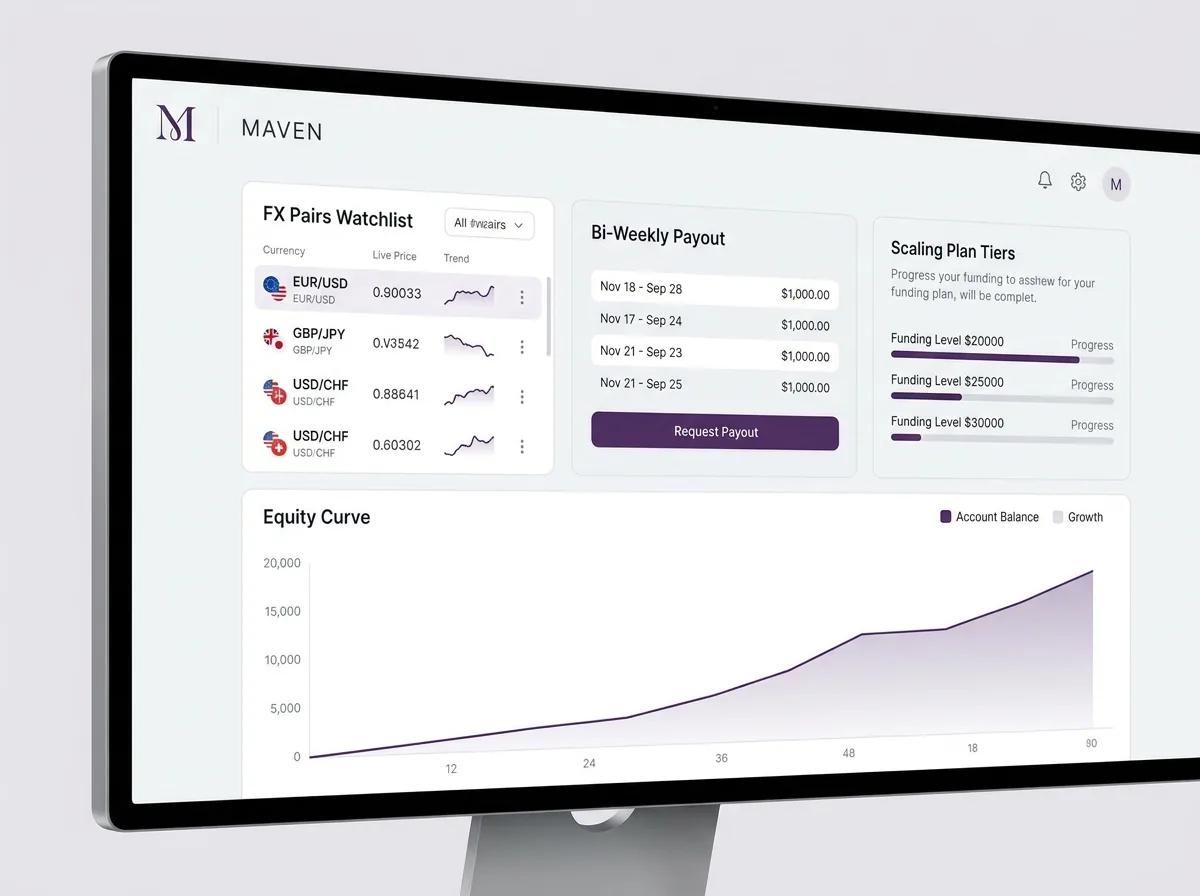
Maven currently has seven Trading account types plus two Prediction account types. Select the product line, product, size and stage before relying on a rule.
🔍Full review checked on
Ratings & Reviews
Four dedicated product pages publish distinct risk structures.
What is well documented?
The four bounded pages publish targets, drawdowns, daily-loss limits and payout shares.
What is still commercial?
Additional variants, checkout availability, final price and promotions remain separate facts. Do not infer an exhaustive catalog from navigation labels.
Have I personally tested Maven?
I have not traded a Maven account or completed a Maven payout. This is a research-based review of the current catalog, dedicated product pages, platform owner and payout controls.
An older version blurred “I researched the firm” into a personal-style narrative. That is not the same as buying an account. Research can compare written rules; it cannot verify spreads, slippage, support, interviews or withdrawal handling.
If I add a Maven test, I will publish the exact product, platform, dates and outcome. Until then, the honest use of this page is product selection and due diligence, not a first-hand endorsement.
Which Maven account should you choose?
Choose the product from the funded-stage constraints, not from the number of evaluation phases. The Data Core above changes price, target, loss rules, payout conditions and platforms with the selected setup.
Standard 1-Step
This route targets 8%, uses a 5% trailing maximum drawdown and a 3% daily limit. It removes an evaluation phase but gives open-equity behavior more influence over the loss floor. It is best suited to a trader who can control intraday giveback.
Standard 2-Step
The targets are 8% and 5%, with 8% static maximum loss and a 4% daily limit. Three profitable days of at least 0.5% apply in each phase and again in the funded stage. This is the most straightforward current Maven route for a strategy that dislikes a moving drawdown floor.
Standard 3-Step
Each phase targets 3%, while the static maximum loss is 3% and the daily limit is 2%. Smaller targets do not make this automatically easier: the usable loss allowance is also much tighter.
Instant
Instant begins in a simulated funded state. It uses a 3% trailing maximum drawdown, 2% daily limit, 3% minimum profit and 20% payout consistency. Faster access does not remove the concentration or account-review gates.
Buy Now Pay Later
The visible first payment is $5. The remaining size-specific balance becomes due after the 4% evaluation target is reached. The evaluation currently shows 10% static maximum loss and no daily-loss limit; the funded stage changes to 8% trailing maximum loss, a 4% daily limit and 20% consistency.
Omo 2-Step
Omo targets 6% then 8%, uses 8% static maximum loss and a 4% daily limit, and requires four 0.5% profitable days in each evaluation phase and the funded stage. Its first two payout caps are 6% and 8% of account size before later requests become uncapped by that product rule.
Mini
Mini is a direct 24-hour product with only one payout. It uses a 3% trailing maximum drawdown, 2% daily loss, 1% maximum floating loss, 15% consistency based on the largest winning trade, one open trade at a time and a 150-second minimum hold for profit to count.
Predictions
Prediction 1-Step and Elite 1-Step use a 9% evaluation target, 5% evaluation maximum loss and 8% funded maximum loss. The current page does not publish the daily-loss value, drawdown calculation or full payout gate, and it contradicts itself on the split. Treat those fields as unanswered before checkout.
Which Maven rules matter most?
The most important Maven rule depends on the product. A firm-wide answer is usually too broad.
Static and trailing drawdown are not interchangeable
Standard 2-Step, Standard 3-Step and Omo publish static maximum-loss structures. Standard 1-Step, Instant, Mini and the funded stage of Buy Now Pay Later use trailing structures. A strategy that gives back open profit can fit one and fail another despite the same nominal account size.
The daily limit uses the higher of balance or equity
Maven's current FAQ describes the daily loss calculation from the higher of balance or equity at the 00:00 UTC reset. Track the dashboard around that reset and keep a personal buffer for spread, commission and fast movement.
The rolling payout cap applies per trader
Maven publishes a $10,000 maximum withdrawal in a rolling 30-day period. Multiple accounts are aggregated, and the current FAQ says excess profit is voided. Planning several accounts does not multiply that personal cap.
Large profit changes the review gate
Above $5,000 in profit, the best day or one trade may not exceed 50% of cycle profit. After more than $5,000 in payouts, Maven requires a risk interview and may request one earlier. This is separate from a product's own consistency rule.
Mini has its own execution model
Mini allows one trade at a time and requires at least 150 seconds for a profitable trade to count. Its 15% concentration test is based on the largest winning trade rather than the largest day. Do not import the Standard account rules into Mini.
Technical possibility is not policy permission
Maven prohibits EAs, latency or tick abuse, arbitrage, copied execution, grid or gap tactics and cross-account hedging. A platform supporting an action does not mean the rulebook permits it.
Which platforms can you use at Maven?
The current Trading purchase cards expose MetaTrader 5 and Match-Trader. Buy Now Pay Later currently exposes MetaTrader 5 only. Maven states that MetaTrader is unavailable in the United States and Canada, so residence can remove a platform even when it appears on a general product card.
The current owner surfaces no longer support a brand-wide cTrader claim. I removed it from this review. If checkout exposes a different route for a particular region or product later, save that account-specific evidence instead of treating an older platform list as current.
Maven Predictions routes through Match-Trader variation IDs. That does not establish that every Trading rule applies to Predictions; the product line has its own account cards and unresolved fields.
Before paying, confirm product, size, residence and platform together. Then test symbols, spreads, stop behavior and any permitted workflow at the smallest practical exposure.
How would I approach Maven today?
I would start with the smallest account that answers the open question. Because I have no first-hand Maven record, the first purchase would be an execution and withdrawal test, not an attempt to maximize headline allocation.
For a static-loss strategy
Standard 2-Step is the cleanest starting comparison. The two targets take longer than 1-Step, but the maximum-loss floor does not chase a profitable equity high.
For a low-variance, patient process
Standard 3-Step spreads the target across three phases but cuts the maximum and daily loss allowances. I would use it only if the strategy naturally operates well inside those tighter limits.
For immediate access
I would compare Instant and Mini as different products, not as two prices for the same task. Instant is a repeat-payout route with a 20% rule. Mini is a one-payout, 24-hour format with trade-level restrictions.
For Predictions
I would wait for the split, drawdown calculation and request gate to be unambiguous in the owner page or written agreement. A visible price and target are not enough to model the funded state.
Is Maven Trading legitimate?
Maven publishes detailed product and FAQ owners, including payout caps, interview triggers, regional platform restrictions and prohibited strategies. That makes the current offer auditable and is more useful than a third-party star score by itself.
Published rules do not guarantee availability, execution quality or a payout. The Prediction page's 70% versus 80% split conflict is a concrete reminder that even first-party pages can disagree. The dated checkout and agreement should control any purchase decision.
I would save the product card, final price, account agreement, platform, payout policy and every support clarification. I would also keep the personal exposure small until the first withdrawal is complete. This is a simulated evaluation product, not a deposit account.
Because I have not personally tested Maven, I do not show a rating or “tested” badge. Research can verify what the owner says today; it cannot become my execution or payout history.
How does Maven compare with other prop firms?
Compare Maven by product and asset, not by the cheapest advertised card. Standard 2-Step belongs beside static two-step CFD evaluations at FundedNext, FTMO or FundingPips. Instant and Mini need matched instant-style products. Predictions needs a Prediction-market comparison, not a CFD table.
Maven's advantage is accessible entry and a wide choice of paths. Its disadvantage is decision complexity: product, stage, residence, platform and payout gates can all change the answer. The $10,000 rolling cap and interview trigger also matter for traders expecting larger withdrawals.
Personally tested competitors have a stronger evidence layer on PTV because I can describe what happened after purchase. Maven remains research-based. I would choose it when the exact rules fit well enough to justify that evidence gap, not because a coupon creates urgency.
What should you save before paying?
Save the checkout label, final total, product rule page, platform and payout conditions. Those records define the purchased configuration.
Key details
- Asset classes
- Forex, Indices, Commodities, Crypto, CFDs, Prediction markets
- Platforms
- cTrader, Match-Trader, MetaTrader 5
- Profit split
- 80% on the four bounded product pages
- Payout frequency
- Ten business days on the three standard paths; Instant after product conditions
- Drawdown
- Mixed
- Max funding
- $200,000 initial; scales to $1,000,000

I may earn a commission if you sign up through my link. It never changes my rating or verdict. I researched this firm but have not personally tested it yet.