

 TESTED WITH REAL MONEY
 TradeDay
90% split · Quick Pay daily; Fast Pass 5 profitable days payouts
Visit firmAffiliate link. It never changes my rating or verdict.
⌄Inside the platform
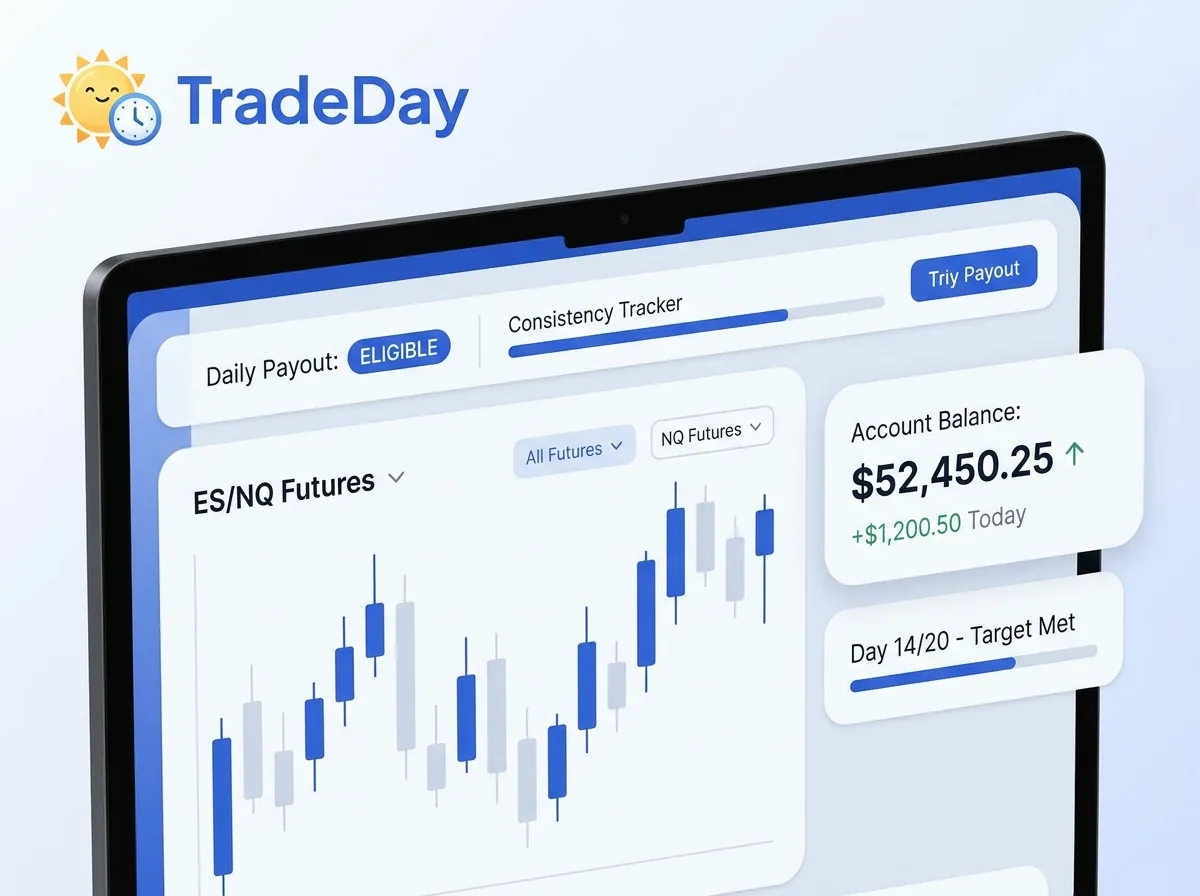
TradeDay currently sells Quick Pay Intraday, Quick Pay EOD and Fast Pass EOD in four sizes. I have traded the firm since December 2024 and confirmed three funded 50K accounts. Use the account selector because drawdown, payout eligibility and capital mode change by route and stage.

Rules checked on
Ratings & Reviews
Three current programs with a choice between intraday and end-of-day funded drawdown
What is attractive, and what is the trade-off?
- Three current route families across 50K, 100K and 150K sizes.
- A broad platform population across CQG and Rithmic.
- No activation fee is presented in the current lineup.
- Quick Pay EOD changes to intraday trailing in Funded Sim.
- Fast Pass payout caps and funded consistency are cohort-specific, so the account-opened date matters.
What I personally tested at TradeDay
I started trading TradeDay in December 2024 and have used the firm long enough to see more than the checkout and evaluation screen. I confirmed three funded 50K accounts on August 25, 2026. My evidence supports a genuine account-process review, not a research-only summary.
The most useful lesson from my accounts is that passing and trading funded are separate tasks. A trader can build a method around an evaluation floor, hit the target and then receive a funded account whose drawdown responds differently. That is especially relevant to Quick Pay EOD: its evaluation uses end-of-day behavior, but every Quick Pay Funded Sim account uses an intraday trail.
What I can say from direct use
I have navigated TradeDay's account workflow, reached funded status and traded 50K accounts. That is enough to judge whether the interface, stage change and rule presentation are usable in practice. It also lets me explain why the funded-stage risk model should be planned before the evaluation begins.
I do not state a personal payout count for TradeDay. I also do not use three funded accounts to promise a support response, a withdrawal speed or a future policy decision. Those claims need their own evidence. Current rules and cohort values come from TradeDay's official pages and the Data Core rather than from a screenshot of one older account.
How I would approach a new TradeDay account
I would choose the funded drawdown first, then the program. On Quick Pay I would trade the evaluation as if the intraday funded floor already applied. That prevents a strategy from becoming suddenly incompatible the moment the account matters more.
I would start with micros, test bracket orders and flatten controls, and keep a personal daily stop comfortably inside the firm's hard maximum loss. I would also save the program name, stage, account size and opening date together. The date matters because some Fast Pass payout conditions differ by cohort.
After a pass I would not place the first funded trade from memory. I would complete the onboarding, open the issued dashboard and compare its loss limit, drawdown mode and payout terms with the current official owner. If something conflicts, I would ask support for a dated answer and keep it with the account record.
Where my coverage stops
My account history does not prove the experience of every platform, size or live-capital stage. TradeDay can move a trader from Funded Sim to Funded Live, and the live account introduces professional data fees, slippage controls and a different withdrawal buffer. I cover that path from TradeDay's documentation unless I explicitly identify a personal event.
What are the current TradeDay routes and list prices?
| Route | 25K | 50K | 100K | 150K | Funded drawdown |
|---|---|---|---|---|---|
| Quick Pay Intraday | $100 | $131 | $240 | $360 | Intraday |
| Quick Pay EOD | $120 | $175 | $285 | $400 | Intraday after funding |
| Fast Pass EOD | $130 | $189 | $330 | $500 | EOD |
Code VIBES is valid according to my August 25 confirmation. PTV does not publish a fixed percentage or discounted price without current checkout evidence. Enter the code and verify the actual total at checkout.
When does Quick Pay become intraday?
Quick Pay offers an evaluation choice: Intraday or EOD. Once the trader reaches Quick Pay Funded Sim, the mechanic is always intraday trailing. The EOD selection does not carry into Quick Pay Funded Sim.
Fast Pass is the separate EOD population. Use the current evaluation objectives and funded rules owner together; neither page should be generalized beyond its named route and stage.
What are the current Fast Pass payout caps?
These are caps per payout cycle, not lifetime caps. For accounts opened on or after July 26, 2026, they are $750 on 25K, $1,500 on 50K, $1,850 on 100K and $2,250 on 150K. Older cohorts use $2,000, $2,500 and $3,000 on 50K, 100K and 150K. The 25K Fast Pass also needs five profitable days of at least $100 each before a payout request. Match the account-opened date against the current Fast Pass payout policy.
Which TradeDay platform fits your workflow?
TradeDay supports both CQG and Rithmic platform ecosystems. That breadth is useful when you already have a stable futures workflow, but the platform logo is only the visible part of the decision. The data connection, credentials, copier setup and order behavior matter just as much.
Choose CQG for a familiar browser or NinjaTrader setup
TradeDay documents Tradovate, TradingView, NinjaTrader and Jigsaw on its CQG side. Tradovate is the straightforward browser and mobile route. TradingView works well when charting and execution are already centered there. NinjaTrader is the natural choice for a desktop trader with saved workspaces, indicators and order templates.
Do not assume that two interfaces using CQG behave identically. Test the bracket, flatten and connection-recovery behavior on the exact account. The worst time to learn how an order-management button works is when the drawdown is already close.
Choose Rithmic for specialist futures tools
The Rithmic group covers tools such as R|Trader Pro, Quantower, ATAS, MotiveWave, Bookmap, Sierra Chart and other specialist front ends. That makes TradeDay relevant to traders who need footprint charts, order-flow tools or a desktop workflow that Tradovate does not provide.
The longer list should not be read as permission for every indicator, automation or copier. A supported connection answers where the account can be opened. Trading practices and multi-account behavior are separate rules.
What to verify before selecting a platform
- That the chosen program and stage are available on the intended connection.
- The session close, forced-flatten time and holiday schedule.
- Whether a personal platform license or data package adds a separate cost.
- How brackets and working orders behave after a disconnect.
- Whether the intended copier sends the same direction and size to every account.
TradeDay allows multiple accounts only on one platform. A trader cannot divide the account group between CQG and Rithmic. That restriction should be considered before the first account is opened, because a later scaling plan may depend on the original platform choice.
For Funded Sim, TradeDay says there is no professional market-data fee. Funded Live is different: the trader becomes responsible for professional exchange data and trading commissions. Platform fit therefore includes the cost of the eventual stage, not just evaluation convenience.
Which TradeDay account should you choose?
Choose the TradeDay path by the account you want after passing. Evaluation price and profit target are temporary. The funded drawdown, payout rules and route to live capital are the mechanics that shape repeated use.
Quick Pay Intraday
Quick Pay Intraday is the most internally consistent route. The evaluation uses an intraday trailing maximum drawdown, and Quick Pay Funded Sim also uses an intraday trail. There is no false sense that the account becomes more forgiving after a pass.
This route fits a disciplined scalper who already monitors unrealized profit and knows how the floor moves during the session. It is less forgiving for a strategy that regularly gives back open profit before closing. A trade can still be positive overall while pulling the trailing floor close enough to create a breach on the reversal.
Quick Pay EOD
Quick Pay EOD makes the evaluation easier to manage for some traders because the drawdown floor updates at the end of the day. The name stops being descriptive after the pass. TradeDay applies intraday trailing drawdown to every Quick Pay Funded Sim account.
I would choose it only if I could trade the evaluation under the stricter funded model anyway. If the strategy needs the EOD cushion to survive normal intraday swings, passing Quick Pay EOD solves the wrong problem.
Fast Pass EOD
Fast Pass is the route for traders who want end-of-day trailing drawdown in both evaluation and Funded Sim. Its evaluation has a shorter minimum-day requirement than Quick Pay, while the funded payout path adds profitable-day and profit-distribution conditions.
Fast Pass also has an account-date boundary. TradeDay introduced a funded consistency rule and revised payout caps for newer accounts. The current Data Core maps the applicable cohort, but the practical lesson is durable: do not copy a payout example from a trader whose account was opened under a different policy.
Which size makes sense?
A larger headline balance does not create proportionally more usable risk. Compare maximum loss, contract limit and payout conditions together. I would pick the smallest size that supports the number of contracts the strategy actually needs, then risk a fraction of the firm's permitted loss.
The 25K option is now part of all three current programs. Older TradeDay reviews that list only 50K, 100K and 150K are incomplete. The selector above is the current owner for available sizes and exact values.
My decision rule
I would use Quick Pay when frequent access to withdrawals matters and intraday trailing drawdown already fits the strategy. I would use Fast Pass when preserving EOD drawdown matters more and I am comfortable building the required distribution of profitable days. I would skip both if the strategy depends on holding overnight or cannot operate within a trailing loss model.
Is TradeDay legitimate?
Yes, I consider TradeDay a legitimate futures prop firm. It was established in 2020, publishes detailed evaluation, funded and payout policies, and has operated my own accounts through funded status. My first-hand history dates to December 2024 and includes three funded 50K accounts confirmed in August 2026.
TradeDay says it has paid traders more than $10 million. I treat that as a company claim, not an independently audited figure. It is supporting context rather than the basis for my rating. My rating rests more heavily on direct account use, named policy owners and whether the current rules can be traced to the selected program and stage.
What increases confidence
- The firm separates Evaluation, Funded Sim and Funded Live instead of presenting every funded account as live capital.
- Quick Pay and Fast Pass have their own payout policies with explicit stage and cohort differences.
- TradeDay documents the review points that can move a trader from simulation to live trading.
- Monthly membership ends after funding, and current funded fees are explained separately for Sim and Live.
What still needs caution
Complexity is the main risk. A statement can be correct for Quick Pay Evaluation and wrong for Quick Pay Funded Sim. A cap can be correct for a newer Fast Pass account and wrong for an older cohort. A Funded Sim account can pay simulated profits without being a live brokerage allocation.
TradeDay also retains discretion around live placement, position limits and risk reviews. That is common in a risk-managed prop model, but it means a trader should not market the fifth payout or a gross-profit threshold as an unconditional entitlement to a specific live account.
Trustpilot remains visible in the page summary as a separate public-review signal. I do not compare volatile competitor Trustpilot scores inside the body. They age quickly and answer a different question from whether the exact TradeDay account fits the reader's trading method.
My conclusion is positive but bounded. The firm has handled my accounts seriously enough for me to keep it in consideration. I still save the terms at purchase, verify the issued dashboard after every stage change and avoid relying on any single prop firm as the only route to payouts.
TradeDay vs Topstep, Tradeify and other futures firms
TradeDay sits between the simple, controlled ecosystem and the product-heavy futures firm. It offers more platform and path choice than a one-route operator, but that flexibility creates more stage and cohort logic to track.
TradeDay vs Topstep
Topstep has the longer operating history and a more concentrated platform ecosystem. I would lean toward Topstep when institutional longevity and a simpler product story matter most. I would lean toward TradeDay when I want CQG or Rithmic platform choice and a documented Quick Pay or Fast Pass path that matches my drawdown preference.
TradeDay vs Tradeify
Tradeify is the stronger comparison for a trader who wants one-time purchase options and a broader multi-brand direction. TradeDay still uses a monthly evaluation subscription, then cancels it when the trader is funded. The better choice depends on total failure-and-reset cost, not a single promotional checkout price.
Tradeify also has its own account-family complexity. TradeDay's defining choice is simpler to state: Quick Pay becomes intraday when funded, while Fast Pass preserves EOD in Funded Sim.
TradeDay vs Lucid Trading
Lucid Trading is relevant when one-time purchases and several payout structures are the priority. TradeDay has the longer operating history and a formal simulated-to-live path with published thresholds. Lucid has been the stronger firm in my personal payout record, while TradeDay's current first-hand boundary is funded account use rather than a disclosed payout count.
TradeDay vs TakeProfitTrader
TakeProfitTrader deserves a look when its PRO account economics and subscription structure suit the strategy better. TradeDay wins when the exact Quick Pay or Fast Pass drawdown and platform route fit the workflow. Neither should be chosen from the advertised balance alone.
Who gets the best fit?
- Intraday-trail specialist: compare Quick Pay Intraday first.
- EOD evaluation trader: choose Fast Pass if EOD must continue after funding.
- Platform-dependent trader: TradeDay is strong when the chosen CQG or Rithmic front end is essential.
- Simplicity-first trader: consider a firm with fewer route, stage and cohort distinctions.
I would choose TradeDay only after matching the funded-stage account against the strategy. The firm-level rating narrows the field; it does not override a product mismatch.
Key details
- Founded
- 2020
- Asset classes
- Futures
- Platforms
- Tradovate, NinjaTrader, TradingView, Sierra Chart, Quantower, MotiveWave, Bookmap, ATAS, Jigsaw, R|Trader Pro, MultiCharts, Rithmic, CQG
- Profit split
- 90%
- Payout frequency
- Quick Pay daily; Fast Pass 5 profitable days
- Drawdown
- Mixed
- Max funding
- $450,000
- Restricted countries
- 82 (Afghanistan, Albania, Algeria, Angola…)
- Referral code
- VIBES
I may earn a commission if you sign up through my link. It never changes my rating or verdict. I tested this firm with my own money.