
Quick Answer: Bybit for Prop Trading
- • Bybit is a top-5 global crypto exchange by derivatives volume; some prop firms connect to it via API so your trades hit real order books instead of synthetic CFD pricing.
- • Execution is the key differentiator: tighter spreads, honest fills, transparent liquidity, no "last look" dealing desk.
- • Fees: 0.01–0.02% maker / 0.04–0.06% taker on perpetuals (tier-dependent, verify current fees on bybit.com), well below typical MT5 crypto CFD spreads of 0.1–0.3%.
- • Crypto only. No forex, no futures indices, no metals. Bybit covers one asset class and that's final.
- • Prop firm support is thin in June 2026: a handful of firms, with Breakout being one of the few verified options in the ecosystem.
The problem with most "crypto prop trading" wasn't the firms. It was the execution layer. MT5 crypto is a CFD. You're not buying Bitcoin. You're buying a derivative that a liquidity provider prices however they like, with spreads that widen during volatility and fills that don't match any real exchange.
Bybit changes that math. When a prop firm routes your trades through Bybit's API, the order hits a real order book with real counterparties. That distinction is small on paper and large in practice, especially if you trade around news, liquidation cascades, or thin overnight sessions.
This review covers Bybit specifically as a prop firm execution venue, not as a retail exchange. You can find Bybit's spot and options features documented elsewhere. Here the focus is: what does trading on Bybit through a funded account actually look like, and is the execution quality worth the tradeoffs?
What Is Bybit and Why Does It Matter for Prop Trading?
Bybit was founded in 2018 and is headquartered in Dubai. As of 2026 it ranks consistently in the top 5 globally for crypto derivatives volume. Over 60 million registered users across 160+ countries. It runs a deep perpetual futures market with BTC, ETH, SOL, and hundreds of altcoin pairs.
None of that is why it matters here. What matters is the architecture.
Real Exchange vs CFD: The Core Difference
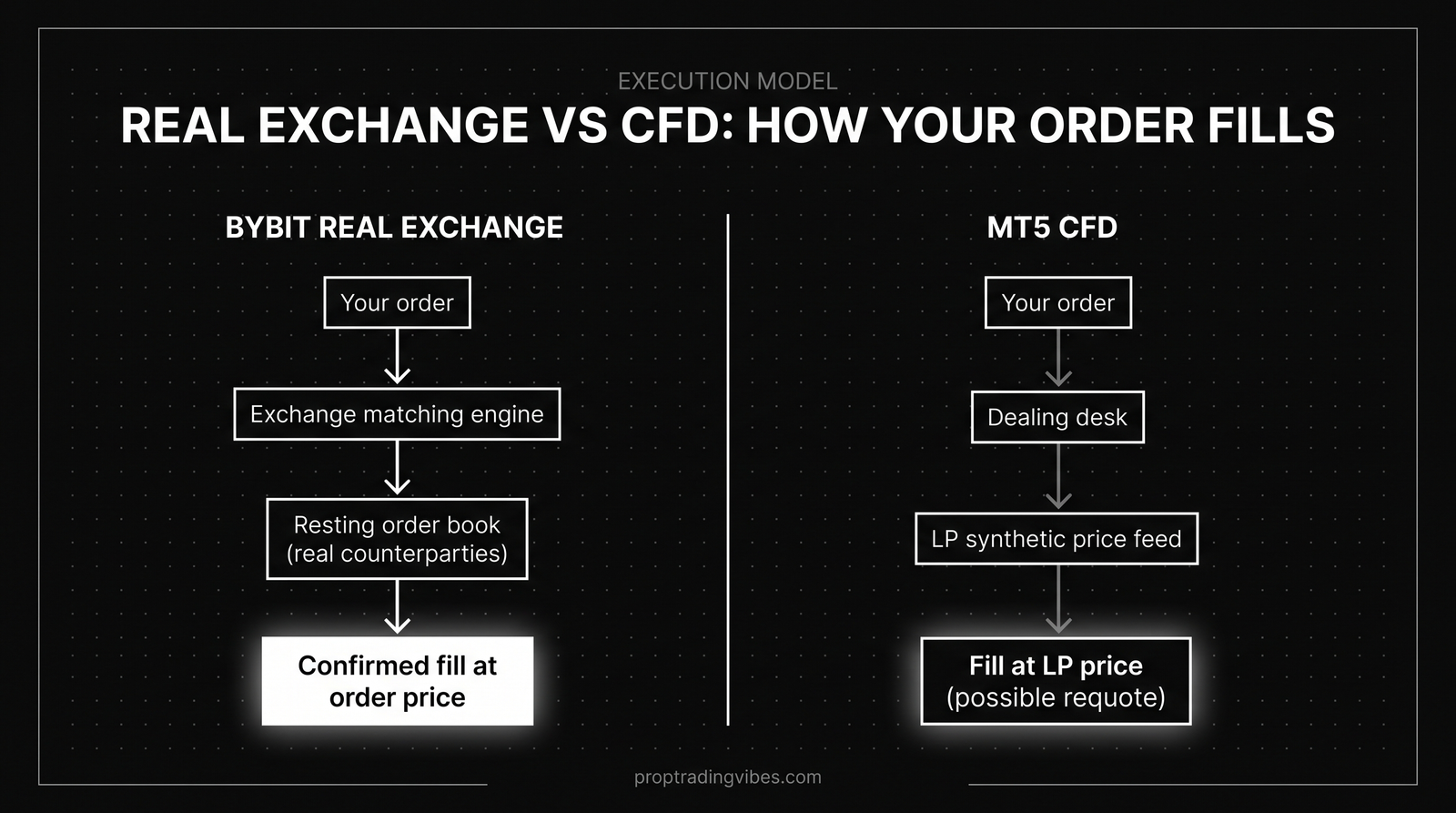
When you trade Bitcoin on MT5 through a typical prop firm, you're trading a Contract for Difference. The price feed comes from a liquidity provider. Spreads are synthetic. There's no order book you can verify. Fills are executed (or rejected) by a dealing desk that may or may not honor the price you saw.
Bybit operates a real exchange. Limit orders rest on a transparent order book. Takers fill against resting liquidity. You can see depth, absorption, and genuine supply-demand dynamics in real time. The spread you're quoted is the actual market spread, not a markup added by a middleman.
For traders who build edge around order flow, the difference is significant. When a $10M BTC bid appears in the Bybit order book, it's a real bid. When the same number shows up in an MT5 CFD, it's a displayed level from a liquidity provider with no obligation to hold it.
How the API Connection Works
Prop firms using Bybit don't hand you a personal Bybit account. They create a subaccount on their master Bybit account and generate API keys tied to that subaccount. Your trades execute on Bybit's infrastructure. The prop firm maintains capital ownership and monitors risk through their own dashboard.
From your side: you see Bybit's exchange interface, the same charts, order book, and depth of market that every retail Bybit trader uses. The capital isn't yours. The evaluation rules, daily loss limits, max drawdown, consistency requirements, are enforced by the firm's system. Bybit just provides the order matching engine.
This matters because it eliminates the dealing desk entirely. If your limit order is sitting at a price that the market trades through, it gets filled. No re-quotes. No mysterious rejections at volatile moments.
Trading on Bybit Through a Prop Firm
The Interface and Charting
Bybit's trading interface is purpose-built for crypto. TradingView's charting engine is native, so you get 100+ indicators, multi-timeframe layouts, Pine Script-compatible community tools, and real-time order book visualization without needing a separate TradingView subscription. This is a meaningful upgrade over MT5's dated charting or the basic charting in some other crypto-adjacent platforms.
Comparing it to purpose-built futures platforms like Quantower or DeepCharts is a different conversation. Those platforms are built for futures order flow with footprint charts, DOM surface, and volume profile. Bybit's strengths are different: transparent order book depth, liquidity heatmaps, and the kind of real-time exchange data that doesn't exist in a CFD environment.
Advanced order types are well covered. Conditional orders, trailing stops, iceberg orders, bracket orders. The mobile app mirrors the web interface closely, which matters for 24/7 crypto markets where things move at 3am.
Available Instruments
Through a Bybit-connected prop firm account you get access to a large range of perpetual futures and spot pairs. BTC, ETH, SOL, XRP, and major altcoins with active derivatives markets. The exact list depends on how the firm configures the subaccount, but it's far wider than what any CFD-based crypto prop firm offers. Typical MT5 crypto firms list 5–15 pairs. Bybit's derivatives market runs hundreds.
Leverage is set by the prop firm, not by Bybit's retail maximums. Bybit allows up to 100x on BTC perpetuals for retail traders. Prop firms cap this at 5x–20x, which is appropriate. Running 50x leverage on an evaluation account with no personal capital at risk is a fast path to breach, not a trading strategy.
Options trading may be available depending on the firm's subaccount configuration, though most prop integrations focus on perpetual futures.
24/7 Market Hours: Feature and Risk
Crypto runs continuously. No exchange close on Friday, no holiday gaps, no Sunday open. You can trade at any hour that fits your schedule. Asian session, European open, US overnight. The market is open.
The flip side: your drawdown limit never sleeps. A 5% overnight BTC move can breach a daily loss limit while you're asleep. Trailing drawdown structures, specifically EOD Trailing variants where the high-water mark locks at end of day, add an extra layer of complexity for overnight holds. Know the drawdown mechanic at your specific firm before holding positions across funding rate intervals. The DXTrade review covers how drawdown rules work in crypto-oriented platforms if you need a reference point.
Fee Structure: Where Bybit Wins Clearly
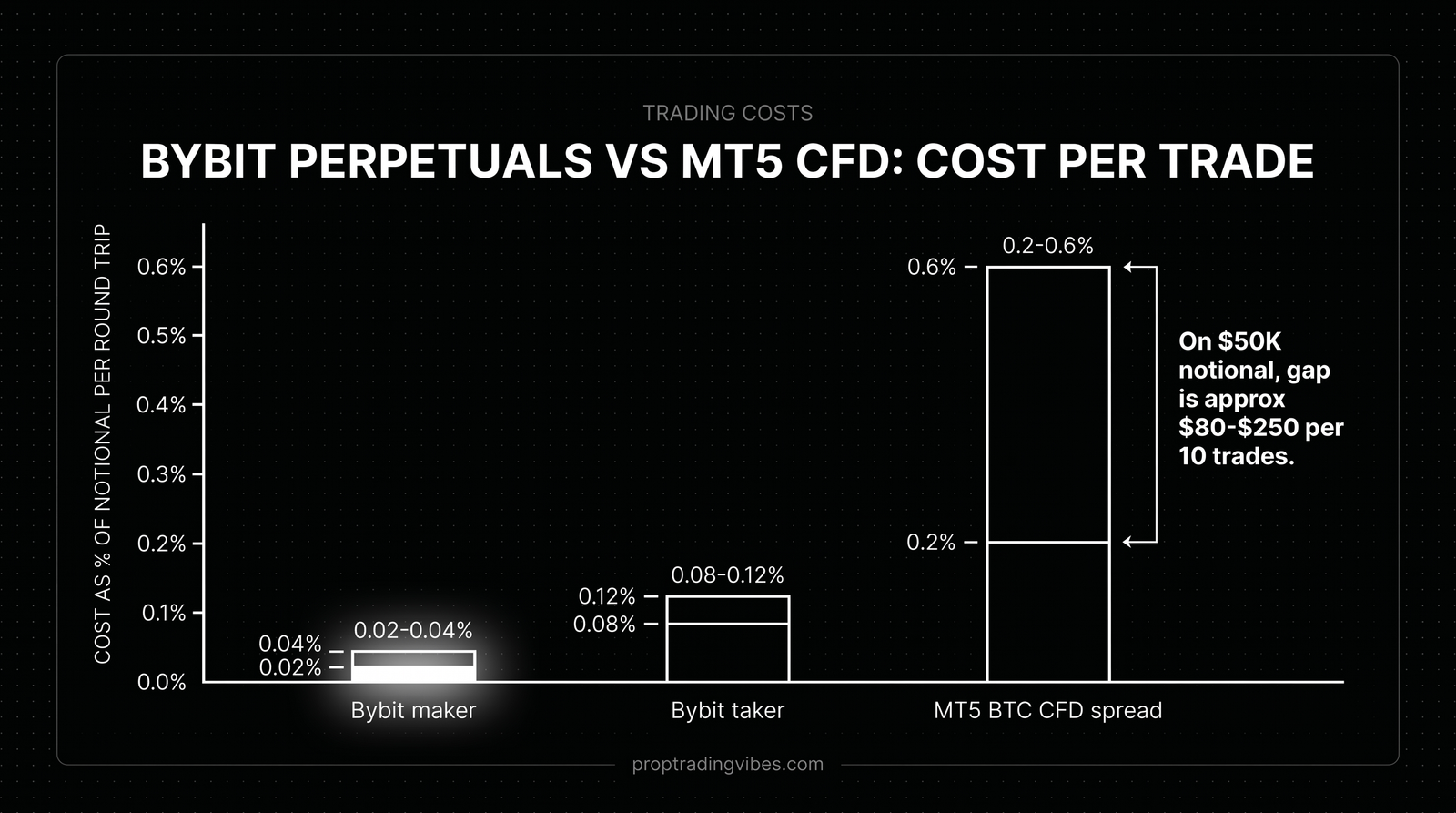
Trading costs are where Bybit's real-exchange model has the most straightforward advantage.
| Fee Type | Bybit Perpetual Futures | Typical MT5 Crypto CFD |
|---|---|---|
| Maker fee | 0.01–0.02% | N/A (spread-based) |
| Taker fee | 0.04–0.06% | Embedded in spread |
| Effective spread (BTC) | 0.02–0.05% at liquid hours | 0.1–0.3%+ |
| Funding rate | Every 8 hours (varies) | None (CFD doesn't expire) |
| Slippage (volatile) | Exchange order book depth | LP discretion |
For an active trader doing 10 round trips per day on a $50K account with 5x leverage, the cost difference between 0.05% and 0.20% per trade compounds into hundreds per month in saved fees. That's not theoretical. It's the arithmetic of professional trading.
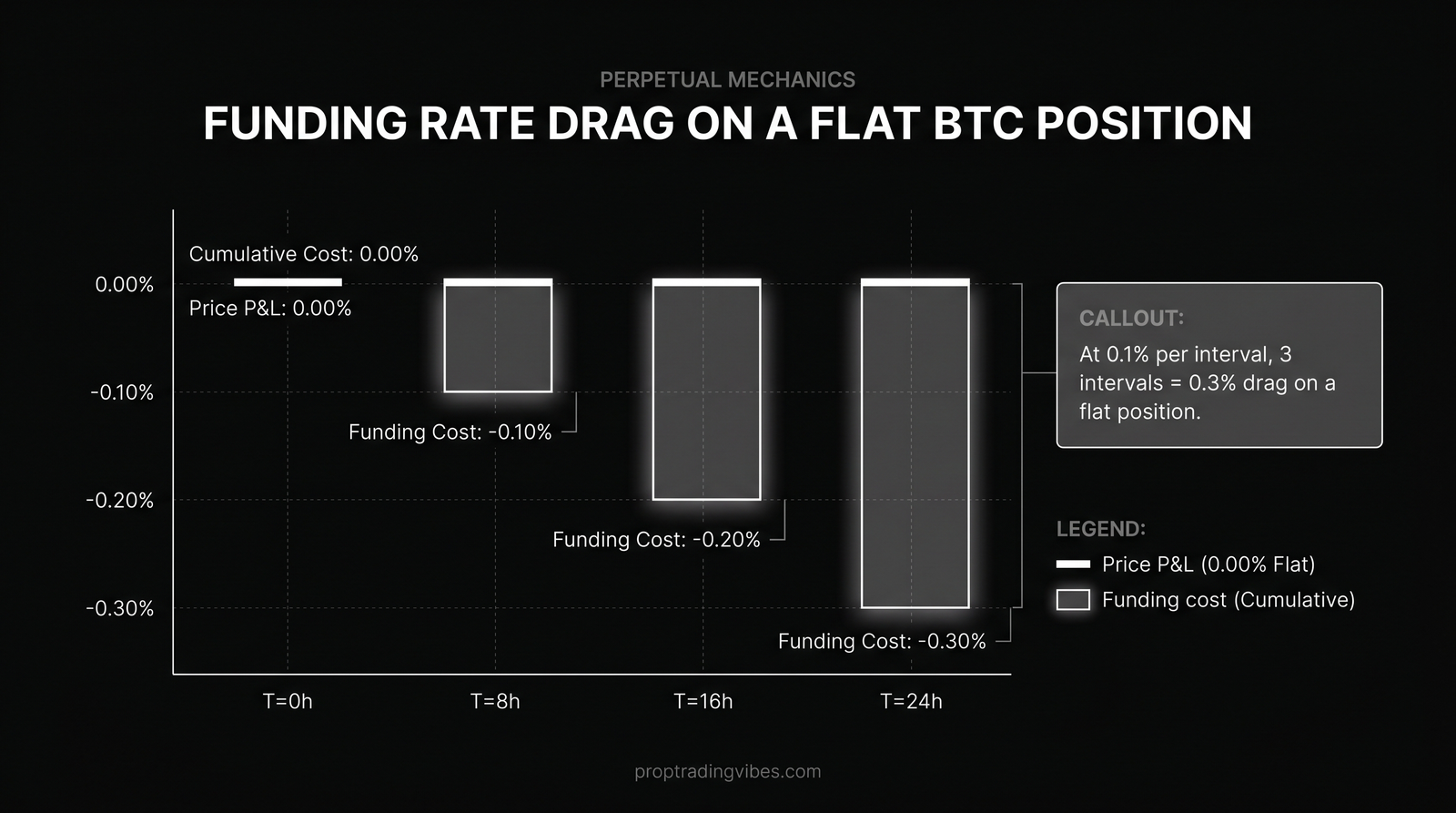
The one cost Bybit adds that CFDs don't: funding rates. Perpetual futures stay anchored to spot via funding payments made every 8 hours. When funding is highly positive, long holders pay short holders. When it's negative, shorts pay longs. Holding a long BTC position through a positive funding period costs money even if price doesn't move. Build that into your P&L model, especially for swing trades held multiple days.
Drawbacks: What Bybit Can't Give You
Prop Firm Ecosystem Is Tiny
This is the largest practical problem. As of June 2026, the number of prop firms offering genuine Bybit API integration remains small. Breakout is among the verified options. A few other firms have explored similar setups, but the ecosystem is nowhere near the scale of futures prop firms on Rithmic/CQG or forex firms on MT5.
Compare: MT5 is supported by 50+ prop firms. Tradovate by 13+. Bybit's prop firm coverage is still in the single digits. That means fewer firms to choose from, less competitive evaluation pricing, and fewer track records to evaluate before committing capital.
Crypto Only
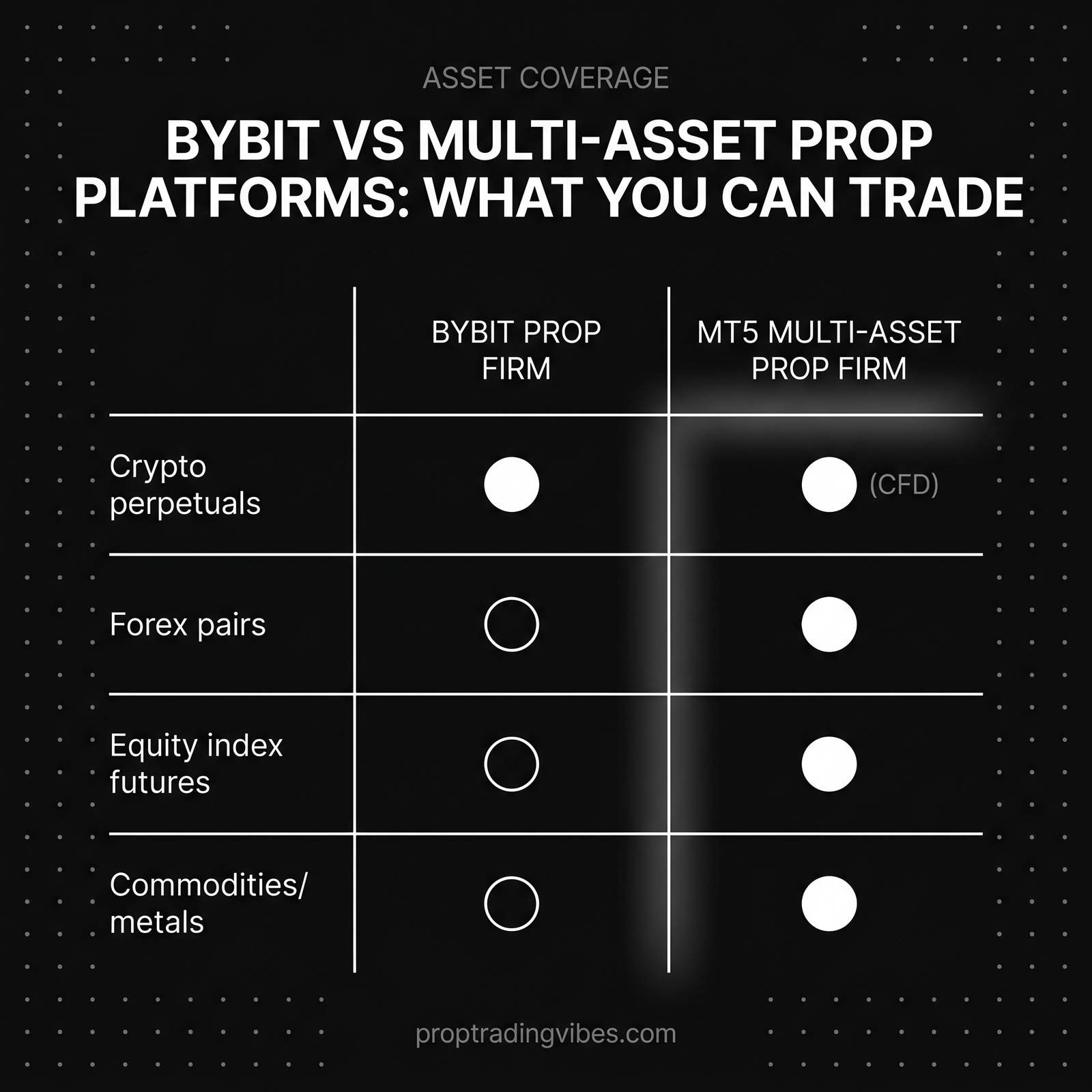
Bybit is a crypto exchange. There is no EURUSD. No Gold. No S&P 500 mini. No crude oil. If your strategy trades multiple asset classes, Bybit covers one of them. You'd need separate accounts on separate platforms for everything else. Firms like Breakout operate across multiple products, so check what their specific Bybit integration covers versus their full offering.
Regulatory Complexity
Bybit operates across 160+ countries but has been restricted or blocked in specific jurisdictions at various points. The regulatory environment for crypto exchanges remains fluid in 2026. A prop firm using Bybit's infrastructure inherits that regulatory exposure. If your country restricts Bybit access, the prop firm's Bybit integration goes with it.
Learning Curve for Futures Traders
Funding rates, perpetual futures mechanics, liquidation cascades, cross-margin vs isolated margin. None of these exist in traditional futures or forex prop trading. If you're a CME futures trader considering a Bybit-based prop account for crypto exposure, budget learning time specifically for exchange mechanics before risking evaluation fees.
Which Prop Firms Support Bybit?
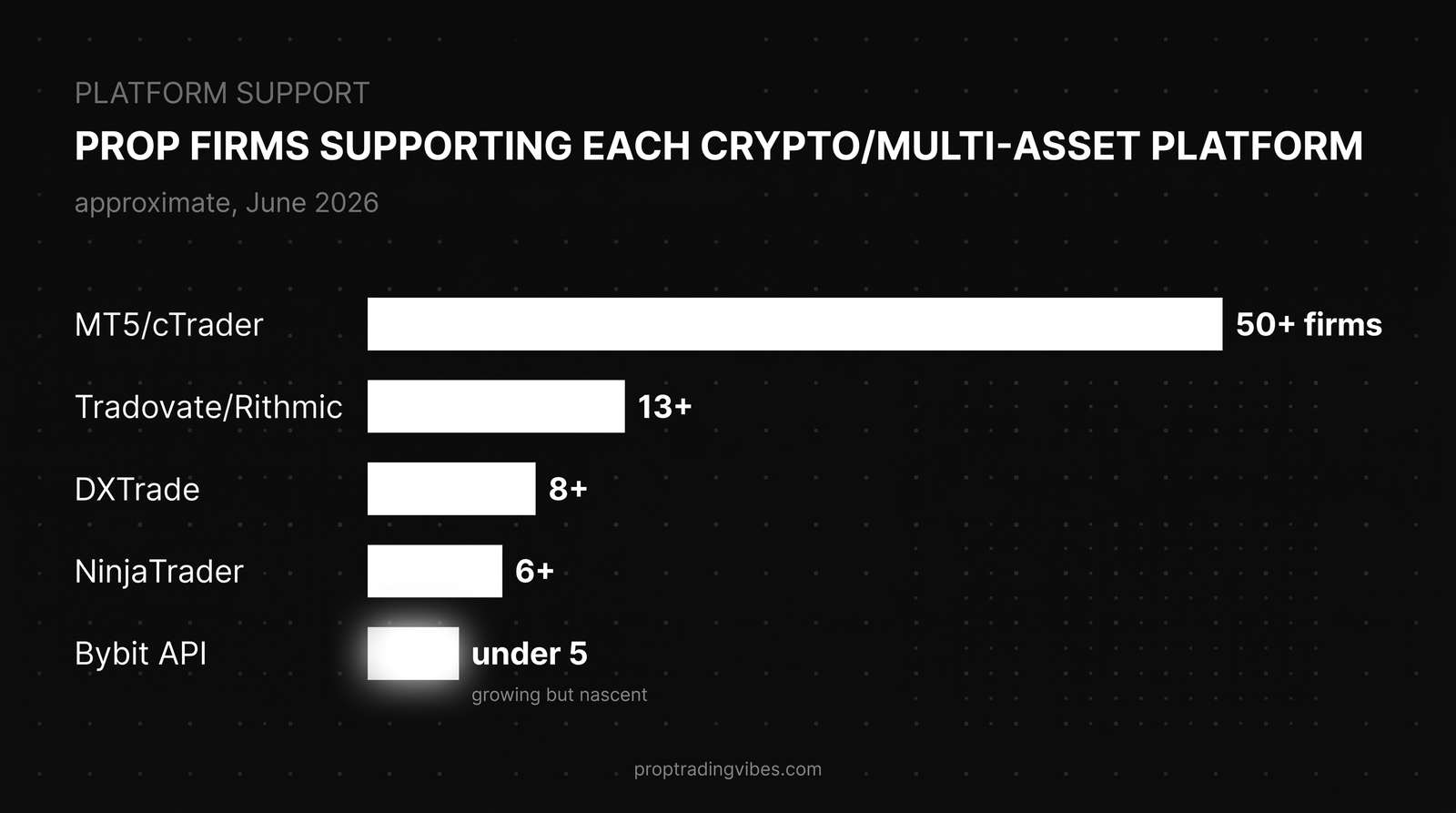
The list is short. Breakout is one of the few verified prop firms operating within this space as of June 2026. Their model includes real-exchange crypto execution alongside their broader product suite. A handful of newer firms are exploring Bybit integration, but implementation depth varies: some use it as the primary execution venue, others offer it alongside MT5/cTrader alternatives.
The model will grow. Real-exchange execution solves real problems with CFD crypto prop trading. Trader demand for transparent fills and honest spreads is there. Regulatory clarity is the main bottleneck. As frameworks around crypto prop trading solidify, more firms will commit to the exchange-API model.
For traders who want solid crypto execution today but aren't finding enough firm options, the practical alternative is trading crypto on DXTrade through an established multi-asset prop firm. You accept CFD pricing in exchange for firm diversity, larger firm track records, and the option to combine crypto with forex or indices in the same account.
Should You Trade Crypto Through a Bybit-Connected Prop Firm?
Use Bybit-based prop trading if all three conditions apply:
- You're focused primarily or exclusively on crypto.
- Execution quality (real order book, transparent fills) matters to your strategy.
- You're comfortable with the limited firm selection today.
The execution advantage is genuine. Trading Bitcoin on a real order book versus a CFD reproduction is a measurably different experience: tighter spreads, fills that don't requote at volatile moments, and the ability to see actual resting liquidity in the order book. For strategies built on order flow or microstructure, that's not a minor upgrade.
Skip Bybit-based prop trading if you need multi-asset access, want to choose from a large pool of competing firms, or aren't primarily a crypto trader. The constraints are real and they don't disappear because the execution quality is good.
The space will develop. But the best time to switch to a Bybit-based prop firm is when the firm selection is wide enough to get competitive conditions, not while the ecosystem is still establishing itself.
Frequently Asked Questions
What is Bybit in the context of prop trading?
Bybit is a major crypto exchange that certain prop firms use as their backend execution venue. Instead of trading crypto CFDs through MT5, you trade on Bybit's real exchange with live order books and genuine market liquidity. The prop firm creates a subaccount on their master Bybit account, generates API keys for your connection, and monitors your risk through their own dashboard.
How is Bybit execution different from MT5 crypto trading?
MT5 crypto trades are CFDs priced by a liquidity provider: synthetic spreads, no real order book, and fills subject to dealing desk discretion. Bybit routes your order directly into the exchange's matching engine. Your limit order fills at the price you set if the market trades through it. Spreads are the actual market spread, not a manufactured markup.
Which prop firms support Bybit API integration in 2026?
The list is short. Breakout is among the verified firms in the space. A small number of other firms have explored Bybit connections, but the ecosystem is genuinely nascent compared to MT5 or Rithmic-based futures firms. Verify directly with any firm before purchasing an evaluation whether their Bybit integration is live and what instruments it covers.
Can I trade forex or futures indices on Bybit?
No. Bybit is a crypto-only exchange. There are no forex pairs, no equity index futures, no commodity contracts. If your strategy requires multi-asset access, you need separate accounts on separate platforms for non-crypto instruments.
What leverage do Bybit-connected prop firms offer?
Bybit's retail maximum reaches 100x on BTC perpetuals, but prop firms running evaluation accounts cap this well below that, typically 5x–20x. The specific limit is set by the firm's risk management rules. Running very high leverage on a funded account with a static or EOD Trailing drawdown limit is a fast path to breach.
How do funding rates affect prop traders on Bybit?
Perpetual futures use funding rates every 8 hours to keep the contract price anchored to spot. When funding is positive, long holders pay short holders. A long BTC position held across multiple positive funding periods carries a real cost even if price stays flat. Factor funding into P&L projections for any hold longer than intraday, especially in strong trending markets where funding rates spike.
What are Bybit's trading fees for perpetual futures?
Maker fees run 0.01–0.02% and taker fees 0.04–0.06% on perpetual futures. That's significantly lower than the effective cost of trading crypto on most MT5 CFD setups, where spreads alone typically run 0.1–0.3%. For active traders, the fee gap compounds into meaningful savings over a month of normal trading volume.
What happens to my position if Bybit has an outage?
Exchange outages on Bybit are rare but have occurred. Open positions stay on the books and the matching engine queues pending orders. Your prop firm's risk monitoring system operates independently and may trigger a breach if a position moves past drawdown limits during the outage. Don't rely solely on the exchange being available for your risk management. Always use resting stop orders rather than mental stops.
Is Bybit itself a prop firm?
No. Bybit is a cryptocurrency exchange. A separate prop firm may use exchange infrastructure or provide access under its own rules.
Can traders in every country use Bybit-connected prop accounts?
No blanket answer is safe. Check both the prop firm’s country policy and the platform or provider restrictions before purchase.
The bottom line
What it actually means to trade through a Bybit-connected prop firm account in 2026, how real-exchange execution differs from MT5 crypto CFDs, the fee math, instrument access, and the small but growing list of firms using Bybit's API.
