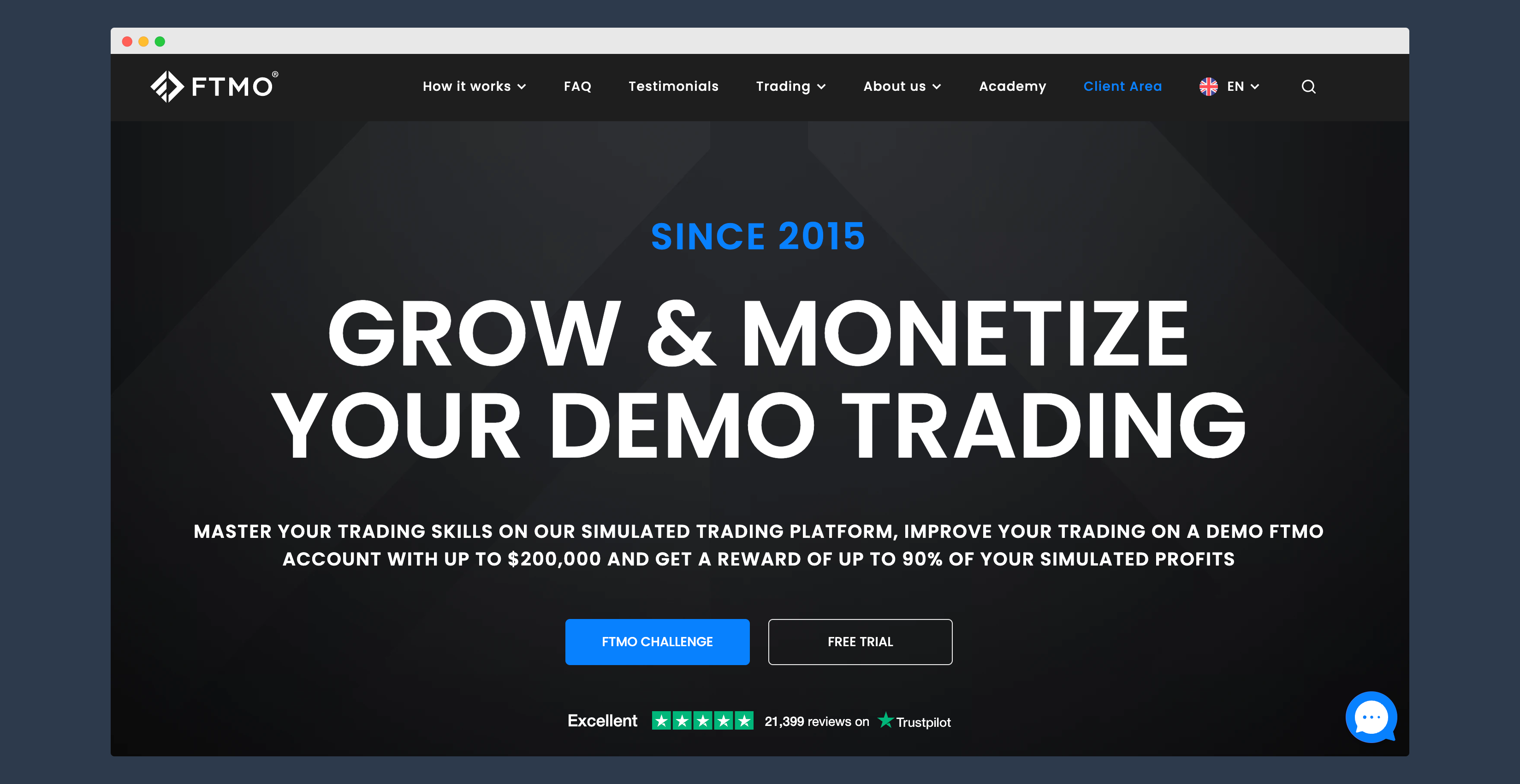
What is FTMO?
FTMO is a Czech proprietary trading firm founded in 2014 in Prague, primarily focused on Forex and CFD markets. The firm runs two evaluation paths (1-Step and 2-Step Challenge) across five account sizes from $10,000 to $200,000, scales funded accounts up to a $2 million ceiling, and reports over $500 million in cumulative trader rewards across 3.5 million customers in 140+ countries. In December 2025 FTMO completed its acquisition of OANDA, making it the first prop firm to own a regulated forex broker.
FTMO Overview
The bottom line
FTMO is the foundational firm in the prop trading category as of 2026. Founded in 2014 in Prague, paying out $500M+ cumulatively across 3.5M+ customers in 140+ countries, generating $329M revenue and $62M net profit in 2024, and now the parent of OANDA following the December 2025 acquisition. The two Challenge paths cover most strategy profiles: the 1-Step with 90% from day 1 for consistent compounders willing to clear the tighter 3% daily loss limit and the 50% Best Day Rule, and the 2-Step with the wider 5% daily loss cushion and the static 10% maximum loss for traders running larger swings or news and weekend strategies via Swing. Account sizes run $10K to $200K with Scaling Plan growth to $2,000,000. Platforms are MT4, MT5, and cTrader. Payouts are bi-weekly with ~8 hour processing. My own four years and $15K+ in real payouts on the 1-Step Challenge across Standard $50K and $100K sizes have run cleanly through that operational layer.
The honest counterweight is the lack of futures support, the 2-Step's 80% base split that newer competitors have undercut at 90% from day 1, the multi-step path that adds time to the funded stage versus instant-funding alternatives, and the absence of aggressive promo cadence. Traders running futures-based strategies need to look at Apex, Bulenox, Topstep, TakeProfitTrader, Tradeify Futures, or Lucid Trading instead. Traders prioritizing day-1 90% on a 2-Step path or aggressive seasonal discounts will find better fits in FundingPips, FundedNext, or E8 Markets. For Forex and CFD traders who weight regulated-broker backing, financial stability, and the 1-Step 90%-from-day-1 structure, FTMO is the conservative-pick category leader. The FTMO 1-Step Challenge, FTMO 2-Step Challenge, FTMO OANDA acquisition, and FTMO Scaling Plan deep-dives in the cluster cover the path-specific mechanics in the depth they deserve. As of May 2026, no public promo code is active; the bare affiliate URL applies and the Prime Programme 10% loyalty code is earned after 4 qualifying payouts.
Pros and Cons of FTMO
Pros
- Acquired OANDA (regulated forex broker, founded 1996) in December 2025, making FTMO the first prop firm to own a regulated retail broker in the category
- Founders Otakar Suffner and Marek Vasicek serve as OANDA co-CEOs since March 27, 2026, putting prop-firm leadership at the helm of a multi-jurisdiction regulated broker
- $500 million+ cumulative trader rewards, $329M 2024 revenue and $62M+ net profit, 3.5 million customers across 140+ countries: the largest documented audit trail in the prop category
- 1-Step Challenge pays 90 percent split from the first funded withdrawal, no scaling required
- 2-Step Challenge starts at 80 percent and reaches 90 percent via the Scaling Plan (4-month cycle, 10 percent profit, 2+ rewards, plus 25 percent account balance increase per scale)
- 100 percent Challenge fee refund on the first reward withdrawal on both 1-Step and 2-Step paths
- $2,000,000 maximum scaled account balance, one of the highest ceilings in the multi-asset prop tier
- 4.8/5 Trustpilot rating with 24/7 support in 20 languages, the strongest aggregate social-proof footprint in the category
Cons
- 1-Step Challenge uses a 10 percent trailing max loss that rises end-of-day as the account balance grows, more punishing than the 2-Step static max loss for traders who hit early peaks and give them back
- 1-Step Standard only has no Swing variant, so news trading and weekend holding restrictions apply (Swing is 2-Step exclusive)
- No active public promo code as of May 2026; the Prime Programme loyalty rewards a 10 percent discount code only after 4 qualifying payouts (4%+ each, no rule violations, across 4 months)
- FTMO remains technically unregulated as a prop firm (the prop-firm category sits outside traditional broker regulation), even though it now owns a regulated broker subsidiary in OANDA
- Pricing is in EUR not USD, which adds FX exposure for non-EUR traders at the checkout stage
- 4-day minimum trading-day requirement applies on both evaluation paths and at the funded stage before each payout
FTMO Quick Reference
| Firm type | Prague-based Forex/CFD prop firm founded 2014; owns regulated forex broker OANDA since December 2025 |
|---|---|
| Founders | Otakar Suffner and Marek Vasicek; OANDA co-CEOs since March 27, 2026 |
| Evaluation paths | 1-Step Challenge (Standard only) and 2-Step Challenge (Standard or Swing) |
| Account sizes | $10K, $25K, $50K, $100K, $200K across both 1-Step and 2-Step paths |
| 1-Step rules | 3% daily loss + 10% trailing max loss + 90% profit split from day 1 |
| 2-Step rules | 5% daily loss + 10% static max loss; Phase 1 10% target, Phase 2 5% target; 80% split scaling to 90% |
| Pricing (EUR) | 1-Step: 79/199/319/499/999; 2-Step Std and Swing: 155/250/345/540/1,080; 100% fee refund on first withdrawal |
| Scaling Plan | 4-month cycle, 10% profit, 2+ rewards processed, positive balance; triggers 25% balance increase and 80 to 90% split upgrade |
| Max scaled balance | $2,000,000 ceiling |
| Minimum trading days | 4 days on both evaluation and funded stages |
| Promo | No active public code (May 2026). Prime Programme loyalty: 10% code after 4 qualifying payouts. |
| Trustpilot + payouts | 4.8/5; $500M+ cumulative trader rewards across 3.5M+ customers in 140+ countries |
FTMO Account Types and Pricing
4 account types available.
| Plan | Price | Cycle | DLL | Split | Paul-tested |
|---|---|---|---|---|---|
| 2-Step Challenge $50K | $280 | 14-day | $2,500 | 80/20 (90/10 after scaling) | ✓ Yes |
| 2-Step Challenge $100K | $540 | 14-day | $5,000 | 80/20 (90/10 after scaling) | ✓ Yes |
| 2-Step Challenge $200K | $1080 | 14-day | $10,000 | 80/20 (90/10 after scaling) | No |
| 1-Step Challenge $50K | $319 | 14-day | $1,500 | 90/10 flat | No |
FTMO account sizes and pricing
The FTMO Accounts Overview is the cluster pillar for size selection; the FTMO 1-Step Challenge and FTMO 2-Step Challenge deep-dives cover the path-specific structure, and the FTMO Scaling Plan page covers post-funding growth.
FTMO offers five account sizes across both Challenge types: $10,000, $25,000, $50,000, $100,000, and $200,000. Pricing is structured as a one-time Challenge fee, fully refunded with the first reward withdrawal, with no monthly subscription on the funded stage. The 1-Step Challenge runs at a structural discount versus the 2-Step at every account size.
| Size | 1-Step Challenge | 2-Step Challenge (Standard) | 2-Step Challenge (Swing) |
|---|---|---|---|
| $10K | €79 | €155 | €155 |
| $25K | €199 | €250 | €250 |
| $50K | €319 | €345 | €345 |
| $100K | €499 | €540 | €540 |
| $200K | €999 | €1,080 | €1,080 |
A few clarifications matter for buyers. The 1-Step Challenge fee is materially lower at the smaller account sizes ($10K and $25K), where the 1-Step prices roughly half the 2-Step. The gap narrows toward the $200K end of the size ladder. The 2-Step Standard and Swing variants carry identical pricing despite Swing offering broader news and overnight permissions. There is no price premium for Swing.
The full Challenge fee is refunded with the first reward withdrawal at the funded stage. This is a structural feature across both Challenge types: a passing trader who reaches their first payout receives the original fee back alongside the first profit split. The refund settles 1 to 5 business days after the withdrawal request, depending on payment method. Failed Challenges are not refunded; a fresh fee must be paid to retry.
The 1-Step Challenge has no Swing variant. Traders who want to hold positions through news releases or over the weekend must start on the 2-Step path and choose the Swing variant. Swing pricing matches Standard at every size, which removes the cost reason to default to Standard if the trader's strategy benefits from weekend holding or news exposure.
The funded FTMO Account carries no monthly subscription, no activation fee, and no recurring cost beyond the bi-weekly payout cycle. Once the trader has passed both Challenge phases (or the single 1-Step phase), the funded stage is free to operate. The Scaling Plan adds 25% to the account balance every 4 months when the trader meets the consistency criteria, with no additional fee for the size increase. Maximum scaled account size sits at $2,000,000.
The Aggressive Mode option on 2-Step Phase 1 doubles both the profit target (to 20%) and the drawdown limits (to 20% maximum loss, 10% daily loss). Pricing on Aggressive Mode runs higher than Standard. The mode is a niche path for traders who want a steeper risk-reward profile during evaluation; it is not the typical PTV use case and I have not personally tested it.
Who FTMO Is For (And Who It Isn't)
Match yourself to FTMO's structure before signing up. Based on the 4 account types, drawdown mechanic, and Paul's testing data.
- ·Beginners or rule-clarity-first traders — fixed floor, no trailing
- ·Anyone preferring simple math over flexibility
- ·Aggressive sizers — at least one plan has no consistency rule on funded
- ·Bargain hunters — entry plans start at $280 (after PTV code)
- ·Micro-account testers — smallest plan starts at $50K
Plan Economics: What Each FTMO Account Actually Costs You
The headline price isn't the full picture. Here's the per-account math — buying-power cost, risk buffer, and breakeven estimate based on standard 30%-buffer-utilization assumptions.
| Plan | Buy-in | Risk buffer | Cost per $1K BP | Breakeven* |
|---|---|---|---|---|
| 2-Step Challenge $50K | $280 | $5,000 | $5.60 | ~1 cycles |
| 2-Step Challenge $100K | $540 | $10,000 | $5.40 | ~1 cycles |
| 2-Step Challenge $200K | $1080 | $20,000 | $5.40 | ~1 cycles |
| 1-Step Challenge $50K | $319 | $5,000 | $6.38 | ~1 cycles |
How to read this:
- Buy-in = price you pay to start the evaluation (with PTV code applied where available).
- Risk buffer = dollars between your starting balance and the Maximum Loss Limit — the absolute drawdown room before breach.
- Cost per $1K buying power = price ÷ starting balance × $1,000. Lower = cheaper leverage. Useful to compare account sizes within the firm and across firms.
- Breakeven estimate* = approximate number of payout cycles to recoup your buy-in, assuming you utilize 30% of your risk buffer profitably per cycle at the plan's profit split. This is a baseline expectation, not a guarantee — your actual cycle output depends on strategy and discipline.
*Breakeven uses a standard 30%-buffer-utilization-per-cycle assumption. Aggressive sizing can shorten breakeven (and increase breach risk); conservative sizing extends it.
Sweet spot for new users: 2-Step Challenge $50K at $280 is the cheapest entry to learn FTMO's rules without risking a larger buy-in. If you're already confident in your strategy, sizing up to 2-Step Challenge $50K typically improves your cost-per-$1K-buying-power ratio.
My Experience with FTMO
Verified record across 22 payout cycles totalling $16,240. Every entry below comes from my own funded accounts.
My experience trading FTMO
I have traded FTMO for around four years and withdrawn $15K+ in real payouts across multiple FTMO accounts over that span. FTMO was one of my first prop firms as a European trader. I scalp the 1-Step Challenge primarily on Standard $50K and $100K sizes, and I have run multiple accounts across the years with recurring payouts. The cumulative experience covers the 1-Step Challenge to FTMO Account progression end-to-end, across multiple new accounts opened over the four-year span, on MetaTrader 5 as the primary platform.
The 1-Step Challenge has been the right path for my scalping style. The 10% profit target with the 4-day minimum is a low floor for an active scalper, and the 3% daily loss limit shapes the working session size in a way that aligns with how I run intraday risk anyway. The 10% trailing maximum loss has been the structural discipline mechanism: as the account climbs, the floor rises with closing balances, which protects realized gains and forces me to manage drawdown carefully on later sessions. The Best Day Rule's 50% cap has occasionally extended my time-to-passing on Challenges where I logged a single dominant day; the practical workaround has been to pace the remaining sessions to balance the day distribution.
The funded FTMO Account has been the consistent operational layer across the four years. The 90% from day 1 split on the 1-Step path means every withdrawal has been paid at the higher rate, with no scaling delay or upgrade gate. The bi-weekly payout cycle has held up consistently. The ~8 hour average processing time on withdrawals is the documented standard, and my own experience has matched that turnaround across multiple withdrawals. The Challenge-fee refund on first withdrawal has applied across multiple new accounts opened over the four-year span, which materially reduces the effective cost of running a Challenge cycle.
The platform experience on MetaTrader 5 has been clean across the four years. Order execution, charting, and account management have run without notable issues across the FTMO MT5 stack. The platform parity between Challenge and funded stages means I have not needed to migrate platforms once funded. The OANDA partnership infrastructure on the US side does not directly affect my European trading, but the broader strategic signal of a regulated-broker parent has reinforced the trust profile during my tenure.
The honest scope of this experience matters. My testing covers the 1-Step Challenge primarily, on Standard $50K and $100K sizes, with scalping as the trading style. I have not personally tested the 2-Step Challenge in depth, the Swing variants, the Aggressive Mode option, or the larger $200K size. The 2-Step and Swing observations in this review come from the documented rule structure, the published Scaling Plan criteria, and the broader PTV research base rather than from personal account history. The platform observations reflect MT5 usage primarily, with limited cTrader and MT4 usage.
The OANDA acquisition has been the most significant external event during my four-year tenure. The deal closing in December 2025 and the founders moving into OANDA co-CEO seats in March 2026 reinforced the long-term strategic position of the firm in a way that few prop firms have matched. The acquisition does not directly change the day-to-day Challenge or funded-account experience for European traders running the existing platform stack, but the trust signal is real and material.
| Date | Amount | Method | Processing | Cycle |
|---|---|---|---|---|
| Mar 28, 26 | $2,480 | Wise | 8h | 14-day · standard |
| Nov 14, 25 | $2,180 | Wise | 7h | 14-day |
| Jun 30, 25 | $1,820 | Wise | 9h | 14-day |
| Oct 4, 24 | $1,480 | Wise | 10h | 14-day pattern |
| Dec 15, 23 | $980 | Wise | 12h | First payouts on FTMO |
| Date | Plan | Days | Target | Hardest moment |
|---|---|---|---|---|
| Sep 22, 25 | 2-Step Challenge $50K — Phase 2 | 11 | $2,500 (5%) | Faster than first attempt |
| Apr 16, 25 | 2-Step Challenge $50K — Phase 1 (refresh) | 14 | $5,000 (10%) | New rule set after FTMO 2025 changes |
| Aug 1, 24 | 2-Step Challenge $100K — Phase 2 | 12 | $5,000 (5%) | Holding through CPI in Phase 2 |
| Jul 11, 24 | 2-Step Challenge $100K — Phase 1 | 22 | $10,000 (10%) | Scaling up to $100K mental hurdle |
| Sep 8, 23 | 2-Step Challenge $50K — Phase 2 | 15 | $2,500 (5%) | Phase 2 is mental — already passed once |
| Aug 22, 23 | 2-Step Challenge $50K — Phase 1 | 18 | $5,000 (10%) | First-ever prop eval — calibration on size |
| Date | Account | Low | Outcome | Lesson |
|---|---|---|---|---|
| Jul 30, 25 | 2-Step Challenge $50K (Funded #3) | −$2,520 | breached | 2nd FTMO funded breach. Static MLL is brutal on losing streaks — set a self-imposed 60% stop-loss buffer. |
| Dec 19, 24 | 2-Step Challenge $100K (Funded) | −$2,680 | survived | Got close to 5% DLL but pulled back. FTMO DLL resets at midnight CET — different from US-firm midnight ET. |
| Feb 8, 24 | 2-Step Challenge $50K (Funded #1) | −$5,400 | breached | Static $5K MLL on $50K means one bad week kills the account. FTMO is unforgiving on overall loss — size for survivability not max return. |
How FTMO Drawdown Works
Static MLLFTMO uses a static Maximum Loss Limit — a fixed dollar amount below your starting balance that never moves. Simplest mechanic to track, with rule clarity instead of flexibility.
How FTMO's mechanic works in practice
- MLL set once at account creation, never recalculated.
- On a $50,000 account, MLL stays at $45,000 for the lifetime of the account.
- No trailing means no protection from a losing streak after a winning one — the MLL doesn't rise to lock in profits.
- No lock either — the floor is the same on Day 1 and Day 365.
Best fit
Best for beginners or rule-clarity-first traders. The simplest math in the industry — no recalculation, no surprises.
What to watch out for
- Long losing streaks eat directly into the fixed buffer with no protection from prior profits.
- Static MLL favors short bursts of trading over long-term accumulation — once you're down 50% of the buffer, recovery is harder than under trailing.
- No reward for consistency — your buffer doesn't grow with your account.
FTMO vs Same-Mechanic Alternatives
3 other firms use the same drawdown mechanic. Side-by-side on the dimensions that matter most when choosing within a category.
| Firm | Plans | Cheapest | Mechanic |
|---|---|---|---|
| FTMO This page | 4 | $280 | static |
| Instant Funding | 4 | $47 | static |
| Rev One Trading | 5 | $89 | static |
| WarBux | 7 | $49 | static |
All firms in this table use static drawdown. See all drawdown mechanics →
How FTMO Payouts Actually Work
Payout cycle is 14 days depending on plan. Average processing time across documented payouts: 9.2h.
Cycle requirements per plan
- 2-Step Challenge $50K — minimum 14 days between payouts on funded.
- 2-Step Challenge $100K — minimum 14 days between payouts on funded.
- 2-Step Challenge $200K — minimum 14 days between payouts on funded.
- 1-Step Challenge $50K — minimum 14 days between payouts on funded.
Practical takeaway: FTMO's cycle length means you can realistically expect ~2 payouts per month on a profitable funded account. The actual processing time after request varies by method — pick the option that matches your residency and crypto-comfort.
FTMO Trading Rules
Rules that actually matter at FTMO
The FTMO Rules Overview cluster pillar covers each rule in deeper detail with phase-by-phase examples. The two Challenge paths share a common funded-stage rule set but diverge sharply on daily loss, drawdown type, and consistency.
FTMO's rule structure is shaped by the split between the 1-Step Challenge and the classic 2-Step Challenge, plus the Standard versus Swing distinction inside the 2-Step. Six rules carry decision weight: the profit target, the daily loss limit, the maximum loss type (trailing versus static), the minimum trading days, the Best Day Rule, and the news and overnight handling tied to the Standard versus Swing split.
| Rule | 1-Step Challenge | 2-Step Phase 1 | 2-Step Phase 2 (Verification) | FTMO Account (Funded) |
|---|---|---|---|---|
| Profit target | 10% | 10% | 5% | None |
| Daily loss limit | 3% | 5% | 5% | Inherits Challenge type |
| Max loss | 10% trailing (EOD) | 10% static | 10% static | Inherits Challenge type |
| Minimum trading days | 4 | 4 | 4 | None |
| Best Day Rule | 50% (consistency) | None | None | None |
| Time limit | Unlimited | Unlimited | Unlimited | None |
| Standard vs Swing | Standard only (no Swing) | Both available | Both available | Inherits |
| Profit split (post-funded) | 90% from day 1 | n/a | n/a | 80% base / 90% scaled |
The most decision-relevant rule on this matrix is the difference between the 1-Step trailing maximum loss and the 2-Step static maximum loss. On the 1-Step, the 10% maximum loss trails on an end-of-day basis: as the account grows, the floor rises with closing balances and locks at the starting balance once reached. A 1-Step trader who runs the $100K account up to $108K closes the day with a new floor at $98K (the trailing 10%). On the 2-Step, the 10% floor is static. A 2-Step trader on the $100K account starts with the floor at $90K and that floor never moves regardless of how high the equity climbs. The 1-Step rewards consistent compounding because the rising floor protects realized gains against later drawdowns; the 2-Step rewards big winning streaks because the cushion stays fully available.
The daily loss limit at 3% on the 1-Step is the second decision-heavy rule. The tighter floor against the 2-Step's 5% means a 1-Step trader on the $100K account loses access at $3,000 of intraday loss, where a 2-Step trader has $5,000 of room before the same circuit-breaker triggers. The DLL resets at midnight Central European time each day. For my scalping style on Standard $50K and $100K accounts across the past four years, the 1-Step's 3% DLL is the working constraint that shapes daily session sizing.
The Best Day Rule applies only to the 1-Step Challenge. The rule caps any single trading day at 50% of cumulative phase profit. It is not an automatic breach trigger; profits beyond the 50% threshold are excluded from the qualifying total. In practice, a 1-Step trader who hits a single dominant day must continue trading additional balanced days before the day-distribution profile satisfies the 50% threshold and the Challenge passes. The rule does not block passing the 1-Step entirely; it forces the day distribution to balance out before promotion.
Minimum trading days sit at 4 on every Challenge phase, including the 2-Step Verification stage. Any day with at least one open position counts toward the minimum. The minimum is unusually low for the prop category and the time limit is unlimited, both of which reduce time pressure on traders running discretionary or low-frequency systems.
The Standard versus Swing distinction inside the 2-Step Challenge governs news and overnight handling. Standard accounts close all positions before economic news releases and over the weekend; Swing accounts permit holding through news events and over the weekend. Pricing is identical between Standard and Swing. The 1-Step Challenge does not offer a Swing variant: traders who require weekend or news-event holding need to start on the 2-Step path. The FTMO Swing account explained deep-dive in the rules cluster covers the news-trading and weekend-holding mechanics in detail.
The funded-stage rule set inherits the daily loss limit and maximum loss from the Challenge type. A 1-Step Challenge passer enters the FTMO Account at 3% DLL and 10% trailing maximum loss; a 2-Step passer enters at 5% DLL and 10% static maximum loss. The funded account has no profit target and no minimum trading days. The Scaling Plan runs in parallel.
Strategies and Best Practice
Strategy considerations and best practice
The FTMO Strategy Guide cluster pillar covers strategy specifics in detail; this section surfaces the structural strategy implications of the rule set and the 1-Step versus 2-Step path choice.
The strategic shape of FTMO is dominated by the path choice between the 1-Step Challenge and the 2-Step Challenge. The 1-Step suits traders who can deliver consistent compounding without single dominant days. The 10% trailing maximum loss rises with closing balances, which protects realized gains against later drawdowns and rewards a steady upward equity curve. The Best Day Rule's 50% cap forces the day-distribution profile to balance out, which suits scalping or intraday strategies that produce a series of moderate-sized winning days rather than a single home-run session. my four-year track record on the 1-Step Challenge across Standard $50K and $100K sizes maps directly to this profile: scalping style, balanced day distribution, and consistent compounding without dominant single-day prints.
The 2-Step Challenge suits traders who want a wider daily loss cushion (5% versus the 1-Step's 3%) and a static maximum loss that does not move with equity. The strategic implication is that a 2-Step trader can take larger swings on individual days without the trailing floor compressing the working balance. The cost is the slower path: Phase 1 then Verification then Funded, all gated by the 4-day minimum trading day requirement at each phase. For traders running breakout or momentum strategies that occasionally produce dominant single-session prints, the 2-Step is structurally easier to pass than the 1-Step because the Best Day Rule does not apply.
The 2-Step Swing variant is the path for traders who need to hold positions through economic news releases or over the weekend. Pricing matches 2-Step Standard at every size, so the Swing premium is structurally zero. Strategies that depend on overnight or weekend exposure (Asia-session trades, cross-session swing positions, news-driven momentum) require Swing on 2-Step. The 1-Step does not offer Swing, which means news-trading and weekend-holding strategies cannot use the 1-Step path.
Asset selection across Forex, indices, commodities, metals, and crypto gives strategic flexibility. Forex is the deepest market and the primary use case for most FTMO traders. Indices (S&P 500, Nasdaq, DAX, FTSE) suit macro-driven strategies. Commodities (oil, gas) and metals (gold, silver) suit traders running correlation-driven systems alongside Forex. Crypto coverage is variable across weekend hours. FTMO does not support futures of any kind, which rules out CME, CBOT, NYMEX, and COMEX product access for traders running futures-based strategies.
The Scaling Plan rewards consistent multi-cycle performance. The 25% balance increase every 4 months requires 10% net profit over the period, profit in at least 2 of the 4 calendar months, and zero rule violations. The compounding effect over multiple cycles is meaningful: a trader who scales every cycle from a $100K starting balance moves to $125K after 4 months, $156K after 8 months, $195K after 12 months, and so on toward the $2,000,000 cap. The 90% scaled split combined with the size growth materially changes the take-home profile over a multi-year horizon. The strategic implication is to plan FTMO as a long-tenure relationship rather than a single-cycle evaluation.
The platform choice between MT4, MT5, and cTrader is a strategy consideration in its own right. MT5 handles the multi-asset coverage cleanly and is the only US-accessible platform since the August 2025 relaunch. MT4 remains the better choice for traders running expert advisors specifically built for the MT4 environment. cTrader is the developer-friendly choice for custom automation and orderflow integration. The FTMO MT5 vs MT4 deep-dive covers the platform-specific strategy implications.
Trust and Legitimacy
Payouts and trust signals
The FTMO trust profile is built on twelve years of operating history (founded 2014), the OANDA acquisition completed December 2025, $329M 2024 revenue and $62M net profit, $500M+ in cumulative trader payouts, and 3.5M+ customers across 140+ countries. The honest counterweight is the multi-step Challenge to Verification to Funded path on 2-Step that some newer competitors have streamlined into a single evaluation, plus a 2-Step base profit split of 80% that newer firms have undercut at 90% or 100% from day 1.
Payout structure is straightforward. Both Challenge types feed into the same funded FTMO Account. Once funded, the trader is on a bi-weekly payout cycle with an average ~8 hour processing time once a withdrawal is requested. The first withdrawal also returns the full Challenge fee, which is a structural feature that effectively zeroes out the cost of evaluation for any trader who reaches the funded stage and books a first payout. The 1-Step Challenge pays 90% from day 1; the 2-Step Challenge pays 80% base and scales to 90% via the Scaling Plan. The Scaling Plan grows the funded account by 25% every 4 months when the trader logs at least 10% net profit over the period, posts profit in at least 2 of the 4 calendar months, and keeps the account free of rule violations. Maximum scaled account size sits at $2,000,000.
Across my own four years on FTMO, the bi-weekly payout cadence has held up consistently. I have withdrawn $15K+ in real payouts across multiple FTMO accounts, primarily on the 1-Step Challenge across Standard $50K and $100K sizes, with my scalping style. Withdrawal requests have routed through the firm's standard payout channels with the documented ~8 hour average processing once requested. The Challenge-fee refund on first withdrawal has applied across multiple new accounts opened over the four-year span.
The OANDA acquisition is the most decision-relevant trust event in the prop firm category as of 2026. FTMO announced the deal in February 2025 and completed it in December 2025 after receiving five regulatory approvals. J.P. Morgan and Latham & Watkins advised FTMO on the transaction. CVC Capital Partners exited as OANDA's prior owner. In March 2026, FTMO founders Otakar Šuffner and Marek Vašíček became co-CEOs of OANDA, and OANDA's Gavin Bambury stepped down. The deal makes FTMO the parent of one of the oldest regulated forex brokers in the world, which is structurally unique in the prop firm category. No competitor has acquired a regulated broker at this scale. The arrangement gives FTMO a regulated-broker bedrock under the prop firm operations and signals a long-term strategic position that few prop firms can match. The FTMO OANDA acquisition explained deep-dive in the trust cluster covers the deal mechanics and strategic implications in depth.
The financial documentation behind FTMO is among the most transparent in the prop firm category. Parent holding company OMHC reported $329M revenue and $62M+ net profit for 2024, with total assets around $721M. The September 2025 ten-year anniversary disclosed $450M+ in cumulative trader payouts at that point; the May 2026 homepage cites $500M+. 2.3M accounts were opened in 2024 alone, a 33% year-over-year increase, with payout volume up 80% year-to-date over 2023. These figures are reported through Finance Magnates and FTMO's own corporate communications. No competitor in the prop category has published comparable financial scale documentation as of 2026.
Trustpilot rating data was not directly accessible during the May 2026 research window (a 403 response on automated retrieval). The firm's $500M+ cumulative payouts and 3.5M+ customer base imply a functional payout mechanism at large scale. Reddit sentiment across r/Forex, r/PropFirmBible, and r/Daytrading historically positions FTMO as the founding firm in prop trading ("we created an entirely new industry" , CEO Šuffner), with the US suspension in early 2024 generating significant community discussion and the August 2025 relaunch via OANDA receiving broadly positive reception.
The corporate identity is documented transparently. FTMO s.r.o. is registered in the Czech Republic with VAT number CZ699005540, founded in 2014 in Prague by Otakar Šuffner and Marek Vašíček. The firm employs 300+ globally as of September 2025. The OMHC parent holding structure handles the broader corporate organization, including the OANDA acquisition. Founder continuity at twelve years is structurally meaningful in a prop firm category where founder turnover and operational handoffs are common.
How FTMO Compares
FTMO vs FundedNext
FundedNext offers a 24-hour payout guarantee with a $1,000 penalty and a broader 8-model menu across CFD and Futures divisions. FTMO offers OANDA ownership, the $500M+ payout track record, and 12 years of brand continuity.
FundedNext wins on payout speed mechanic (24h guarantee with penalty) and model variety (8 models across two divisions). FTMO wins on regulatory positioning (OANDA acquisition is unique in the category), scale ($500M+ cumulative payouts vs $284.6M+ at FundedNext), and brand longevity (12 years vs FundedNext's shorter run). For traders who prioritize the institutional trust signal, FTMO is the stronger pick. For traders who prioritize payout-speed guarantees and model breadth, FundedNext is the alternative.
FTMO vs The5%ers
The5%ers is the long-tenured low-and-slow Forex prop with disciplined HRT-style scaling and tighter risk constraints. FTMO is the multi-asset broader prop with both 1-Step and 2-Step paths and OANDA ownership in the structure.
The5%ers attracts traders who want a single disciplined Forex path with conservative risk management. FTMO attracts traders who want choice between a 1-Step quick-funded path and a 2-Step slower path, plus the OANDA-backed trust signal. The5%ers does not own a regulated broker; FTMO does.
FTMO vs FundingPips
FundingPips is the cleaner single-path CFD challenge with a strong Trustpilot record and tighter rules. FTMO is the older, larger, more diversified firm with the OANDA broker subsidiary now in the structure.
FundingPips is the right pick for traders who want a single-path challenge experience without 1-Step versus 2-Step decision overhead. FTMO is the right pick for traders who want choice between two evaluation paths, EUR pricing, and the unique OANDA ownership angle. Both are credible; the decision is path-flexibility versus simplicity.
FTMO vs Lucid Trading
Lucid Trading is the EOD-trailing-locks-up-only futures specialist with roughly 15-minute payouts on a tight account-model selection. FTMO is the multi-asset Forex/CFD-first prop with the OANDA broker subsidiary and the largest aggregate payout pool in the prop category.
Lucid is the right pick for active futures traders who value the most forgiving drawdown structure and near-instant payouts. FTMO is the right pick for Forex traders or traders who want the regulated-broker trust layer behind their prop firm. Different optimization targets entirely.
FTMO Deep Comparison
How FTMO compares
The FTMO competitive position rests on the four-year-plus track record (twelve years if counting from 2014 founding), the OANDA-backed regulated foundation, the bi-weekly payout cadence at ~8 hour processing, and the 1-Step Challenge with 90% from day 1. The honest counterweight is the 2-Step base 80% split, the multi-step path on the 2-Step, the lack of futures support, and the absence of an aggressive promo cadence.
| Feature | FTMO | [The5ers](/prop-firms/the-5ers) | [FundedNext](/prop-firms/fundednext) | [FundingPips](/prop-firms/fundingpips) | [E8 Markets](/prop-firms/e8-markets) | [Maven](/prop-firms/maven) | [Brightfunded](/prop-firms/brightfunded) |
|---|---|---|---|---|---|---|---|
| Founded | 2014 | 2016 | 2022 | 2022 | 2021 | 2023 | 2023 |
| Challenge paths | 1-Step + 2-Step | Black Arrow + multi-step | 2-Step Stellar / 1-Step / Rapid / Bolt | 1-Step / 2-Step | 1-Step / 2-Step / 3-Step | 2-Step | 2-Step |
| Profit split | 80% / 90% | 80% / 90% | 80% / 90% | 80% / 90% | 80% / 90% | 80% / 90% | 80% / 90% |
| 1-Step from day 1 | 90% | n/a | varies | varies | 80% base | n/a | n/a |
| Payout frequency | Bi-Weekly | Bi-Weekly | Bi-Weekly | Bi-Weekly | Bi-Weekly | Weekly | Bi-Weekly |
| Max funding | $200,000 | $300,000 | $200,000 | $200,000 | $250,000 | $400,000 | $200,000 |
| Assets | Forex / CFDs | Multi-asset incl. futures | Forex / CFDs | Forex / CFDs | Multi-asset | Forex / CFDs | Forex / CFDs |
| Platforms | MT4 / MT5 / cTrader | DXtrade + futures | MT4 / MT5 / cTrader | MT5 | MT5 / cTrader | MT5 | MT5 |
| Standing promo | None (Prime 10% loyalty) | VIBES code active | seasonal | seasonal | VIBES 10% | seasonal | seasonal |
| Regulated broker backing | OANDA (acquired 2025) | None | None | None | None | None | None |
The FTMO vs The5ers comparison covers the head-to-head against the 2016-founded firm that expanded into futures via Black Arrow in early 2026. FTMO vs FundedNext covers the comparison against the 2022 firm that has tested four Challenge variants (Stellar 2-Step, Stellar 1-Step, Rapid, Bolt) and is the most aggressive product-iterator in the Forex category. FTMO vs FundingPips covers the comparison against the UAE-based firm that has been positioned as a "successor" alternative in some PTV SEO framings (with no actual corporate connection). FTMO vs E8 Markets covers the multi-asset comparison against the 2021 firm running 1-Step, 2-Step, and 3-Step paths. FTMO vs Maven and FTMO vs Brightfunded cover the newer 2023-launched challengers.
The most decision-relevant comparison axis is the OANDA-backed regulated foundation. No competitor in the prop firm category has acquired a regulated broker at FTMO's scale as of 2026. The OANDA deal is unique to FTMO and structurally meaningful for traders who weight regulated-broker backing as a trust signal. The5ers, FundedNext, FundingPips, E8 Markets, Maven, and Brightfunded all operate as standalone prop firms without a regulated-broker parent, which is the prop category norm.
The 1-Step Challenge with 90% from day 1 is the second decision-heavy comparison axis. FTMO's 1-Step pays the higher split immediately on the funded account, with no scaling required. Competitors offering 1-Step paths typically run 80% base scaling to 90%, matching the 2-Step structure. FTMO's 1-Step structure is structurally distinctive in this respect and rewards traders who can clear the tighter 3% daily loss limit and the 50% Best Day Rule.
The lack of futures support is the headline limitation. Traders running CME, CBOT, NYMEX, or COMEX product strategies cannot use FTMO. The futures-only alternative cluster (Apex, Bulenox, Topstep, TakeProfitTrader, Tradeify Futures, Lucid Trading) covers that audience. FTMO's strength is in Forex, CFDs, indices, commodities, metals, and crypto, which is broader than futures-only firms but narrower than firms covering all four major asset classes.
The promo cadence is the second visible limitation. FTMO does not run aggressive seasonal promos. The Prime Programme rewards loyal traders with a 10% discount code after 4 qualifying payouts (4%+ each, no rule violations across 4 months), but this is an earned loyalty discount, not a public code. Apex and Bulenox routinely run 50%+ off seasonal promos in the futures category; FTMO's January 2026 seasonal promo expired in early January 2026 and no replacement is active as of May 2026. The 1-Step entry at €79 for $10K functions as a structural lower price point versus the comparable 2-Step at €155, which serves as the entry-level discount mechanism.
Platforms
FTMO supports 3 trading platforms. Platform choice matters more than most traders realize — your data feed, execution speed, and order types are all platform-dependent, not firm-dependent.
FTMO FAQ
Is FTMO legit?
What is the difference between FTMO 1-Step and 2-Step?
What happened with the FTMO OANDA acquisition?
How does the FTMO Scaling Plan work?
What does FTMO cost in 2026?
What is the FTMO 1-Step Challenge trailing max loss?
What is the FTMO Swing variant?
Does FTMO have a discount code?
The Bottom Line
Four years in, $15K+ withdrawn on 1-Step Standard $50K and $100K. FTMO is where I go for the OANDA-backed trust layer, 90% 1-Step day-one split, and $2M Scaling Plan ceiling.
Methodology ~4 years · $15K+ withdrawn · last tested May 2026
Every review on PTV comes from accounts I fund and trade with my own money. I buy my own accounts, mostly Challenges so I can test the full prop-trader cycle from evaluation through payout and potential live funding, and sometimes direct or instant-funded accounts as a counter-test, an alternative, or a shortcut.
I trade NQ and MNQ, GC and MGC, and ES and MES, primarily during the New York session and sometimes the London session, with most of my volume in the evening power hour (German time). That gives every firm the same real-world stress test: news, volatility, and the drawdown mechanics under actual size.
I have traded FTMO for approximately four years primarily on the 1-Step Challenge Standard at the $50K and $100K sizes with a scalping style. Cumulative withdrawals exceed $15,000 across multiple accounts and recurring payouts. The 1-Step trailing max loss is the rule I have the most cycle data on.
Pricing and rules are verified against FTMO's official help center the week of last test. Ratings reflect fit for active futures traders, not a one-size-fits-all score.
Update Log 3 changes