
Table of contents
Quick Answer, Bookmap review, the short version
- • Bookmap is an order-flow trading platform whose core feature is a real-time liquidity heatmap showing resting limit orders as a color-coded map.
- • It also bundles a depth-of-market ladder (DOM), volume dots, large-trade alerts, and CVD on higher tiers.
- • As of 2026, plans run free (Digital), $19/mo (Digital Plus), and $99/mo (Global), with a top tier above that; market data is billed separately.
- • Real-time futures data through feeds like Rithmic, dxFeed, or BookmapData adds roughly $34 to $101+ per month on top of the software.
- • It's built for discretionary order-flow scalpers and short-term futures day traders, not set-and-forget swing traders.
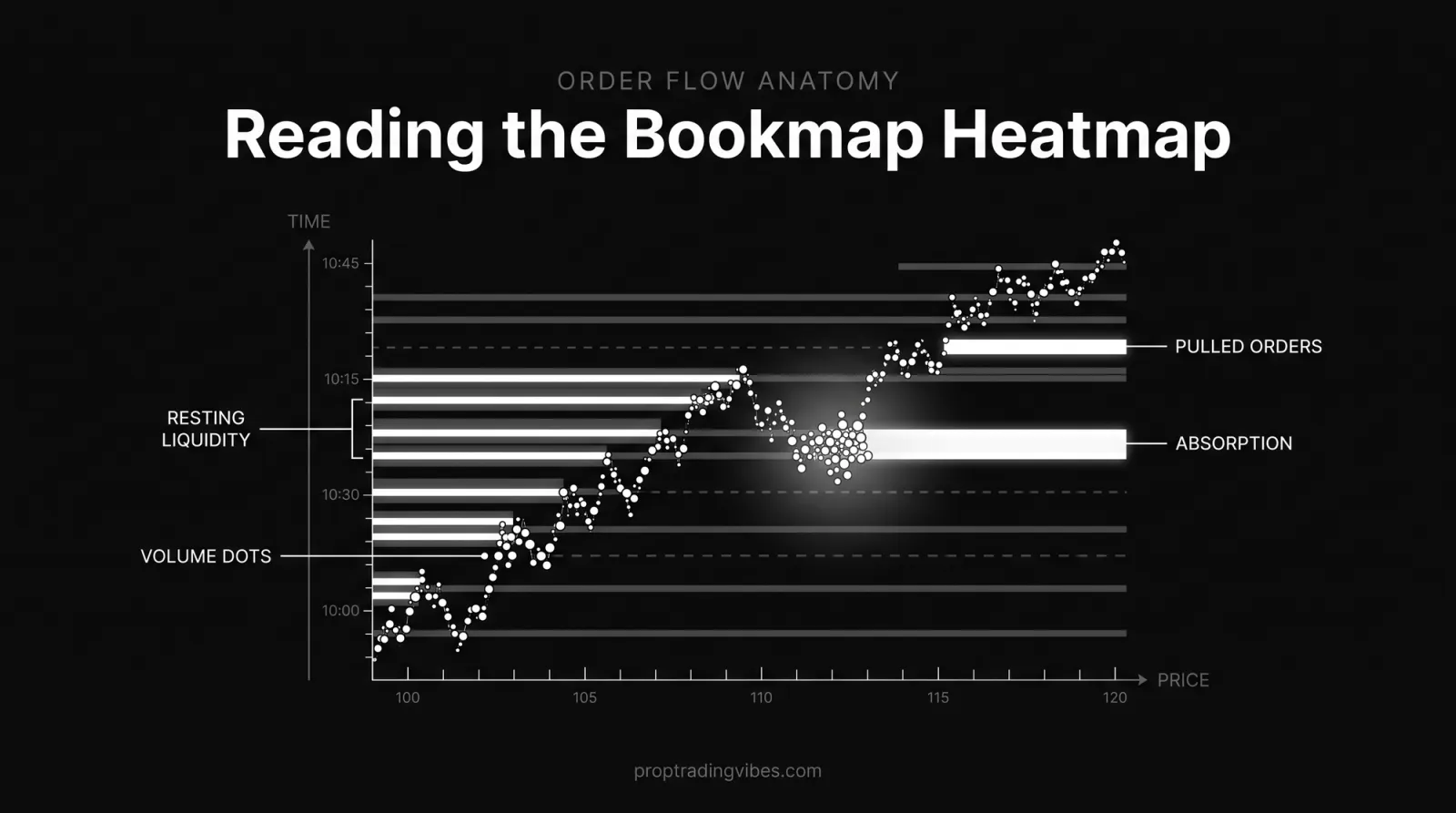
Bookmap is an order-flow trading platform built around a real-time liquidity heatmap that plots the limit order book as a color-coded map over price and time. Instead of a static chart, you watch where large resting orders sit, build, get pulled, or get absorbed, second by second. That heatmap, paired with a depth-of-market ladder and volume dots, is what traders are actually paying for.
This review is written for futures day traders deciding whether Bookmap earns a slot on the monitor. It covers what the platform does, how the heatmap and DOM create value, what it actually costs once you include data, which traders it suits, and the honest question of prop-firm compatibility. No hype, no "secret weapon" framing. Order flow is information, not a holy grail.
If you're still learning the foundations of reading executed trades and resting liquidity, start with the order flow trading guide and the best indicators for futures trading first, then come back to decide whether Bookmap fits how you trade.
What is Bookmap?
Bookmap is a market-data visualization and trading platform whose signature feature is a live order-book heatmap. Where a normal chart shows price as a line or candle, Bookmap renders the entire visible order book as a heat-colored field: bright zones mean large resting limit orders, dim zones mean thin liquidity. The map scrolls horizontally with time, so you see the history of the order book, not just a single snapshot.
That historical dimension is the core idea. A standard depth-of-market ladder tells you what the book looks like right now. Bookmap tells you what it looked like over the last several minutes and hours, which lets you spot patterns a live ladder hides.
The core modules
Bookmap bundles several order-flow tools into one screen. The main ones:
| Module | What it shows | Why traders use it |
|---|---|---|
| Heatmap | Resting limit orders as a color map over price and time | Spot large liquidity, pulled orders, absorption |
| DOM | Live bid/ask depth as a numeric ladder | Read current book pressure, place orders |
| Volume dots | Executed trade size at each price/time point | See where real trading happened, not just resting orders |
| CVD (higher tiers) | Cumulative volume delta, net aggressive buying vs selling | Gauge who controls the session |
| Large-trade alerts | Flags unusually large executions | Catch institutional-size prints in real time |
The heatmap and volume dots together answer two different questions. The heatmap shows intentions (orders waiting to trade). Volume dots show actions (orders that already traded). Reading the gap between the two is most of what order-flow trading is.
How the heatmap actually creates an edge
The value isn't "see big orders, follow big orders." Large resting orders get pulled and spoofed constantly. The edge is contextual:
- A level holds because real size keeps refreshing there, not because of a line you drew.
- Liquidity that vanishes the moment price approaches is a different signal than liquidity that sits and absorbs.
- Absorption (price grinding into resting size that doesn't break) often precedes a reversal more reliably than a candlestick pattern does.
None of this is automatic. The heatmap gives you better raw information about the book. Turning that into entries and exits is still a skill, and it pairs naturally with volume profile and the broader best indicators for day trading toolkit rather than replacing them.
How much does Bookmap cost in 2026?
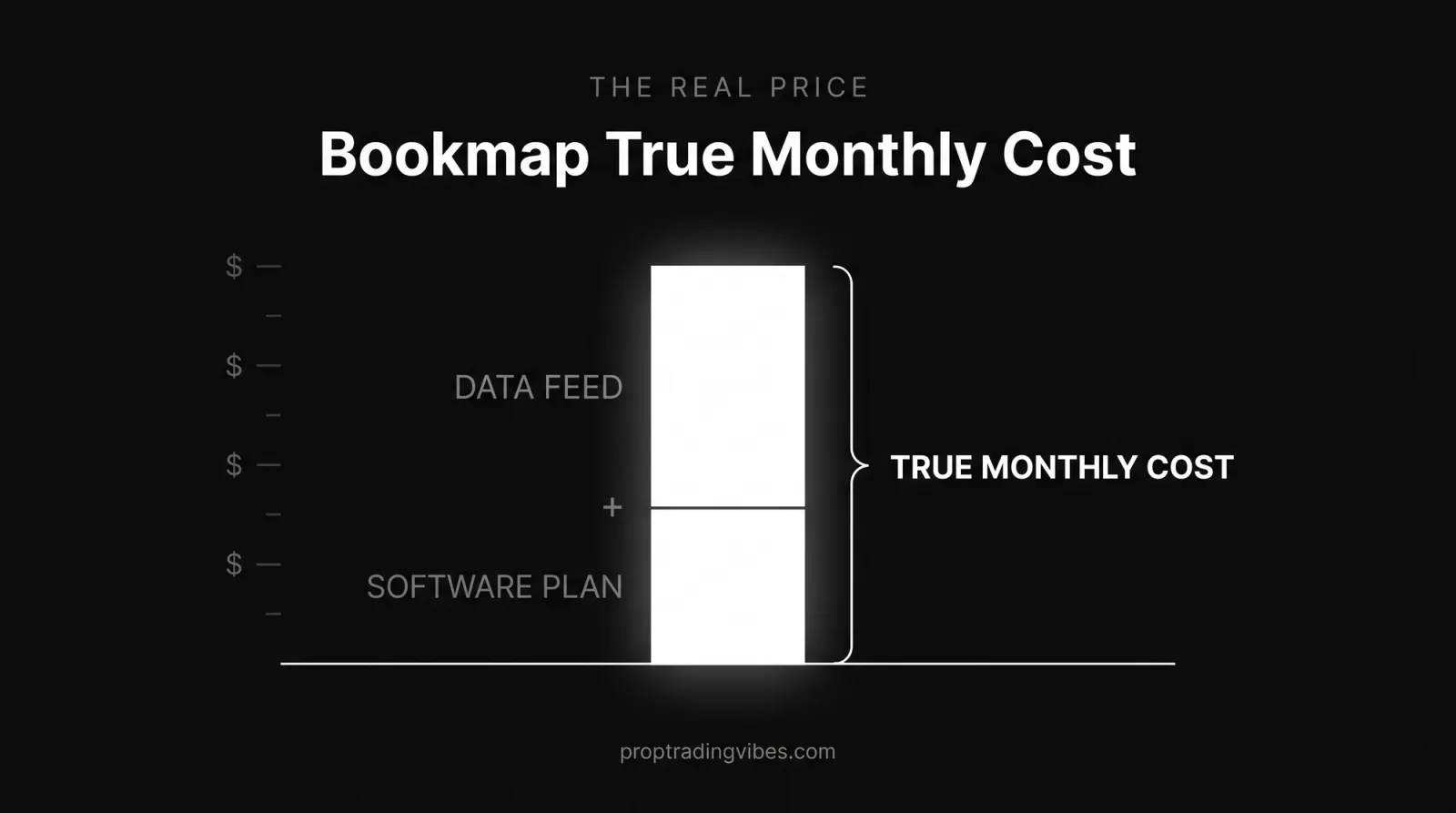
As of 2026, Bookmap's software runs on a tiered subscription, and crucially, the real-time market-data feed is billed separately on top. The software price alone understates the true monthly cost for a futures trader.
Bookmap software tiers
As of 2026, the published software plans are:
| Plan | Price (monthly) | Built for |
|---|---|---|
| Digital | Free | Delayed US data, free real-time crypto, basic features |
| Digital Plus | ~$19/mo | A few simultaneous symbols, multibook |
| Global | ~$99/mo (less billed annually) | 10 symbols, CVD, large-trade alerts, advanced add-ons, extended order book |
| Top tier (Global Plus) | Above Global | More symbols, DOM Pro, footprint, advanced execution, multi-account |
The free Digital tier is genuinely useful for learning the interface and for crypto, where real-time data is included. But for live futures, the delayed data on the free tier makes it a learning tool, not a trading tool.
The data feed is the hidden cost
Real-time futures and equities data is not included in the software price. As of 2026, the feed providers and rough monthly ranges are:
| Data feed | Approx. monthly range |
|---|---|
| BookmapData | ~$34–79/mo |
| dxFeed (futures) | ~$37/mo per exchange |
| Rithmic | ~$40–101/mo |
So a realistic futures setup is the software plan plus a feed: roughly $100/month on the Global plan once you add real-time data, and meaningfully more if you connect multiple exchanges. Crypto traders dodge this because crypto connections are free.
Budget for the data feed before you decide Bookmap is or isn't worth it. The number most people quote ("$99") is only half the bill.
What platforms and data does Bookmap support?
Bookmap is its own standalone platform rather than an indicator that bolts onto NinjaTrader or Tradovate. You run the Bookmap application and connect a data feed and broker through it.
Data and broker connectivity
Bookmap connects to several real-time data and execution providers. Futures and equities data comes through Rithmic, dxFeed, or BookmapData, and the platform includes 20+ crypto exchange connections at no extra data cost. Because many futures setups route through Rithmic, traders coming from a Rithmic-based platform often find the connection familiar.
If you're comparing standalone order-flow software against the more mainstream futures platforms, the NinjaTrader vs Sierra vs Tradovate breakdown and the Tradovate platform guide are useful context for where Bookmap sits.
Bookmap vs a plain DOM platform
The honest comparison most traders care about is Bookmap against a standard DOM:
- A plain DOM shows the current book as a live ladder of numbers. Fast, but no memory.
- Bookmap keeps that ladder and adds the historical heatmap, so you see how the book got to where it is.
- A plain DOM is cheaper or free on many platforms. Bookmap charges for the visualization layer and the order-flow add-ons.
If you already trade well off a DOM and never wish you could see the book's history, Bookmap may be a feature you don't need. If you constantly wonder "was that big bid there a minute ago or did it just appear," the heatmap is exactly what you're missing.
Who is Bookmap for, and who should skip it?
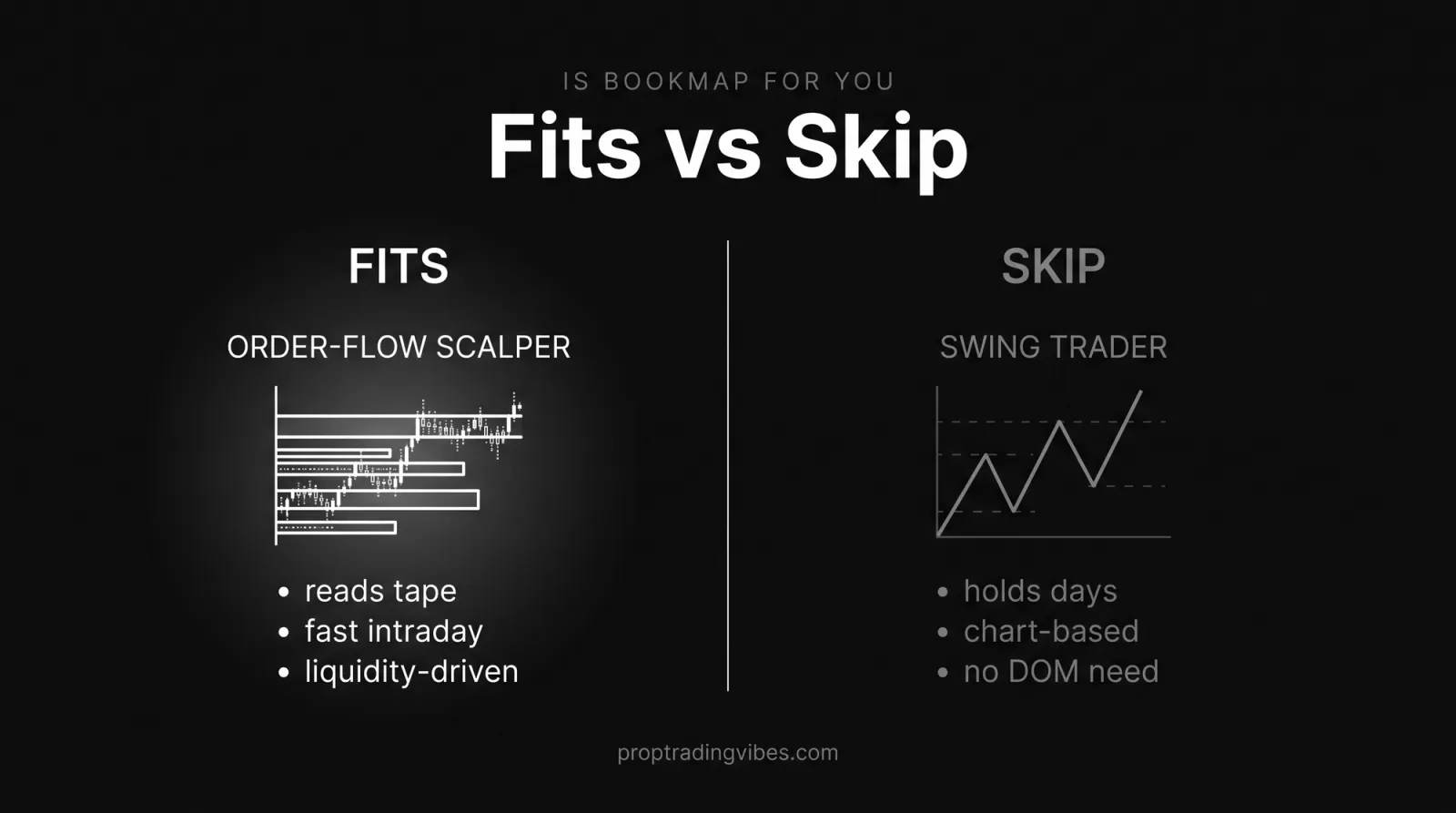
Bookmap is built for discretionary, short-term traders who make decisions from order flow. It is not a general-purpose charting platform, and treating it like one wastes the subscription.
Bookmap is a strong fit if you:
- Day trade or scalp liquid futures like the ES or NQ, where the order book is deep and the heatmap renders cleanly.
- Already understand the basics of order flow and want better raw data, not a strategy handed to you.
- Trade crypto and want to test the heatmap with free real-time data before paying for futures feeds.
- Care about absorption, liquidity, and large prints as part of your read, alongside your day trading setup.
Bookmap is a poor fit if you:
- Swing trade or position trade off higher timeframes, where microstructure doesn't drive entries.
- Are brand-new and still learning to read a basic chart or DOM. Start with futures trading for beginners first.
- Trade purely off indicators or patterns and won't actually look at the heatmap.
- Aren't ready to pay for both software and a real-time data feed.
In my own trading I lean on order-flow context mostly to avoid bad entries rather than to manufacture new ones. When I see resting size getting absorbed instead of holding a level, I stand down. That defensive use is where a heatmap earns its keep for me. The traders who get burned are the ones who expect it to print signals.
Do prop firms allow Bookmap?
Whether you can use Bookmap with a funded account depends on two things: whether the prop firm's platform list and data connection support it, and whether the firm restricts third-party data feeds. There is no single yes-or-no answer across the industry, so this is the part to verify firm by firm rather than assume.
What actually matters for compatibility
- The connection. Many futures firms route order execution through Rithmic, which Bookmap supports. If your firm uses a Rithmic connection and permits third-party front-ends, Bookmap can often sit on top.
- The firm's platform policy. Some firms only allow their named platforms (Tradovate, NinjaTrader, their proprietary web platform). Bookmap being an external app can fall outside that list.
- Data-feed rules. A firm may include data in your account or require its own feed, which affects whether you can attach Bookmap's separate data subscription.
Because policies differ and change, confirm directly with the firm before counting on Bookmap for a funded evaluation. Firms like Topstep, Apex Trader Funding, and TradeDay each publish their own supported-platform lists, and what's allowed on the evaluation can differ from what's allowed on a funded account. Don't pay for a Bookmap data feed on the assumption it'll connect, check first.
The bottom line
Bookmap is the right platform for futures and crypto day traders who genuinely trade from order flow and will use the liquidity heatmap to read resting size, absorption, and large prints in real time. For that trader, the heatmap is information you can't get from a plain chart, and the $99 Global plan plus a data feed is a reasonable cost of doing business.
Skip Bookmap if you swing trade, trade purely off indicators, or are still learning the basics, because the heatmap will sit unused while you pay for it. In that case, a free DOM and a solid grounding in the order flow trading guide and best indicators for futures trading will serve you better until your style actually demands order-flow microstructure. Bookmap rewards traders who already know what they're looking for in the book.
Frequently Asked Questions
What is Bookmap?
Bookmap is an order-flow trading platform built around a real-time liquidity heatmap that plots resting limit orders in the order book as a color-coded map over price and time. It also includes a depth-of-market ladder, volume dots, and large-trade alerts, and is used mainly by futures and crypto day traders who trade from order flow.
How much does Bookmap cost in 2026?
As of 2026, Bookmap has a free Digital tier, a Digital Plus plan around $19/month, and a Global plan around $99/month (cheaper if billed annually), plus a higher top tier. Real-time market-data feeds are billed separately and add roughly $34 to $101+ per month depending on the exchange and provider.
Is Bookmap free?
Bookmap has a free Digital tier, but it comes with delayed US stocks and futures data and a limited feature set. Real-time crypto connections are included free. To trade futures live with the heatmap, you need a paid plan plus a real-time data feed, which together usually start north of $100/month.
What is the Bookmap heatmap?
The Bookmap heatmap is a visual map of the limit order book over time. Bright zones show large resting limit orders (concentrated liquidity), and the map scrolls left as time passes so you can see where liquidity built up, got pulled, or got absorbed. It's the platform's signature feature and the main reason traders pay for it.
Is Bookmap good for futures trading?
Bookmap is well-suited to futures trading because liquid futures like the ES and NQ have a deep, centralized order book that the heatmap can render clearly. Short-term futures day traders and scalpers get the most out of it. You do need a real-time futures data feed (Rithmic, dxFeed, or BookmapData) on top of the subscription.
Does Bookmap show order flow?
Yes. Bookmap is fundamentally an order-flow tool. The heatmap shows resting liquidity, volume dots show executed trades at each price, the DOM shows current bid/ask depth, and CVD (on higher tiers) tracks net buying versus selling. Together these are the core building blocks of order-flow trading.
What data feeds does Bookmap support?
Bookmap connects to several market-data providers for real-time futures and equities data, including Rithmic, dxFeed, and its own BookmapData feed, plus 20+ crypto exchange connections that are included for free. The data subscription is separate from and on top of the software plan.
Bookmap vs DOM trading platforms, what's the difference?
A standard DOM platform shows you the current order book as a ladder of numbers that changes in real time. Bookmap keeps that ladder but adds a historical heatmap, so you see not just the order book right now but how liquidity evolved over the last minutes and hours. That history is the main edge Bookmap offers over a plain DOM.
Who should not use Bookmap?
Swing traders, position traders, and anyone trading off higher-timeframe charts get little from Bookmap, because order-flow microstructure doesn't drive their decisions. Brand-new traders who haven't learned to read a chart or a DOM yet will also find it overwhelming. Bookmap rewards traders who already trade short-term and want to add order-flow context.
Do prop firms allow Bookmap?
Whether you can use Bookmap with a prop firm depends on whether the firm's platform connection supports it and whether the firm restricts data feeds. Many futures firms route through Rithmic, which Bookmap supports, but each firm sets its own platform list. Always confirm with the specific firm before assuming Bookmap will connect to your funded account.
Can you trade directly from Bookmap?
Yes, higher Bookmap tiers include order-execution features so you can place and manage trades directly from the heatmap or DOM, including advanced order tools on the top plan. The free and lowest paid tiers are oriented more toward analysis than execution, so check the tier before relying on it for live order entry.
Is Bookmap worth it for day traders?
Bookmap is worth it for futures and crypto day traders who trade from order flow and will actually use the heatmap to read liquidity, absorption, and large orders. If you trade purely off indicators or candlestick patterns, the heatmap is an expensive feature you won't lean on. The value is entirely in whether you read order flow.
What is CVD in Bookmap?
CVD stands for cumulative volume delta. In Bookmap it tracks the running difference between aggressive buying and aggressive selling, helping you see who is in control over a session. CVD is available on Bookmap's higher tiers rather than the free or entry plan, so you need at least the Global-level subscription to use it.
Does Bookmap work for crypto?
Yes. Bookmap includes 20+ crypto exchange connections at no extra data cost, which makes it a relatively low-friction way to try the heatmap on crypto order books. Many traders start on crypto precisely because the real-time data is free, then move to futures once they want to trade ES, NQ, or other contracts.
Is Bookmap a charting platform or an order-flow tool?
Bookmap is both, but it leans order-flow. You get standard charting (candles, indicators, technical-analysis add-ons on higher tiers), but the reason traders choose it over a generic charting platform is the liquidity heatmap and the order-flow toolset. If you only need charts, cheaper or free options exist.

Where to go next
The most useful next decision from this page.