
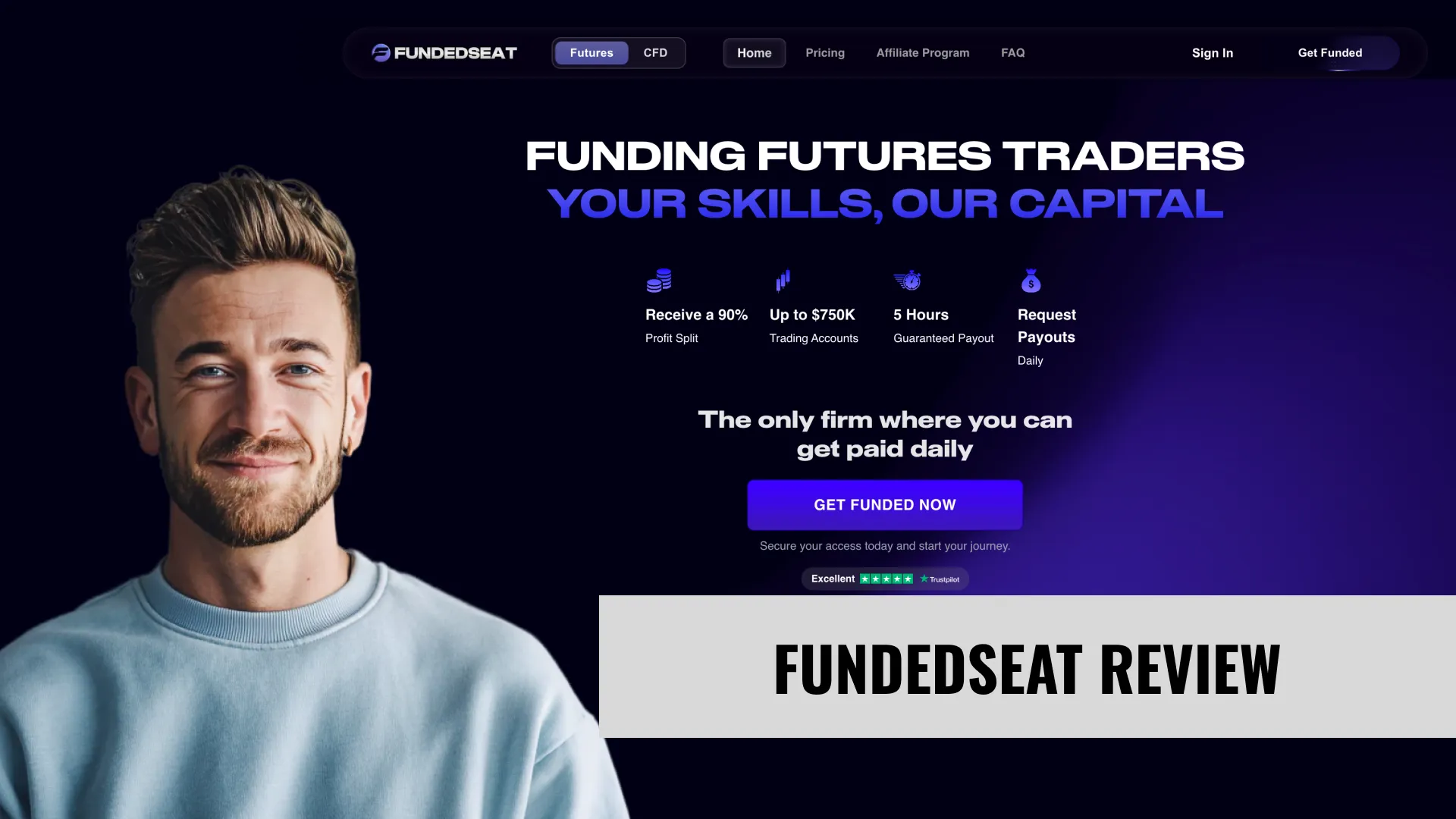

FundedSeat offers 6 futures account models from $25K to $150K with 90% profit split and daily payouts. EOD trailing drawdown, no daily loss limit in eval, and news trading allowed. Based in LA, relatively new, here's what you need to know.
- Six distinct futures models from 1-Step evaluations to instant funding — more variety than Topstep, Apex, and TakeProfitTrader combined
- EOD trailing drawdown instead of intraday on most models, meaning intraday spikes don't kill your account
- News trading explicitly allowed with zero restrictions — rare for a Rithmic-based prop firm
- Daily payouts from day 1 on most models, with 90% profit split across the board
- Path to Live program after 4 payouts — actual transition to real capital, not just a marketing gimmick
- No NinjaTrader or Tradovate support — if you're locked into that ecosystem, FundedSeat isn't an option
- Bots and EAs completely banned — algorithmic traders are out of luck
- Payout caps vary wildly between models ($500 to $5,000 per withdrawal) and the fine print is dense
- Only ~74 Trustpilot reviews as of April 2026 — limited public track record compared to firms with thousands of reviews
- No swing trading on any model — every position closes by 4:59 PM EST, which locks out overnight setups
Account Types & Pricing
6 account types available. Pricing verified May 30, 2026.
| Plan | Price (VIBES) | Cycle | DLL | Split | Paul-tested |
|---|---|---|---|---|---|
| 1-Step $50K (Evaluation) | $69.95 | — | $UNKNOWN | up to 90% | No |
| 1-Step $100K (Evaluation) | $UNKNOWN | — | $UNKNOWN | up to 90% | No |
| 1-Step $150K (Evaluation) | $174.95 | — | $UNKNOWN | up to 90% | No |
| Instant $25K | $199.95 | — | $UNKNOWN | up to 90% | No |
| Instant $50K | $UNKNOWN | — | $UNKNOWN | up to 90% | No |
| Instant $100K | $374.95 | — | $UNKNOWN | up to 90% | No |
As of April 2026, FundedSeat runs two product lines: Futures (the main business) and CFDs. I'm focusing on futures here because that's what most traders reading this care about.
The Six Futures Models
FundedSeat splits their futures offering into two categories: three 1-Step evaluation models and three instant-funded models.
1-Step evaluations require you to hit a 6% profit target while respecting drawdown limits and a 50% consistency rule. No minimum trading days.
Instant funded models skip the evaluation entirely. You start with a funded account, eligible for payouts from day 1. The trade-off is higher monthly fees and tighter payout rules.
Pricing Breakdown
| Model | Sizes | Monthly Fee | Profit Target | Drawdown | Payout Frequency |
|---|---|---|---|---|---|
| 1-Step Daily | 50K / 100K / 150K | $69.95 / $119.95 / $174.95 | 6% | EOD Trailing | Daily |
| 1-Step Edge | 50K / 100K / 150K | $69.95 / $119.95 / $174.95 | 6% | EOD Trailing | Every 3 days |
| 1-Step Rapid | 50K / 100K / 150K | $69.95 / $119.95 / $174.95 | 6% | EOD Trailing | Daily (min 3 days) |
| Instant Bolt | 25K / 50K / 100K | $199.95 / $299.95 / $374.95 | None (instant) | EOD Trailing | Daily |
| Instant Edge Payouts | 25K / 50K / 100K | $199.95 / $299.95 / $374.95 | None (instant) | EOD Trailing | Daily |
| Instant Direct | 25K / 50K / 100K | $199.95 / $299.95 / $374.95 | None (instant) | EOD Trailing | Daily |
Who Is FundedSeat Actually Built For?
Here's what I think FundedSeat is doing differently from most firms: they've structured their models around the full trader lifecycle instead of offering one product and hoping everyone fits.
Getting started? The 1-Step eval accounts start at $69.95/month ($21 with the 70% promo). That's lower than Topstep's base price and puts the barrier to entry well within reach for traders who are still building consistency.
Intermediate stage? The larger 100K and 150K eval accounts give you more room to work with — higher contract limits, bigger drawdown buffers, and meaningful payout caps once you pass.
Experienced and want to skip the evaluation? The three instant-funded models (Bolt, Edge Payouts, Direct) let you start trading a funded account from day 1 with daily payouts. Higher monthly fees ($199.95-$374.95), but zero wait time if you already know your edge works.
Most prop firms force everyone through the same funnel. FundedSeat gives you six entry points depending on where you are as a trader. That's a genuine differentiator.
Why I'd Pick the 1-Step Daily (100K)
If I were starting with FundedSeat today, I'd go with the 1-Step Daily 100K. The $119.95 monthly fee ($36 with the 70% promo) gets you a 6% profit target ($6,000), EOD trailing drawdown of $3,000, and daily payouts in the funded phase. The contract limit is 8 minis, which is plenty for ES and NQ scalping.
The 1-Step Edge has the same eval structure but restricts payouts to every 3 trading days and introduces progressive scaling in the funded phase. Unless you specifically want that scaling path, the Daily gives you more flexibility.
The CFD Side
FundedSeat also offers CFD models (1-Step, 2-Step, and Instant) covering forex, metals, indices, and crypto. Key differences from the futures side: 80% profit split (not 90%), different leverage ratios (up to 1:30 for forex), and a $300,000 max allocation. The CFD product targets a different audience — forex and crypto traders who want leverage and overnight holding. I'm not covering it in depth here because this review focuses on their core futures product.
Who FundedSeat Is For (And Who It Isn't)
Match yourself to FundedSeat's structure before signing up. Based on the 6 account types, drawdown mechanic, and Paul's testing data.
- ·Systematic traders who close cleanly each day
- ·Maximum profit-retention via trailing without lock
- ·Aggressive sizers — at least one plan has no consistency rule on funded
Plan Economics: What Each FundedSeat Account Actually Costs You
The headline price isn't the full picture. Here's the per-account math — buying-power cost, risk buffer, and breakeven estimate based on standard 30%-buffer-utilization assumptions.
| Plan | Buy-in | Risk buffer | Cost per $1K BP | Breakeven* |
|---|---|---|---|---|
| 1-Step $50K (Evaluation) | $69.95 | — | $1.40 | — |
| 1-Step $100K (Evaluation) | $UNKNOWN | — | $NaN | — |
| 1-Step $150K (Evaluation) | $174.95 | — | $1.17 | — |
| Instant $25K | $199.95 | — | $8.00 | — |
| Instant $50K | $UNKNOWN | — | $NaN | — |
| Instant $100K | $374.95 | — | $3.75 | — |
How to read this:
- Buy-in = price you pay to start the evaluation (with PTV code applied where available).
- Risk buffer = dollars between your starting balance and the Maximum Loss Limit — the absolute drawdown room before breach.
- Cost per $1K buying power = price ÷ starting balance × $1,000. Lower = cheaper leverage. Useful to compare account sizes within the firm and across firms.
- Breakeven estimate* = approximate number of payout cycles to recoup your buy-in, assuming you utilize 30% of your risk buffer profitably per cycle at the plan's profit split. This is a baseline expectation, not a guarantee — your actual cycle output depends on strategy and discipline.
*Breakeven uses a standard 30%-buffer-utilization-per-cycle assumption. Aggressive sizing can shorten breakeven (and increase breach risk); conservative sizing extends it.
Sweet spot for new users: 1-Step $50K (Evaluation) at $69.95 is the cheapest entry to learn FundedSeat's rules without risking a larger buy-in. If you're already confident in your strategy, sizing up to 1-Step $50K (Evaluation) typically improves your cost-per-$1K-buying-power ratio.
How FundedSeat Drawdown Works
EOD · Trails upFundedSeat uses end-of-day trailing drawdown that follows your highest EOD equity forever. The MLL never locks — it keeps moving up as your account grows. Intraday equity peaks don't affect it; only closing balance.
How FundedSeat's mechanic works in practice
- Daily close determines the new MLL high-water mark.
- A profit at close = MLL moves up by the profit amount.
- A loss at close (with overall account still above MLL) = MLL stays at the previous high.
- Intraday drawdown does NOT trigger the MLL — only EOD close matters.
- No lock event. The mechanic favors profit retention but never gives back the protection of a locked floor.
Best fit
Best for systematic strategies that close positions cleanly each session. Maximum profit retention without the lock-up trade-off. Strong fit for traders who care more about pulling profits than protecting initial capital.
What to watch out for
- The MLL keeps climbing forever — a 20% gain followed by a 15% retracement can still breach the account.
- Without a lock, every winning streak creates a higher threshold for the next losing streak.
- Holding a swing through close is risky — the EOD position decides whether the MLL moves up or stays put.
Calculate Your Drawdown
⚡ ToolPre-selected for FundedSeat. Full tool with all firms →
FundedSeat vs Same-Mechanic Alternatives
4 other firms use the same drawdown mechanic. Side-by-side on the dimensions that matter most when choosing within a category.
| Firm | Plans | Cheapest | Mechanic |
|---|---|---|---|
| FundedSeat This page | 6 | $69.95 | eod-trail |
| AquaFutures | 4 | $166 | eod-trail |
| BluSky | 8 | $497 | eod-trail |
| Blue Guardian Futures | 8 | $99 | eod-trail |
| DayTraders | 6 | $229 | eod-trail |
All firms in this table use eod-trail drawdown. See all drawdown mechanics →
How FundedSeat Payouts Actually Work
3 payout methods supported.
Payout method comparison
| Method | Fees | Speed | When to use |
|---|---|---|---|
| ACH | Free | 1-2 business days | US bank-direct. Slower than Plaid but universal. |
| Wise | Free or ~0.5% | Minutes to hours | Best for EU/UK/AU. USD → SEPA EUR works cleanly. Standard for non-US. |
| Rise | Free for traders | Same-day after request | Tradeify-class platform — 7 days/week processing. |
Practical takeaway: FundedSeat's cycle length means you can realistically expect multiple payouts per month on a profitable funded account. The actual processing time after request varies by method — pick the option that matches your residency and crypto-comfort.
Trading Rules
How Does the EOD Trailing Drawdown Work at FundedSeat?
As of April 2026, FundedSeat uses End-of-Day trailing drawdown on all six futures models. The drawdown threshold only adjusts based on your closing balance, not your intraday high-water mark.
Here's a concrete example on a $100K account with a $3,000 drawdown:
- Starting balance: $100,000. Drawdown floor: $97,000.
- Day 1 you close at $102,000. New drawdown floor: $99,000.
- Day 2 your account spikes to $105,000 intraday but you close at $101,000. Drawdown floor stays at $99,000 (no change — EOD balance didn't exceed the previous day).
- Day 3 you close at $103,100. Since profits now exceed the drawdown by $100, the floor locks at $100,100 and never moves again.
That lock mechanism is important. Once your profits exceed the drawdown amount by $100, the floor freezes. You can't blow past it even on a massive losing streak.
Compare that to Topstep or Apex, where intraday trailing means a spike to $105,000 during the session would have ratcheted the floor up immediately — even if you gave it all back by close. FundedSeat's EOD approach gives you breathing room for normal intraday volatility.
What Is the Consistency Rule During Evaluation?
FundedSeat requires that your most profitable day cannot exceed 50% of your total profits. If your best day was $1,000, you need at least $2,000 in total profits to pass.
This isn't unusual — many firms have similar rules. What's different is that FundedSeat has no minimum trading days during evaluation. You could technically pass in 2 days if your profits distribute correctly. Most traders will need 5-10 days to hit the 6% target while keeping the consistency rule in check.
The consistency rule varies in the funded phase depending on your model. The Rapid model uses 40% instead of 50%. The Instant Bolt uses 20% for the first payout only. Know your model's specific number before you start trading.
Does FundedSeat Have a Daily Loss Limit?
During evaluation: no. There's no daily loss limit in the evaluation phase for any model. Your only constraint is the trailing drawdown.
In the funded phase: yes, but it varies. The 1-Step Daily 100K has a $1,500 daily loss limit. The Instant Bolt 50K also has $1,500. The 25K Bolt and 25K Direct accounts have no daily loss limit at all.
The daily loss limit in the funded phase is a soft breach — it pauses your trading for the day, it doesn't fail your account. That's a meaningful distinction. At Topstep, hitting the daily max loses your account. At FundedSeat, you just stop trading until tomorrow.
Can You Trade News Events at FundedSeat?
Yes. FundedSeat explicitly allows news trading with zero restrictions on their futures models. Their help center states it directly: trade any news events, trade how you like.
This is notable because many Rithmic-based firms restrict or ban news trading, especially around FOMC, NFP, and CPI releases. If news trading is part of your strategy, FundedSeat gives you full freedom here.
One caveat: on the CFD side, only 40% of profits count if they come from trades within 10 minutes of high-impact news. That restriction doesn't apply to futures.
What Strategies Are Banned at FundedSeat?
The prohibited list is straightforward:
- Gap trading
- High-frequency trading
- Hedging across accounts
- Arbitrage (latency, long-short, reverse)
- Bots and EAs (automated trading completely banned)
- Trading both mini and micro futures simultaneously
- Server spamming or execution abuse
- Third-party account management
Microscalping is allowed but can't be your primary strategy — at least 50% of your profit must come from trades held longer than 10 seconds.
The bot ban is the big one. If you use automated strategies, FundedSeat isn't for you. Period. Firms like Apex and TakeProfitTrader are more permissive on automation.
When Can You Trade at FundedSeat?
All positions must close before 4:59 PM EST Monday through Thursday, and before 3:59 PM EST on Friday. Trading resumes at 6:00 PM EST Sunday through Thursday evenings.
No swing trading. No overnight holds. If you forget to close, FundedSeat auto-liquidates at the deadline without penalty. That's a nice safety net — you won't lose your account because you forgot to flatten before close.
Strategies & Best Practice
Risk Management at FundedSeat
FundedSeat's EOD drawdown changes the risk math compared to intraday-trailing firms. You can trade more aggressively during the session because a spike in unrealized gains doesn't permanently ratchet up your floor.
For a 100K account with a $3,000 trailing drawdown, I'd risk no more than $600 per trade (20% of drawdown). That gives you five consecutive losers before you're in danger. With 8 minis available, that means roughly 1-2 contracts on ES with a 6-12 point stop, or 1 contract on NQ with a 15-20 point stop.
Handling the Payout Cycle
Different models have different payout mechanics, and this is where FundedSeat gets complex.
On the 1-Step Daily (funded phase), payouts are available daily with a $500 minimum (50K account) to $2,500 maximum (150K account). The daily loss limit in funded ($1,000-$2,000 depending on size) means you can't risk everything for one big payout day.
On the Instant Bolt, you need to hit a 5% profit target between payouts. That's $1,250 on a 25K, $2,500 on a 50K, and $5,000 on a 100K. Then your per-payout amount is $500/$1,000/$2,000.
The Instant Edge Payouts model caps withdrawals at 60% of total profits. So if you make $5,000, you can only pull $3,000.
My recommendation: pick one model, learn its payout rules cold, and don't try to optimize across multiple models simultaneously. The complexity will trip you up.
Common Mistakes I See Traders Make
Ignoring the consistency rule. You nail a massive day, then realize your best day is 60% of total profits. Now you need to grind out more green days just to bring the ratio below 50%. Trade consistently from the start.
Forgetting the biggest trade rule on Instant Direct. No single trade can exceed 15% of total profits. If you catch a runner that nets $600, you need $4,000 in total profits before you can request a payout. This rule doesn't exist on all models — know which one you're on.
Trading the full contract allowance immediately. Just because FundedSeat gives you 8 minis on a 100K doesn't mean you should use them all. Start with 2-3 contracts. Scale up as your buffer grows.
Platforms
Rithmic Is the Foundation
FundedSeat runs on Rithmic infrastructure. Your account connects through Rithmic, and your primary free options are Rithmic R Trader Pro and Volumetrica (which includes DeepMap and DeepCharts tools).
Tradesea is their newest addition and gaining traction fast. It's a web-based trading platform with charting and order management, available for $10/month as a paid add-on. Hanna from FundedSeat told me directly that Tradesea is "picking up a lot of momentum" — so expect more features and integration updates in the coming months.
Third-Party Platforms You Can Connect
If you have your own license, you can connect these through Rithmic's data feed:
- Quantower (via dxFeed)
- ATAS (via dxFeed)
- Sierra Chart (via Rithmic)
- BookMap (via Rithmic)
- EdgePro X (via Rithmic)
- MotiveWave (via Rithmic)
- VolFix (via Rithmic)
- Finamark (via Rithmic)
The important caveat: FundedSeat doesn't support these third-party platforms. If something breaks on Sierra Chart's end, you're on your own.
NinjaTrader Is Not Supported
If you trade on NinjaTrader or Tradovate, FundedSeat isn't compatible. Full stop. This eliminates a large chunk of the retail futures community. Topstep, Apex, and TakeProfitTrader all support NinjaTrader. If that's your platform, look elsewhere.
My Platform Recommendation
If I were trading FundedSeat, I'd use Rithmic R Trader Pro to start. It's free, it's the native platform, and support can actually help you if something goes wrong. Once comfortable, switching to Quantower or Sierra Chart gives you better charting and order flow tools. But start simple.
Trust & Legitimacy
Payout Track Record
FundedSeat's payout data is limited compared to established firms. PropFirmPlus reports $350,000+ paid in a recent month, and the firm guarantees 5-hour payout processing. Community reports on Reddit are mixed — some traders report smooth payouts, others express caution about the firm's short history.
What stands out: FundedSeat's team told me directly that they don't deny payouts. Their words: "The process is straightforward and fast, no hoops to jump through." That's a strong claim, and from what I've seen in community reports, it checks out so far. No verified complaints about delayed or rejected withdrawals as of April 2026. For context, payout denial is a common frustration with other prop firms — some bury conditions deep in their terms that let them reject payouts on technicalities. FundedSeat appears to take a cleaner approach here.
I haven't found large-scale payout proof compilations like you'd see for Apex ($300M+ total) or Topstep. That's expected for a newer firm, but it's something to weigh in your decision.
Company Background
FundedSeat is based in Los Angeles, California. Their search interest first spiked significantly in November 2025, suggesting the firm launched or gained major visibility around that time. They operate as a simulated trading environment — standard for the prop firm industry post-2024 regulatory shifts.
As of April 2026, FundedSeat has approximately 74 Trustpilot reviews with generally positive sentiment. Reviewers highlight fast customer service and smooth payout processing. ScamAdviser rates the domain as having "average to good" trust.
Red Flags and Concerns — Being Honest
I'm not going to sugarcoat this.
FundedSeat is young. Sub-two-years in an industry where firms have disappeared overnight. Remember MyForexFunds? Flourishing one month, shut down the next. Age alone doesn't guarantee reliability, but it's a risk factor.
The payout cap structure is complex and varies dramatically across models. Some traders may not realize their maximum withdrawal is $500 on an Instant Bolt 25K until they're already funded. Read the fine print before you buy.
The bot ban is absolute. Some firms say "no bots" but look the other way. FundedSeat's help center is explicit: automated trading of any kind results in account closure. If you're semi-automated, that's a gray zone you don't want to be in.
Community data is thin. Reddit threads about FundedSeat are sparse, and most feedback comes from traders with limited track records at the firm. I'd feel more confident if there were funded traders with 6+ months of consistent payouts documenting their experience.
FundedSeat is the youngest firm I've reviewed at this depth. That's not a disqualifier — MyFundedFutures was barely a year old when I started recommending it, and they've delivered. But it means you're taking on more uncertainty.
How FundedSeat Compares
| Feature | FundedSeat | Apex Trader Funding | Topstep | TakeProfitTrader | MyFundedFutures |
|---|---|---|---|---|---|
| Profit Split | 90% | 100% first $25K then 90% | 100% first $10K then 90% | 80% | 100% first $10K then 90% |
| Drawdown Type | EOD Trailing 🏆 | EOD Trailing | Intraday Trailing | EOD Trailing | EOD / Static (model-dep.) |
| News Trading | Allowed 🏆 | Allowed | Restricted | Allowed | Allowed |
| Bots/EAs | Banned | Allowed | Allowed | Allowed | Allowed |
| NinjaTrader | Not supported | Supported 🏆 | Supported 🏆 | Supported 🏆 | Supported 🏆 |
| Payout Frequency | Daily 🏆 | 2x/month | Weekly | On demand | Daily |
| Evaluation Steps | 1-Step | 1-Step | 1-Step or 2-Step | 1-Step | 1-Step |
| Account Models | 6 models 🏆 | 2 models | 2 models | 1 model | 3 models |
| Instant Funded Option | Yes (3 options) 🏆 | No | No | No | Yes (1 option) |
| Max Funding | $750K | $300K | $150K | $200K | $600K |
| Swing Trading | Not allowed | Allowed 🏆 | Allowed 🏆 | Allowed 🏆 | Allowed 🏆 |
| Track Record | ~1 year | 4+ years 🏆 | 13+ years 🏆 | 5+ years | 2+ years |
Where FundedSeat Wins
Model variety. Six distinct futures programs. No other firm I've reviewed offers this level of choice. Whether you want a cheap evaluation, instant funding, or something in between, there's a model for you.
Daily payouts. Most models support daily withdrawals after reconciliation. Apex pays twice a month. Topstep pays weekly. If cash flow speed matters to you, FundedSeat delivers.
EOD drawdown with no news restrictions. The combination of EOD trailing drawdown and unrestricted news trading is uncommon. You can trade FOMC, NFP, and CPI releases without worrying about intraday drawdown spikes killing your account.
Where FundedSeat Loses
Platform compatibility. No NinjaTrader, no Tradovate. Every major competitor supports both. If your charting, indicators, and muscle memory live in NinjaTrader, switching to Rithmic R Trader Pro is a nontrivial ask.
Automation. Complete ban on bots and EAs. Apex, Topstep, TakeProfitTrader — they all allow some form of automation. If you're an algo trader, FundedSeat has nothing for you.
Proven reliability. Topstep has been paying traders since 2012. Apex since 2021 with $300M+ distributed. FundedSeat is roughly a year old with ~74 Trustpilot reviews. The product can be great, but the track record still needs time.
Swing trading. Every competitor allows holding overnight. FundedSeat doesn't. If your strategy involves catching multi-day moves, this is a dealbreaker.
My Recommendation by Trader Type
Choose FundedSeat if you...
- Day-trade futures exclusively (no overnight holds needed)
- Want daily payouts and can't wait for bi-weekly or monthly cycles
- Want multiple account model options to match your risk profile
- Trade news events and want zero restrictions
- Use Rithmic-compatible platforms (not NinjaTrader)
Choose Apex Trader Funding if you...
- Want the largest proven payout track record in the industry
- Need NinjaTrader or Tradovate support
- Use automated trading strategies
- Want swing trading capability
Choose Topstep if you...
- Prioritize long-term reliability (13+ year track record)
- Want a well-established community and educational resources
- Need NinjaTrader support
- Are comfortable with intraday trailing drawdown
Choose MyFundedFutures if you...
- Want static drawdown options (no trailing at all)
- Prefer a firm that's grown rapidly with strong community trust
- Need both evaluation and instant funding options
Choose TakeProfitTrader if you...
- Want the simplest rule structure in the industry
- Prefer no consistency rule during evaluation
- Value a long, clean track record over maximum model variety
Bottom Line
FundedSeat is the right choice for active day traders who want model flexibility, daily payouts, and EOD drawdown without news restrictions. The six futures models offer more customization than any competitor I've reviewed. It is not the right choice for algo traders, swing traders, or anyone locked into NinjaTrader. The biggest risk is the short track record — solid product, limited proof. As of April 2026, the most established alternatives are Topstep for reliability and Apex for proven payout volume.
Frequently Asked Questions About FundedSeat
What Is FundedSeat?
FundedSeat is a proprietary trading firm based in Los Angeles, California, that provides traders with simulated funded accounts to trade futures and CFDs. FundedSeat offers six distinct futures models with a 90% profit split and daily payouts from day one on most accounts.
How Many Account Models Does FundedSeat Offer?
FundedSeat offers six futures models: 1-Step Daily, 1-Step Edge, 1-Step Rapid, Instant Bolt, Instant Edge Payouts, and Instant Direct. FundedSeat also offers three CFD models (1-Step, 2-Step, Instant) for traders who want forex, metals, or crypto exposure.
What Is the Profit Target at FundedSeat?
FundedSeat's 1-Step evaluation models require a 6% profit target. On a $100K account, that's $6,000. FundedSeat has no minimum trading days during evaluation — you can pass as quickly as your trading and the 50% consistency rule allow.
Does FundedSeat Use Intraday or EOD Drawdown?
FundedSeat uses End-of-Day (EOD) trailing drawdown on all futures models. The drawdown floor only adjusts based on your closing balance, not intraday high-water marks. FundedSeat's EOD drawdown locks permanently once profits exceed the drawdown amount by $100.
What Is the Profit Split at FundedSeat?
FundedSeat offers a 90% profit split on all futures models and an 80% profit split on the CFD 1-Step model. FundedSeat's 90% split is competitive with industry standards, though some competitors offer 100% on initial payouts.
Can You Use NinjaTrader with FundedSeat?
No. FundedSeat does not support NinjaTrader or Tradovate. FundedSeat's platform options include Rithmic R Trader Pro, Volumetrica (free), Tradesea ($10/month), and various third-party Rithmic-compatible platforms like Quantower, Sierra Chart, and BookMap.
Is News Trading Allowed at FundedSeat?
Yes. FundedSeat explicitly allows news trading with zero restrictions on futures models. FundedSeat's help center states traders can trade any news events freely. On CFD models, a 40% profit cap applies within 10-minute windows around high-impact news.
How Fast Are Payouts at FundedSeat?
FundedSeat processes payouts within 5 hours of request. Payout requests are available daily after the 5:00-6:00 PM EST reconciliation window. FundedSeat payout amounts and frequency vary by model — from $500 per withdrawal on Instant Bolt 25K to $5,000 on Instant Edge Payouts 100K.
Are Bots or EAs Allowed at FundedSeat?
No. FundedSeat explicitly prohibits all forms of automated trading, including bots and Expert Advisors (EAs). FundedSeat enforces this strictly — violating the automation ban results in account closure and reward denial.
Which Countries Are Restricted at FundedSeat?
FundedSeat restricts traders from 21 countries including Russia, Iran, North Korea, Syria, Ukraine, Belarus, Cuba, Afghanistan, Iraq, Libya, Myanmar, and 10 others. FundedSeat's restricted country list is smaller than many competitors, and the firm accepts traders from most of the world.
Does FundedSeat Have a Consistency Rule?
Yes. During evaluation, FundedSeat requires that your most profitable day cannot exceed 50% of total profits. In the funded phase, FundedSeat's consistency rules vary by model: 50% on 1-Step Daily/Edge, 40% on Rapid, and 20% on Instant Bolt (first payout only).
What Is the Path to Live Program at FundedSeat?
FundedSeat's Path to Live program transitions funded traders to live capital accounts after 4 payouts on a single account. The promotion is at FundedSeat's discretion and represents a shift from simulated to real-market trading with potential for increased profit-sharing.
Is FundedSeat Legit?
FundedSeat appears legitimate based on available data: based in Los Angeles, ~74 Trustpilot reviews with generally positive sentiment, reported $350K+ monthly payouts, and transparent rule documentation. FundedSeat is newer than most competitors (operating since approximately 2024/2025), so long-term reliability remains to be fully proven.
How Much Does FundedSeat Cost?
As of April 2026, FundedSeat's 1-Step evaluation accounts cost $69.95-$174.95/month (50K-150K). Instant funded accounts cost $199.95-$374.95/month (25K-100K). FundedSeat currently offers a 60% discount on all accounts, bringing 1-Step prices to roughly $21-$52.50/month.
Should I Choose FundedSeat in 2026?
FundedSeat makes sense for day traders who want model variety, daily payouts, and EOD trailing drawdown. FundedSeat does not make sense for swing traders, algo traders, or NinjaTrader users. Start with a small 1-Step evaluation account to test the waters before committing larger capital.