


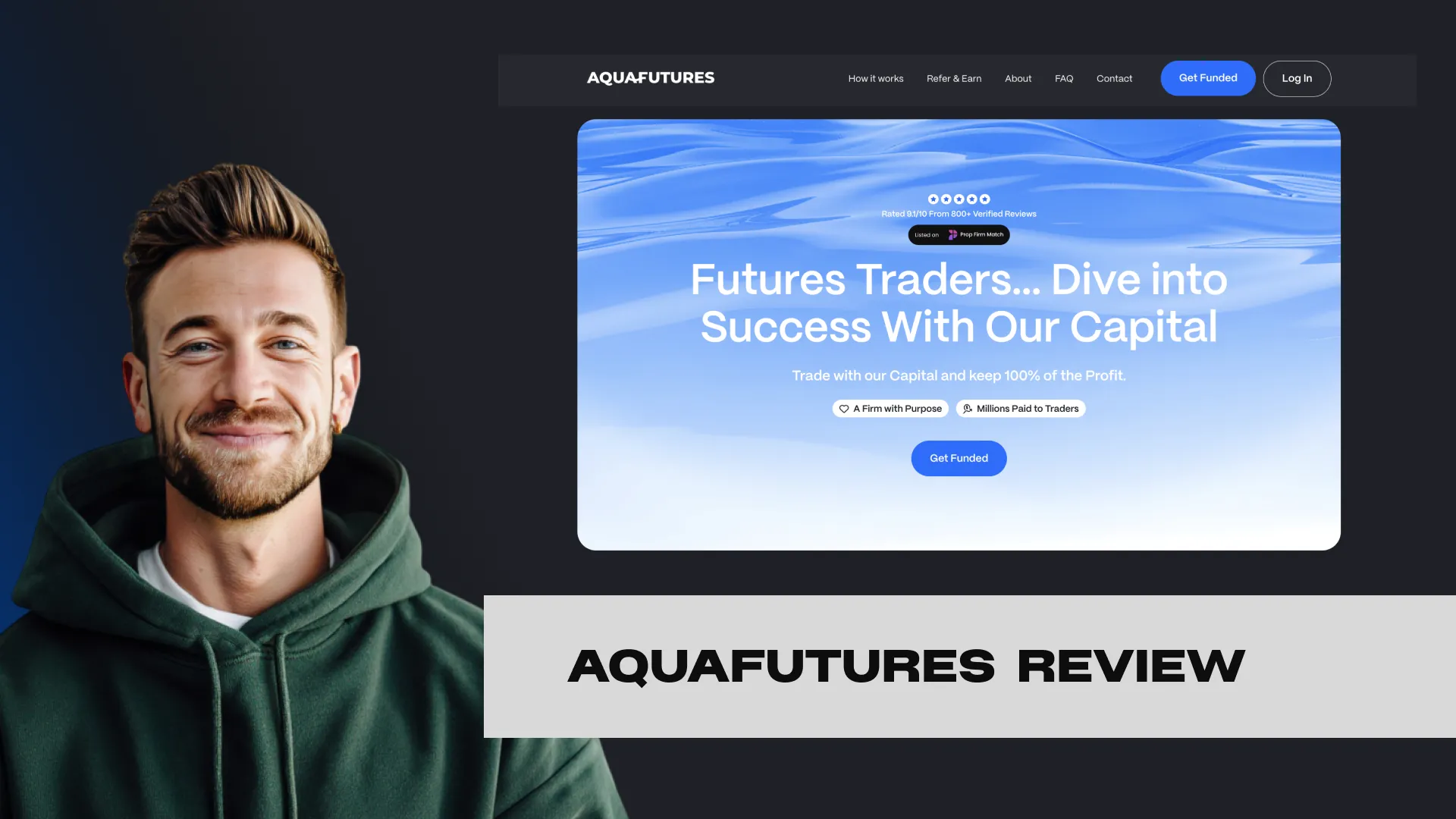
- Instant and Instant Pro models skip evaluations entirely — no profit targets, no time pressure, just trade within drawdown and request payouts on demand
- Up to 100% profit split on the first $15,000 in lifetime profits, then 90% — the best split structure in the futures prop space right now
- 48-hour payout guarantee with a $100 bonus if they miss it (Instant Pro gets 24 hours or +$500) — I've pulled 4 payouts totaling roughly $8K without a single delay
- Quantower and Volumetrica offer clean execution with no slippage games — fills behave exactly like you'd expect from live data feeds
- One-time fees on Instant accounts mean no recurring subscriptions eating into your profits month after month
- Consistency rules exist on every account type — 15% on Instant Pro, 20% on Instant, 40% on challenges — contradicting the "no consistency" marketing some affiliates promote
- The 2% Wave Stop on Instant accounts breaches you if unrealized losses hit 2% of balance — one bad candle on NQ with full contract size and you're done
- No NinjaTrader, no Rithmic, and ProjectX went Topstep-exclusive in Feb 2026 — if your workflow depends on NT8 indicators or you liked ProjectX's simplicity, AquaFutures lost both options
- Trustpilot sits at 3.1/5 across ~100 reviews — lower than every major futures competitor and a legitimate concern for a firm this young
- Contract caps of 6 on Instant/Pro accounts limit position sizing for traders used to 10-15 contracts on similarly sized accounts at other firms
My Experience
After running accounts at over 50 prop firms — Tradeify, Bulenox, TakeProfitTrader, Lucid, the full rotation — I'm always looking for firms that do something genuinely different. AquaFutures caught my eye because of the Instant funding model. No evaluation. No profit target. No monthly subscription bleeding you while you try to pass. Pay once, get a funded account, and start trading immediately.
That's a fundamentally different proposition from the traditional "pay monthly, hit 6-8% profit target, hope you don't breach" cycle that most futures prop firms run. I'd been watching AquaFutures since they launched in late 2024, and once traders started posting real payout confirmations in early 2025, I decided to test them myself.
Passed Challenges and Four Payouts Totaling ~$8K
I've been trading AquaFutures for several months now. Passed their challenges, got funded, and have pulled four payouts totaling roughly $8,000 so far. Every single one processed without drama. No extended review periods. No "trade log inconsistency" flags. No mysterious emails asking me to verify trades I made three weeks ago.
The payout process is genuinely simple — request a withdrawal through the dashboard, wait for processing, money shows up. Both times I tested the Instant Pro payout guarantee, funds arrived well within the 24-hour window. I didn't trigger the $500 bonus because they were too fast. That's the kind of problem I want to have with a prop firm.
What I Actually Like: The Simplicity
Here's what separates AquaFutures from most firms I've traded: the rule set is short. Most futures prop firms hide complexity behind marketing — "simple rules!" they say, then you find 14 pages of fine print about consistency calculations, windfall clauses, flipping policies, and profit factor requirements. AquaFutures keeps it tighter. EOD or trailing drawdown. Contract caps. Consistency percentage. That's the core of it.
The Instant models in particular strip away the evaluation grind that burns most traders out. No profit target means no pressure to force trades when setups aren't there. No time limit means you can sit on your hands for a week if the market isn't giving you anything. For disciplined futures traders who already have a strategy, this removes the artificial performance pressure that causes most evaluation failures.
The Concerns I'm Watching
AquaFutures is young. Founded late 2024, barely over a year old. They're backed by AquaFunded (a CFD prop firm with a longer track record), but futures is a different business. The 3.1 Trustpilot score across roughly 100 reviews isn't great — it's significantly below Topstep (4.6), Bulenox (4.6), and Apex (4.5). Some negative reviews mention payout delays on first withdrawals, strict enforcement of the Wave Stop rule, and support response times.
I haven't personally experienced these issues. My payouts came through cleanly, support answered my questions within a day, and I haven't triggered the Wave Stop because I size conservatively. But a 3.1 Trustpilot from a young firm means I'm keeping my position sizes moderate and not going all-in on AquaFutures as my only prop firm. It's part of my rotation — not the whole thing.
Where I Stand Today
AquaFutures is in my active prop firm lineup alongside Tradeify and Lucid Trading. I use it specifically for the Instant Pro model — the no-daily-loss-limit structure gives me more flexibility during volatile sessions, and the on-demand payouts mean I'm not waiting for bi-weekly or monthly windows. Four payouts in, roughly $8K out, zero complaints about the actual trading and withdrawal experience. The firm just needs more time and more volume to build the kind of reputation that matches its product.
Account Types & Pricing
AquaFutures runs a multi-lane system: two Instant funding models (Standard and Pro) and two 1-Phase challenge paths (Beginner and Standard). The Instant models are the headline — one-time fee, no evaluation, immediate funded access. The challenges exist for traders who want a cheaper entry point with monthly subscriptions.
| Feature | Instant Standard | Instant Pro | 1-Phase Beginner | 1-Phase Standard |
|---|---|---|---|---|
| Fee Type | One-time | One-time | Monthly subscription | Monthly subscription |
| Account Sizes | $25K – $100K | $25K – $100K | $25K – $150K | $25K – $150K |
| Fee Range | $166 – $765 | $149 – varies | $65 – $285/mo | $114 – $490/mo |
| Profit Target | None | None | 6% | 8% |
| Daily Loss Limit | 2.5% | None | 2.5% | None |
| Max Drawdown | 4% (3% on $100K) | 4% (3% on $100K) | 6% – 3.3% | 6% – 3.3% |
| Drawdown Type | EOD Trailing | Real-time Trailing | EOD Trailing | EOD Trailing |
| Consistency Rule | 20% | 15% | 40% | 40% |
| Contract Cap | 6 contracts | 6 contracts | Up to 9 (scaling) | Up to 15 |
| Payout Frequency | On demand | On demand (24hr guarantee) | Weekly (every 7 days) | Bi-weekly (every 14 days) |
| Min Win Days Per Payout | 7 winning days | 7 winning days | 5 winning days | 5 winning days |
| Profit Split | 100% first $15K, then 90% | 100% first $15K, then 90% | 100% first $15K, then 90% | 100% first $15K, then 90% |
| Time Limit | Unlimited | Unlimited | Unlimited | Unlimited |
Why Instant Pro Is the Flagship
The Instant Pro removes the daily loss limit entirely. That single change transforms how you can trade. On the Instant Standard, a 2.5% daily loss limit on a $100K account means you're cut off after a $2,500 loss in one session. On the Instant Pro, your only constraint is the trailing max drawdown — 4% on the $50K, 3% on the $100K. No daily cap means you can take multiple setups in volatile sessions without the timer running out on your risk budget.
The tradeoff: Instant Pro uses real-time trailing drawdown instead of EOD. Every tick of unrealized profit raises your floor. If NQ spikes 50 points in your favor and you don't close, your drawdown permanently moves up. That's harsher than EOD, where drawdown only updates at session close. The Instant Standard's EOD model is more forgiving intraday, but you're capped by the daily loss limit. Pick the one that matches your style.
The Subscription Challenge Models
The Beginner and Standard 1-Phase challenges are solid for traders who want to earn funding through evaluation rather than paying a larger upfront fee. The Beginner is genuinely affordable — $65/month for a $25K account is among the cheapest entry points in futures prop trading. You hit a 6% profit target with micro-scaling contract limits, prove consistency across 5 minimum winning days, and you're funded.
The Standard challenge removes the daily loss limit and gives you up to 15 contracts, but costs more ($114-$490/month) and has a higher 8% profit target. Both use the same 40% consistency rule — no single trading day can account for 40% or more of total profits. Unlimited time on both, which means no pressure to force trades before a deadline.
The catch with subscriptions: they renew monthly until you pass or cancel. Fail to pass in month one, and you're paying again in month two. If your average pass time is 2-3 months, the cumulative subscription cost starts approaching what you'd pay for an Instant account anyway. Run the math before choosing.
Profit Split Structure
AquaFutures runs the most generous split in the futures space right now. You keep 100% of the first $15,000 in lifetime profits — no split, no platform fee, nothing. After $15K, the split shifts to 90/10 in your favor. Compare that to Topstep (100% of first $10K, then 90%), Apex (100% of first $25K, then 90%), or Bulenox (100% of first $10K, then 90%). The first-$15K-free structure at AquaFutures hits a sweet spot — it's not the highest ceiling (Apex at $25K) but it's competitive and clean.
Trading Rules You Need To Know
AquaFutures gets praised for "no hidden rules" and that's mostly accurate. The rules that exist are published clearly and enforced predictably. But "simpler" doesn't mean "no rules." There are constraints you need to understand cold before trading.
| Rule | Instant / Instant Pro | 1-Phase Challenges |
|---|---|---|
| Daily Loss Limit | 2.5% (Standard) / None (Pro) | 2.5% (Beginner) / None (Standard) |
| Max Drawdown | 4% (3% on $100K) | 6% – 3.3% (size dependent) |
| Drawdown Type | EOD (Std) / Trailing (Pro) | EOD Trailing |
| Wave Stop (Instant only) | 2% unrealized loss = breach | N/A |
| Consistency Rule | 20% (Std) / 15% (Pro) | 40% |
| Contract Cap | 6 contracts | 9 (Beginner) / 15 (Standard) |
| Min Winning Days Per Payout | 7 days (min $75-$200/day) | 5 days (min $75-$300/day) |
| News Trading | No positions 2 min before/after Tier 1 | No positions 2 min before/after Tier 1 |
| Overnight Holds | Positions closed at market close | Positions closed at market close |
| CME Price Limit Rule | No trading within 2% of limit | No trading within 2% of limit |
| Inactivity | 7 days = closure | 7 days = closure |
| Automation/Bots | Not permitted | Not permitted |
The Wave Stop: AquaFutures' Hidden Landmine
The Wave Stop applies to Instant accounts and it's the rule most traders don't see coming. If your unrealized losses on open positions reach 2% of your account balance or equity at any point, your account is immediately breached. Not closed at end of day. Not a soft warning. Immediate hard breach.
On a $100K Instant account, that's a $2,000 unrealized loss threshold. If you're holding 6 contracts on NQ and it moves 33 points against you, you've hit the Wave Stop. That can happen in under a minute during volatile sessions. The Wave Stop effectively functions as a real-time floating drawdown limit specifically on open trades — separate from your max trailing drawdown, which tracks closed P&L.
I manage this by never using more than 3-4 contracts on NQ and keeping tight stops. But if you're the kind of trader who lets positions breathe and expects to recover from 50-point drawdowns, the Wave Stop will end you before your thesis plays out.
The Consistency Rule That Actually Matters
Despite some marketing suggesting "no consistency rules," AquaFutures absolutely has them. Instant Pro is the strictest at 15% — no single trading day can account for 15% or more of your total profits during a payout cycle. That means if you make $5,000 in total profit, no single day can show more than $750.
This doesn't breach your account — it blocks your payout request until the percentage drops below the threshold. You have to keep trading and generating profits until your biggest day is diluted below 15% of the total. In practice, this forces you to trade consistently across multiple sessions rather than hitting one home run and withdrawing.
The challenge models are more relaxed at 40%, which is standard for the industry. But on the Instant accounts, the 15-20% consistency requirement is tighter than Topstep's 50%, Apex's 30%, and Bulenox's 40%.
EOD vs. Trailing — The Right Choice Depends on Your Style
EOD (End-of-Day) drawdown only updates at market close (9 PM UTC). You can be down $3,000 at 10 AM, fight back to $500 profit by 3 PM, and your drawdown doesn't move because it only cares about your balance at close. This gives intraday traders room to recover from bad starts.
Trailing drawdown (Instant Pro) follows your highest balance in real time, including unrealized P&L. Every new equity high permanently raises the floor. If you're a scalper who hits quick targets and takes clean exits, trailing is manageable. If you let trades run and give back gains regularly, trailing will suffocate you.
I use the Instant Pro because I trade NQ during the first hour of US session with defined targets and stops. I rarely let unrealized gains run beyond 2-3% of account before locking profits. For my style, trailing is fine. For swing setups or wider-stop strategies, the EOD accounts are safer.
Platforms You Can Trade With
AquaFutures used to offer ProjectX as its default trading platform. That's gone. In February 2026, ProjectX pulled third-party support for every prop firm except Topstep — leaving AquaFutures (and dozens of other firms) scrambling for alternatives. What remains: Quantower and Volumetrica (DeepCharts).
| Feature | Quantower | Volumetrica (DeepCharts) |
|---|---|---|
| Best For | Footprint charts, DOM depth, advanced analysis | Order flow specialists, heatmaps, volume visualization |
| Setup Complexity | Moderate — requires configuration | Moderate — order flow experience recommended |
| Order Flow Tools | Full footprint, volume profile, cluster charts | Heatmaps, cumulative delta, advanced visualization |
| Charting | Highly customizable multi-screen workspaces | Focused on volume-based visual tools |
| Data Feed | Included with account | Included with account |
| Instruments | Full CME/CBOT/NYMEX/COMEX futures | Full CME/CBOT/NYMEX/COMEX futures |
| Mobile App | No | No |
Quantower Is Now Your Default
With ProjectX gone, Quantower is the platform most AquaFutures traders should default to. It supports volume profiling, cluster charts, footprint analysis, and flexible multi-screen workspace layouts. If you traded ProjectX before, the transition to Quantower takes some setup — you'll need to configure connections, select the ProjectX data feed within Quantower's connection manager, and build your workspaces from scratch.
I made the switch myself. Quantower's charting is more powerful than ProjectX ever was, and the order flow tools give you data that ProjectX simply didn't offer. The tradeoff is complexity — Quantower isn't plug-and-play. Expect a few hours of setup and configuration before your workspace feels natural. But once it's dialed in, the platform handles NQ and ES execution cleanly during high-volume sessions. No ghost fills, no phantom wicks, no disconnection issues around CPI or NFP.
Volumetrica for Pure Order Flow Traders
Volumetrica (also called DeepCharts) is the more specialized option. It's built specifically for traders who make decisions from heatmaps, cumulative delta, and real-time volume visualization. If you don't already know what those terms mean, this isn't your platform — stick with Quantower. But if your entire trading approach is built around reading order flow, Volumetrica provides sharper visualization tools than Quantower's footprint charts.
Think of it this way: Quantower is a full trading platform that includes order flow tools among many other features. Volumetrica is an order flow platform that happens to let you execute trades. If order flow is your edge, Volumetrica is more focused. If you need traditional charting plus order flow, Quantower covers both.
The NinjaTrader and Rithmic Gap — Now Wider
AquaFutures doesn't support NinjaTrader, Rithmic, or Tradovate. With ProjectX gone, the platform gap between AquaFutures and competitors just got wider. Topstep now has exclusive access to ProjectX on top of NinjaTrader and Quantower. Apex runs NinjaTrader, Tradovate, and Rithmic. Bulenox supports 20+ platforms including NinjaTrader, Sierra Chart, and Bookmap. Tradeify offers Tradovate, NinjaTrader, and Rithmic.
If your entire workflow — indicators, automated strategies, backtesting — runs on NinjaTrader 8 with Rithmic data, AquaFutures can't accommodate you. That's a hard limitation. For traders who are platform-flexible and comfortable learning Quantower, the transition is manageable. I adapted within a few days. But losing ProjectX means AquaFutures lost the "easy, plug-and-play" option that most traders defaulted to, and that's a real downside the firm needs to address.
My Strategy To Regular Payouts
My AquaFutures strategy centers on NQ (Nasdaq 100 futures) during the first 90 minutes of US market open. That's when volume is deepest, moves are directional, and the spread is tightest. I trade 2-4 contracts maximum on the $100K Instant Pro, keeping well inside the 6-contract cap and managing the Wave Stop risk by never holding more than 3 contracts in a single direction at once.
Typical trade: identify a level with volume cluster support on the 5-minute chart, enter on a pullback with a 15-20 point stop on NQ, target 25-40 points. Risk per trade stays under 1.5% of account balance. At 3 contracts on NQ, a 15-point stop represents roughly $900 in risk — well below the 2% Wave Stop threshold and comfortably inside the 3% max drawdown on the $100K account.
Building Consistency to Beat the 15% Rule
The Instant Pro's 15% consistency rule shapes how I plan my trading week. I can't afford one monster $3,000 day followed by four days of $200 profits — that $3,000 day would be 60% of total profit and I'd be locked out of payouts.
Instead, I aim for $500-$800 per day across 7-10 trading days per cycle. That creates a distribution where no single day exceeds 15% of the total. Some days are better, some are worse, but the target is steady accumulation. When I hit $4,000-$5,000 in the cycle and my consistency math checks out, I request a payout.
This approach also naturally manages the trailing drawdown. Small, consistent wins don't spike my equity high enough to create a dangerous drawdown floor. Large single-day wins raise the trailing threshold dramatically, which then requires perfect execution just to protect gains. Consistency isn't just a payout rule — it's a risk management strategy.
Managing the Payout Cycle
AquaFutures requires 7 minimum winning days per payout cycle on Instant accounts, with minimum profit per day varying by account size ($75 on 50K, $100-$200 on larger accounts). I structure my trading to hit 7 qualifying days within 10-12 calendar days, then request a payout. That creates a roughly bi-weekly cash flow rhythm.
After your first payout, the max drawdown locks at starting balance + $100. On a $100K account, that means your drawdown floor becomes $100,100 permanently. This is actually helpful — it creates a hard floor that no longer trails, giving you stable parameters for position sizing going forward. The first 60 days have a reward cap to limit early withdrawals, but after 3 successful payouts, the cap lifts entirely.
The $35 Processing Fee to Factor In
There's a flat $35 processing fee deducted from your first payout each calendar month. On a $2,000 payout, that's 1.75% — noticeable but not painful. On a $500 minimum payout, it's 7% — which is why I try to batch profits and withdraw larger amounts less frequently rather than pulling minimum amounts weekly. Consolidate, then withdraw.
Trust & Legitimacy: What You Need To Know
AquaFutures is a Dubai-based (UAE) prop firm that launched in late 2024. The firm is part of the AquaFunded ecosystem, which also operates AquaFunded (a CFD prop firm) and AquaTV. The COO is Kyle Tate, who's active in community engagement and handles escalated support issues personally. The firm reports 118,000+ futures traders onboarded, $5 million+ in total rewards paid, an average payout of $2,450, and a highest single-trader payout of $119,175.
The Dubai registration is worth noting. Unlike US-registered firms (Topstep, Apex, Bulenox) that operate under American regulatory frameworks, Dubai's financial regulations are different. This doesn't make AquaFutures illegitimate — many successful prop firms operate from the UAE — but it's a factor for traders who prioritize US-based companies.
Trustpilot Data: 3.1 Rating Across ~100 Reviews
This is the most concerning data point. A 3.1/5 Trustpilot score places AquaFutures significantly below every major futures competitor: Topstep (4.6), Bulenox (4.6), Apex (4.5), and Tradeify (4.7 on parent). The review count is also low — roughly 100 reviews versus 1,000+ for established competitors.
Positive themes: fast payouts when they work, supportive COO Kyle, clean platform execution, affordable pricing. Negative themes: payout delays on first withdrawals (support slowdowns), strict enforcement of rules traders didn't fully understand (particularly Wave Stop and DLL as hard breaches), some confusion about which rules are "soft" vs. "hard" violations.
AquaFutures replies to negative reviews, which is a positive signal. They engage with complaints rather than ignoring them. But the volume of negative reviews relative to total count (roughly 25-30% at 1-2 stars) is higher than industry average for funded futures firms.
What Gives Me Confidence
Four personal payouts without issues. That's my strongest trust signal — real money in my wallet, repeatedly, without drama. The AquaFunded parent company has been operating longer and has a larger review base, which provides some institutional backing. The $5M+ in total rewards suggests the firm is paying traders at scale. And the payout guarantee (48 hours or +$100, 24 hours or +$500 on Instant Pro) puts real money behind their processing speed claims.
What I'm Watching
The Trustpilot trajectory matters more than the current number. If the score trends upward as the firm matures and resolves early-stage support issues, that's a healthy signal. If it stays flat or drops, that's a warning. The firm is barely over a year old — most successful prop firms needed 2-3 years to build strong reputations. AquaFutures has the product, they just need time and consistent execution on payouts and support to earn the trust scores that match.
I'm also monitoring how the firm handles disputes. One Trustpilot review reported a scalping trade being deducted $655 for an 8-second hold time despite scalping not being explicitly prohibited in the rules. That kind of ambiguity — where the published rules say one thing but enforcement suggests another — is exactly what erodes trader trust. The firm needs crystal-clear rule documentation with no gray areas.
How This Firm Compares To Other Ones
AquaFutures competes in the "instant funding + low friction" lane of futures prop trading. Their direct competitors aren't the legacy evaluation firms — they're the newer firms offering simplified paths to funding with one-time fees and fast payouts. But traders compare across all options, so let's put AquaFutures next to the firms you're most likely considering.
The Full Comparison
| Feature | AquaFutures | Topstep | Apex Trader | Bulenox | Tradeify |
|---|---|---|---|---|---|
| 50K Eval Price | $100/mo (Beginner) or $615 Instant | $49/mo + $149 activation | ~$85/mo (subscription) | ~$145/mo + activation | $150 one-time |
| Fee Type | Monthly (eval) or One-time (Instant) | Monthly + activation | Monthly (ongoing on funded) | Monthly + activation | One-time |
| Activation Fee | None | $149 | $85-$105/mo funded | $248+ (one-time) | None ($0 funded) |
| Drawdown Type | EOD or Trailing (plan dependent) | EOD Trailing | Real-time Trailing | EOD or Trailing (choice) | EOD Trailing |
| Max Drawdown (50K) | 4% ($2,000) | $2,000 | $2,500 | $2,500 | $2,000 |
| Profit Split | 100% first $15K, then 90% | 100% first $10K, then 90% | 100% first $25K, then 90% | 100% first $10K, then 90% | 80% flat |
| Consistency Rule | 15-40% (plan dependent) | 50% | 30% | 40% | None after funding |
| Payout Speed | 48 hrs (24 hrs Instant Pro) | 1-2 business days | 3-7 business days | Weekly processing | 24 hrs (Rise) |
| Max Funding | $450K (3 accounts) | $150K per account | $300K (up to 20 accts) | $250K | $150K per account |
| Platforms | Quantower, Volumetrica | TopstepX, ProjectX (exclusive), NinjaTrader, Quantower | NinjaTrader, Tradovate, Rithmic | NinjaTrader, 20+ platforms | Tradovate, NinjaTrader, Rithmic |
| Daily Loss Limit | 2.5% or None (plan dependent) | EOD-based (no intraday cut) | 30% P&L rule | Plan dependent | $1,250 (50K) |
| Trustpilot | 3.1 / ~100 reviews | 4.6 / 15,000+ reviews | 4.5 / 15,000+ reviews | 4.6 / 1,400+ reviews | 4.7 / 1,900+ reviews |
| Founded | Nov 2024 (Dubai, UAE) | 2012 (Chicago, USA) | 2021 (Austin, USA) | 2022 (Delaware, USA) | 2022 (USA) |
Where AquaFutures Wins
Profit split structure is the best in this comparison for traders making under $15K. You keep 100% of the first $15,000 in profits — better than Topstep's $10K threshold, equal to Tradeify's flat 80% only until you've earned $12,500 (where Tradeify's 80% = AquaFutures' 100%), and competitive with Apex's $25K threshold for traders who won't reach that level quickly.
No activation fee is a genuine advantage. Topstep charges $149 to activate a funded account. Apex charges $85-$105/month on funded accounts indefinitely. Bulenox has activation fees based on account size. AquaFutures charges nothing beyond the initial purchase — Instant accounts are one-time, and challenge subscriptions stop once you're funded.
Instant funding with no evaluation skips the 2-4 week pass time that other firms require. If you're a proven trader who doesn't want to spend weeks proving what you already know, paying $615 for a $50K Instant account and starting immediately has real value compared to months of subscription fees at evaluation firms.
Payout speed is competitive. The 48-hour guarantee (with penalty for missing it) and the 24-hour Instant Pro guarantee are among the fastest in the industry. Apex's 3-7 business days and Bulenox's weekly processing cycle look slow by comparison.
Where AquaFutures Loses
Trustpilot reputation is the weakest in this comparison by a significant margin. A 3.1 rating versus 4.5-4.7 at every competitor matters. For traders who weigh social proof heavily, AquaFutures can't compete with Topstep's 13-year track record or Apex's $378M+ in payouts.
Platform selection is the most limited — and got worse after ProjectX went Topstep-exclusive in February 2026. Two platforms (Quantower and Volumetrica) versus Topstep's ProjectX-exclusive access plus NinjaTrader and Quantower, Apex's NinjaTrader/Tradovate/Rithmic ecosystem, Bulenox's 20+ platform options, and Tradeify's NinjaTrader/Tradovate/Rithmic support. No NinjaTrader and no simple plug-and-play option is a hard pass for a large segment of futures traders.
Consistency rules on Instant accounts are the strictest. At 15% on Instant Pro and 20% on Instant Standard, AquaFutures demands more even profit distribution than Topstep (50%), Apex (30%), or Bulenox (40%). Tradeify has no consistency rule after funding, making it the most trader-friendly on this metric.
The Wave Stop (2% unrealized loss breach) has no equivalent at other firms. This is an additional layer of risk management that doesn't exist at Topstep, Apex, Bulenox, or Tradeify. It effectively gives you less room to hold losing positions than any competitor.
Max drawdown on $100K accounts (3%) is tighter than the industry standard. Most competitors offer $2,500-$3,000 drawdown on $50K accounts (5-6%). AquaFutures' 3% on $100K is only $3,000 — comparable to what smaller accounts get elsewhere.
My Recommendation by Trader Type
Want instant funding with no evaluation and you trade disciplined, consistent setups? AquaFutures' Instant Pro is the cleanest instant model in the futures space right now. Pay once, trade, get paid.
Want the most established firm with the longest track record? Topstep. Thirteen years of operation, 15,000+ Trustpilot reviews, and the evolution to live funded accounts make it the safest bet in the industry.
Want maximum scale and aggressive profit splits? Apex Trader Funding lets you run up to 20 accounts, keeps 100% of your first $25K, and has paid out $378M+. The rules are more complex, but the ceiling is higher.
Want platform flexibility and the simplest rules? Bulenox supports 20+ platforms including NinjaTrader and Sierra Chart, has no consistency rules during evaluation, and pays weekly. The Trustpilot score backs it up.
I'm trading AquaFutures because the Instant Pro model fits my NQ scalping style — no evaluation waste, no monthly subscription drain, on-demand payouts when I need cash flow. Four payouts in, roughly $8K out, and the simplicity of the product keeps me coming back. The firm just needs time to build the reputation that matches the experience I've had.
Frequently Asked Questions
What is AquaFutures and how does it work?
AquaFutures is a Dubai-based futures prop firm offering Instant funding (no evaluation) and 1-Phase challenge models. You trade futures on Quantower or Volumetrica, keep up to 100% of the first $15K in profits and 90% after, with on-demand payouts processed within 48 hours. The firm reports $5M+ in total rewards paid.
How much does AquaFutures cost?
Instant Standard accounts range from $166 ($25K) to $765 ($100K) as one-time fees. Instant Pro runs from $149 to varies by size. Beginner challenges start at $65/month and Standard challenges at $114/month. All Instant fees are one-time with no recurring charges. Discounts of 40-60% are frequently available.
What is the profit split at AquaFutures?
You keep 100% of the first $15,000 in lifetime profits across all accounts — no split with the firm. After $15K, the split shifts to 90/10 in your favor. There's also a $35 processing fee on the first payout each calendar month.
How fast are AquaFutures payouts?
Standard payout guarantee is 48 hours or AquaFutures adds $100 to your reward. Instant Pro has a 24-hour guarantee with a $500 bonus if they miss it. From my experience, all four of my payouts arrived within 24 hours. Payouts are via crypto (USDC/stablecoins) or bank transfer.
Does AquaFutures have a consistency rule?
Yes. Instant Pro accounts have a 15% rule — no single day can be 15%+ of total payout cycle profits. Instant Standard has a 20% rule. Challenge accounts have a 40% rule. Violating the consistency rule doesn't breach your account — it blocks payout requests until the ratio improves.
What platforms does AquaFutures support?
Quantower and Volumetrica (DeepCharts) are the two available platforms. ProjectX was removed in February 2026 after going Topstep-exclusive. Both remaining platforms cover full CME, CBOT, NYMEX, and COMEX futures. AquaFutures does not support NinjaTrader, Rithmic, Tradovate, or MetaTrader. Quantower is recommended for most traders; Volumetrica for dedicated order flow analysis.
What is the Wave Stop rule?
On Instant accounts, if your unrealized (open) losses reach 2% of your account balance or equity at any point, your account is immediately breached. This is a hard breach — the account closes permanently. It functions as a real-time floating loss limit on open positions, separate from the trailing drawdown.
Can I hold positions overnight at AquaFutures?
No. All open positions are automatically closed at market close. This is enforced across all account types. The auto-close doesn't cause a breach, but it means you can't run swing trades or hold through overnight sessions. Your trading must be completed within the market session.
How many accounts can I have at AquaFutures?
You can trade up to 3 funded accounts simultaneously with a combined maximum of $450,000 in total capital. Account combinations are flexible — three $150K accounts would hit the $450K cap. Copy trading between your own funded accounts is permitted.
Is AquaFutures legit or a scam?
AquaFutures is a registered company operating from Dubai, UAE, backed by AquaFunded (a larger CFD prop firm). They report $5M+ in total rewards paid and 118,000+ traders. The Trustpilot score is 3.1/5 across ~100 reviews — lower than industry leaders but with positive payout confirmations from verified users. I've personally received four payouts without issues.
What futures instruments can I trade?
Full CME Group futures including ES, NQ, RTY, YM (equity indices), CL, NG (energies), GC, SI (metals), ZB, ZN (treasuries), 6E, 6J (currencies), and agricultural contracts. Both mini and micro contracts are available depending on your account type and scaling rules.
Does AquaFutures allow news trading?
Not freely. You cannot open or hold positions or pending orders within 2 minutes before or after Tier 1 data releases. Red folder news events on ForexFactory are also restricted. If your strategy specifically trades NFP or CPI releases, this restriction limits your approach.
What happens if I breach a rule at AquaFutures?
Hard breaches (exceeding max drawdown, daily loss limit, or Wave Stop) result in immediate permanent account closure. Funded accounts cannot be reset — you'd need to purchase a new account. Evaluation accounts can be reset if you breach. The consistency rule is the only "soft" restriction — it blocks payouts but doesn't close your account.
Is there an inactivity rule at AquaFutures?
Yes. You must place at least one trade within every 7-day period. If 7 consecutive calendar days pass without a trade, the account is closed. This is stricter than most competitors — Topstep and Apex have more lenient inactivity windows.
Should I choose Instant or the 1-Phase Challenge?
Instant is better if you're confident in your strategy and want to skip evaluation entirely. The one-time fee eliminates subscription drain. The challenge is better if you want a cheaper entry point ($65-$285/month) and don't mind the evaluation process. Run the math: if your average pass time is 3+ months on a Standard challenge ($210/month = $630+), the Instant at $615 is actually cheaper and gives you immediate access without evaluation risk.