Quick Answer — Opening Range Breakout
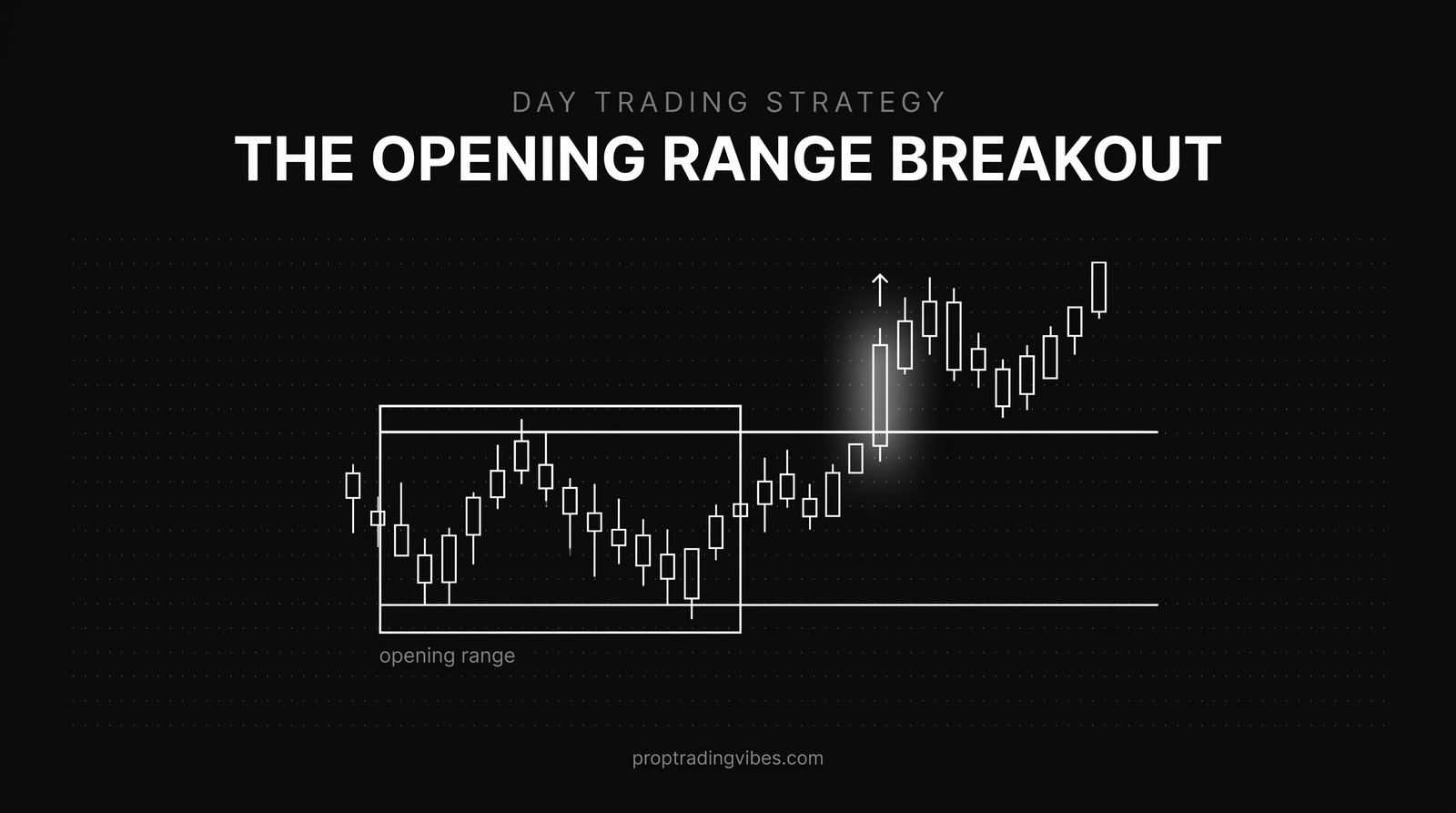
- • The opening range breakout (ORB) is a strategy where you mark the high and low of a defined time window after the market opens, then trade the breakout above or below that range.
- • The most common ORB timeframes are 5, 15, 30, and 60 minutes after the cash open (9:30 AM Eastern for futures), each offering a different trade-off between signal quality and opportunity window.
- • The 15-minute ORB on NQ futures has the best balance of win rate and frequency in my experience, producing clean setups roughly 3 out of 5 trading days.
- • Stop placement belongs on the opposite side of the opening range, giving you a pre-defined risk that most prop firms consider acceptable for evaluation accounts.
- • The biggest ORB mistake is taking breakouts on narrow-range days or ahead of major news events, where false breakouts destroy accounts fast.
The opening range breakout (ORB) is a day trading strategy built on one idea: the first X minutes after the market opens establish a price range, and when price breaks above or below that range, it tends to continue in that direction. The "X" is your timeframe choice. Five minutes. Fifteen. Thirty. Sixty. Each gives you a different kind of trade.
I've been using a form of ORB on NQ futures since mid-2024. It's not the only thing I trade, but it accounts for the cleanest, most mechanical setups in my week. When I pass prop firm evaluations or stay funded across accounts at FundedSeat, YRM Prop, Top One Futures, and FundingPips, ORB plays a significant role. The defined risk makes it perfect for funded accounts where one blown stop can end your evaluation.
This guide covers everything: what the opening range actually is, how to draw it correctly, which timeframe to use, how to set entries and stops, what targets work, when ORB fails, and the modified version I trade on NQ daily.
What Is the Opening Range?
The opening range is the high and low price established during a specific time window after the cash market opens. For US equity index futures like NQ (Nasdaq 100 E-mini) and ES (S&P 500 E-mini), the cash session starts at 9:30 AM Eastern. If you are using a 15-minute opening range, your range runs from 9:30 AM to 9:45 AM. Mark the highest price and the lowest price during that window. That is your opening range.
The concept traces back to Toby Crabel's work in the late 1980s. Crabel studied how the first few minutes of a trading session predict the direction of the rest of the day. His research showed that when price broke out of a narrow opening range, the breakout move tended to be larger and more reliable than breakouts from wide ranges. That insight still holds.
The opening range matters because it represents the first battle between buyers and sellers after fresh overnight information gets priced in. Institutional order flow is heaviest in the first 30 minutes of the cash session. The opening range captures that initial auction. When price breaks out of this contested zone, it often signals that one side has won the early fight and momentum will carry the move further.
One nuance worth understanding: the opening range for futures is not the same as for stocks. Futures trade nearly 24 hours. NQ has been trading since 6:00 PM the prior evening. But the cash open at 9:30 AM is when the highest volume hits, when institutions execute their largest orders, and when the opening range carries real predictive value. Overnight range data can supplement your analysis, but the ORB strategy focuses specifically on the cash session open.
How Do the Different ORB Timeframes Compare?
There is no single "correct" opening range timeframe. Each one gives you a different trade profile. I've tested all four main timeframes on NQ and ES over hundreds of sessions. The differences are substantial.
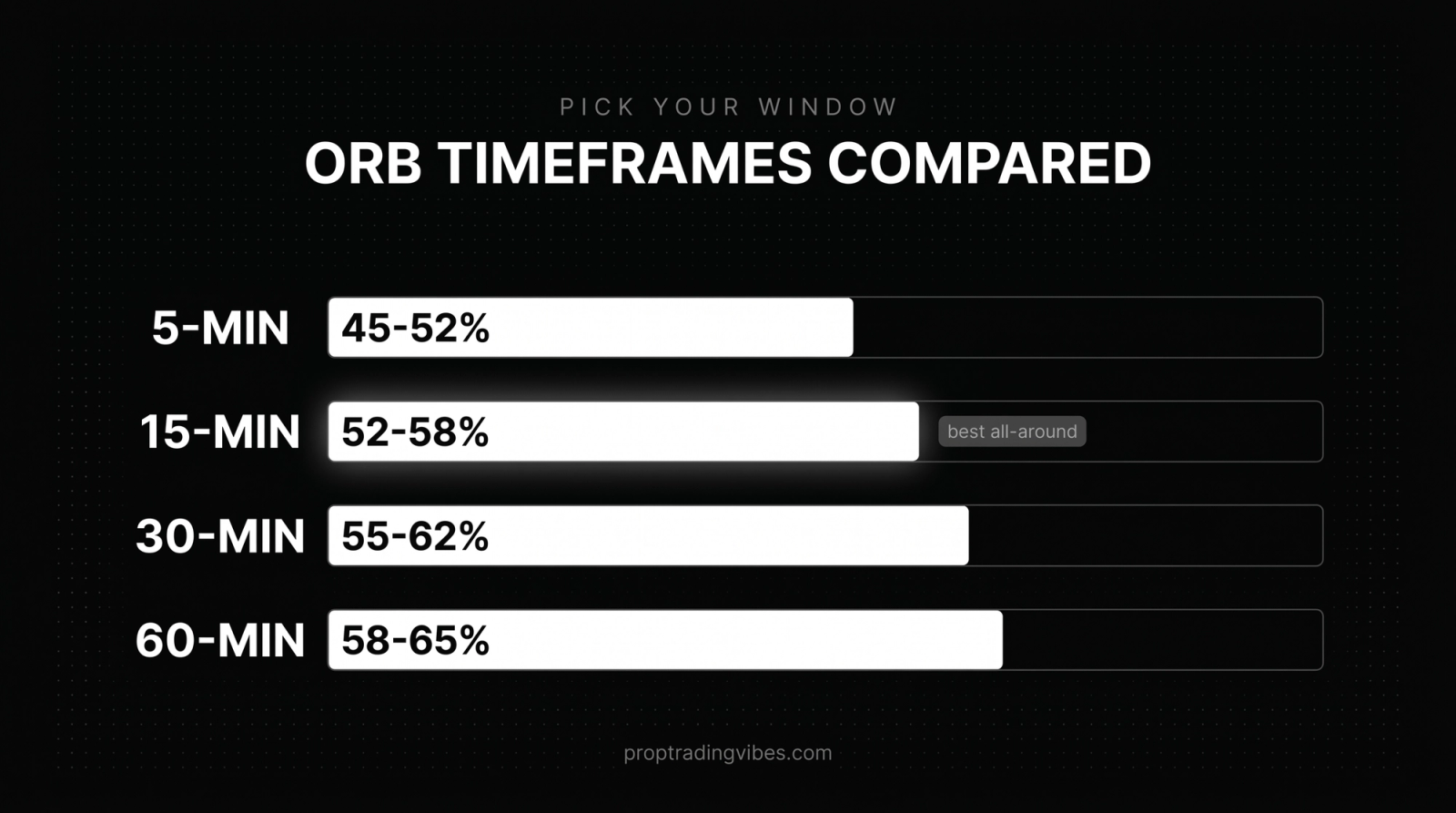
| Timeframe | Avg. Win Rate | Best Markets | Typical Stop Distance (NQ) | Notes |
|---|---|---|---|---|
| 5-Minute ORB | 45-52% | NQ, high-beta stocks | 15-30 points | Highest frequency, lowest win rate. Tight stops, fast resolution. Great R-multiples when it works. |
| 15-Minute ORB | 52-58% | NQ, ES, CL | 25-50 points | Best all-around timeframe. Enough data to filter noise, still early enough for a full-session move. |
| 30-Minute ORB | 55-62% | ES, NQ, YM | 40-80 points | Higher win rate but wider stops. Misses early explosive moves. Good for larger accounts. |
| 60-Minute ORB | 58-65% | ES, bond futures, forex futures | 60-120 points | Highest win rate, widest stops. Fewer setups per week. Less time to reach targets before the session ends. |
The 5-minute ORB gives you the most setups but also the most false breakouts. The range is small, so stops are tight and you get chopped out frequently. On high-volatility days it can produce incredible R-multiples because the initial range is compressed and the move that follows covers 5x or 10x that range. On average days, expect whipsaws.
The 15-minute ORB is what I trade most often on NQ. Fifteen minutes is enough time for the opening auction to settle, for the initial gap-fill move to play out, and for the real direction to emerge. Your stop is wider than the 5-minute, but you get meaningfully fewer false breakouts. I find the 15-minute range on NQ averages 30-45 points on a normal day. That means a full-range stop of 30-45 points, which is comfortable on a $50K prop firm account.
The 30-minute ORB is the classic Crabel timeframe. It catches the entire initial balance period and produces the most reliable signals. The trade-off is that by 10:00 AM, a significant portion of the day's range has already been established. Your upside is limited on some days because the move already happened inside the opening range. I use the 30-minute ORB more on ES than NQ. ES is slower, more institutional, and the 30-minute range captures the true auction better.
The 60-minute ORB has the highest win rate in my logs, but I rarely trade it. By 10:30 AM, you know the direction, but the stop is so wide that position sizing on a prop firm account becomes restrictive. If the 60-minute range on NQ is 100 points, your stop is 100+ points. On a 50K evaluation account, that single trade risk can eat your entire allowable drawdown if sizing isn't managed carefully.
How Do You Draw the Opening Range Correctly?
Drawing the opening range seems straightforward, but I see traders make the same mistakes repeatedly.
Step one: set your chart to the cash session open. On NQ and ES, the cash open is 9:30 AM Eastern. Your opening range starts at exactly 9:30:00. Not 9:29. Not the overnight session.
Step two: at the end of your chosen timeframe, mark the highest price and the lowest price reached during that window. For a 15-minute ORB, you mark the high and low between 9:30 and 9:45 AM. Use the candle bodies or wicks, depending on your preference. I use wicks because I want the full range including where price was rejected. Some traders argue bodies are more meaningful. I've tested both and the difference is marginal.
Step three: extend those two horizontal lines forward through the rest of the session. These are your breakout levels. Price above the high is a long trigger. Price below the low is a short trigger.
Step four: mark the midpoint of the opening range. This is where I place my stop on most trades (more on that in the stop placement section). The midpoint also acts as a reference level during the session. If price breaks out above the range but then falls back to the midpoint, the breakout is weakening.
Most charting platforms have drawing tools or indicators that plot the opening range automatically. Sierra Chart has the Opening Range study built in. NinjaTrader has third-party indicators. TradingView has scripts on the public library that draw ORB levels automatically. I use Sierra Chart's native study with a 15-minute setting and it updates in real time.
The mistake I see most often: traders use the wrong session start time. If your data feed starts the session at 6:00 PM ET and you are measuring the "first 15 minutes" from the session open, you are measuring 6:00-6:15 PM. That is not the opening range for ORB. The cash open at 9:30 AM is the starting point. Your platform settings matter.
What Are the Entry Rules for an Opening Range Breakout?
The basic entry rule for ORB is simple: go long when price breaks above the opening range high, go short when price breaks below the opening range low. But if you trade it that mechanically, you'll get destroyed by false breakouts.
My refined entry rules for the 15-minute ORB on NQ:
Wait for a close above/below the level. I don't enter on the tick that price touches the opening range high. I wait for a full 5-minute candle to close above it. A wick poke that immediately reverses is not a breakout. A candle that closes beyond the level with commitment is.
Volume must confirm the breakout. When NQ breaks the opening range high, I want to see volume spike on that breakout candle. If price drifts through the level on declining volume, I pass. A real breakout attracts participation. No participation, no trade.
Check the overnight context. If NQ gapped up 150 points and the opening range is sitting right at the overnight high, a breakout above the range is pushing into new territory with no resistance. Good setup. If the opening range is sitting in the middle of the overnight range, a breakout in either direction might just be noise within the larger range. Less reliable.
Avoid the first false breakout. This is my most important rule. On NQ specifically, the first break of the opening range high or low is often a trap. Price pokes above the range by 5-10 points, triggers long entries, then reverses hard. I let the first breakout attempt happen. If price comes back inside the range and then breaks out again in the same direction, that second breakout is far more reliable. I call this the "retest and go" pattern.
Skip setups where the range is too narrow. If the 15-minute opening range on NQ is under 15 points, I don't trade it. Narrow ranges produce breakouts that immediately reverse because there was no real auction. The range needs to be large enough to represent a genuine contest between buyers and sellers. On NQ, I look for a minimum 20-point opening range for the 15-minute window.
Where Do You Place Your Stop on an ORB Trade?
Stop placement on ORB trades has two schools of thought. I've tested both extensively.
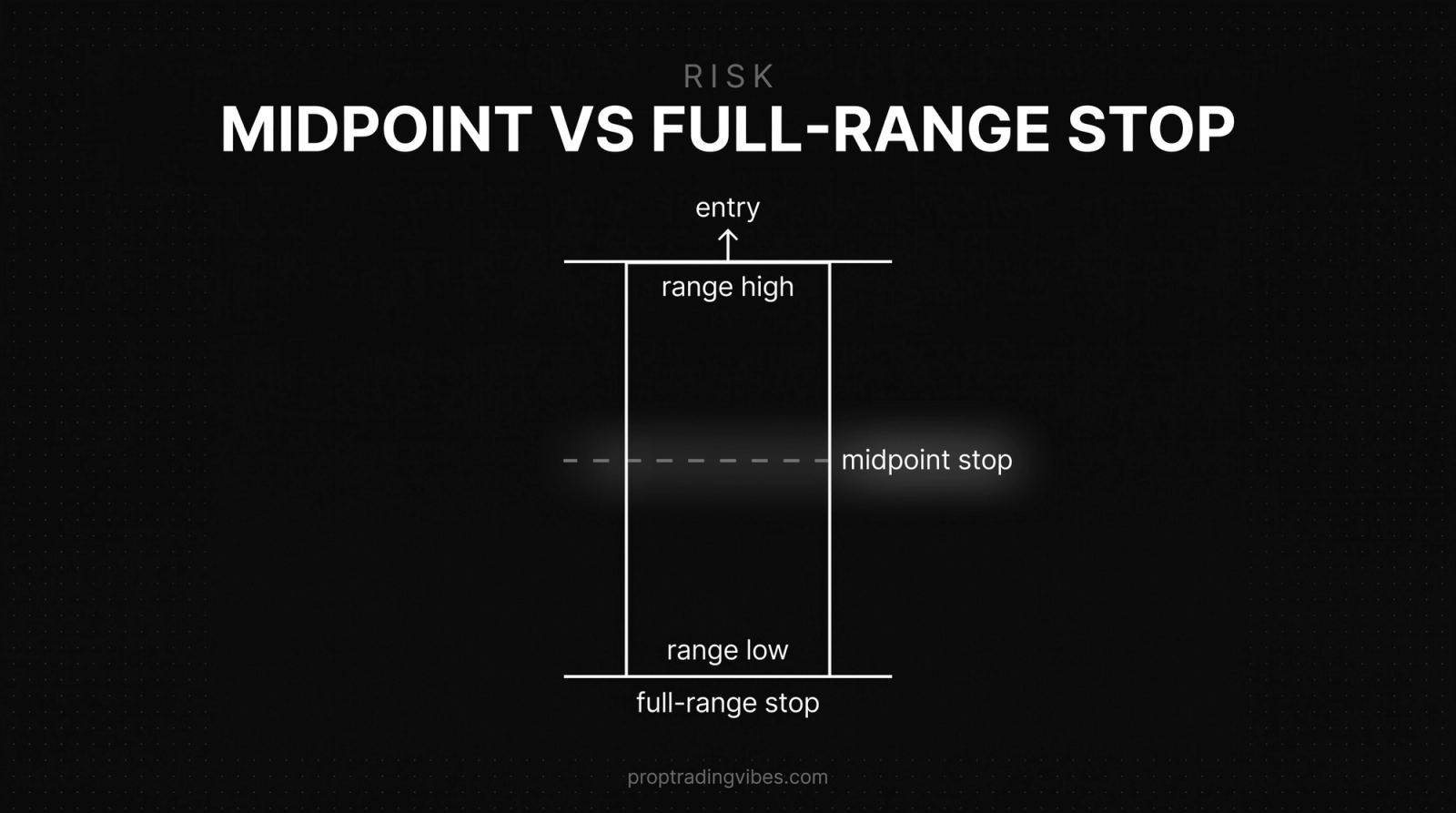
Option 1: Opposite side of the range. If you go long on a breakout above the opening range high, your stop goes below the opening range low. This gives you the maximum room for the trade to work, but your risk per trade is the full width of the opening range. On NQ with a 40-point range, that is a 40+ point stop. On a 50K account trading 2 contracts, that is $400 per contract or $800 total risk. Manageable but not small.
Option 2: Midpoint of the range. If you go long on a breakout above the range high, your stop goes at the midpoint between the high and low of the opening range. This cuts your risk in half. The logic is that if price breaks out above the range but then falls all the way back to the midpoint, the breakout has failed. You don't need price to go all the way to the opposite side before admitting the trade is wrong.
I use option 2. The midpoint stop. I've run both approaches over 200+ ORB trades and the midpoint stop produced better risk-adjusted returns. Yes, it gets stopped out more often. But the trades that do work give you a much better R-multiple because your initial risk is smaller relative to the target.
On NQ with a 40-point 15-minute opening range, my stop sits 20 points below entry (at the midpoint). If NQ breaks out and runs 60 points, that is a 3:1 reward-to-risk. With the full-range stop it would be 1.5:1 for the same target. The midpoint approach keeps me in the game longer during evaluation periods because each loss is smaller.
There is one exception. On days where the opening range is very tight (20-25 points on NQ), I use the full-range stop because the midpoint would be only 10-12 points away, which is inside the noise. NQ can move 10 points in two seconds. That stop would get hit on random volatility, not because the trade was wrong.
How Do You Set Targets for Opening Range Breakout Trades?
Target setting for ORB follows a logical framework tied to the opening range width itself.
Target 1: 1x range extension. Measure the height of the opening range and project it above the breakout level (for longs) or below (for shorts). If the 15-minute opening range on NQ is 35 points and the range high is 18,500, your first target is 18,535. This is the most conservative target and gets hit on roughly 60-65% of legitimate breakouts in my data.
Target 2: 1.5x range extension. Same math, but multiply by 1.5. Using the example above, that is 18,500 + 52.5 = 18,552. This target gets hit maybe 45-50% of the time. I take partial profits at 1x and trail the remainder to 1.5x.
Target 3: 2x range extension. Double the range projected from the breakout level. This is the full runner target. In the example: 18,570. On trending days, NQ will hit 2x regularly. On normal days, 2x is ambitious. I leave a small piece (1 contract out of 3, for example) for the 2x target with a breakeven stop.
My actual approach: I scale out. If I enter with 3 NQ micro contracts, I take 1 off at 1x extension, 1 off at 1.5x, and trail the last contract with the stop moved to breakeven after the first target is hit. This approach protects profits while giving the trade room to run on big days.
R-multiples matter more than absolute point targets. If your stop is 20 points (midpoint stop on a 40-point range) and your first target is 40 points (1x extension), that is a 2:1 R-multiple on the first scale. A 2:1 R-multiple means you only need to win 34% of the time to break even. Since ORB breakouts that clear the first false breakout test win closer to 55% of the time, the math works in your favor.
How Does ORB Perform on NQ Versus ES?
I trade ORB on both NQ and ES, but the strategy behaves differently on each contract.
NQ (Nasdaq 100 E-mini) is more volatile. The opening range is typically 30-50 points on a normal day and can stretch to 80-120 points on FOMC or CPI days. NQ breakouts tend to be faster and more explosive. When NQ clears the opening range, it often doesn't look back for 20-30 minutes. The flip side: NQ false breakouts are more violent too. Price can spike 20 points above the range, trigger every long entry in existence, and reverse 50 points in three minutes.
ES (S&P 500 E-mini) is slower and more institutional. The opening range on ES is typically 10-20 points on a normal day. Breakouts unfold gradually. ES will inch above the range high, pull back, test it from above, then continue. This makes it easier to manage entries, but the profit potential per trade is lower in point terms. In dollar terms, ES points are worth $50 per contract versus $20 per NQ micro, so the economics can balance out depending on your sizing.
My preference is NQ for ORB. The wider opening ranges give cleaner breakout signals. When the NQ opening range is 40 points, a breakout that clears the level by 15 points is meaningful. When the ES opening range is 12 points, a breakout that clears by 5 points might just be noise.
One thing I've noticed across 18 months of tracking: NQ ORB trades work better on trend days where the overnight session already established direction. If NQ gapped up 80 points and the 15-minute opening range forms above the prior close, a breakout above that range is a continuation setup. Those are my highest-conviction ORB plays. ES ORB trades, by contrast, work better on mean-reversion days where the opening auction establishes a range and then breaks out of it after the initial volatility settles.
How Do You Combine ORB with Gap Analysis?
Combining the opening range breakout with gap analysis is the single most impactful filter I've added to this strategy.
A gap occurs when the market opens at a different price than the previous session's close. On NQ, this happens virtually every day because futures trade overnight and news moves price between the prior close at 4:00 PM and the cash open at 9:30 AM. Gaps are categorized by size: a small gap (under 0.3% on NQ) is less meaningful, while a large gap (over 0.5%) demands attention.
My framework for combining gaps with ORB:
Gap up + ORB breakout above range high = strong long. When NQ gaps up 50+ points and the opening range forms above the prior close, a breakout above the range signals buyers are in full control. The gap creates a vacuum below, meaning there is less support if the trade reverses, but the momentum is heavily in your favor. This is the highest-probability ORB setup in my entire system.
Gap up + ORB breakout below range low = gap fill play. When NQ gaps up but then breaks below the opening range, it's usually heading back toward the prior close to fill the gap. I trade this as a short with a target at the prior session's closing price. The stop goes above the opening range high. Gap fills on NQ complete roughly 70% of the time when the breakout below the opening range happens within the first 45 minutes.
Gap down + ORB breakout below range low = strong short. Mirror image of the first setup. When sellers dominate overnight and then push through the opening range low, the downtrend is confirmed.
Gap down + ORB breakout above range high = potential reversal. This is the trickiest setup. NQ gaps down, but during the opening 15 minutes buyers absorb the selling, and price breaks above the range. This can produce massive moves as shorts cover, but it also fails more often than continuation setups. I trade this with tighter stops and smaller size.
The gap size matters. I filter out ORB trades entirely when the gap is under 10 points on NQ. Small gaps produce indecisive opening ranges where the market doesn't commit to either direction. When the gap is 30+ points, the opening range typically forms with clear directional bias and the breakout is more decisive.
Why Does ORB Work Specifically for Prop Firm Evaluations?
The opening range breakout has several characteristics that make it ideal for prop firm funded accounts and evaluation challenges.
Defined risk before you enter. Every prop firm evaluation has a maximum drawdown limit. At most firms, you cannot lose more than $2,000-$3,000 on a 50K account before you fail. ORB gives you a hard stop level before you take the trade. You know exactly how many points you are risking and can size your position to stay within the firm's drawdown rules. No guessing. No hoping. No "I'll move my stop if it goes a bit further."
Quick resolution. Most ORB trades resolve within 60-90 minutes of the breakout. Either the trade works and you are in profit within the first hour, or it fails and you take a controlled loss. You are not sitting in a position all day wondering if it will turn around. Prop firms want consistent behavior, and ORB delivers fast decisions.
Objective rules eliminate emotion. Evaluation periods are stressful. When you are two losing days into a Lucid Trading or FundedSeat evaluation, emotional trading destroys accounts. ORB is mechanical. You mark levels. You wait for a breakout. You enter. You set your stop. There is no room for "I feel like the market is going to reverse." The levels are the levels.
One trade per day is often enough. I know traders who burn through evaluations by overtrading, taking 8-12 trades per session. ORB typically gives you one, maybe two setups per day. That forces discipline. One good ORB trade on NQ can produce $300-$600 in profit on a single micro contract. Two or three of those per week passes most evaluation targets.
Easy to journal and review. Because ORB is rule-based, it is straightforward to log every setup. Did the range meet minimum width? Was the breakout confirmed by volume? Did you use the midpoint stop? Was the gap context favorable? You can review a week of ORB trades in 15 minutes and identify exactly where you deviated from the plan. That review process is how you improve, and it's why ORB-style trading has the fastest learning curve of any strategy I've traded.
When Should You Avoid Taking ORB Setups?
ORB does not work every day. Knowing when to skip the setup is worth as much as knowing the entry rules.
FOMC, CPI, NFP, and other high-impact news days. When the Federal Reserve announces rate decisions at 2:00 PM or CPI data drops at 8:30 AM, the opening range breakout after 9:30 AM becomes unreliable. On CPI days specifically, the initial move at 8:30 AM often exhausts the day's range before the cash session even opens. By 9:30 AM, the market has already moved 100-200 points and the opening range forms in a dead zone. I skip ORB entirely on CPI and NFP days. On FOMC days, I skip the morning ORB and sometimes look at the 15-minute range after the 2:00 PM announcement, but that is a different strategy.
Narrow opening ranges. If the 15-minute opening range on NQ is under 20 points, I walk away. A narrow range means the market is indecisive, volume is low, or participants are waiting for something. Breakouts from narrow ranges fail at a much higher rate because there was no real auction to begin with. The one exception is when a narrow range follows a large gap, which can signal compression before an explosive move. But even then, I reduce my size.
Range-bound overnight sessions. If NQ traded in a 30-point range overnight with no directional conviction, the opening range at 9:30 AM is likely to produce a choppy, two-sided session. ORB works best when the overnight session established a trend or the market has a catalyst. No overnight range, no gap, no news? I skip or look for a different setup.
Monday mornings. This one is anecdotal from my own data, but Mondays produce the worst ORB results in my log. I think it's because institutional traders ease into the week and the first 15 minutes often lack the volume conviction that drives reliable breakouts. By Tuesday the machine is fully running.
Triple witching and expiration weeks. Quarterly expiration creates abnormal price behavior as options and futures contracts settle. The opening range during these periods can be distorted by hedging flows that have nothing to do with directional conviction. I reduce size or skip ORB during the last two days of expiration weeks.
What Is My Modified ORB Approach on NQ?
My version of the opening range breakout is not a textbook ORB. I've adapted it over hundreds of trades to fit NQ's personality and my own risk tolerance on prop firm accounts.
I use the 15-minute opening range on NQ as my primary setup, starting at 9:30 AM Eastern. But I don't trade the first breakout. I wait for the first breakout to fail or succeed, and then I trade the second move. On NQ, the first break of the opening range high or low is a false breakout more than 40% of the time. The market spikes through the level, grabs stops from early entries, and reverses back into the range. That reversal shakes out the impatient traders.
My entry comes after that shakeout. If NQ breaks above the opening range high, reverses back inside the range (or to the midpoint), and then breaks above the high again, I enter on that second breakout with a stop at the midpoint. The second breakout has already cleared out the weak hands. The participants driving the second move are more committed.
I also layer in gap analysis as a filter. If there is a gap up of 30+ points and the 15-minute opening range forms entirely above the prior close, I am biased long. I only take the long breakout. I do not take the short breakout against the gap unless the gap is already 80%+ filled during the opening 15 minutes.
My position sizing is fixed: I risk 1% of the evaluation account per trade. On a $50K account, that is $500 of risk. If my midpoint stop on NQ is 20 points away and I'm trading NQ micros ($2 per point), I can trade 12 micros. If the stop is 30 points, I trade 8 micros. The sizing adjusts to the range, but the dollar risk stays constant.
On days where my ORB trade hits the first target (1x extension), I take 50% off and trail the rest. The trailing stop goes to the opening range high (for longs) after the first target is hit. If price comes all the way back to the breakout level after I've already banked half the position, I'm flat with a small profit overall. No round trip. No giving back gains.
This modified approach has fewer setups than pure ORB. I take maybe 2-3 ORB trades per week instead of 4-5. But the quality is higher and the drawdowns are shallower, which is the entire point when you are managing multiple prop firm accounts simultaneously.
How Do You Backtest and Validate Your ORB Strategy?
You can forward-test ORB with a simple spreadsheet before risking real capital or evaluation fees.
Open your charting platform each morning at 9:30 AM Eastern. Mark the 15-minute opening range (or whatever timeframe you choose). Write down the high, low, midpoint, and range width. Then watch what happens. Note whether the first breakout was true or false. Note where price went relative to the 1x, 1.5x, and 2x extension targets. Note whether the day was trending or choppy.
After 20 sessions of observation, you will have a dataset that tells you the ORB win rate for your timeframe and market. You'll know the average range width, the typical target hit rate, and how often false breakouts occur. That data is worth more than any YouTube video or course because it's specific to current market conditions, not historical data from five years ago.
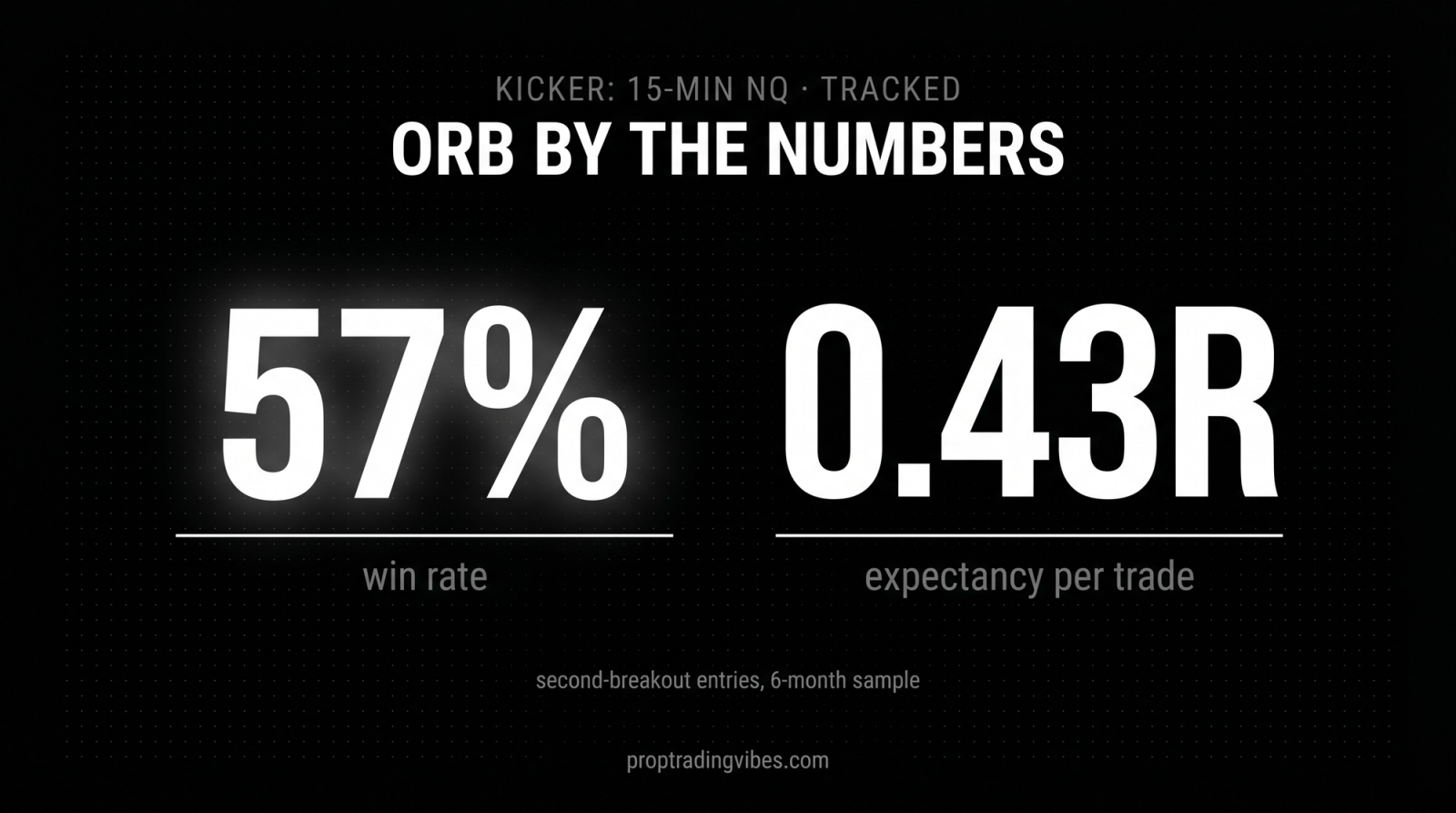
As of March 2026, my tracked ORB stats on NQ for the 15-minute timeframe over the past 6 months: 57% win rate on second-breakout entries, average winner of 1.8R, average loser of 1.0R. That gives me a positive expectancy of roughly 0.43R per trade. Nothing spectacular. But consistent enough to pass evaluations and stay funded.
I log every trade in a Google Sheet with columns for date, direction, opening range width, gap size, gap direction, entry price, stop, target, result, and a notes field. The notes field is where the real learning happens. "Entered too early before the retest." "Skipped because range was narrow but the gap was huge, should have taken it." These observations compound over months into a refined system.
Can You Use ORB on Instruments Other Than NQ and ES?
The opening range breakout works on any liquid, volatile instrument. I've personally used it on NQ, ES, CL (crude oil), GC (gold), and 6E (euro futures). Each market has quirks.
CL (crude oil) has a cash open at 9:00 AM Eastern and is extremely responsive to ORB. The opening range on CL captures the overlap between Asian and European sessions closing and the US session opening. Crude oil breakouts tend to trend hard once they clear the range. The downside is that CL can gap on inventory data (Wednesdays at 10:30 AM) which distorts the morning ORB setup.
GC (gold) responds to ORB, but the opening range is heavily influenced by the London session which is already well underway by 9:30 AM. I find the 30-minute ORB more reliable than the 15-minute on gold because the initial US session often just continues whatever London started.
For equity index futures, NQ and ES are the clear winners for ORB. RTY (Russell 2000) works but is choppier and produces more false breakouts. YM (Dow) is slower and the breakouts tend to be more gradual, which can be an advantage if you don't like the speed of NQ.
I do not recommend ORB on MNQ or MES micro contracts during low-volume sessions. The microcontract order books are thinner, and during the opening range the spread can widen briefly. It matters less on the breakout itself but can affect your fills on the initial entry.
What Are the Most Common ORB Mistakes?
I've made most of these mistakes personally. Some of them twice.
Entering before the range closes. At 9:37 AM during a 15-minute ORB setup, NQ is already above what looks like the range high. The temptation to jump in early is massive. Don't. Price can reverse in the final 8 minutes and reset the range. Wait for the full 15 minutes, mark the levels, then act. Patience is not optional with ORB.
Trading every breakout regardless of context. Not every day is an ORB day. If the overnight session was dead, the gap is tiny, and there's no news catalyst, the opening range breakout is more likely to fail than succeed. Being selective is the difference between an ORB trader who passes evaluations and one who bleeds out slowly.
Moving your stop. The stop is the stop. If you entered long on a breakout and set your stop at the midpoint, do not move it lower when price starts pulling back. If you wanted a wider stop, you should have used the full-range stop from the beginning. Moving stops on losing trades is the single most destructive habit in prop firm trading.
Ignoring the opening range on losing days. When I have a losing ORB trade, I am not allowed (by my own rules) to take another ORB trade that day. One ORB attempt per day. If it fails, I close the platform and review what happened. Revenge trading an ORB failure by trying the opposite direction or a different timeframe almost always compounds the loss.
Using ORB on instruments you don't understand. Every futures contract has different volatility, session times, and catalysts. NQ's ORB behaves nothing like CL's ORB. Before you apply this strategy to a new instrument, observe 20+ sessions first. The generic ORB concept is universal. The specific parameters need calibration for each market.
How Does Opening Range Size Predict the Day's Range?
Research going back to Crabel's original work shows a correlation between opening range width and the total daily range. Narrow opening ranges tend to precede wider daily ranges. Wide opening ranges tend to precede narrower daily ranges (relative to the open).
This is counterintuitive but makes sense. A narrow opening range means the market is compressed. Energy is building. When the breakout happens, it releases that stored energy in a directional move. A wide opening range means the market already moved significantly in the first 15-30 minutes. Much of the day's range has been used up.
On NQ, when the 15-minute opening range is under 25 points, the total daily range (high to low of the cash session) averages 1.5-2x the typical daily range. These are the days where ORB breakouts can produce 3:1 or 4:1 winners. When the 15-minute opening range is over 60 points on NQ, the remaining move after the breakout is often limited because the range already captured a big chunk of the day's volatility.
I track this ratio in my journal. Opening range width divided by the 20-day average daily range gives me a normalized number. When that ratio is below 0.4, I know the potential for a large move is elevated. When it's above 0.7, I expect a more modest breakout and set my targets accordingly.
This insight also helps with risk management on prop firm accounts. On compressed-range days, I'm more aggressive with my trailing stops because the probability of an extended move is higher. On wide-range days, I take profits faster and don't expect the 2x extension target to get hit.
How Do You Manage ORB Trades After Entry?
Trade management after the entry is where most of the edge lives. Getting in is mechanical. Staying in (or getting out) is where judgment matters.
My management rules for the 15-minute ORB on NQ:
Once I'm in a breakout trade, I do nothing for the first 10 minutes. Seriously. I set an alarm and step away from the screen. The most common reason traders lose on ORB is that they micromanage the first few minutes of the trade, panicking on every pullback. Price will pull back after the breakout. It's normal. If your stop was placed correctly, trust it.
After 10 minutes, I check the trade. If it's at or beyond the 1x extension, I take 50% off and move the stop to the breakout level (breakeven). If it's between entry and 1x, I leave everything alone. If it's back near the entry but hasn't hit my stop, I still leave it alone.
If the trade reaches 1.5x extension, I take another 25% off (so I'm down to 25% of original size) and trail the stop to the 1x extension level. The remaining piece rides with a guaranteed profit locked in.
On the rare day where NQ breaks out and just keeps running without pulling back, I trail the stop using the 5-minute candle lows. As long as each 5-minute candle is making a higher low (for longs), I stay in. The first 5-minute candle that closes below the previous 5-minute candle's low triggers my exit on the remaining position.
I close all ORB positions by 12:00 PM Eastern regardless of profit or loss status. After noon, the midday chop on NQ makes holding positions increasingly risky. The institutional order flow that drives ORB moves in the morning dries up at lunch. Holding into the afternoon turns a strategy trade into a gamble.
The bottom line: the opening range breakout is one of the most time-tested strategies in futures trading, and it's earned a permanent place in my playbook across multiple prop firm accounts. ORB works because it captures the highest-volume, highest-conviction price action of the day and converts it into a trade with defined risk, clear targets, and fast resolution. It won't make you rich on any single trade. But combined with gap analysis, proper filtering, and the discipline to skip bad setups, it produces a positive expectancy that compounds over weeks and months. If you're trading NQ or ES on a funded account and you don't have a structured strategy for the first 15 minutes of the cash session, you're leaving edge on the table.
Frequently Asked Questions
What is the opening range breakout strategy?
The opening range breakout (ORB) strategy involves marking the high and low of a specified time window after the market opens and trading in the direction of the breakout when price moves beyond that range. Traders typically use 5, 15, 30, or 60-minute windows starting from the cash session open at 9:30 AM Eastern for US equity index futures. The strategy was popularized by Toby Crabel in the late 1980s and remains one of the most widely used intraday approaches for futures, equities, and forex.
Which ORB timeframe is best for NQ futures?
The 15-minute opening range breakout works best on NQ (Nasdaq 100 E-mini) futures for most traders. The 15-minute window captures enough of the initial auction to filter out noise from the first few chaotic minutes while still allowing plenty of time for a full-session move. On NQ, the 15-minute opening range averages 30-45 points on a normal day, which provides comfortable stop placement for funded accounts at prop firms like Lucid Trading or FundedSeat.
What is the success rate of the opening range breakout strategy?
The opening range breakout strategy success rate varies by timeframe and market. On NQ futures, the 5-minute ORB produces approximately 45-52% winning trades, the 15-minute ORB wins about 52-58% of the time, the 30-minute ORB wins 55-62%, and the 60-minute ORB wins 58-65%. These win rates improve significantly when you filter setups using gap analysis, minimum range width requirements, and by waiting for a confirmed breakout rather than entering on the initial poke above the range.
Where should you place your stop on an ORB trade?
Stop placement on an opening range breakout trade has two main approaches. The conservative stop goes on the opposite side of the opening range, giving maximum room but wider risk. The midpoint stop goes at the center of the opening range, cutting risk in half while still providing a logical invalidation level. On NQ futures with a 15-minute ORB, the midpoint stop typically sits 15-25 points from entry, which produces better risk-adjusted returns over a large sample of trades.
How do you set profit targets for opening range breakout trades?
Profit targets for opening range breakout trades are typically set as multiples of the opening range width. The first target at 1x range extension gets hit approximately 60-65% of the time on valid breakouts. The 1.5x target hits about 45-50% of the time, and the 2x extension target hits on strong trending days. A common approach is scaling out: take half your position at 1x, another quarter at 1.5x, and trail the remaining position toward 2x with a breakeven stop.
Does the opening range breakout work for prop firm evaluations?
The opening range breakout is particularly well-suited for prop firm evaluations because it provides defined risk before entry, quick resolution within 60-90 minutes, and objective rules that reduce emotional decision-making during stressful evaluation periods. Most prop firm evaluations require consistent daily performance with controlled drawdowns, and ORB delivers exactly that. One solid ORB trade on NQ can produce $300-$600 in profit per micro contract, which adds up quickly toward evaluation targets.
What is the difference between ORB on NQ versus ES?
NQ (Nasdaq 100 E-mini) produces wider opening ranges (30-50 points on normal days), faster breakouts, and more explosive moves, but also sharper false breakouts. ES (S&P 500 E-mini) produces narrower opening ranges (10-20 points), slower more institutional breakouts, and more gradual price movement. NQ works better with the 15-minute ORB timeframe while ES responds well to the 30-minute window. NQ ORB excels on trending days while ES ORB works best on days when the initial auction transitions into a clean directional move.
How do you combine opening range breakout with gap analysis?
Combining the opening range breakout with gap analysis involves using the overnight gap direction and size as a filter before trading the ORB setup. A gap up followed by a breakout above the opening range high is the highest-probability setup because it confirms buyer control. A gap up followed by a breakout below the range signals a gap fill play targeting the prior close. The gap size matters: gaps under 10 points on NQ are too small to provide a meaningful directional filter, while gaps of 30+ points create strong directional bias for ORB entries.
When should you avoid trading the opening range breakout?
Avoid trading the opening range breakout on major news days (FOMC rate decisions, CPI releases, Non-Farm Payrolls) when the initial move at 8:30 AM often exhausts the day's range before the cash session opens. Skip ORB when the opening range is unusually narrow (under 20 points on NQ), when the overnight session was range-bound with no directional conviction, on Monday mornings when institutional volume tends to be lighter, and during triple witching expiration weeks when hedging flows distort normal price behavior.
How do you filter false breakouts on the opening range?
False breakouts on the opening range can be filtered by waiting for a candle close beyond the breakout level rather than entering on the first tick, confirming the breakout with a volume spike on the breakout candle, checking overnight context for directional bias, and most importantly letting the first breakout attempt play out before entering on the second break in the same direction. On NQ specifically, the first break of the opening range high or low is a false breakout more than 40% of the time, making the "retest and go" pattern on the second breakout a much more reliable entry signal.
Can you trade the opening range breakout on crude oil and gold futures?
CL (crude oil) futures respond well to the opening range breakout strategy, with a cash open at 9:00 AM Eastern and strong trending characteristics once the range is cleared. Gold futures (GC) are more influenced by the London session that is already active by 9:30 AM, making the 30-minute ORB more reliable than the 15-minute on gold. Both markets require separate observation periods of at least 20 sessions to calibrate range width expectations, stop distances, and target extensions before trading with real capital or on prop firm evaluation accounts.
How does opening range width predict the day's range?
Opening range width has an inverse correlation with the day's remaining range. A narrow 15-minute opening range on NQ (under 25 points) typically precedes a larger daily range, as the compression signals stored energy waiting for a directional catalyst. A wide opening range (over 60 points) suggests much of the day's movement has already occurred, limiting the potential breakout extension. Tracking the ratio of opening range width to the 20-day average daily range helps calibrate target expectations and trailing stop aggressiveness for each session.
What is the midpoint of the opening range and why does it matter?
The midpoint of the opening range is the price exactly halfway between the opening range high and low. It serves two purposes in the ORB strategy: as a stop placement level that cuts risk in half compared to placing the stop on the opposite side of the range, and as a reference level for breakout strength. If price breaks above the opening range high but then falls back to the midpoint, the breakout is losing momentum and may fail. The midpoint stop approach produces better risk-adjusted returns on NQ futures because it limits the loss per trade while maintaining a reliable invalidation level.
Who developed the opening range breakout strategy?
The opening range breakout strategy was developed and popularized by Toby Crabel, a trader and researcher who published his findings in the late 1980s. Crabel's research demonstrated that narrow opening ranges produced larger subsequent moves than wide opening ranges, and that breakouts from the initial trading period had strong predictive value for the rest of the session. While Crabel focused on daily ranges and stocks, futures traders adapted his concepts to intraday timeframes using 5, 15, 30, and 60-minute windows at the cash session open.
How many ORB trades should you take per day?
One opening range breakout trade per day is the recommended maximum, especially for traders on prop firm evaluation accounts where preserving capital is critical. Taking multiple ORB attempts in a single session often leads to overtrading and compounding losses. If the first ORB setup fails, the probability that a second attempt in the opposite direction also fails increases because the market is likely in a choppy, range-bound state. On NQ futures, one solid ORB trade producing a 2:1 or 3:1 reward-to-risk winner is enough to meet most weekly evaluation profit targets at firms like Top One Futures or FundingPips.