
Table of contents
Table of contents

Quick Answer, Prop Firm Rules
- Prop firm rules define the loss, position, trading-time and payout conditions attached to an account. The consequence depends on the rule: a maximum-loss breach can close the account, a soft daily-loss limit can pause trading, and a payout gate can delay a request without breaching the account.
- The 8 most common rules are: trailing drawdown, daily loss limit, profit target, consistency rule, max position size, no news trading, no overnight holds, and scaling plan requirements.
- Trailing drawdown (EOD vs. intraday) is the rule that kills the most accounts. EOD drawdown only recalculates at market close; intraday trailing moves tick-by-tick against unrealized profits.
- Original data: across 9 futures prop firms in our June 2026 comparison, 6 of 9 use EOD trailing drawdown and 7 of 9 enforce a consistency rule, with caps ranging from 30% to 50% (median 40%).
- The rules on the sales page are never the full picture. Hidden restrictions in the fine print (time-of-day limits, instrument caps, payout thresholds) catch more traders than the obvious ones.
What Are Prop Firm Rules and Why Do They Exist?
Prop firm rules are the specific conditions, loss limits, and trading restrictions that govern your funded account. Break one, and the account is gone. No warning, no appeal on most platforms.
I've traded with over 50 prop firms since 2022 and retained a documented payout record across multiple firms. I've also blown dozens of accounts. Not from bad trades. From not reading the rules carefully enough, or from rules I didn't even know existed until my account got terminated.
Every prop firm needs rules because they're managing risk across thousands of traders simultaneously. They're not handing you real capital and hoping you don't blow it up. The rules are the guardrails that protect the firm's risk pool, and honestly, they protect you from yourself. A trader without loss limits is a trader who revenge-trades a $50K account into the ground by Thursday.
But not all rules are created equal. Some are standard across the industry. Some are unique to specific firms. Some aren't even on the sales page. And the way different firms implement the same rule can mean the difference between keeping your account and losing it on a normal trading day. If you're new to the whole model, our explainer on what a funded trading account actually is covers the fundamentals before you get into the rule weeds.
How the Same Rule Changes by Program and Stage
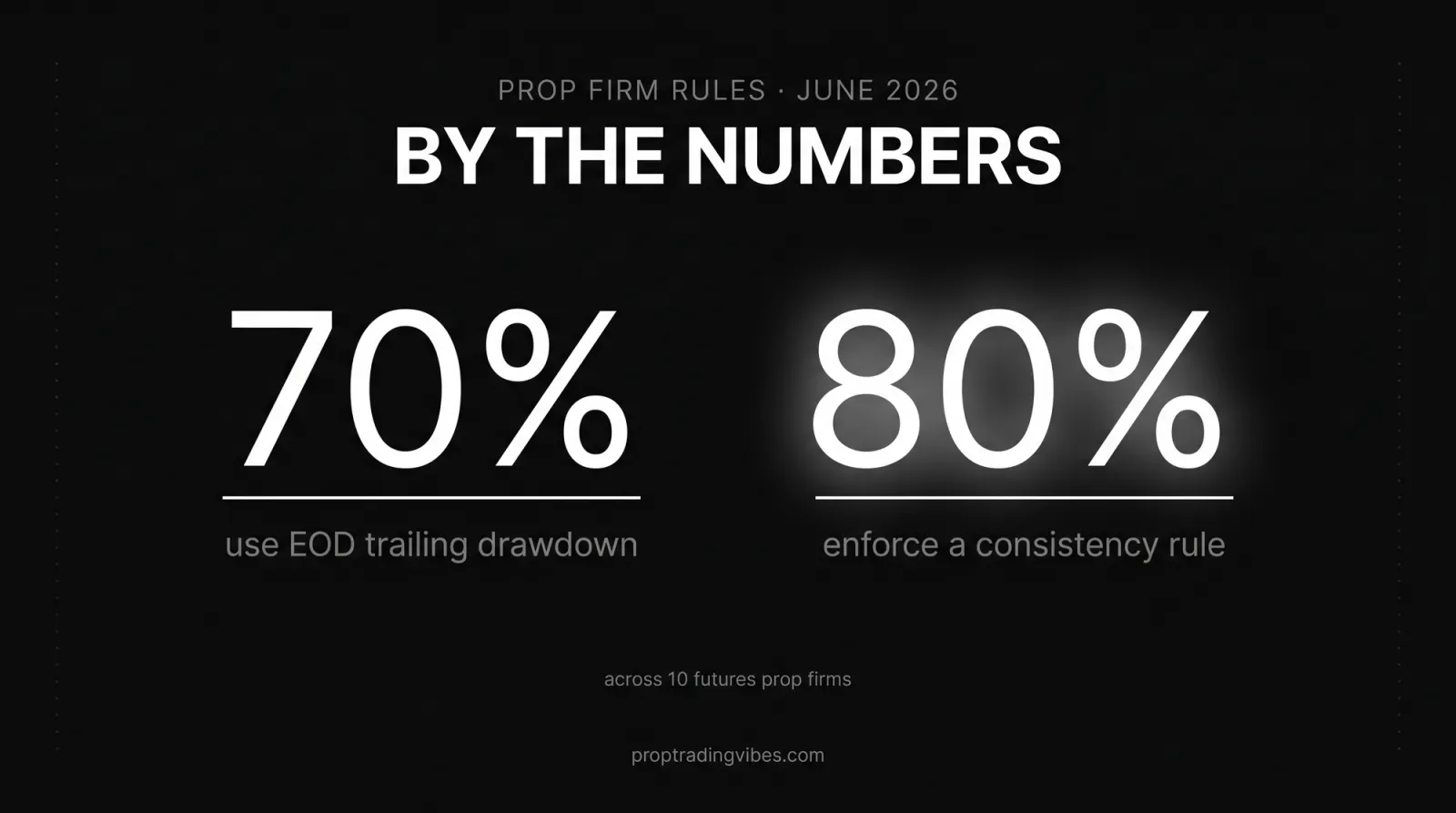
A firm-wide label is rarely enough. The same company can use one drawdown clock during evaluation, another after passing and a third set of payout gates. The useful comparison names the current program, size and stage.
Five current examples show the pattern:
- EOD describes when the maximum-loss floor moves. It does not prove that an intraday touch of the active floor is recoverable. Apex and Topstep both calculate from end-of-day balance while enforcing the active floor in real time.
- Consistency can sit in evaluation, Sim Funded payout eligibility, both or neither. MFFU Builder 50K has no evaluation consistency rule; MyFundedFutures then applies 50% in Sim Funded. LucidPro uses 40% for Sim Funded payouts.
- A daily loss limit can be a hard breach or a soft pause. MFFU Builder 50K uses a $1,000 soft daily limit in evaluation and Sim Funded, while Topstep describes its selected DLL as a temporary violation rather than an automatic account closure.
- Stage transitions can change the risk box. TradeDay calculates both evaluations at end of day, then uses EOD drawdown for Fast Pass Funded Sim and intraday drawdown for Quick Pay Funded Sim.
| Current route | Maximum-loss behavior | Daily-loss behavior | Consistency or payout gate |
|---|---|---|---|
| Apex EOD Performance Account | Floor moves from EOD balance; active floor enforced intraday | Use the selected account's current limit | Five qualifying days, 50% payout consistency, safety net and $500 minimum |
| LucidPro 50K Sim Funded | EOD trailing; locks at starting balance plus $100 | $1,200 soft DLL until the initial trail is reached; then scales by balance | Profit goal, 40% consistency and buffer before request |
| MFFU Builder 50K | EOD maximum loss in evaluation and Sim Funded | $1,000 soft daily limit in evaluation and Sim Funded | No evaluation consistency; 50% in Sim Funded |
| TradeDay Quick Pay | Evaluation calculated EOD; Funded Sim trails intraday | Maximum drawdown is the stated failure rule | Five evaluation days and 30% consistency |
| Topstep Express Funded | Floor moves from EOD balance; active floor monitored in real time | Selected DLL is a temporary violation | Standard: five $150+ winning days; Consistency: three days plus 40% |
These examples were checked against the exact current program and stage owner on September 7, 2026. They are not firm-wide defaults. Recheck the selected account before purchase because a new cohort or product version can carry different rules.
How Does the Trailing Drawdown Work at Prop Firms?
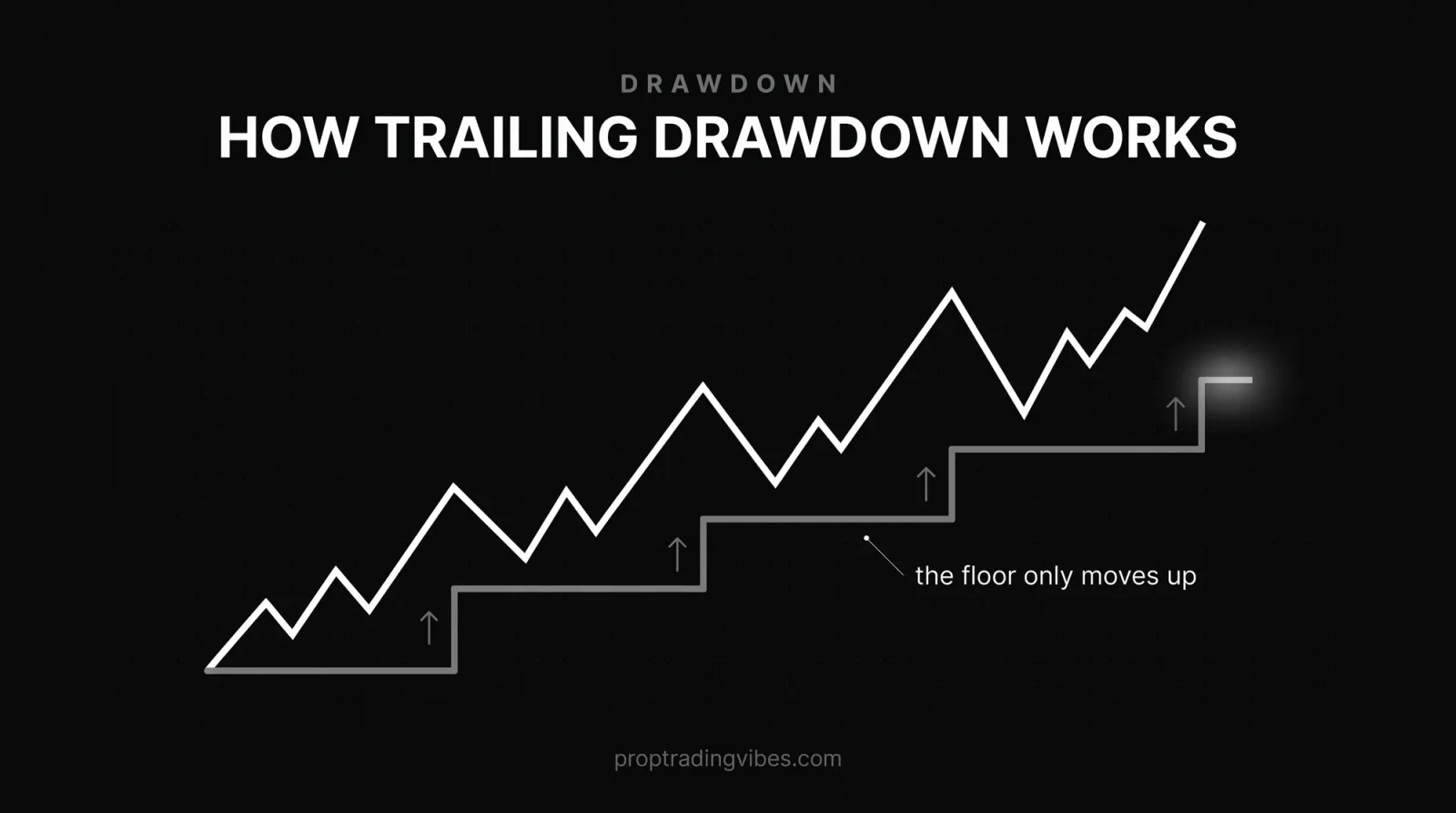
The trailing drawdown is the single most important rule in prop trading. It kills more accounts than any other restriction. Not because traders don't know about it, but because they don't understand the mechanics until it's too late.
A trailing drawdown is a maximum loss limit that moves upward as your account grows but never moves back down. Once your account equity reaches a new high, the drawdown floor ratchets up. Your allowed loss shrinks relative to your peak.
There are two types: intraday trailing and end-of-day (EOD) trailing.
Intraday trailing drawdown tracks your equity in real time, tick by tick. If you're up $3,000 in unrealized profit at 10:30am and then give back $2,800 before closing the trade, the drawdown floor already moved up by $3,000. It doesn't care that you only realized $200.
EOD trailing drawdown only recalculates after the market closes, based on your closing balance. That same $3,000 intraday spike doesn't count if you close the day at $200 in profit. The floor only moves up by $200.
The difference is massive. On a $50,000 account with a $2,500 trailing drawdown, one volatile MNQ session can eat $800-$1,200 more of your drawdown buffer under intraday trailing compared to EOD.
Do not infer the breach clock from the word EOD. Apex and Topstep move their floors from end-of-day balance but monitor the active floor intraday. TradeDay Quick Pay changes from an EOD evaluation calculation to intraday trailing after passing.
Early account failures reinforced the need to model intraday trailing before trading. I was hitting my profit targets but letting unrealized gains push my floor too high, then getting stopped out on normal pullbacks. Switching to firms with EOD trailing changed everything for me.
Floor locks are product-specific. On an Apex 50K EOD account, the floor can stop at $50,000. LucidPro instead locks its EOD maximum-loss floor at the starting balance plus $100 after the account exceeds the initial trailing amount. Similar labels do not mean the lock value is identical.
What Is the Daily Loss Limit?
A daily loss limit is separate from the maximum-loss floor. Some routes treat it as a soft pause for the session; others make it a hard account violation. The reset time, calculation basis and stage must be read from the exact rule owner.
There is no useful firm-wide “typical” daily loss limit. LucidPro 50K starts with a fixed $1,200 soft DLL, MFFU Builder 50K uses a $1,000 soft DLL, and other routes omit a DLL or attach a different amount and consequence.
Here's what catches traders off guard: at some firms, the daily loss limit includes unrealized losses. So if you're holding a position that's $1,200 against you and your daily limit is $1,500, you only have $300 of room left for the entire day. Close that position for a $600 loss and re-enter, and you've already used $600 of your $1,500 daily limit even though your unrealized loss earlier was worse.
No DLL does not mean unlimited risk. The maximum-loss floor, contract limit and payout buffer remain binding. Conversely, the presence of a DLL does not always mean the account closes when it is touched; some current routes pause trading instead.
Set planned risk from the smallest remaining constraint: maximum-loss room, daily-loss room, contract cap and any payout buffer you intend to protect. A fixed percentage of the DLL is not a universal sizing rule, especially on routes with no DLL or a soft pause.
How Does the Profit Target Affect Your Strategy?
The profit target is the amount you need to earn during the evaluation phase to pass and get funded. Most firms set it between 6% and 10% of the account size.
A profit target is only one evaluation variable. The usable loss buffer, drawdown sequence, minimum days and consistency formula determine how difficult that target is for a specific strategy.
Evaluation-style profit targets usually end after passing, but funded and Sim Funded routes can introduce new profit gates before payout. LucidPro, LucidDirect and Tradeify Lightning all require model-specific profit conditions before a request, so “funded” does not mean money is immediately withdrawable.
Traders who fail evaluations usually fail because they chase the profit target. They're at $2,400 out of $3,000 needed and start oversizing positions to close the gap. That's when they hit the drawdown limit.
The firms know this. That's why the profit target exists. It's not just a performance benchmark. It filters for discipline. The traders who pass consistently are the ones who trade the same size whether they need $800 more or $3,000 more.
What Is the Consistency Rule and Why Is It Controversial?
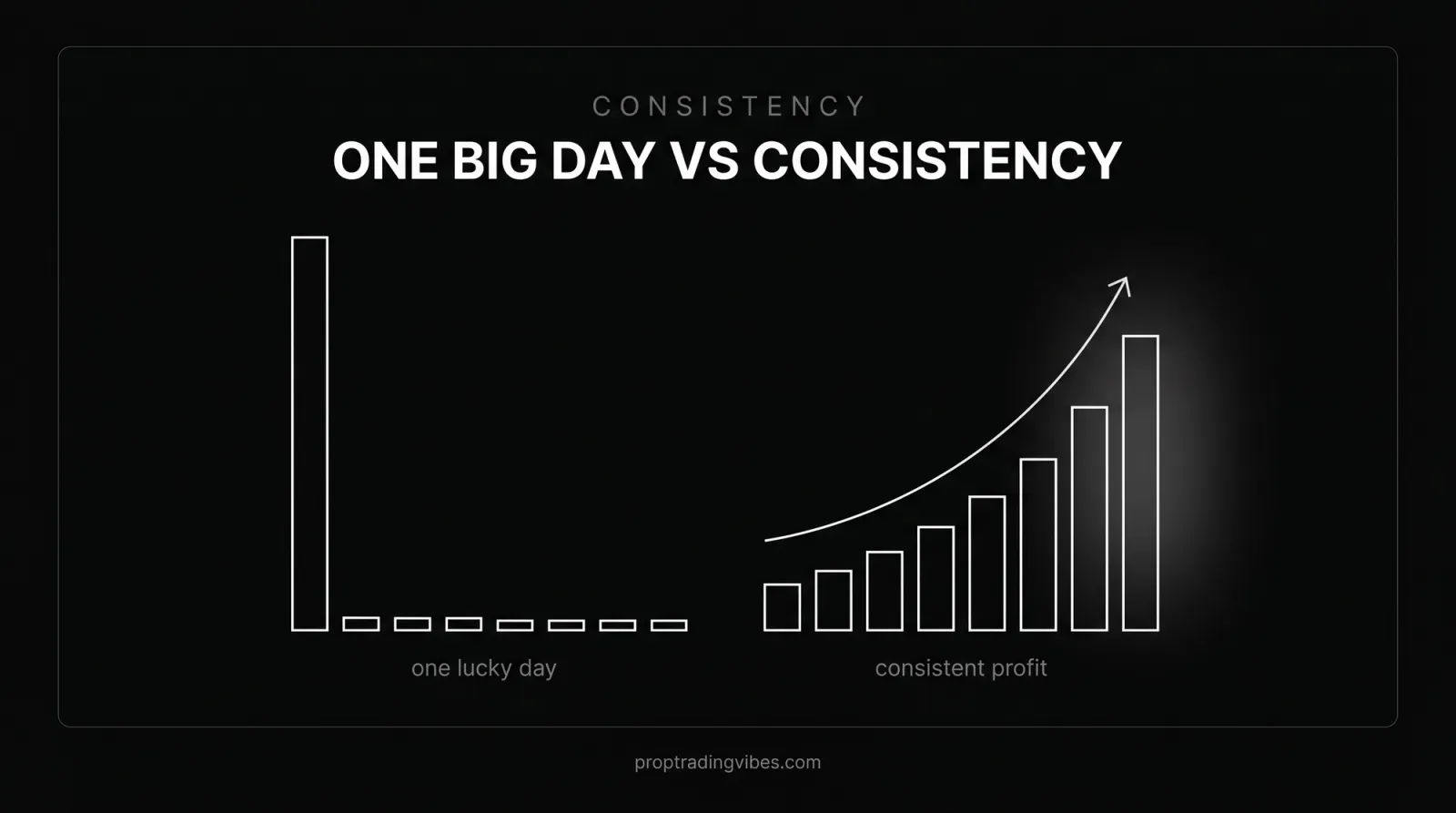
A consistency rule limits how much of total profit may come from one day or trade. Its location matters as much as its percentage: evaluation consistency affects passing, while payout consistency delays eligibility until the denominator is large enough.
Current examples differ sharply. TradeDay Quick Pay uses 30% during evaluation. MFFU Builder 50K has no evaluation consistency rule, and MyFundedFutures applies 50% in Sim Funded. LucidPro uses 40% for Sim Funded payouts. Topstep offers an XFA path that uses three trading days plus 40% consistency.
If one day produces $2,600 and total profit is still $2,600, that day represents 100% of the current total. On a 40% rule, the account has not necessarily breached; the trader may need to keep trading until total profit is at least $6,500. The exact consequence belongs to the selected route.
FundingPips shows why the reward cycle matters. Its 2 Step Standard On Demand cycle uses 35% consistency. Weekly and Biweekly do not use that 35% gate. Monthly accounts opened from August 15, 2026 use 35% consistency plus seven profitable days.
Firms use consistency rules to separate repeatable profit from one concentrated result. That does not make one threshold universally fair or predictive; it makes the denominator and consequence part of the product traders are buying.
I understand the logic. But the implementation frustrates me. Consistency rules punish traders who have a legitimately great day. If NQ gaps up 400 points on FOMC and I'm positioned perfectly, I shouldn't be penalized for good timing. But under most consistency rules, I need to spread that profit over multiple days somehow.
The practical workaround: know your firm's consistency threshold and plan accordingly. If the cap is 35% of total profit, and your target is $3,000, your max single-day profit should stay under about $1,050. Once you get close to the target, scale down your size so you don't accidentally blow past the consistency cap on your final day.
Consistency is stage-specific. MFFU Builder 50K has none in evaluation, 50% in Sim Funded and none in Live. Take Profit Trader and other firms use their own stage rules. Check the exact account rather than carrying an evaluation answer into the funded stage.
What Are the Position Size and Scaling Limits?
Every prop firm caps how many contracts you can trade simultaneously. On a $50K futures account, that's usually 5-10 standard contracts or the equivalent in micros.
The max position size exists to prevent one catastrophic trade from wiping out the account instantly. If you can trade 100 NQ contracts on a $50K account and the market moves 10 points against you, that's a $20,000 loss in seconds. No drawdown rule can protect against that.
Scaling also changes by route. TradeDay Fast Pass Funded Sim adds one contract per $2,000 of end-of-day profit, while Quick Pay keeps its account-tier position limit. Other products grant the full published maximum immediately or use a different milestone table.
The scaling plan matters because it directly affects your earning potential in the early days of a funded account. If you're capped at 2 contracts until you make $2,000, and your normal trading size is 5 contracts, you're operating at 40% capacity. Your daily P&L will be smaller, which means reaching the payout threshold takes longer.
I prefer routes that publish the full position allowance immediately when that matches my risk plan. LucidPro documents full maximum size from the start with no scaling plan. That is a LucidPro fact, not a firm-wide Lucid Flex claim.
The position size trap I see most often: traders max out their contract size on every trade. If your limit is 10 contracts, they trade 10 contracts every time. That leaves zero room for adding to winners or scaling into positions. I rarely use more than 60% of my allowed contracts on the initial entry. That gives me room to add if the trade moves in my favor.
Does News Trading Get You Banned from Prop Firms?
News trading restrictions vary widely across the prop firm industry. Some firms ban it outright. Others allow it with conditions. A few don't care at all.
News rules are route-specific. Breakout permits news trading on its crypto programs. FundingPips applies a window around listed events on Master accounts, with payout deductions or other consequences depending on the violation. A futures account at another firm can use a different calendar and clock.
A restriction can apply to opening, closing or holding through an event, and the window may continue through a speech rather than ending at the scheduled start. Use the current official calendar and the exact stage policy.
Why do firms restrict this? Because news events create extreme volatility and slippage. A 200-point gap on NQ in 3 seconds can blow through any stop loss. The firm's risk management can't protect against that kind of move, so they prevent traders from being exposed to it.
A conservative personal buffer can reduce slippage exposure, but it does not replace the rule. Record the firm’s event list, time zone, before-and-after window, holding rule and consequence for the selected account.
Can You Hold Overnight Positions at Prop Firms?
Overnight hold restrictions determine whether you can keep positions open after the market's daily close. In futures trading, "overnight" usually means holding through the session close into the next trading session.
Holding permission must name the session boundary. Tradeify requires futures positions flat by 4:45 PM ET. MFFU Builder 50K also requires positions closed before the end of the trading session. Breakout permits weekend holds on its crypto product, which is not a futures route.
The reasoning behind the restriction: overnight gaps can be brutal. If NQ opens 150 points lower on Monday morning because of geopolitical news over the weekend, that gap can blow through your trailing drawdown instantly. The firm can't manage that risk if you're holding positions through the close.
If you're specifically a swing trader, Tradeify is not a next-session hold option: every position must close by 4:45 PM ET. Breakout permits overnight and weekend positions under its own rules. For day traders, the practical task is simpler: set a forced-flat reminder before the firm's cutoff and leave time for rejected exit orders.
How Have Prop Firm Rules Changed from 2024 to 2026?
The prop firm industry has gone through more rule changes in the past two years than in the entire decade before it. If you evaluated prop firms in 2023 and haven't looked since, the landscape is different.
Consistency rules went from rare to standard. Current products place consistency in different stages. MFFU Builder 50K has none in evaluation and 50% in Sim Funded, while LucidPro applies 40% to Sim Funded payouts. I do not publish a 2024-to-2026 adoption percentage without a dated inventory normalized by asset, program and stage.
EOD drawdown replaced intraday trailing. Firms that were using intraday trailing lost traders to competitors with EOD. The market spoke. By mid-2026, 6 of 9 firms in this sample run EOD trailing and just one uses intraday on the compared plan.
Payouts got faster and more frequent. In 2023, many firms made you wait 30 days for your first payout. Now, first payouts within 7-14 days are common. Some firms offer near-instant payouts after your second or third withdrawal.
Scaling plans got more aggressive. More firms introduced scaling requirements, but they also made the scaling milestones more achievable. The trade-off is that you start smaller but unlock full size faster.
Hidden rules got more hidden. As competition increased, firms started burying restrictive rules deeper in their terms of service. The sales page shows you the attractive numbers. The full rulebook is in a PDF you download after purchasing the account.
Simulated funded accounts became the norm. Almost every firm now uses simulated funded accounts rather than live capital. This changed the regulatory picture and allowed firms to adjust rules more freely. The practical impact on traders is minimal, since your payouts are still real money.
I track these changes across every firm I trade with. The trend is clear: rules are getting more sophisticated, more numerous, and more targeted at specific trading behaviors the firms don't want to underwrite. This is also why prop trading carries real tax and reporting consequences once the payouts start; if you're trading from outside the US, our guide to prop trading taxes and structure in Germany walks through how funded income is treated.
What Are the Hidden Rules Most Firms Don't Advertise?
Every prop firm has rules that don't appear on the pricing page or the FAQ. You find them in the terms of service, the help center, or sometimes only after your account gets flagged.
Minimum trading days. Most firms require 5-10 active trading days before you can pass the evaluation or request a payout. "Active" usually means a day where you opened at least one trade. Some firms define it as a day with at least one round-trip trade.
Maximum trading days. Some evaluations have a time limit. If you don't pass within 30 or 60 days, the evaluation expires and you need to buy a new one. Other firms offer unlimited time, which is a selling point.
Instrument restrictions. The sales page says "trade futures." The rules document specifies which contracts. Some firms only allow CME Group products. Others exclude certain low-liquidity contracts. A few restrict you to specific sessions (RTH only, no globex overnight).
Copy trading and automation rules. Many firms ban or restrict automated trading systems, copy trading from external signals, and trade copiers across multiple accounts. If you're running the same strategy on 5 accounts simultaneously and they detect identical entries, that can trigger a violation.
Payout thresholds and splits. Your first payout might only be 70% or 80% of profits, with the rest going to the firm. Subsequent payouts improve. Some firms cap your first withdrawal at a low number (like $1,000) regardless of how much you've made.
Account inactivity. Stop trading for 14-30 days and some firms will close your account. No refund, no warning on some platforms.
I got caught by an instrument restriction once. Trading an instrument outside the approved list can terminate an otherwise compliant account. The trade was profitable. Didn't matter. Violation.
Read the full terms of service before you trade a single contract. Every time.
My Rule Hierarchy: Which Rules Actually Matter Most?
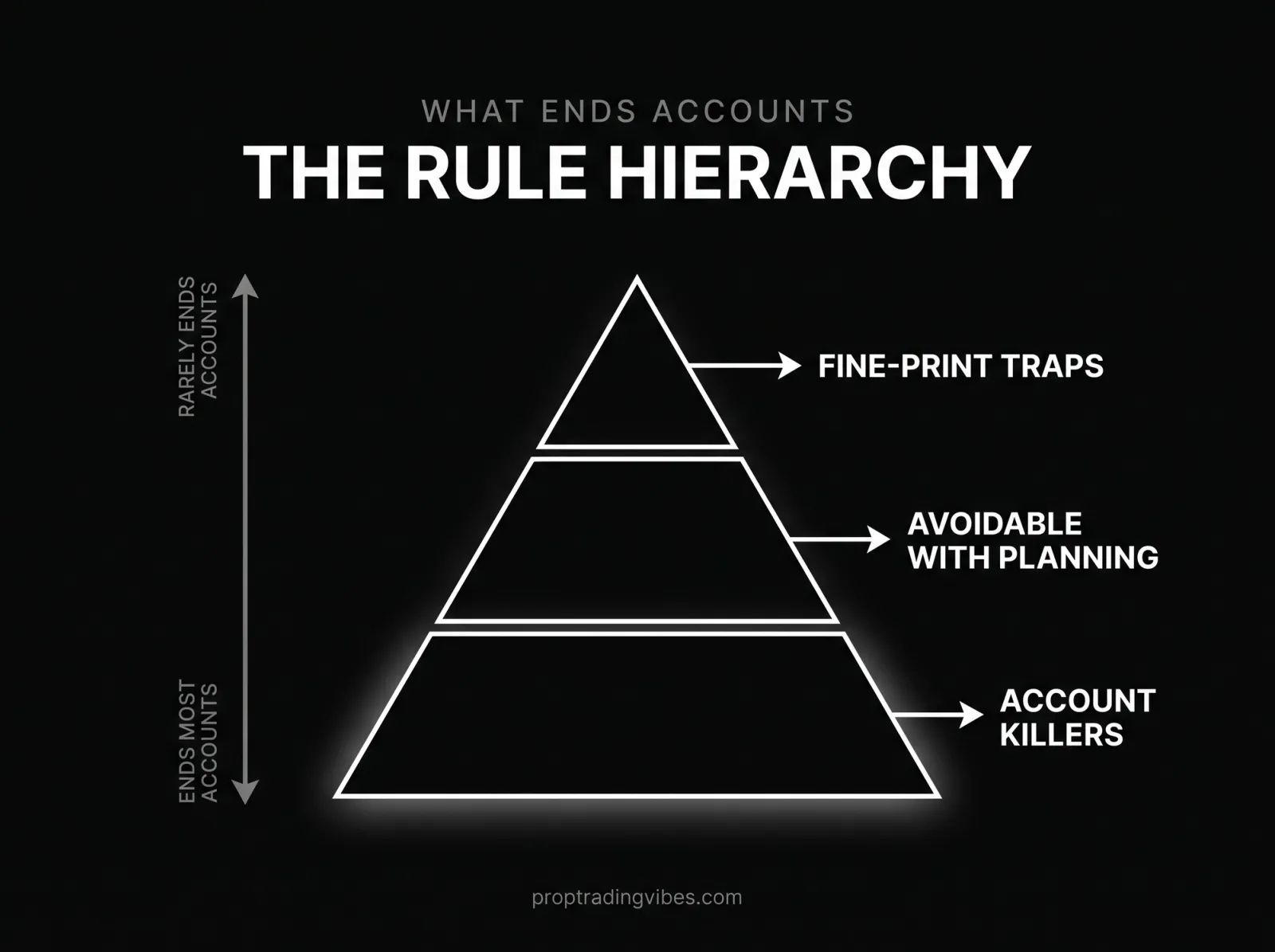
After trading with 50+ prop firms, I rank rules by their direct account consequence: hard maximum-loss breaches first, then daily pauses, payout gates, deductions and warnings. This is an editorial risk order, not a statistical claim about hundreds of account terminations.
Tier 1: Account killers (these end most accounts)
- Trailing drawdown. The number one account killer. Doesn't matter how good your strategy is if your drawdown management is sloppy.
- Daily loss limit. One bad session and you're done for the day. Two bad sessions in a row and your drawdown is in dangerous territory.
- Consistency rule. Catches traders who passed the evaluation with one lucky day and can't replicate it.
Tier 2: Avoidable with planning
- News trading restrictions. Easy to avoid. Put the economic calendar on your screen and stay flat during events.
- Overnight hold restrictions. Close your positions before the cutoff. Simple.
- Max position size. Know your limit and don't exceed it. Set it in your platform settings.
Tier 3: Fine print traps
- Minimum trading days. Just trade the minimum required days. Don't try to pass on day 2 and then sit idle.
- Hidden restrictions. Read the terms of service. Seriously. All of them.
The Tier 1 rules require actual trading skill and discipline to manage. You can't just "avoid" the trailing drawdown; you have to actively manage your risk around it. The Tier 2 and Tier 3 rules are more about preparation and awareness. They're the ones that catch lazy traders, not bad traders.
My best advice: before you take a single trade on any prop firm account, write down the exact numbers for your trailing drawdown, your daily loss limit, and your consistency rule threshold. Tape them to your monitor. Those three numbers define the box you're trading inside.
How to Pick a Firm Based on Its Rules
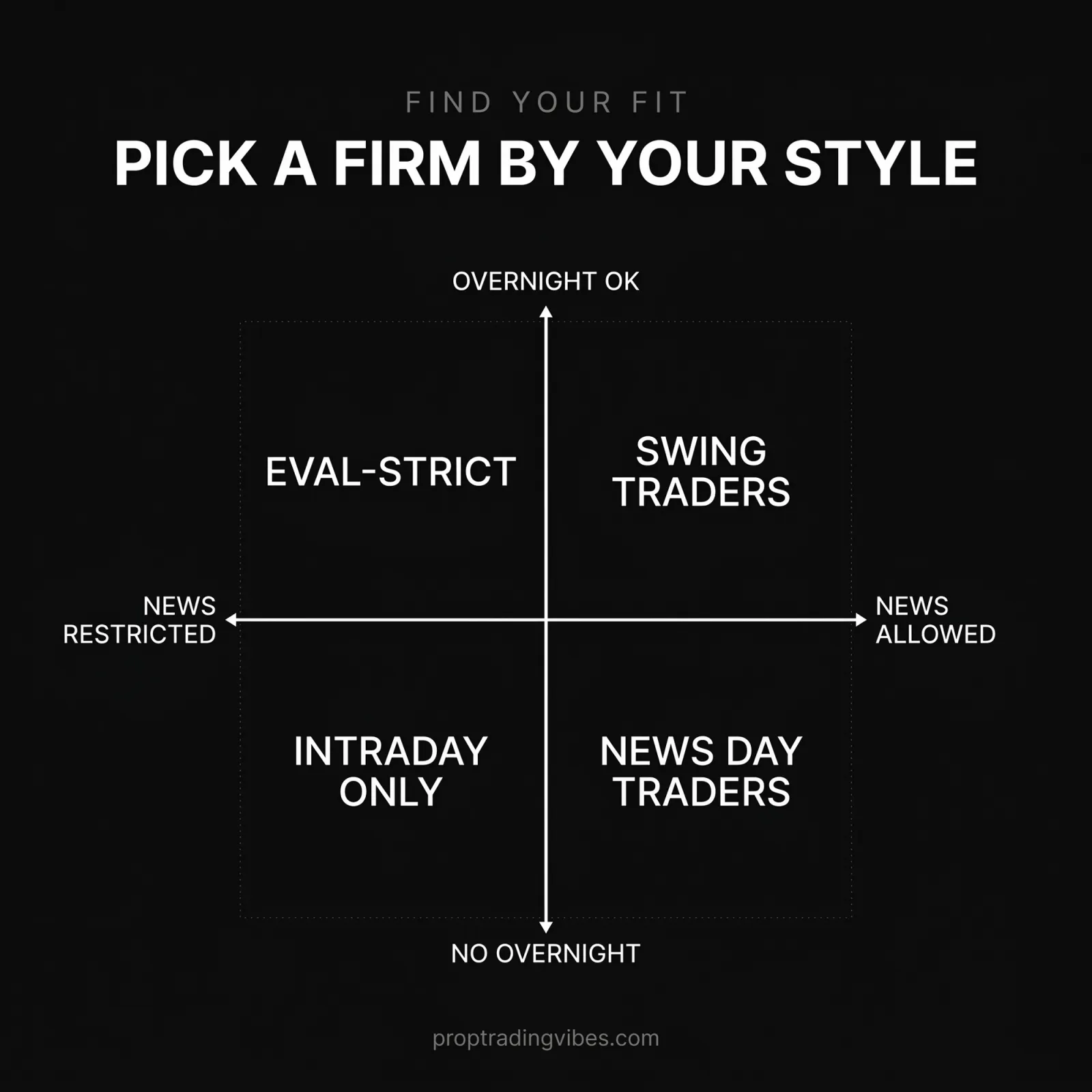
The rules table above is most useful when you read it through the lens of your own trading style. A few patterns from the data:
- If you hold futures beyond an intraday session, verify the exact route and cutoff before buying. MFFU Builder 50K requires positions closed before session end, and Tradeify requires futures positions flat by 4:45 PM ET. Breakout’s weekend permission belongs to its crypto product, not to a futures account.
- If you trade the news, the conditional and restricted firms (Take Profit Trader, MyFundedFutures) will frustrate you. Breakout and the other "allowed" firms fit better.
- If you have occasional big days, the consistency cap is your constraint. A 30% cap (TradeDay) is far tighter than a 50% cap (Apex, Take Profit Trader), and Top One Futures ranges from 15% (Ignite) to 40% (Elite programs) depending on the program. Breakout's no-consistency Classic plan removes the problem entirely.
- If drawdown management is your weak spot, prioritize EOD trailing over intraday, and look for a floor that locks at your starting balance like Apex and Lucid Trading.
If you're trading from the US and weighing which of these firms actually accept your account and payout method, our breakdown of the best prop firms for US traders pairs well with this rules comparison.
Why Prop Firm Rules Actually Protect You as a Trader
It's easy to see rules as the enemy. I did for a long time. Every drawdown limit, every consistency check, every position cap felt like the firm trying to prevent me from making money.
That perspective is wrong.
Without a trailing drawdown, I would have blown accounts far worse than I did. The drawdown floor is basically a forced stop-loss on your worst impulses. You think you want unlimited downside risk? You don't. I've watched traders in unregulated setups lose $30,000+ in a single session because nothing stopped them.
The daily loss limit forces you to walk away. Even when your ego says you can make it back. Even when your analysis says the next trade is the one. The best traders I know treat hitting the daily limit as a signal, not a punishment. If the market got the best of you today, tomorrow is a clean slate.
Consistency rules force you to build a repeatable edge instead of gambling. Yes, they're annoying when you have a legitimately great day. But the rule isn't designed for you, the disciplined trader. It's designed for the version of you that sizes up 10x on a "sure thing" and tries to pass the evaluation in one trade.
The traders who consistently profit from prop firms are the ones who treat the rules as part of their strategy, not obstacles to it. Build your trading plan around the rules. Size your positions to stay well within the drawdown limit. Spread your profits across multiple days. Close before the session cutoff.
The rules aren't the problem. How you trade within them is.
Frequently Asked Questions
What are the most common prop firm rules?
Common prop-firm rules include maximum loss, daily loss, profit target, consistency, position size, permitted instruments, trading times, news, automation, inactivity and payout eligibility. Their calculation and consequence can change by program, size, stage and cohort.
How does the trailing drawdown work at prop firms?
A trailing drawdown is a maximum-loss floor that can move upward and not back down. EOD identifies when the floor is recalculated; it does not by itself identify when a breach is checked. Apex and Topstep calculate from end-of-day balance while monitoring the active floor in real time.
What is the consistency rule in prop trading?
A consistency rule limits how much of total profit may come from one day or trade. It can apply during evaluation, at payout, in both places or not at all. The denominator, threshold and consequence must come from the exact program and stage.
Can you hold positions overnight at prop firms?
The label is ambiguous unless the session boundary is stated. Tradeify allows a position to continue after midnight within the same CME session, but it requires every position closed by 4:45 PM ET and prohibits holding through the maintenance break or weekend. Other firms publish different cutoffs, so verify the exact account policy before treating any program as overnight-friendly.
Do prop firms allow news trading?
News rules differ by route. The policy can restrict entries, exits or holding around listed events and speeches. Breakout permits news trading on its crypto programs; FundingPips applies model-specific Master-account windows. Check the current account owner and calendar before trading.
What happens if you break a prop firm rule?
The consequence depends on the rule. A hard maximum-loss breach can close the account. A soft daily-loss limit can pause trading for the session. A consistency or profit gate can delay payout eligibility. Some prohibited-practice rules can cause deductions, warnings or closure.
How much is a typical daily loss limit at prop firms?
There is no useful firm-wide typical daily loss limit. The amount, calculation basis and consequence vary by program and stage. LucidPro 50K and MFFU Builder 50K both publish soft DLLs, while other routes omit a DLL or treat it as a hard violation.
Are prop firm rules the same during evaluation and when funded?
No. Passing can change drawdown, daily-loss, consistency, position and payout rules. TradeDay Quick Pay changes from an EOD evaluation calculation to intraday trailing in Funded Sim. MFFU Builder 50K moves from no evaluation consistency to 50% in Sim Funded and none in Live.
What is a scaling plan at a prop firm?
A scaling plan limits initial position size and raises it after defined milestones. Tradeify Select Flex publishes a reduced starting size and a larger scaled maximum, while other Tradeify paths use their own position tables. TradeDay Fast Pass adds one contract per $2,000 of end-of-day profit in Funded Sim; that is not a firm-wide rule. The account-specific table matters more than a firm-wide scaling label.
Which prop firm has the most relaxed rules?
There is no universal most-relaxed firm because the answer changes by asset, program and stage. Compare the rules your strategy is most likely to touch: drawdown clock, DLL consequence, session cutoff, consistency and payout buffer.
How can I avoid breaking prop firm rules?
Record the exact program, size, stage and cohort before trading. Set platform limits for contracts and loss, maintain a buffer above the active floor, track consistency against current total profit, use the official news calendar and close before the documented session cutoff. Size risk from the tightest active constraint rather than a universal percentage.
What are hidden prop firm rules I should know about?
Easy-to-miss rules include inactivity, permitted instruments, contract equivalents, session cutoffs, news windows, automation restrictions, copy-trading rules, payout buffers and changes after passing. They are not necessarily hidden, but they may live outside the sales page.
Why do prop firms have consistency rules?
Firms use consistency rules to limit reliance on one concentrated result. The rule may reduce a risk team’s exposure, but a percentage alone does not prove future trader performance. For the trader, one large day can require more total profit before passing or payout.
How has the prop firm industry changed its rules since 2024?
Rule sets have become more product-specific. A firm can sell several routes with different drawdown clocks, consistency gates and payout schedules. Compare the exact current account and stage instead of relying on an industry-wide percentage or firm-level label.
The bottom line: prop firm rules are the framework you trade inside, not obstacles to trade around. The trailing drawdown, daily loss limit, and consistency rule are the three that will determine whether you keep your funded account. Learn them cold for every firm you trade with. Write the numbers down. Build your position sizing and risk management around those limits. The traders who treat rules as part of their strategy, not a constraint on it, are the ones who collect consistent payouts. Compare the rules table above, read the full terms of service, and pick the firm whose rules match your trading style. The cheapest account at the worst-fit firm will cost you more than the right-fit account at a firm whose rules you can actually live with.
The bottom line
A trader's breakdown of the 8 rules that govern funded accounts, plus original June 2026 data on how 9 futures prop firms implement them.
