
Table of contents
Quick Answer, Topstep Trustpilot, Quick Facts
- • Rating: 3.6/5 from 14,532 reviews (checked August 2, 2026)
- • Lowest among PTV-mature firms, Lucid 4.5-4.6, FN 4.5, Tradeify 4.6, YRM 3.8
- • One of the longest-running futures prop firms = the largest accumulated complaint surface in the industry
- • Paul (PTV): on the $50K Combine since 2023, recurring payouts via Wise
- • Common valid complaint: the trailing Max Loss Limit liquidating mid-session, including on an open position
- • Common invalid complaint: 'they took my account' usually traces back to MLL violation

Why I trust Topstep: one of the longest operating histories in futures props, FCM-backed via Plus500US, and personally pulling multiple payouts via Wise on the $50K Combine since 2023. The weak spots worth knowing: Trustpilot 3.6/5 from 14,532 reviews (checked August 2, 2026, largest complaint surface in the industry, context matters), VPN hard-banned, 0.71% Live advance rate, and no PTV affiliate discount. Full firm assessment in the Topstep review, rules in Topstep rules guide. Visit Topstep.
Topstep's Trustpilot rating is 3.6 out of 5 stars from 14,532 reviews, checked August 2, 2026. That is the lowest among the prop firms I cover at Proptradingvibes, Lucid sits at 4.5 to 4.6 from roughly 4,800 reviews, FundedNext at 4.5, Tradeify at 4.6, and YRM at 3.8 from 223 reviews, checked August 11, 2026. I have traded Topstep since 2023 on the $50K Combine, with 6 Combines and multiple payouts via Wise over the past 12 months. The rating is real. It is also misleading if you read it without context.
This is the deep-dive on what those 14,532 reviews actually say, why the headline number is what it is, which complaints are valid signals about Topstep's rule set, and which ones are operator error or noise.
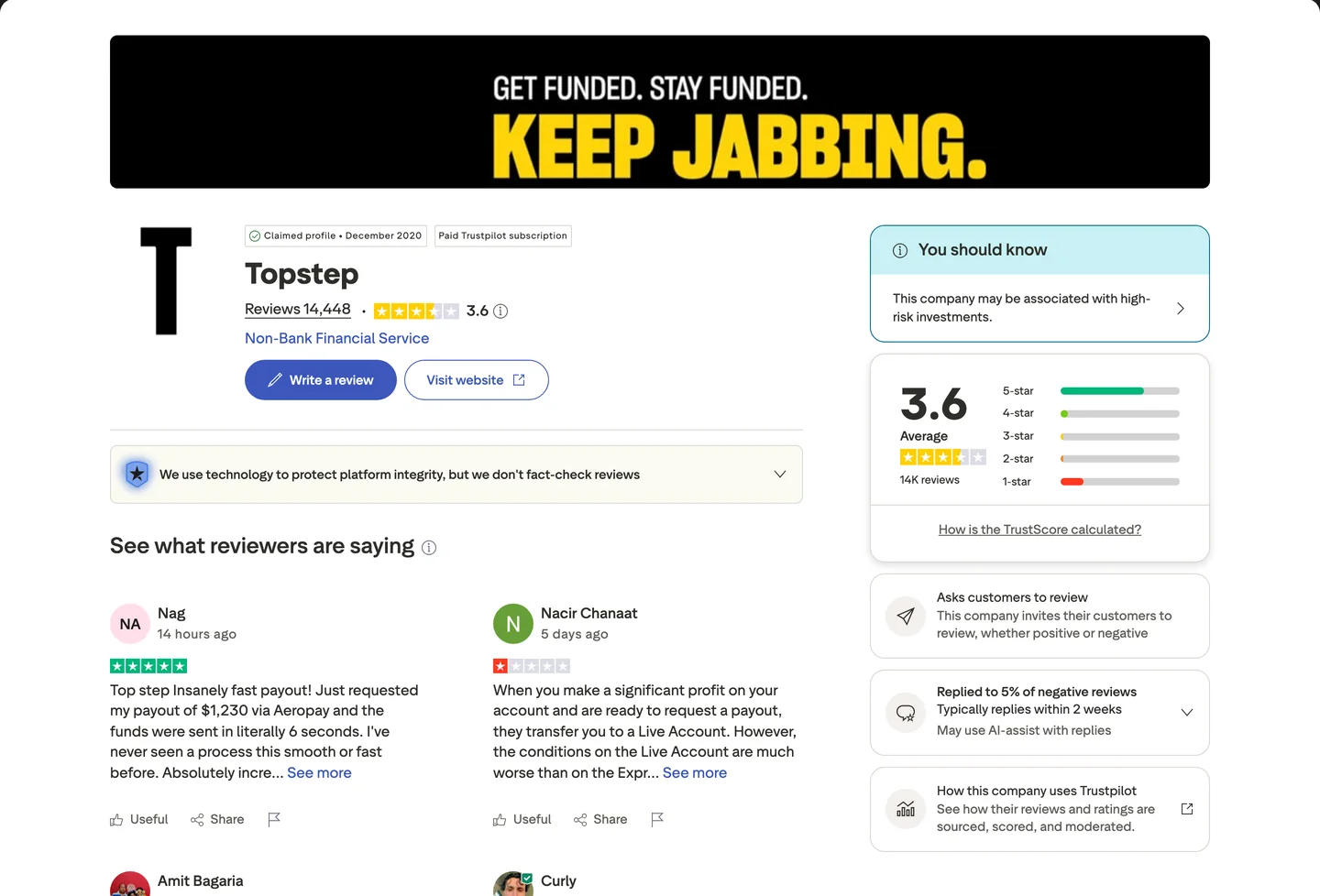
What does Topstep's 3.6 Trustpilot rating represent?
Trustpilot is not a quality score. It is a self-selected sample of users who felt strongly enough, usually negatively, to write a review. For one of the longest-running prop firms in futures, with hundreds of thousands of cumulative users, the math punishes incumbents.
Three structural forces hold Topstep's rating down:
| Force | Effect on rating |
|---|---|
| One of the longest operating histories in the industry | Every disgruntled user across that whole history has had time to review |
| 14,500+ review volume | Mathematically harder to maintain a high average than firms with 2-4K reviews |
| Trailing Max Loss Limit, monitored in real time | The floor never moves back down, and a touch during the session, even on unrealized loss, liquidates immediately |
| Cohort attrition reality | Topstep's own 2025 statistics: 16.8% of Combines completed, 33.3% of participants at the Funded Level received a payout, most users never see money |
The cohort attrition number matters most. Topstep publishes its own metrics on its prop pricing page: from January through December 2025, 16.8% of all Trading Combines initiated were completed successfully, and 33.3% of all participants at the Funded Level received a payout. By definition, the majority of users who pay $49+ never withdraw a cent. Some fraction of those will leave a one-star review. That is true of every prop firm, but Topstep has been running the funnel longer than almost anyone.
Compare this to a firm like YRM Prop, which launched in 2025. YRM has fewer reviews because it has been collecting them for one year, and the disgruntled-after-multiple-resets cohort has not built up yet. The rating has already slipped to 3.8 from 223 reviews as of August 11, 2026, and it may fall further if YRM keeps its softer drawdown model but ten times the user base.
How does Topstep compare with other PTV-mature firms?
Direct head-to-head:
| Firm | Trustpilot | Reviews | Years operating | Drawdown style |
|---|---|---|---|---|
| Tradeify | 4.6/5 | 3,862 (checked Aug 4, 2026; external snapshot) | ~3 | EOD-trailing |
| Lucid Trading | 4.5-4.6 | ~4,800 | ~1.5 | EOD trailing |
| FundedNext | ~4.5 | 73,000+ | ~6 | Mixed (forex + futures) |
| YRM Prop | 3.8 | 223 | ~1 | EOD-trailing, locks at breakeven |
| Topstep | 3.6 | 14,532 | Longest of this group | EOD-trailing, real-time breach |
FundedNext is the most interesting data point. It has more reviews than Topstep, 73,000+ versus roughly 14,500, and still holds 4.5. That undercuts the lazy "volume alone drives the rating down" argument. The honest read: rule design matters more than age. FundedNext's blend of EOD-trailing futures rules and forex-style evaluation produces fewer angry traders per capita than Topstep's Combine, where the loss limit locks in every green close and is enforced in real time. Newer firms learned from incumbents and chose softer rule sets to compete on rating.
What did I experience on the $50K Topstep Combine?
I started trading Topstep in 2023, alongside Apex, as one of my first futures props. I have stayed on the $50K Trading Combine the whole time, multiple Combine passes since 2023, multiple Funded cycles, recurring payouts via Wise.
Here is the honest account, broken out the way the average Trustpilot reviewer never structures their feedback:
What worked
Payouts arrived. Wise was usually next trading day after I requested. The 90/10 split (under my grandfathered terms, 100% on first $10K then 90/10) was generous. TopstepX as a platform improved significantly through 2024 and 2025. Customer service replied to email tickets within 24 hours in normal periods.
What hurt
The trailing drawdown caught me twice in the first year. Both times I was up nicely on the day, then a normal pullback into my session bias took the equity below the trailing line and the account locked. That is the rule working: the floor only moves at the end of the day and never moves back down, but it is watched in real time, so an open position far enough under water touches it before you ever close the trade. It is brutal but it is in the contract.
The Daily Loss Limit auto-liquidation also bit me once. Auto-liquidation is not a rule violation (the account stays open, just locked for the day), but losing a Combine day to one bad print stings.
Why I stayed
The math worked. Across multiple payouts across 6 Combines over 12 months, the firm paid every withdrawal request I submitted. For a sim-funded futures firm with a track record this long, that is a stronger trust signal than any Trustpilot rating.
The longer story is in Why traders leave Topstep, and why I have not.
The valid complaints in the 1-star reviews
Reading through Topstep one-stars systematically, four complaint patterns recur and they are real signals about the firm's rule set, not noise:
1. Trailing-drawdown brutality
This is the most legitimate complaint and the biggest single driver of the 3.6 rating. Topstep's Maximum Loss Limit trails the end-of-day balance and never moves back down, so every day you close green permanently tightens the floor beneath you. It is then monitored in real time: if the balance touches the limit at any point during the session, including on unrealized loss from an open position, the account is liquidated immediately. Traders who plan to hold a drawdown until the close find out that the close never arrives. YRM used a static MLL at launch and now runs an EOD-trailing model that locks permanently once it reaches the starting balance.
Topstep's design forces consistency under pressure. It also blows up otherwise-profitable traders on choppy reversal days. Both things are true.
2. Subscription billing surprises
Topstep's monthly Combine subscription auto-renews. If your Combine ends and you do not actively cancel, you get billed again. The Reset Credit Bank introduced in 2025 partly addressed this, renewals now add Reset Credits to your bank, but the UX for "I am done with this Combine" still confuses users. Real complaint, partly fixable on Topstep's end.
3. Slow support during high-volume periods
NFP weeks, FOMC days, and major payout weeks see longer response times. Topstep's queue is not 24/7 instant. For traders in time zones outside US business hours, this can stretch to 36+ hours. Real, recurring, valid.
4. No PTV affiliate, fewer public discounts than peers
Topstep does not run a PTV affiliate program. Its public promo cadence is also lighter than newer competitors who run constant 50%-off events. Traders shopping on price walk away frustrated. Topstep's positioning, "we are the incumbent, the discount is the track record", is a coherent strategy but it loses the discount-shoppers.
The complaints that are FUD or operator error
Plenty of one-star reviews are not signal. Honest taxonomy:
| Complaint pattern | Reality |
|---|---|
| "They took my account / stole my money" | 95% of cases trace to MLL violation, DLL auto-liquidation, or prohibited conduct. The consistency rule is not on that list, going over it raises the Profit Target instead of closing the account. The system enforces rules automatically, no human "took" anything. |
| "Stuck for support, ghosted" | Usually subscription confusion solved by checking the right email inbox or canceling via dashboard. Real ghosting is rare. |
| "Rules changed without notice" | January 12, 2026 profit-split change was announced and grandfathered existing traders. Reviews calling it "fraud" missed the grandfathering clause. |
| "Couldn't withdraw" | Almost always traces to: not enough winning days yet, consistency rule failure, Follower accounts auto-unlinked when an XFA payout is submitted (a real Topstep policy), or KYC incomplete. |
| "Topstep is a scam" | A long-running firm with FCM-backed real-money payouts is not a scam. Disagree with the rules, fine. Scam is the wrong word. |
The MLL-violation-as-"theft" pattern is the most common single FUD bucket. The Max Loss Limit is in every onboarding email, in the dashboard, and in the platform itself. When it hits, the platform locks the account and shows the violation. Calling that theft tells you more about the reviewer's preparation than about Topstep.
Topstep's response to its own Trustpilot rating
Topstep is not ignoring the score, though the reply cadence is thinner than it looks from the outside: Trustpilot's own profile labels show Topstep replied to 5% of negative reviews, typically within 2 weeks, and may use AI-assist with replies. When a reply does come, it is usually a request to email support with the account email so the team can investigate. Topstep also publishes its cohort metrics (16.8% Combine pass, 33.3% Funded payout) on the homepage, which is unusually transparent. That does not move the headline number but it shows operational seriousness.
The Futures Desk acquisition is the most interesting structural play. Topstep's help center says it acquired Futures Desk and that its founder, Josh Schwartzberg, now runs Topstep Labs, the limited-drop program Topstep uses to test new offerings before they reach the main program. Topstep publishes neither an acquisition date nor a TopstepX integration roadmap, so treat any claim about specific technology landing in the platform as unconfirmed. If the Labs work reduces friction over the next 6 to 12 months, expect a slow rating drift upward.
The February 5, 2026 XFA dual-path launch (today: Standard 5 winning days of $150+, Consistency 3 days at a 40% target) also gives funded traders a faster path to live capital. Both moves attack the most-complained-about parts of the funnel. The score has in fact ticked up to 3.6 as of July 21, 2026, and the underlying user experience is changing. One change cuts the other way: on April 28, 2026 Topstep reduced the XFA payout caps, and the $50K account now caps at $2,000 per request on the Standard path and $3,000 on the Consistency path. Expect that to feed a fresh round of frustrated reviews from funded traders who planned around the old limits.
How to read Topstep's Trustpilot in 2026
Three honest takeaways:
- The rating is a complaint surface, not a fraud signal. A long-running FCM-backed firm that reports more than $1.4 billion paid out to traders (topstep.com/topstep-prop, checked August 2, 2026) and runs a working withdrawal process is not what 3.6 looks like at, say, an offshore broker. The June and July 2026 reviews follow the same split. Positive reviews cluster around payouts arriving once traders are eligible and helpful support agents, often praised by name. Negative reviews cluster around TopstepX glitches and freezes, support that stretches to days during busy periods, and friction from the legacy-to-new dashboard migration.
- The rating IS a rule-set signal. The trailing Max Loss Limit is unforgiving: it locks in every green close, never moves back down, and is enforced in real time. If you do not understand it before you fund a Combine, you will likely contribute to the 3.6.
- Newer competitors with softer rules will keep out-rating Topstep until their cohorts age out. That is mechanics, not quality. In 5 years, expect Tradeify, Lucid, and YRM ratings to drift down toward Topstep's range as their user bases mature and their drawdown rules bite more late-stage traders. Lucid's drift from 4.6 in April 2026 to 4.5 to 4.6 by July is that mechanic already playing out.
If you want softer peer rule sets at higher ratings: YRM Prop (EOD-trailing locking at breakeven, 3.8), Lucid Trading (4.5 to 4.6). If you want the longest track record and the deepest payout history, that is Topstep at 3.6.
What I would tell a friend
If a friend asked me whether to fund a Topstep Combine in 2026, I would say yes, with conditions. Trade the $50K Combine (where I have my testing), respect the trailing Max Loss Limit, set a personal daily-loss circuit-breaker tighter than Topstep's official limit, and treat the first few thousand in payouts as the goal, not $20K. The firm pays. The rating reflects the population that did not respect the rules, not the population that did.
The bottom line
Topstep's 3.6 Trustpilot rating from 14,532 reviews (checked August 2, 2026) is the lowest among PTV-mature firms but it is not a fraud signal. It reflects years of accumulated reviews, the largest user base in futures props, and a Maximum Loss Limit that locks in every green close and is enforced in real time. I have traded the $50K Combine since 2023 and pulled multiple payouts via Wise. The firm pays when you follow the rules. The rating tells you the rules are unforgiving. Both things are true and both belong in the decision.
If you want a higher-rated peer experience, Lucid Trading (4.5 to 4.6 from roughly 4,800 reviews) is the contrast. The Topstep FAQ and full main review round out the picture.
Frequently Asked Questions
What is Topstep's Trustpilot rating in 2026?
Topstep sits at 3.6 out of 5 stars on Trustpilot from 14,532 reviews, checked August 2, 2026. That is the lowest rating among PTV-mature futures prop firms (Lucid 4.5 to 4.6, FundedNext 4.5, Tradeify 4.6, YRM 3.8). The number is real, but it reflects years of accumulated reviews and a much larger user base than the competitors above.
Why is Topstep's Trustpilot rating lower than competitors?
Three reasons. First, time: Topstep is one of the longest-running futures prop firms, and every disgruntled trader across that history has had a chance to leave a review. Second, volume: 14,532 reviews is far more than newer firms carry. Third, the Maximum Loss Limit is unforgiving, it locks in every green close, never moves back down, and is enforced in real time, which produces a steady stream of frustrated one-stars. Newer firms have not yet built up the same complaint surface.
Is Topstep still legit despite the 3.6 rating?
Yes. Topstep has been paying traders for years, partners with Plus500US as the FCM for Live Funded payouts, and reports more than $1.4 billion paid out to traders on its prop pricing page (checked August 2, 2026). I have personally pulled multiple payouts via Wise across 6 Combines over 12 months on the $50K Combine. The rating reflects review volume and the hardness of the trailing loss limit, not whether Topstep pays.
What do positive Topstep Trustpilot reviews say?
Positive reviews cluster around four themes: payouts arrive when you follow the rules (Wise runs 1 to 3 business days after approval), the longest track record in futures props gives confidence the firm will not vanish, the Live Funded tier is real money via FCM, and TopstepX UX has improved significantly since the platform overhaul. Many positive reviewers explicitly mention multiple successful payouts over months or years.
What do negative Topstep Trustpilot reviews actually complain about?
Most one-star reviews fall into three buckets. First, the trailing Maximum Loss Limit ending an account in the middle of a session, including on an open position, a real and harsh feature. Second, subscription billing surprises after a Combine ends, usually preventable but the UX has caused friction. Third, slow support during high-volume periods like NFP weeks. A smaller bucket complains "they took my account" which almost always traces back to a Max Loss Limit violation.
How does Topstep's 3.6 rating compare to Apex Trader Funding?
Apex sits in similar territory, both are long-running futures props with massive user bases and trailing drawdown rules. Newer firms with softer drawdown models (YRM, Lucid) consistently rate higher because their rule sets end fewer accounts. Review volume and years of accumulated history explain most of the rating gap.
Is FundedNext at 4.5 with more reviews than Topstep meaningful?
Yes. FundedNext has 73,000+ Trustpilot reviews, more than Topstep, and still holds 4.5. That undercuts the "volume alone explains the rating" argument. The honest read: FundedNext's evaluation rules and customer-service operations produce fewer angry traders per capita than Topstep's Combine. Topstep's age does matter, but rule design matters more than the company would like to admit.
Should I trust Topstep with $149 plus monthly fees given the 3.6 rating?
If you understand how the trailing Max Loss Limit works and trade conservatively, yes. The firm pays. The rating is a signal that the rule set is unforgiving, not that the firm is a scam. If you want softer rules, YRM Prop (EOD-trailing locking at breakeven, 3.8) may suit you better. Compare via Why traders leave Topstep. The $149 in that question is the Standard Path activation fee. On the No Activation Fee path it is $0 and the monthly subscription is higher instead, which is laid out in the Topstep pricing breakdown.
What is the most common Topstep Trustpilot complaint that is actually FUD?
Variations of "Topstep stole my account." Almost every case I have read traces back to a Max Loss Limit hit or a Daily Loss Limit auto-liquidation that the trader did not understand. Topstep's MLL is trailing and lives in the platform, the system enforces it automatically. That is not theft, it is the rule set working as designed.
Does Topstep respond to Trustpilot reviews?
Yes, but less often than it looks from the outside. Trustpilot's own profile labels show Topstep replied to 5% of negative reviews, typically within two weeks, and note that replies may be AI-assisted. When a reply does come, it usually asks the reviewer to email support with the account email so the team can investigate. That does not improve the headline rating, but it does show the firm is monitoring feedback rather than ignoring it.
How long has Topstep been on Trustpilot?
Topstep has been collecting Trustpilot reviews for years and had 14,532 as of August 2, 2026, on a profile claimed since December 2020. The volume reflects one of the longest-running firms in futures props with a large active user base. Most newer competitors have collected reviews for 2 to 4 years, which mechanically caps how many one-star reviews can stack up.
What happened with the January 2026 profit-split change and Trustpilot?
On January 12, 2026, Topstep moved from a grandfathered 100%-on-first-$10K split to a flat 90/10 from dollar one for new sign-ups. There was a short Trustpilot bump in negative reviews from grandfathered traders who felt blindsided, even though grandfathering protected existing accounts. The noise has since faded. The 90/10 flat is still trader-friendly versus older 80/20 splits.
Did the Futures Desk acquisition affect Trustpilot reviews?
Not visibly. Topstep's help center documents the Futures Desk acquisition and puts its founder in charge of Topstep Labs, but it publishes no acquisition date and no TopstepX integration roadmap. Reviews through July are dominated by the usual themes (payouts, drawdown, platform glitches, support) rather than acquisition-specific feedback.
What rating does Topstep need to hit to match newer competitors?
Realistically, Topstep cannot match Lucid's 4.5 to 4.6 or Tradeify's 4.6 without either softening the real-time breach check on its trailing loss limit or waiting for a decade of newer reviews to dilute the historical complaint pool. A target around 4.0 to 4.2 is plausible if the post-Feb-5-2026 XFA Consistency Path and TFD platform improvements reduce the most common complaint threads. Until then, expect the rating to sit in the mid-3s.
Where to go next
The most useful next decision from this page.