
Quick Answer, What is drawdown in trading?
- • Drawdown is the peak-to-trough decline of an account or equity curve, measured from a high-water mark down to the next low, usually as a percentage of the peak.
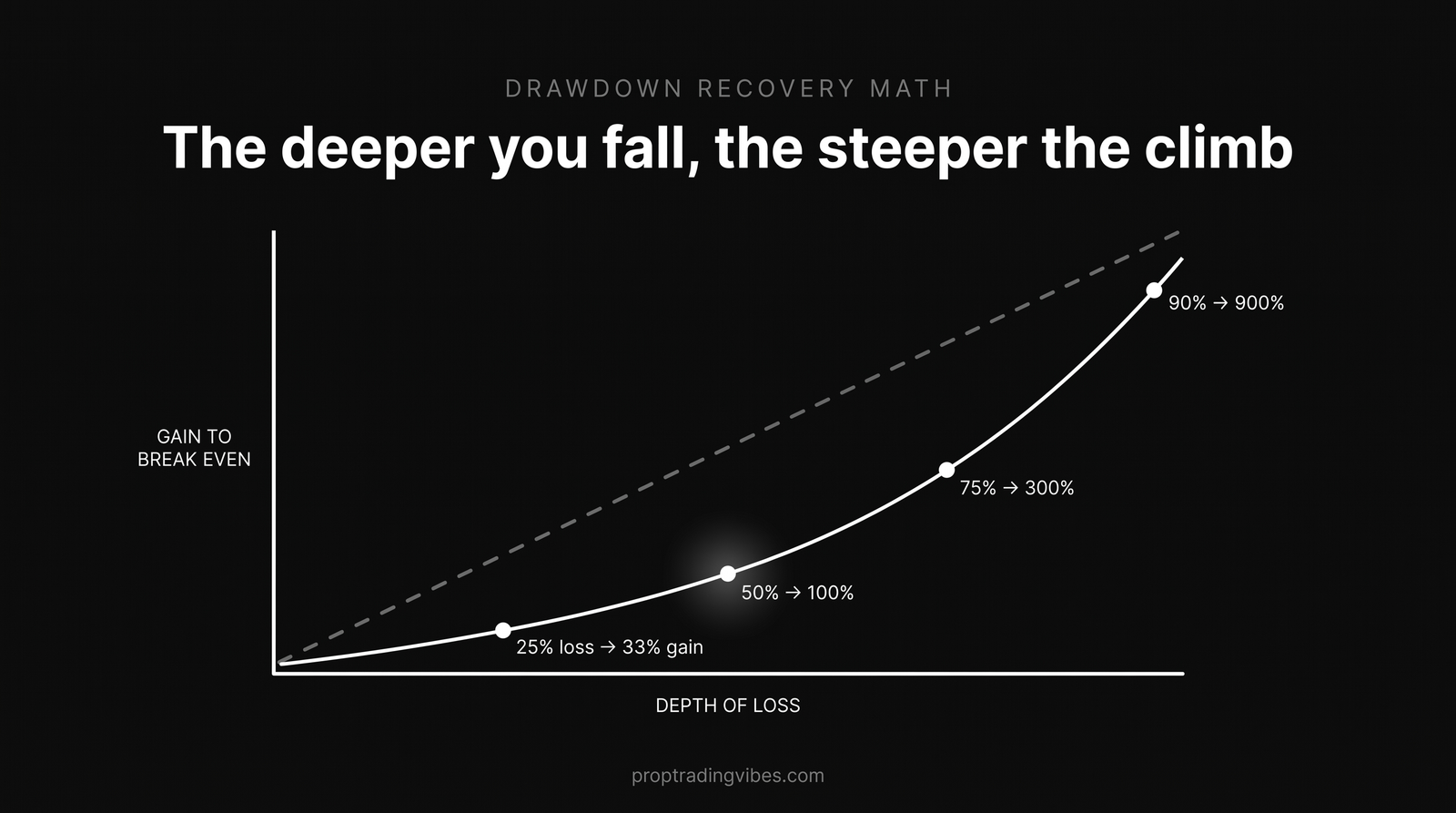
- • Recovery is asymmetric: a 25% drawdown needs a 33% gain to break even, a 50% drawdown needs 100%, and a 75% drawdown needs 300%.
- • Maximum drawdown is the worst dip ever recorded; relative drawdown is measured as a percent of peak; absolute drawdown is measured in dollars from the starting balance.
- • Prop firms enforce three drawdown mechanics: EOD Trailing (floor updates on the daily close), Intraday Trailing (floor updates tick-by-tick on unrealized P&L), and Static (floor never moves).
- • The mechanic decides your real room: Lucid's EOD floor trails up only and locks at starting balance, while an intraday-trailing floor tightens every time price wicks into profit.
Drawdown is the peak-to-trough decline of a trading account or equity curve, measured from a high-water mark down to the next low before a new high is made. It is usually expressed as a percentage of the peak, sometimes in dollars. Where return tells you how much you made, drawdown tells you how much you risked giving back along the way, which is why it is the headline risk metric serious traders watch.
The number that makes drawdown dangerous is the recovery math. A loss and the gain needed to undo it are not symmetric, and the gap widens the deeper you fall. A 25% drawdown needs a 33% gain to break even. A 50% drawdown needs 100%. A 75% drawdown needs a 300% gain. That asymmetry is why protecting capital beats chasing return.
In prop trading the stakes are sharper. Your firm's drawdown rule is a hard line, and crossing it ends the account regardless of how well you traded otherwise. Whether that line trails up on the daily close, ratchets up tick-by-tick on unrealized profit, or stays fixed decides how much room you actually have. This guide covers all of it, from the textbook definition to how five firms implement the rule.
What does drawdown mean in trading?
Drawdown measures downside loss from a peak, not total return. Two accounts can finish a year at the same balance and have completely different drawdowns, because one took a smoother path and the other dug a deep hole and climbed back out. That path matters, because the deeper hole is far harder to escape, and because most traders quit or breach somewhere inside it.
Think of it as the distance from the top of your equity curve to the bottom of the dip that follows, before you make a new high. As long as the account keeps printing new highs, the drawdown for that stretch is zero. The moment it turns down, the clock starts on a new drawdown that only ends when a fresh high is reached.
> "Across 5+ years and more than a dozen prop firms, the single rule that has cost me, and almost every funded trader I know, more accounts than bad strategy ever did is the trailing drawdown. The profit target is rarely the thing that ends a run. The floor moving underneath you is."
That is the practical heart of it. In a funded trading account, drawdown is not a statistic you review after the fact. It is a live floor that can breach you mid-trade. Drawdown is the first thing I check before I evaluate any firm, ahead of profit split or payout speed, and it belongs at the center of risk management in prop trading.
What are the three types of drawdown measurement?
The three measurement types are maximum drawdown, relative drawdown, and absolute drawdown. They are not interchangeable. Maximum drawdown is a statistic about size. Relative and absolute are about the unit you measure in.
| Type | What it measures | Reference point |
|---|---|---|
| Maximum drawdown (Max DD) | The single largest peak-to-trough decline over the whole period | The worst dip ever recorded |
| Relative drawdown | The decline as a percentage of peak equity | The running peak (scales with size) |
| Absolute drawdown | The decline in fixed dollars from the starting balance | Your initial deposit |
Maximum drawdown
Maximum drawdown is the worst peak-to-trough decline over the period being measured. If your equity curve had three dips of 8%, 15%, and 22%, your maximum drawdown is 22%. It is a backward-looking statistic that answers one question: how bad did it ever get? Strategy backtests and track records lead with it because it sets the realistic expectation for the worst stretch a trader can stomach.
Relative versus absolute drawdown
Relative drawdown is the decline expressed as a percentage of peak equity. A peak of $10,000 falling to a trough of $8,500 is a 15% relative drawdown, and it scales with account size. Absolute drawdown is the decline measured in fixed dollars from the starting balance, so it tracks how far below your initial deposit you went, not below your running peak. Relative drawdown answers "how much of my high did I give back" while absolute drawdown answers "how far underwater am I from where I started."
What does the drawdown recovery math look like?
The recovery math is the hero lesson of this whole topic: the gain needed to break even is always larger than the loss, and the gap widens non-linearly. The formula is exact: Required Gain = 1 / (1 - Drawdown) - 1.
| Drawdown (loss) | Gain required to recover |
|---|---|
| 5% | 5.3% |
| 10% | 11.1% |
| 20% | 25.0% |
| 25% | 33.3% |
| 30% | 42.9% |
| 50% | 100% |
| 75% | 300% |
| 90% | 900% |
Each row checks independently. A 10% loss leaves 90%, and 0.10 divided by 0.90 is 11.1%. A 50% loss leaves half, and you need to double the half, which is 100%. A 75% loss leaves a quarter, and tripling a quarter to get back to whole is 300%.
This is why deep drawdowns are so much more dangerous than they look. Two 25% losses in a row do not cost you 50%, they leave you at roughly 56% of your peak needing a 78% gain, because losses compound from a shrinking base. The shallower you keep your drawdowns, the more linear and survivable the climb back is. Managing that math is the entire job of managing trading drawdown, and it is also why risk-reward ratio discipline matters more than win rate for long-term survival.
Drawdown in real markets
Markets show the asymmetry at scale. The S&P 500 fell about 57% peak-to-trough in the 2007 to 2009 bear market, from 1,565 in October 2007 to 677 in March 2009, which required roughly a 132% gain to recover. The dot-com crash cut the index about 49% over 685 days. The COVID crash was the fastest on record, about 34% in just 32 days, showing that drawdown has a speed dimension and not only a depth one. The worst on record, the 1929 to 1932 Great Depression decline of about 82%, required a roughly 456% gain to recover, which took decades.
How does drawdown work in prop trading?
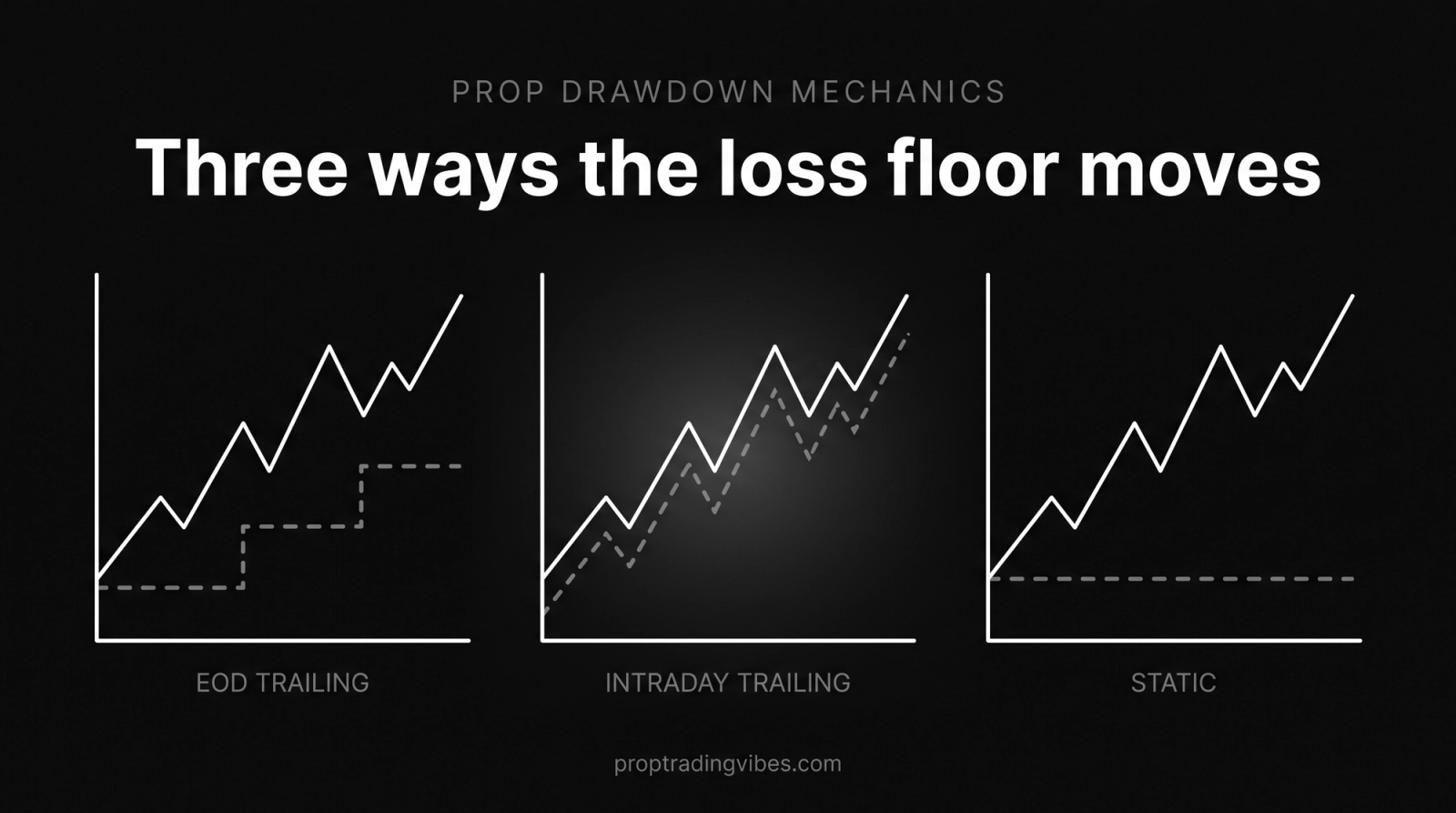
In prop trading, drawdown is enforced as a hard maximum loss limit, and there are three canonical mechanics: EOD Trailing, Intraday Trailing, and Static. The mechanic, not just the dollar size, decides how much real room you have.
| Mechanic | When the floor updates | Strictness |
|---|---|---|
| EOD Trailing | Only at the end-of-day close, on settled balance | More forgiving, intraday wicks do not move it |
| Intraday Trailing | Tick-by-tick on unrealized P&L | Strictest, every profit wick ratchets it up |
| Static / Max DD | Never, fixed at start minus the buffer | Most predictable, the line does not move |
EOD trailing drawdown
EOD Trailing means the loss floor updates only at the end-of-day close, based on your closed, settled balance. Intraday wicks into profit do not move the floor up, so a spike you never banked cannot tighten your buffer. This is the more forgiving of the two trailing styles, because it lets a trade breathe through normal intraday noise.
> "The difference between EOD trailing and intraday trailing completely changes where I place my stops. On EOD-trailing accounts, the loss floor only updates on the daily close, so I can let a trade breathe through normal intraday wicks. A pullback into the red doesn't permanently tighten my buffer."
Intraday trailing drawdown
Intraday Trailing means the floor updates in real time on unrealized profit. Every wick into a new profit high ratchets the floor up permanently, and pulling back does not lower it again. This is the strictest mechanic, because an unrealized spike you never closed can still raise your floor and shrink your room. The canonical term is intraday trailing, never "intra-bar trailing." For the live mechanics, see the TradeDay intraday trailing drawdown breakdown and the trailing drawdown explainer.
> "What most new funded traders miss is that on a trailing account, your unrealized high-water mark is what sets the floor, not your closed P&L. I have watched the math do this to me: you spike up nicely, the floor trails up to match, then the trade reverses and you close flat or even green on the day, but your drawdown floor has permanently moved and your buffer is gone."
Static drawdown
Static, sometimes called fixed Max DD, means the floor is set at starting balance minus the maximum-drawdown buffer and never moves. There is no trailing at all. It is the most predictable mechanic because the line is the line from day one, which suits traders who want a fixed, knowable breach level rather than a floor that chases their profit.
How does a trailing drawdown lock?
A lock is when a trailing mechanic stops trailing. It is a modifier on EOD or intraday trailing, not a fourth type. The most common version is locks-at-start: the floor trails up only until it reaches your starting balance, then freezes, so the account can no longer be breached below where you began through trailing.
There are two other lock behaviors worth knowing. Locks-up-only, or ratchet-up-only, is where the floor only moves up on green days and never moves down on red, which is Lucid Trading's distinctive variant. Locks-at-pass is where the floor freezes the moment you hit the profit target. Knowing your lock behavior tells you exactly when your floor stops being a moving target.
> "Lucid is my flagship for exactly this reason. Its drawdown only trails up on the close and then locks at the starting balance, never below. Once that floor locks at start balance, the account effectively can't be breached below where I began, which fundamentally changes how I trade a funded account: I stop trading scared and start trading the setup."
Why does the drawdown mechanic matter more than the dollar size?
The mechanic matters more than the dollar size because the same "$2,000 max drawdown" behaves completely differently under each rule. Under EOD trailing it is forgiving, since only closes count. Under intraday trailing it is strict, since every unrealized spike tightens the floor. Under static it is the most predictable, since the line never moves at all. Two firms can advertise an identical buffer and offer wildly different real room.
The common trap is breaching a trailing account by ignoring how the floor shifts up on unrealized gains. The floor moved up while you were in profit, so a perfectly normal pullback now breaches you.
> "I have genuinely breached accounts on trailing drawdown by not respecting the floor shifts. On Bulenox Option 1 I let unrealized gains move the trailing limit and then gave it all back, and the breach was on me, not the firm. The same firm's Option 2 caught me on a daily loss limit during an FOMC session."
Community reviews describe the same mechanic in harsher terms. One Topstep reviewer called it "a silent account killer," where a trader "can be up +$3k, manage the trade properly, allow a normal pullback... and still get auto-closed and locked out because unrealized P&L is now treated like realized loss." Another wrote that the account "reached 50,200 and went down to 4200 and they breached them same day like if their trailing is now intraday, counting floating profit."
How tight is a real prop-firm drawdown?
A real futures prop trailing drawdown is typically about 3% to 5% of account size, which is far tighter than most newcomers expect. Topstep's official Maximum Loss Limit is $2,000 on a $50K account (4%), $3,000 on $100K (3%), and $4,500 on $150K (3%). Many firms set roughly $2,500 on a $50K account, which is 5%.
| Account size | Max Loss Limit (trailing) | Approx. % of account |
|---|---|---|
| $50K | $2,000 | 4.0% |
| $100K | $3,000 | 3.0% |
| $150K | $4,500 | 3.0% |
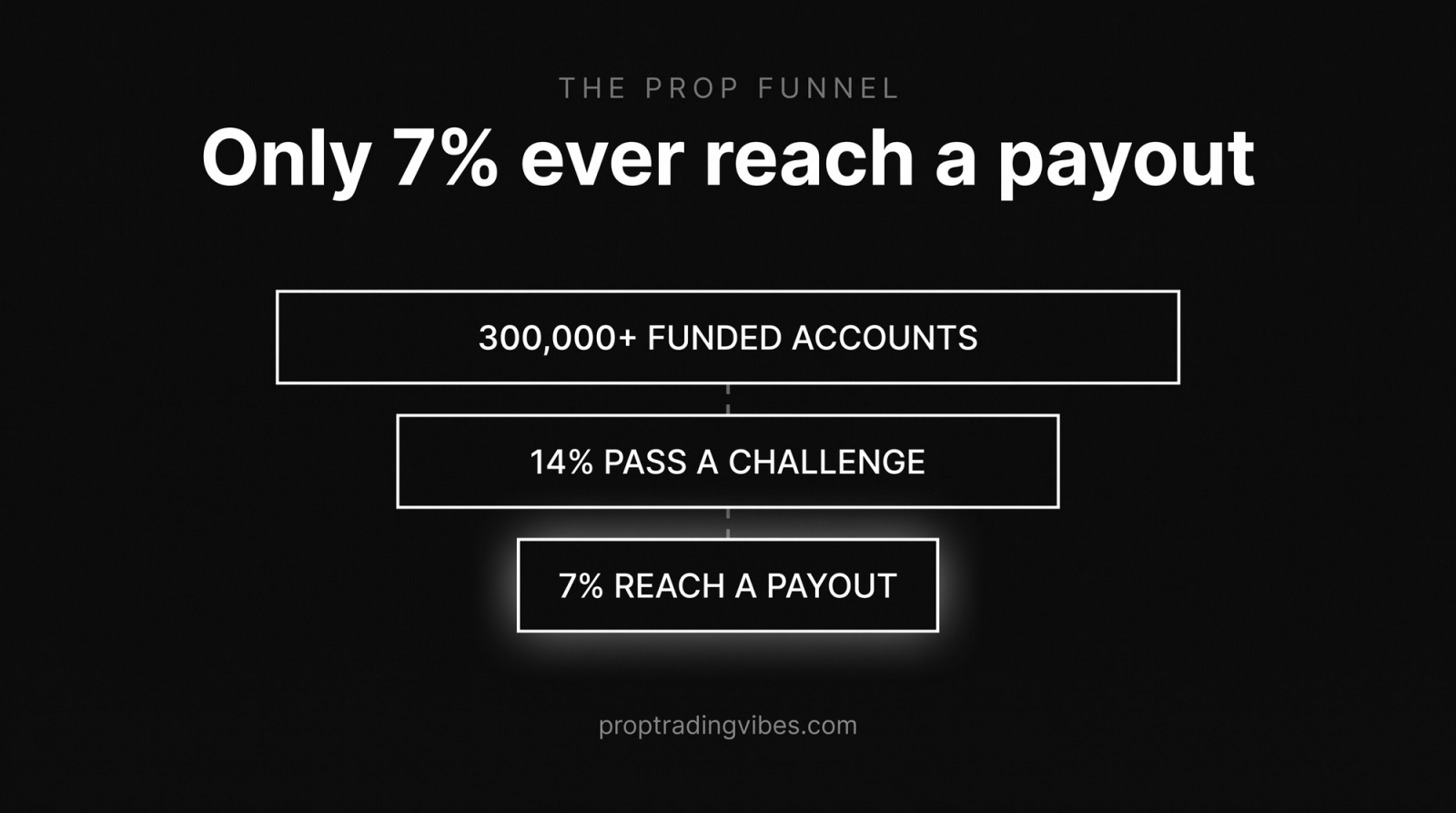
A few percent is not much margin when the floor is also moving up underneath you on profit. That tightness is exactly why only 7% of prop accounts ever reach a payout, per an FPFX Tech study of more than 300,000 accounts across 10 firms, reported by Finance Magnates in September 2024. About 14% passed a challenge, and loss-limit and drawdown breaches were the dominant failure cause. The average account in that study spent around $800 on challenge fees across roughly three attempts.
How do four prop firms implement drawdown?
Four firms cover the full range of drawdown mechanics, from the forgiving locks-up-only EOD model to a two-path trailing and EOD-scaling structure. As of 2026, here is how each handles it.
| Firm | Mechanic | Lock behavior |
|---|---|---|
| Lucid Trading | EOD trailing, up only | Locks-up-only, locks at starting balance |
| Apex Trader Funding | EOD trailing 4.0 default, Static post-eval | Trailing then static state |
| Bulenox | Option 1 trailing, Option 2 EOD scaling | Locks at $100 above start |
| TradeDay | Intraday or EOD (Static retired 2026) | Trails to start, then freezes |
Lucid Trading
As of 2026, Lucid Trading uses EOD trailing where the maximum loss limit only trails up on the close and never moves down. Its locks-up-only behavior is the distinctive part: the floor ratchets up on green and locks at the starting balance, after which the account cannot be breached below where you began via trailing. Lucid also runs a 20% general consistency rule, so it is not a no-consistency firm. You can see the full setup on the Lucid Trading firm page, and the code is VIBES.
Apex Trader Funding
As of 2026, Apex Trader Funding 4.0 uses EOD trailing by default, plus a Static Max DD state as the post-evaluation default. Pre-4.0, some accounts used intraday trailing. Apex also enforces separate daily loss limits in 4.0: $500 on $25K, $1,000 on $50K, $1,500 on $100K, and $2,000 on $150K. The daily loss limit is distinct from the trailing max drawdown, and you can breach either independently, which is covered in the Apex daily loss limit guide and on the Apex firm page. Apex has no PTV affiliate code.
Bulenox
As of 2026, Bulenox offers two paths: Option 1 uses trailing drawdown and Option 2 uses EOD scaling. The drawdown locks at $100 above starting balance, so a $50K Master account locks its floor at $50,100. The classic Option 1 breach happens when traders let unrealized gains move the trailing limit, then give the profit back, which the Bulenox trailing drawdown explainer and the Bulenox firm page walk through. The code is VIBES for 45% off the eval subscription.
TradeDay
As of 2026, TradeDay offers Intraday or EOD drawdown after its 2.0 relaunch in May, which retired the old Static option. Current TradeDay runs Quick Pay with a choice of Intraday or EOD, plus Fast Pass on EOD only. Historically TradeDay offered all three mechanics side by side, which made it a clean teaching example, but Static is now sunset, so treat that three-way only as past context. The live mechanics are on the TradeDay intraday trailing drawdown page and the TradeDay firm page. The code is VIBES.
Other firms with notable drawdown rules
Drawdown rules vary widely across the rest of the industry too. For broader comparison, the E8 Markets drawdown rules, The 5%ers drawdown rules, and FundingPips max drawdown breakdowns each show a different take on how the loss floor is set and whether it trails.
What is the hardest drawdown lesson in prop trading?
The hardest drawdown lesson is that getting funded is not the finish line. Staying inside the loss floor is, and a single breach erases everything that came before it. A funded account is only as safe as the distance between your equity and the floor, and that distance can vanish on one bad tick if you have not respected the mechanic.
> "My hardest drawdown lesson was the cleanest: at Hyrotrader in April 2026 I got a 25K 1-step funded, then hit the Maximum Loss Limit before a single payout cleared. No payout, account gone. That is the whole point about drawdown in a sentence: getting funded is not the finish line, staying inside the loss floor is, and a breach erases everything that came before it."
Community voices land in the same place. One Apex reviewer described the trailing drawdown as "brutal and unforgiving" inside what they called "a predatory, casino-style setup." Another wrote that "if you have a good day with a decent run-up but your target is not hit then you might lose your account for a perfectly calculated and normal stop loss." Whether or not you agree with the tone, the underlying mechanic is real and worth respecting: on a trailing account, your unrealized high sets the floor.
The bottom line
Drawdown is the peak-to-trough decline of your account, and the recovery math makes it the metric that matters most: a 50% loss needs a 100% gain to recover, a 75% loss needs 300%. In prop trading, the firm's drawdown mechanic, EOD trailing, intraday trailing, or static, decides how much real room you have, often more than the headline dollar figure does.
If you are new or trade through normal intraday volatility, an EOD-trailing rule that locks up only is the most forgiving, which is why Lucid Trading is a common starting point. If you want a fixed, knowable breach line, look for a static or locks-at-start structure. If you choose an intraday-trailing account like the stricter end of the range, trade tighter, bank partials sooner, and never let an unrealized peak sit there inviting a reversal. Whatever you pick, learn whether your floor moves on closed balance or live equity before you place a single trade, because the floor moving underneath you ends more funded runs than any losing strategy.
Frequently Asked Questions
What is drawdown in trading?
Drawdown in trading is the peak-to-trough decline of an account or equity curve, measured from a high-water mark down to the subsequent low before a new high is made. It is usually expressed as a percentage of the peak and sometimes in dollars. Drawdown measures downside risk from a peak, not total return, which is why it is the headline risk metric traders track alongside profit.
What is the difference between maximum, relative, and absolute drawdown?
Maximum drawdown is the single largest peak-to-trough decline over the whole period being measured, the worst it ever got. Relative drawdown is that decline expressed as a percentage of peak equity, so it scales with account size. Absolute drawdown is the decline measured in fixed dollars from the starting balance, meaning how far below your initial deposit you fell. They answer different questions: how big was the worst dip versus what unit you measure it in.
Why does a 50% drawdown need a 100% gain to recover?
Because gains and losses compound from a smaller base after a loss. If a $10,000 account drops 50% to $5,000, you now need to double that $5,000 to get back to $10,000, which is a 100% gain. The formula is Required Gain = 1 / (1 - Drawdown) - 1. A 25% drawdown needs 33%, a 75% drawdown needs 300%, and a 90% drawdown needs a 900% gain. The deeper the hole, the disproportionately harder the climb out.
What is trailing drawdown at a prop firm?
Trailing drawdown is a maximum loss limit that moves up as your account makes new profit highs but never moves back down on losing trades. It comes in two forms: EOD Trailing, where the floor updates only on the end-of-day close, and Intraday Trailing, where the floor updates tick-by-tick on unrealized profit. Most prop firms cap the trailing at starting balance, after which the floor freezes.
What is the difference between EOD trailing and intraday trailing drawdown?
EOD Trailing updates the loss floor only at the end-of-day close, based on your settled balance, so intraday wicks into profit do not move the floor up. Intraday Trailing updates the floor in real time on unrealized profit, so every wick into a new high ratchets the floor up permanently. Intraday trailing is stricter because an unrealized spike that you never banked can still tighten your buffer.
What does it mean when a trailing drawdown locks?
A lock is when a trailing drawdown stops trailing. The most common version is locks-at-start, where the floor trails up only until it reaches your starting balance, then freezes there so the account can no longer be breached below where you began. Lucid Trading uses a locks-up-only variant where the floor only ratchets up on green days and never moves down. Bulenox locks at $100 above starting balance. The lock is a modifier on EOD or intraday trailing, not a separate type.
How does Lucid Trading's drawdown work?
Lucid Trading uses EOD trailing where the maximum loss limit only trails up on the close and never moves down. Its distinctive locks-up-only behavior means the floor ratchets up on green and locks once it reaches the starting balance, after which the account cannot be breached below where you began via trailing. Lucid also runs a 20% general consistency rule, so it is not a no-consistency firm. The discount code is VIBES.
How does Apex Trader Funding's drawdown work?
As of 2026, Apex Trader Funding 4.0 uses EOD trailing by default, plus a Static Max DD state as the post-evaluation default. Pre-4.0, some Apex accounts used intraday trailing. Apex also enforces separate daily loss limits in 4.0: $500 on a $25K account, $1,000 on $50K, $1,500 on $100K, and $2,000 on $150K. The daily loss limit is distinct from the trailing max drawdown. Apex has no PTV affiliate code.
How does Bulenox drawdown work?
Bulenox offers two paths: Option 1 uses trailing drawdown and Option 2 uses EOD scaling. The trailing or EOD drawdown locks at $100 above starting balance, so a $50K Master account locks its floor at $50,100. The most common Option 1 breach happens when traders do not respect the floor shifting up on unrealized gains, then give the profit back. The discount code is VIBES for 45% off the eval subscription.
Does TradeDay still offer static drawdown?
No. As of the TradeDay 2.0 relaunch in May 2026, the Static drawdown option was retired. Current TradeDay offers Quick Pay with a choice of Intraday or EOD drawdown, plus Fast Pass on EOD only. Historically TradeDay offered all three side by side (Intraday, EOD, and Static), which made it a clean example for illustrating the differences, but the Static variant is now sunset.
What percentage of prop accounts actually get a payout?
Only 7% of prop-trading accounts ever achieved a payout, according to an FPFX Tech study of more than 300,000 accounts across 10 firms, reported by Finance Magnates in September 2024. About 14% passed a challenge, and of those funded, roughly 45% received at least one payout. Loss-limit and drawdown breaches are the dominant failure cause, which is why understanding your firm's drawdown mechanic matters.
How tight is a typical prop-firm trailing drawdown?
Futures prop trailing drawdown is typically about 3% to 5% of account size. Topstep's official Maximum Loss Limit is $2,000 on a $50K account (4%), $3,000 on $100K (3%), and $4,500 on $150K (3%). Many firms set roughly $2,500 on a $50K account, which is 5%. The limit trails up with the end-of-day balance, never down, and locks at starting balance once reached.
Is drawdown the same as a daily loss limit?
No. A drawdown or maximum loss limit is the total floor your account cannot fall below across the whole account life, and at most prop firms it trails. A daily loss limit is a separate, fixed cap on how much you can lose in a single trading day. Apex Trader Funding enforces both: an EOD trailing max drawdown and a daily loss limit that resets each session. You can breach either one independently.
Why is drawdown more important than total return?
Drawdown matters more than total return because two accounts with the same end balance can have wildly different risk paths, and the deeper the drawdown, the harder it is to recover. The S&P 500 fell about 57% peak-to-trough in 2007 to 2009, which required roughly a 132% gain to recover. In prop trading, a single breach erases everything before it, so staying inside the loss floor matters more than the size of any winning run.
What is the best drawdown rule for a beginner?
For a beginner, an EOD-trailing drawdown that locks up only is generally the most forgiving, because the floor only updates on the daily close and never tightens from an unrealized intraday spike. Lucid Trading is a common pick here, since its loss limit trails up on the close and locks at starting balance, after which the account cannot be breached below where you began. Intraday-trailing accounts are stricter and reward tighter, earlier profit-banking.
