
 TESTED WITH REAL MONEY
 TakeProfitTrader
80% / 90% split · Daily payouts
Visit firmAffiliate link. It never changes my rating or verdict.
⌄Inside the platform
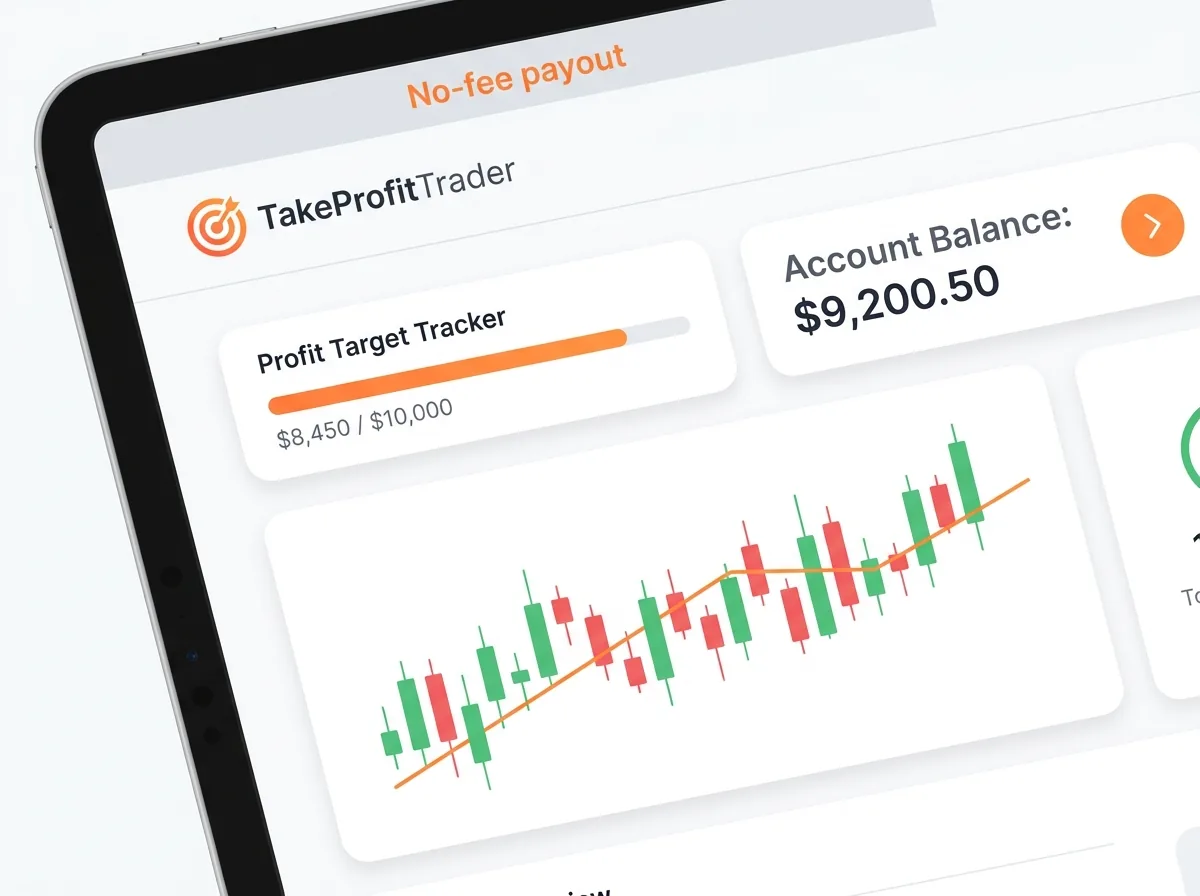
My current TPT evidence is three passed Tests, three active PRO accounts with $100K combined size and prior withdrawal experience. Current product rules are source-checked separately and do not become a new personal payout claim.

Rules checked against TakeProfitTrader Help Center · exact Test and PRO rule owners on
Ratings & Reviews
My own multi-year use, three current PRO accounts and prior withdrawal experience
What have I personally tested at TakeProfitTrader?
I have bought and traded TakeProfitTrader accounts across several years. The current checkpoint is July 2026: three Tests passed, three PRO accounts activated and $100K in combined nominal account size. I continue to trade those accounts.
The Test rewards controlled end-of-day progress. PRO punishes giving back open profit because unrealized peak equity can move the trailing floor. Passing the first stage does not prove readiness for the second.
What passing three Tests confirmed
The Test workflow operated as expected for me. The accounts were delivered, the targets and contract limits were clear, and I completed the one-step evaluations. Three passes in one month also confirmed that my process could repeat across more than one account rather than relying on a single fortunate sequence.
It did not confirm that the same size was appropriate in PRO. Test drawdown is calculated at end of day. Open profit can retrace without raising the official threshold during the session. PRO uses the opposite behavior: its floor follows realized and unrealized peak equity intraday until it reaches the original starting balance.
How I run the active PRO accounts
I begin with the account that has the least usable room, not the largest nominal balance. Before the session I check remaining drawdown, open positions, working orders, the economic calendar and whether all three accounts show the same intended state. One stale follower order is enough to create a problem.
I also treat open profit as risk information. If an account moves from $1,000 open profit to $300 before the close, the trade may still be green while the trailing floor has already moved. That mismatch is the main reason I reduce size after passing instead of treating PRO as a larger version of the Test.
What my withdrawal experience proves
I have prior withdrawal experience with TakeProfitTrader. That supports my view that the firm is operationally real. It does not prove every future request will be approved or establish a current payout amount.
This update deliberately leaves those unsupported details out. The current official workflow differs by feed and account state. Eligible active Tradovate PRO transfers can move automatically to the TPT Wallet. Rithmic, disabled and cancelled accounts can require manual handling. The external bank, PayPal or Wise leg is another step.
What I have not personally established
I do not present PRO+ as a stage I have personally reached in this current account set. I can explain its published live-market rules and upgrade process, but I do not use that research as a personal live-capital claim. The firm decides upgrades through a holistic review.
I also do not claim all five sizes as current hands-on tests. The rules scale by size, but my current evidence is the three passed Tests and three active PRO accounts described above. The account panel shows official size-specific values; the review explains what those values mean in practice.
Which TakeProfitTrader account size should you choose?
Choose a TakeProfitTrader size from usable drawdown, target and total cost. The nominal account label is the least useful number. A 50K account does not give a trader $50,000 of risk. It gives a $2,000 maximum-loss boundary, a $3,000 Test target and a six-contract ceiling.
| Size | Monthly Test | Target | Maximum loss | Reset | Max contracts |
|---|---|---|---|---|---|
| $25K | $150 | $1,500 | $1,500 | $79 | 3 |
| $50K | $170 | $3,000 | $2,000 | $99 | 6 |
| $75K | $245 | $4,500 | $2,500 | $139 | 9 |
| $100K | $330 | $6,000 | $3,000 | $169 | 12 |
| $150K | $360 | $9,000 | $4,500 | $199 | 15 |
Those are standard base prices before temporary checkout offers. The monthly Test price, Test reset, one-time PRO activation and possible PRO reset are separate costs. A discount on one line does not automatically discount the others.
25K: lowest commitment, tightest working room
The 25K Test has a $1,500 target and $1,500 maximum-loss amount. The target therefore equals the total available loss boundary. Three full-size contracts are permitted, but that ceiling is far above what many strategies can carry safely inside $1,500 of room.
This size can suit a trader validating execution at lower cost. It is less forgiving when a normal stop is large, several instruments are correlated or the trader needs room to adapt after one losing day.
50K and 75K: practical middle sizes
The 50K account combines a $3,000 target with $2,000 maximum loss. The 75K combines $4,500 with $2,500. Both require more net profit than the full drawdown allowance, so passing depends on a positive process rather than merely surviving.
I would compare the dollar stop used in normal trading with these loss amounts. If the personal daily stop is $300, the 50K offers roughly six such losing days before costs and trail movement. If the intended stop is $800, the same account is structurally too tight even though six contracts are allowed.
100K and 150K: more room, larger recurring cost
The 100K and 150K plans provide $3,000 and $4,500 of maximum loss. Their targets are $6,000 and $9,000. The larger contract ceilings should not be read as a position recommendation. They are platform limits.
A larger plan makes sense when the strategy genuinely needs more dollar room. It makes less sense when a trader simply increases size to finish a bigger target. Monthly billing continues until the Test is passed or cancelled, so time is part of the cost.
Reset and activation math
A Test reset changes account performance but does not move the renewal date. Resetting shortly before the next monthly charge can create two costs close together. After passing, the standard PRO activation fee is $130. PRO accounts have their own much higher reset prices and a maximum of three resets per account.
I would calculate one monthly fee, one plausible Test reset and the $130 activation before purchase. That is a more honest budget than the headline subscription alone. Check the account panel above for the current size and stage values before relying on any number here.
Which TakeProfitTrader rules matter most?
The most important TPT rule is the one that changes. Test uses end-of-day trailing drawdown. PRO uses intraday trailing drawdown. PRO+ returns to end-of-day. The account stage must be known before any risk number is interpreted.
| Rule | Test | PRO | PRO+ |
|---|---|---|---|
| Environment | Simulated | Simulated funded | Live market |
| Drawdown | End-of-day trail | Intraday trail | End-of-day trail |
| Consistency | Largest day below 50% | None published for payouts | None published for payouts |
| Minimum activity | 3 days for new cohort | 1 round trip each week | 1 round trip each week |
| Profit split | Not applicable | 80/20 | 90/10 |
Test consistency changes the target, not account status
The highest profit day must remain below 50% of total net profit. If one day produces $2,000, total net profit must exceed $4,000 before the ratio falls below 50%. TPT says crossing the threshold raises the target rather than failing the Test.
The practical response is not to manufacture tiny days. I set a daily profit ceiling and aim for several genuine sessions. A large early winner is still valuable, but it changes the amount of follow-through required.
PRO intraday trailing follows open equity
PRO drawdown follows the highest account equity reached during the session, including unrealized profit and loss. Once the floor reaches the original starting balance it stops moving. Before that lock, an open winner can tighten the account even if the closed trade remains profitable.
For a 50K PRO account with a $2,000 maximum-loss amount, the starting threshold is $48,000. If equity reaches $51,500, the trail can rise toward $49,500. Giving back $1,200 before closing leaves a profitable trade but far less room than the opening balance suggested.
No daily loss limit is not unlimited risk
The standard account does not publish a separate daily-loss cap. The maximum-loss trail remains active. Without a personal daily stop, a trader can consume the entire account boundary in one session. I use a lower stop because the firm does not provide a reset button after every emotional decision.
News and session rules apply after passing
PRO and PRO+ have named high-impact news windows. Traders must be flat and have no working orders from one minute before until one minute after the specified release. Some products have extra event restrictions. Positions also cannot be carried into the next trading day or over the weekend.
Copying is allowed only inside a controlled boundary
TPT permits approved copying across accounts owned and controlled by the same trader. Bots, algorithms, pass services, payout services, copying between different users and opposing positions are prohibited. A copier does not remove responsibility for every follower.
I verify quantity, side, working orders and flat status on each account. A leader can close correctly while a disconnected follower remains open. Multi-account execution is an operational system, not merely a way to multiply one order.
Which TakeProfitTrader platform should you use?
TakeProfitTrader supports two data-feed families. CQG connects to TradingView, NinjaTrader and Tradovate. Rithmic connects to Bookmap, MultiCharts, MotiveWave, Trade Navigator, R|Trader, VolFix, ATAS, Investor R/T, Quantower, Finamark and Jigsaw Trader.
Most third-party front ends need their own licence. Connection behavior differs, and the current PRO-to-wallet process is easier for eligible active Tradovate accounts than for Rithmic accounts.
Tradovate for the simplest operational route
Tradovate is the cleanest default when the strategy does not require a specialist order-flow tool. It is browser-friendly, works with the CQG path and can qualify for the automated PRO-to-wallet transfer. That reduces one manual step without guaranteeing the later external payment leg.
TradingView for chart-led execution
TradingView can fit a trader whose analysis and order entry already live in that interface. I would still verify bracket behavior, working-order state and the exact TPT account connection before normal size. A familiar chart does not change the account rules.
NinjaTrader for local tools and structured execution
NinjaTrader can suit traders using its desktop workflow, indicators or order templates. The licence, feed connection and copier setup need to be understood before purchase. I would test a minimal position and a full flatten sequence before relying on an account group.
Rithmic for specialist front ends
Rithmic opens the wider list of order-flow and professional-style interfaces. It can be the better technical fit for Bookmap, Jigsaw, Quantower or another supported tool. The tradeoff is a more manual TPT Wallet request path and possible additional software cost.
My platform checklist
- Choose the feed before buying any separate platform licence.
- Confirm that the intended copier is approved and every account is self-owned.
- Test stop, bracket, flatten and reconnect behavior at minimum size.
- Check whether the payout workflow for the chosen feed is automated or manual.
- Verify the current approved futures products and trading hours.
I would choose Tradovate for simplicity and Rithmic only when a specific front end materially improves execution. Platform preference should not override the PRO intraday trail, which is the same economic risk problem underneath either feed.
How would I approach TakeProfitTrader today?
I would build the entire plan around PRO, not around the easier-looking Test. The evaluation is temporary. The simulated funded stage is where the payout buffer, intraday trail, weekly activity and news restrictions determine whether the account survives.
1. Pick size from a personal stop
I would set a normal per-trade risk and personal daily stop before choosing the account. The maximum-loss amount should contain several ordinary losing days plus execution error. If it contains only one or two, the account is too small for the current strategy.
2. Trade Test as if open profit already mattered
The Test does not trail intraday, but I would behave as if it did. That means scaling out, moving risk only for a defined reason and avoiding large open giveback. The goal is to make passing evidence that the PRO method can work.
3. Control the 50% rule from the first session
I would use a daily profit stop rather than chase the full target in one move. If the first day is unusually large, I would recalculate the total needed and trade normal setups. I would not add token trades merely to create calendar days.
4. Reduce size immediately after activation
On PRO I would begin below the Test size until the intraday trail locks at the starting balance. That early buffer-building period is the account's most sensitive state. Open profit is helpful only when its giveback cannot breach the moving floor.
5. Plan the first withdrawal before the first trade
The buffer equals the maximum-loss amount for the selected size. I would write down the balance required to preserve it, the amount eligible above it, the 80/20 split and the account state after a request. I would avoid a withdrawal of $250 or less because TPT publishes a $50 fee at that level.
6. Add accounts only after the workflow is stable
TPT permits five active PRO and PRO+ accounts combined. That is capacity, not a goal. I would add a second or third account only after the platform, copier, risk check and payout checklist work without improvisation.
This is close to how I manage my current three-account group. The account with the least room sets the size, all followers are checked before restricted news and a personal daily stop ends the session before the firm boundary becomes the decision.
Is TakeProfitTrader legitimate?
Yes. I consider TakeProfitTrader legitimate. I have traded it repeatedly over several years, passed three more Tests in July 2026, activated three PRO accounts and have prior withdrawal experience. That is stronger evidence for my verdict than an external review score.
TakeProfitTrader says it began in 2021 and publishes a detailed Help Center for the Test, PRO, PRO+, platforms, withdrawals and universal trading policy. The current Trustpilot profile showed 4.4 from 10,510 reviews on September 6, 2026. That score is a separate sentiment signal, not the source of the PTV rating.
What supports the verdict
- My own multi-year use, current active accounts and prior withdrawal history.
- Separate current rule owners for Test, PRO and PRO+.
- A clear disclosure that Test and PRO are simulated while PRO+ is live-market.
- Published buffer, split, withdrawal route and fee terms.
- A documented platform and data-feed matrix rather than one generic compatibility claim.
What still needs caution
PRO drawdown reacts to unrealized equity and is materially harder than the Test's end-of-day trail. PRO+ access is discretionary. TPT can review trading under its broader policies even when a trader believes every isolated numeric rule was respected.
The upgrade can also interrupt normal operations. TPT says setup usually takes several days, professional market data can create a pause of up to 12 hours, the old PRO is held and $5,000 of PRO profit remains frozen while PRO+ is active. That is not a simple account toggle.
How I use Trustpilot
I look for repeated themes about support, payments and account transitions. I do not compare a row of competitor Trustpilot numbers inside this review. Different profiles, dates and trader populations make that look more precise than it is.
A high Trustpilot score does not override the agreement or my own results. A negative review from a breached account does not automatically prove misconduct. The useful question is whether a repeated complaint matches an actual decision point in the official rules.
My conclusion is direct: TPT is a serious operator and remains in my rotation. It is not low-risk. The main risk is understandable and avoidable only through smaller size, stage-aware drawdown management and clean account operations.
How does TakeProfitTrader compare with other futures prop firms?
TakeProfitTrader's differentiator is not the cheapest Test. It is the combination of a one-step evaluation, broad platform choice and on-demand PRO withdrawals above a buffer. Its main disadvantage is the move from end-of-day drawdown in Test to intraday trailing drawdown in PRO.
Against firms with end-of-day funded drawdown
A firm that keeps end-of-day drawdown after passing can be easier for strategies that build open profit and allow normal retracement. TPT can suit a trader who closes gains efficiently and wants a payout model without funded consistency days.
Against integrated-platform firms
Topstep offers a more integrated product and a longer operating history. TPT offers a broader choice of front ends. The decision is whether platform freedom or one controlled ecosystem creates fewer execution errors.
Against broader account menus
Lucid Trading, Tradeify and MyFundedFutures expose more account routes and payout configurations. TPT is simpler at purchase: one Test structure in five sizes. Its complexity appears later in the stage transition and feed workflow.
I keep TPT in active rotation because I know the product, have passed repeatedly and have prior withdrawal experience. I would choose it when a supported platform and the PRO withdrawal design fit the strategy. I would choose an alternative when intraday peak-equity trailing would change normal trade management.
Compare the complete path: subscription, possible reset, activation, Test target, funded drawdown, buffer, split, platform licence, withdrawal fee and whether live capital is automatic. At TPT, live capital is not automatic. PRO+ remains a discretionary review outcome.
Frequently Asked Questions
Is TakeProfitTrader legit?
Yes. TakeProfitTrader has operated since 2022, publishes a detailed official rule center, and currently shows 4.3 from 10,215 Trustpilot reviews. I also trade the firm repeatedly and currently hold three active PRO accounts with $100K combined size.
What account stages does TakeProfitTrader use?
TakeProfitTrader uses a simulated Test, a simulated funded PRO account, and an invitation-only live PRO+ account. PRO+ Development is a stricter live variant for selected risk profiles.
Is TakeProfitTrader PRO live or simulated?
TakeProfitTrader PRO is simulated, even though eligible profit can be withdrawn. PRO+ is the live-market stage routed to the exchange.
What is the TakeProfitTrader profit split?
TakeProfitTrader allocates 80% to the trader on PRO and 90% on PRO+. The Test is an evaluation and has no profit split.
What drawdown does TakeProfitTrader use?
TakeProfitTrader Test uses EOD trailing drawdown, standard PRO uses intraday trailing drawdown from realized and unrealized peaks, and PRO+ uses EOD trailing drawdown.
Does TakeProfitTrader have a consistency rule?
Yes. TakeProfitTrader Test requires the highest-profit day to be less than 50% of total net profit. Standard PRO and PRO+ do not publish the same payout consistency rule.
How many TakeProfitTrader accounts can I have?
TakeProfitTrader allows unlimited Tests and five active PRO and PRO+ accounts combined per person. It also limits passed-Test activations to ten within 30 calendar days.
Can you copy trade at TakeProfitTrader?
Yes. TakeProfitTrader permits approved copiers across accounts owned and controlled by the same trader. Bots, cross-user copying, pass services, and offsetting structures remain prohibited.
How fast are TakeProfitTrader payouts?
Active Tradovate PRO transfers into the TPT wallet can complete in five to ten seconds after validation. Wallet review and delivery by Plaid, Wise, or PayPal are separate steps with separate timing.
What are the TakeProfitTrader reset fees?
TakeProfitTrader Test resets cost $79 to $199 by size. PRO resets cost $449 to $1,499 and are limited to three per account. PRO+ cannot be reset directly.
Can you trade news at TakeProfitTrader?
TakeProfitTrader PRO and PRO+ require no positions or working orders one minute before, during, and one minute after specified FOMC, NFP, CPI, crude-inventory, and bond-auction events.
Which platforms support TakeProfitTrader?
TakeProfitTrader lists TradingView, NinjaTrader, and Tradovate through CQG, plus Bookmap, Quantower, MotiveWave, R|Trader, and several other front ends through Rithmic.
How do you get a TakeProfitTrader PRO+ account?
TakeProfitTrader sends PRO+ invitations after a holistic review of consistency, risk management, execution, and discipline. No published profit threshold guarantees promotion.
Does PTV have a TakeProfitTrader referral code?
Yes. VIBES and the tracked VIBES referral URL identify PTV as the referrer. The separate public NOFEE40 promotion currently provides the advertised 40% Test discount and $130 PRO activation credit. Verify both at checkout.
Key details
- Founded
- 2022
- Asset classes
- Futures
- Platforms
- Tradovate, NinjaTrader, TradingView, Quantower, MotiveWave, Bookmap, ATAS, Jigsaw, MultiCharts, Rithmic, CQG
- Profit split
- 80% / 90%
- Payout frequency
- Daily
- Max funding
- $150,000
- Referral code
- VIBES
I may earn a commission if you sign up through my link. It never changes my rating or verdict. I tested this firm with my own money.