Table of contents
Table of contents
Quick Answer, Best funded trading accounts, 2026
- Best futures funded account overall: Lucid Trading, with an EOD-trailing lock (intraday on LucidDaily), ~15-min payouts and five account types, four purchasable, 40% off eligible checkout prices with code VIBES; check the final price
- Beginner shortlist: MyFundedFutures, but select the exact plan. Rapid EOD 50K has no sim-funded daily loss limit; Builder 25K has a $600 soft pause and a 50% sim-funded payout consistency rule. No PTV code
- Best forex funded account: FTMO, with a ~4-year track record, $650M+ paid out, and a 90% split from day one on the 1-Step Challenge
- Best multi-account scaling: Apex Trader Funding, with up to 20 copy-tradeable funded accounts and a 100% split on 4.0 payouts (no PTV code, buy on Apex's own 80-90% promo)
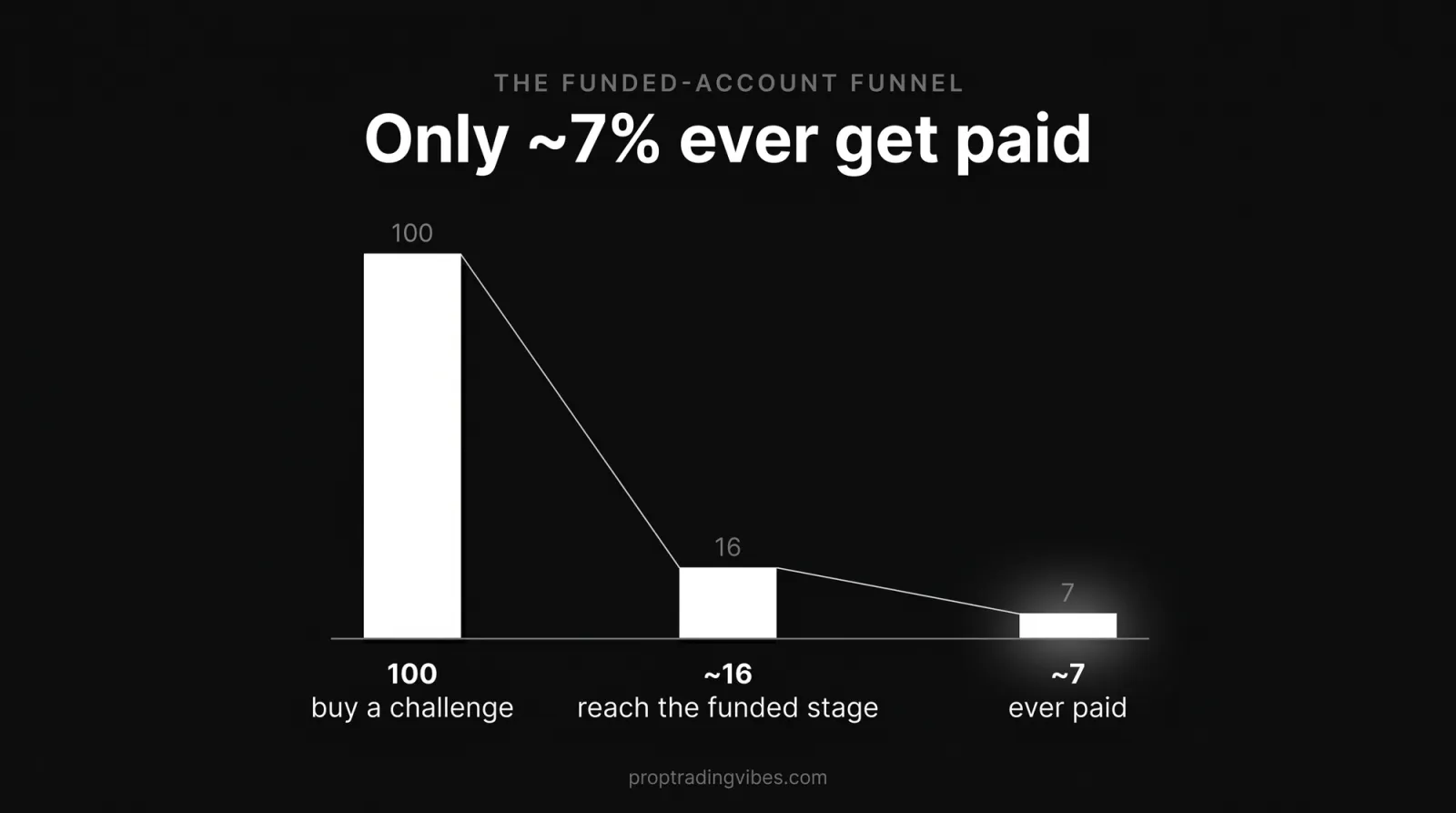
- A funded account is simulated capital, not real money, and only about 7% of accounts ever see a payout, so pick on rules and cost, not marketing
A funded trading account is usually a simulated account whose rules determine when you can request a real payout. For futures, Lucid Trading remains my tested overall pick. MyFundedFutures offers several possible first accounts, but its rules differ by plan: Rapid EOD 50K has no sim-funded daily loss limit, while Builder 25K has a $600 soft pause and 50% consistency on sim-funded payout cycles. For forex, compare FTMO’s documented product and payout path. Start with the account rulebook, then check the live checkout.
One fact reframes the whole decision. At nearly every retail futures and forex prop firm in 2026, the funded account is simulated, not a live brokerage account with your own money. The payouts are real cash, but the trading happens in a simulated environment with firm-defined risk parameters. That is not a scam, it is the standard model, and knowing it changes how you should pick.
The other fact that matters: across the industry, only about 7% of all funded-account buyers ever see a payout, and even among traders who reach the funded stage only roughly 45% go on to take a withdrawal, per figures The Funded Trader's CEO shared in March 2025 and reported by Finance Magnates. So the right account is not the one with the biggest headline funding number or the flashiest marketing. It is the one whose rules and cost give you the best odds of actually getting paid. This guide ranks the firms I cover on exactly that, with verified rules and a side-by-side table you can lift straight into a comparison.
A note on this ranking, in the interest of transparency: I trade these firms myself, and where a firm offers a Proptradingvibes discount code I say so and earn an affiliate commission if you use it. That does not buy a higher ranking. Two of my top picks here, MyFundedFutures and Apex Trader Funding, have no PTV code at all, and they earn their spots purely on rules and cost. For the broader, all-categories ranking beyond funded-account mechanics, see the best prop firms 2026 pillar; this guide narrows to the funded-account buyer's path of evaluation, funding and payout.
What is a funded trading account?
A funded trading account is an account funded by a proprietary trading firm rather than by your own deposit, where you trade the firm's capital and split the profits. You pay a fee to access it, either an evaluation fee to prove your skill first or an instant-funding fee that skips the test, and once you are trading the funded account you earn a profit split, typically 80% to 100%, on what you make.
Two details define how a funded account actually behaves. The first is whether it is real or simulated. In 2026, firms like Lucid Trading, Apex Trader Funding, MyFundedFutures and FTMO fund simulated accounts, so you are not trading a live brokerage account with your own money, even though the payouts you earn are real cash. The second is the drawdown mechanic, the rule that decides when the firm takes the account back. That rule, not the profit target, is what ends most accounts.
A funded account is not passive income and it is not a job offer. It is a performance contract: clear the firm's risk rules, stay consistent, and the firm pays you a share of the simulated profit.
Is a funded trading account real money?
The payouts are real money; the trading account is simulated. This is the single most misunderstood thing about funded trading, so it is worth stating plainly: when you buy a funded account at Apex Trader Funding, Lucid Trading, MyFundedFutures or FTMO, you are trading a simulated account that mirrors live market data, not a live account holding firm or personal capital.
What that means in plain terms is that your trades fill against simulated liquidity inside risk parameters the firm sets, and your performance determines a cash profit split the firm pays you. The firm makes money primarily from evaluation and subscription fees, and pays winning traders out of that revenue and its risk management. None of that makes the model dishonest. It makes it a fee-for-access skill contest with a real cash reward at the end.
The practical takeaway is to treat the funding number as a risk budget, not a bank balance. A "$150K funded account" means you trade with $150K of simulated buying power and the firm's drawdown rules, not that $150K is sitting in your name. Pick the size you can manage, not the biggest number you can afford.
Which is the best funded trading account for futures?
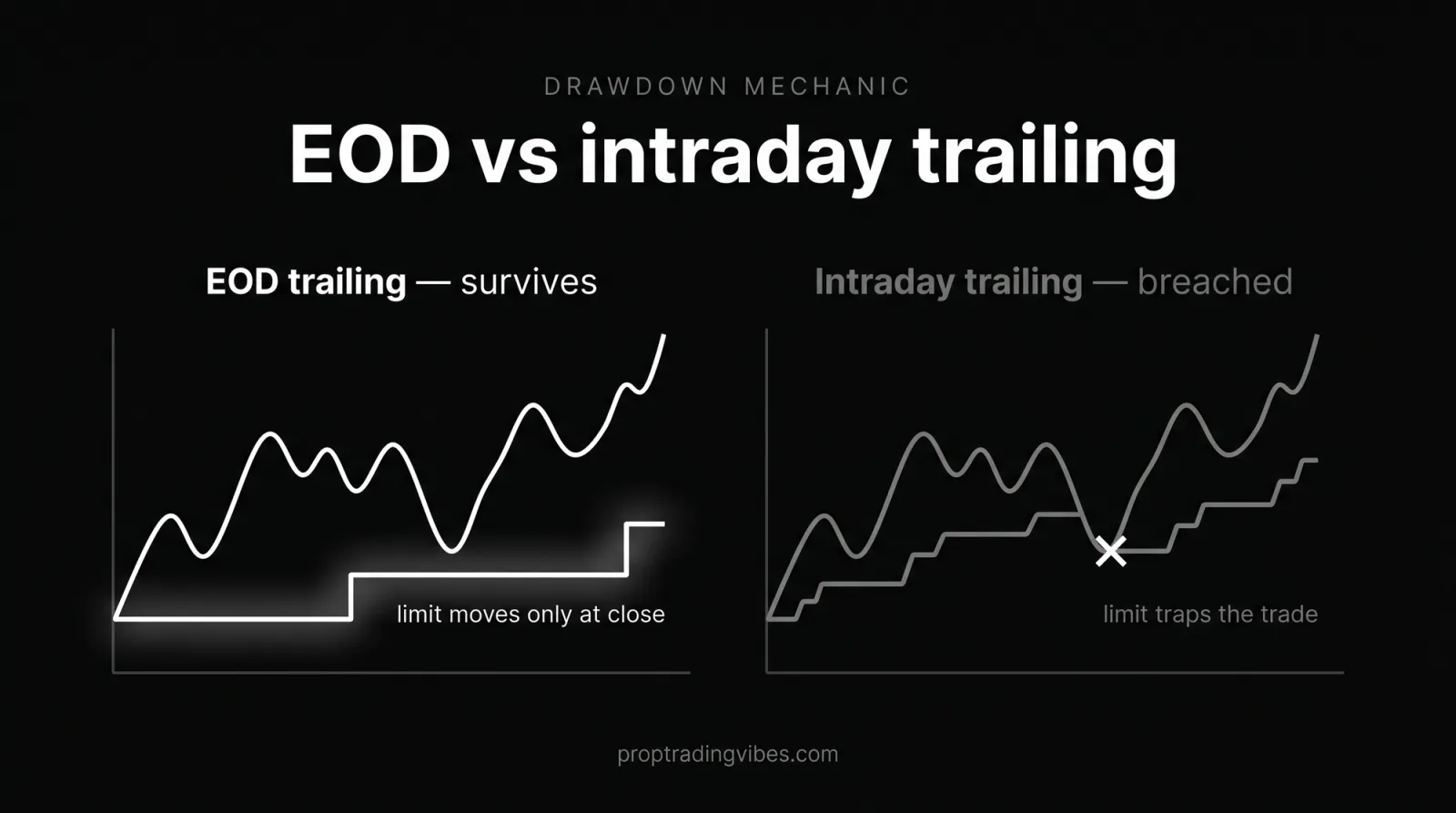
Lucid Trading is the best funded trading account for futures in 2026, on the strength of its drawdown mechanic and payout speed. On its core accounts Lucid uses an EOD-trailing drawdown that only trails up at the daily close and never intraday (the exception is LucidDaily, whose funded accounts trail intraday), and the maximum loss limit locks once it reaches your starting balance, which makes the account un-breachable below starting balance from that point on. Payouts process in roughly 15 minutes on average, and the firm runs five account types, four of them purchasable (LucidPro, LucidFlex, LucidDaily, LucidDirect), with VIBES currently taking 40% off eligible checkout prices; check the final amount.
Lucid is PTV's flagship firm and the one I have traded the most, across many payout cycles on the LucidFlex and LucidPro products with fast, repeat withdrawals. Lucid's consistency rules vary by product: 50% in the LucidFlex and LucidDaily evaluations only, and a funded-phase rule on LucidPro, so it is not a blanket no-consistency-rule firm. You can read the full breakdown in the Lucid Trading review.
The newest of the five is LucidDaily, launched July 2026 and built around daily payout requests on funded accounts. The LucidDaily breakdown covers how it differs from Flex and Pro.
Why EOD trailing matters more than the funding number
EOD trailing is more forgiving than intraday trailing because your drawdown line only moves up when the day closes green, not tick by tick during the session. On an intraday-trailing account, a spike of unrealised profit that you give back before the close can push your loss limit up and then trap you. On Lucid Trading's EOD-trailing accounts, that trap does not exist intraday. For a trader who scalps or holds runners, that difference decides far more accounts than any profit target does.
The runner-up futures picks
Apex Trader Funding is the runner-up for futures and the clear winner for anyone scaling. As of the March 1 2026 launch of Apex 4.0, the firm pays a 100% profit split on approved payouts, defaults to EOD trailing, and removed six older rules including the 5:1 risk-reward and one-direction rules. Apex allows up to 20 copy-tradeable funded accounts at once, which is why scaling traders favour it; The published parallel-account maximum is a product rule, not a live personal account chronology or scaling recommendation. PTV has no Apex affiliate code, so the value comes from buying on Apex's own 80% to 90% promo cycles, not from a code. See the full Apex Trader Funding review for the 4.0 details.
MyFundedFutures fills out the futures shortlist. MyFundedFutures is covered below as the beginner pick.
Which is the best funded trading account for beginners?
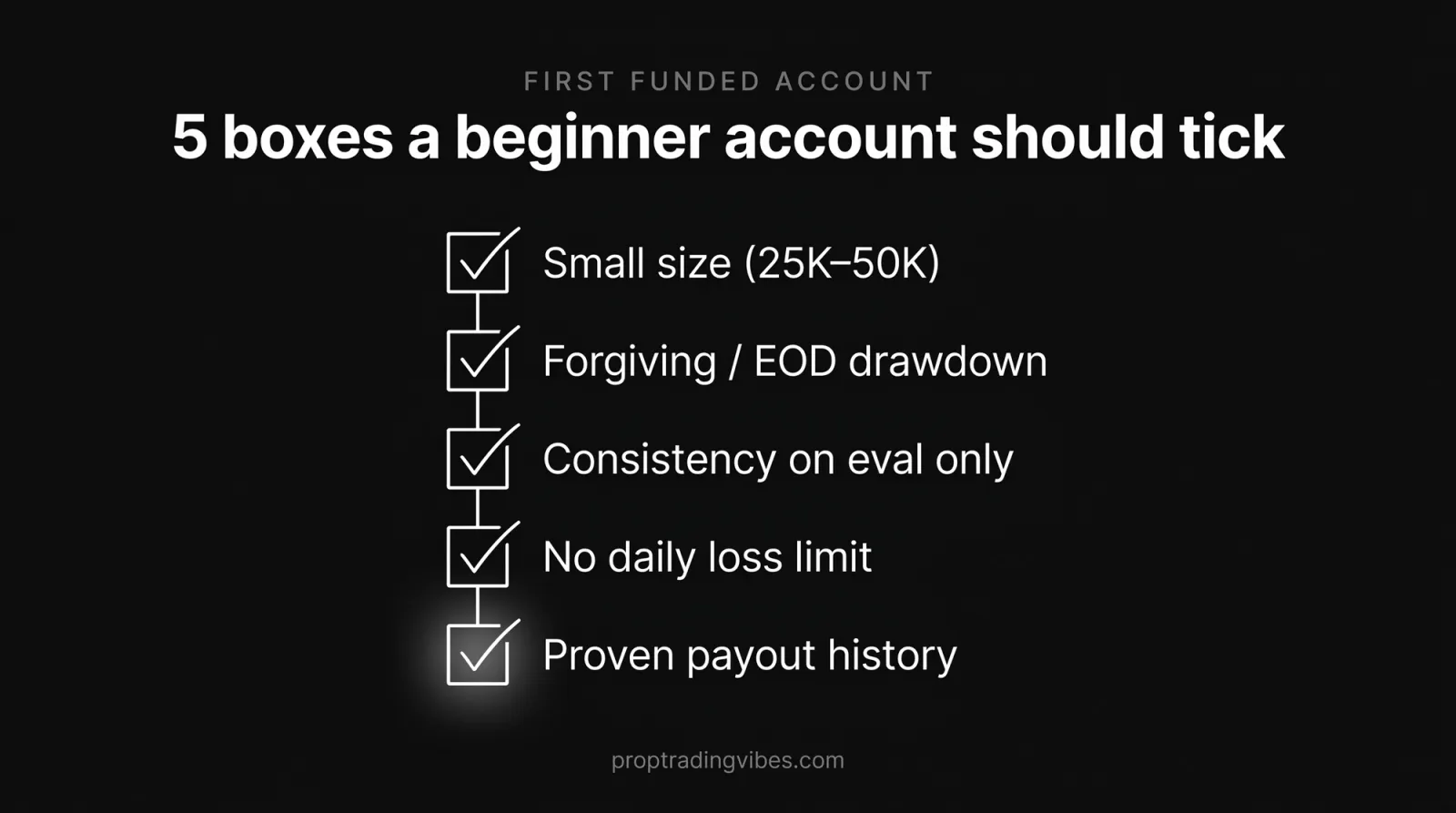
MyFundedFutures can suit a first futures account, but the plan must be named. Rapid EOD 50K has an end-of-day sim-funded drawdown, no daily loss limit and no sim-funded payout consistency rule; its evaluation has a 30% rule. Builder 25K has a $600 soft daily-loss pause in evaluation and sim funded. It does not breach the account, but it stops trading for that session. Builder’s evaluation has no consistency rule; its sim-funded payout cycles use 50%. Neither product is a firm-wide promise about MFFU.
MyFundedFutures backs that forgiving rule set with seven supported platforms, including NinjaTrader, Tradovate and TradingView, and a strong reputation, around 4.9 on Trustpilot across more than 11,000 reviews. The recommendation is tied to the current rules and documented evidence; the MyFundedFutures review has the full plan matrix. PTV has no MyFundedFutures affiliate code, so all links are bare, and the third-party promo codes that float around rotate too often to rely on.
What makes a funded account beginner-friendly
For a first account, I check five things: the smallest useful size, the drawdown floor, any session pause, the payout consistency test, and whether the firm has paid traders. MFFU offers different answers by plan. Rapid EOD 50K removes the sim-funded daily-loss limit and payout consistency test; Builder 25K adds a soft pause and a payout consistency test. Pick the rule set you can actually trade rather than the cheapest headline size.
What beginners should avoid
Beginners should avoid instant funding and oversized accounts. Instant funding skips the evaluation but costs more upfront and usually adds a stricter, progressive consistency rule, which punishes the single big days that new traders rely on. A cheap evaluation is a better first purchase because it doubles as a low-cost test of your own discipline. If you cannot pass a $50K evaluation, paying more for an instant $50K account does not fix the problem, it just makes the same failure more expensive.
Which is the best funded trading account for forex?
FTMO is the best funded trading account for forex in 2026, on track record above all. FTMO is one of the longest-running firms in the sector and has paid out more than $650 million to traders across a decade, a figure its founder announced on the firm's tenth anniversary and Finance Magnates reported in September 2025. Its 1-Step Challenge pays a 90% profit split from day one with a 3% daily loss limit and a 10% trailing maximum loss.
FTMO is one of the established firms in PTV’s test and research set. My first-hand FTMO scope is Standard CFD accounts. The company now also offers a separate FTMO Futures Beta with Growth and Pro; that new line is source-based and does not inherit the CFD payout record. Use the full FTMO review for the product boundary.
FundedNext is the forex runner-up and a genuine multi-asset alternative. It has paid out over $284 million and holds 4.5 on Trustpilot across more than 62,000 reviews, both per FundedNext's own figures, and runs both 1-Step and 2-Step Stellar models on the CFD side plus Bolt and Rapid models on futures. The FundedNext CFD and futures assessments are source-based; see the FundedNext review for the plan range.
How do the best funded trading accounts compare?
The best funded trading accounts in 2026 differ most on three axes: the drawdown mechanic, the profit split, and whether PTV has a discount code. The table below compares the six firms PTV covers across the metrics that decide whether you keep an account and get paid. All figures are from each firm's own materials as of June 2026; verify the live page before you buy, because prop firms change pricing and rules often.
| Firm | Market | Best for | Drawdown | Profit split | PTV code (discount) |
|---|---|---|---|---|---|
| Lucid Trading | Futures | Overall + payout speed | EOD trailing, locks at start balance (LucidDaily: intraday) | 90% (Flex and Pro) | VIBES (40% off eligible checkout) |
| MyFundedFutures | Futures | Beginners | Rapid EOD 50K: no DLL; Builder 25K: $600 soft pause | 80/20 to 90/10 by plan | None (bare link) |
| Apex Trader Funding | Futures | Multi-account scaling | EOD trailing (4.0 default) | 100% on 4.0 payouts | None (buy on 80-90% promo) |
| FTMO | Forex / CFD | Forex track record | 10% trailing (1-Step) / static (2-Step) | 90% day one (1-Step) | None |
| FundedNext | Forex + Futures | Multi-asset | Varies by model | Up to 95% reward | None |
| Tradeify | Futures | Instant funding | EOD-trailing options | 90/10 on current Lightning | None (verify at checkout) |
Two things stand out in the table. First, EOD trailing is the dominant drawdown mechanic among the top picks, because firms learned that intraday trailing fails too many otherwise-profitable traders. Second, a PTV discount code is not the deciding factor: Apex has no code yet remains a top pick because its own promo cycles beat most coded discounts, and MyFundedFutures earns the beginner spot purely on rules. Tradeify rounds out the table as the instant-funding option; if that is your route, the best instant-funding prop firms guide compares it head to head.
What does a funded trading account actually cost?
A funded account may have a one-time purchase, a recurring charge on a legacy subscription, a reset fee or a later activation cost. Compare the full path for the exact plan. VIBES currently applies 40% to eligible Lucid programs, but I have not reconfirmed a starting checkout price for this guide. MFFU new evaluations use one-time purchases; older subscriptions can retain renewal terms. Apex and FTMO prices and promotions also need a current checkout before a cost winner can be named.
The real cost is fees plus resets plus the activation fee on some firms, multiplied by how many attempts you need. Apex 4.0 charges the size-based Standard PA price on EOD accounts due within seven days of passing, separate from the evaluation price. Resets and re-buys after a failed attempt are where most traders actually spend their money, which is the case for instant funding only when an evaluation route would have cost less overall.
The cheapest path to a funded account is a discounted evaluation, not instant funding. Instant funding skips the test but charges more upfront, so it pays off only for proven traders who keep failing evaluations on the clock rather than the trading. For everyone else, a cheap evaluation on a promo cycle is the lowest-cost route, and it doubles as a test of your own discipline before real money is on the line.
Are funded trading accounts worth it?
Funded trading accounts are worth it for disciplined traders who treat them as a fee-for-access skill contest, and a money pit for everyone who treats them as easy income. The industry numbers are blunt: only about 7% of all funded-account buyers ever receive a payout, and even among the smaller group who clear the evaluation and reach the funded stage, only roughly 45% go on to withdraw, per figures The Funded Trader's CEO shared in March 2025 and Finance Magnates reported. The gap between those two numbers is the point: passing the challenge is the hard part, but a meaningful share of funded traders still never collect, usually because a drawdown rule catches them first.
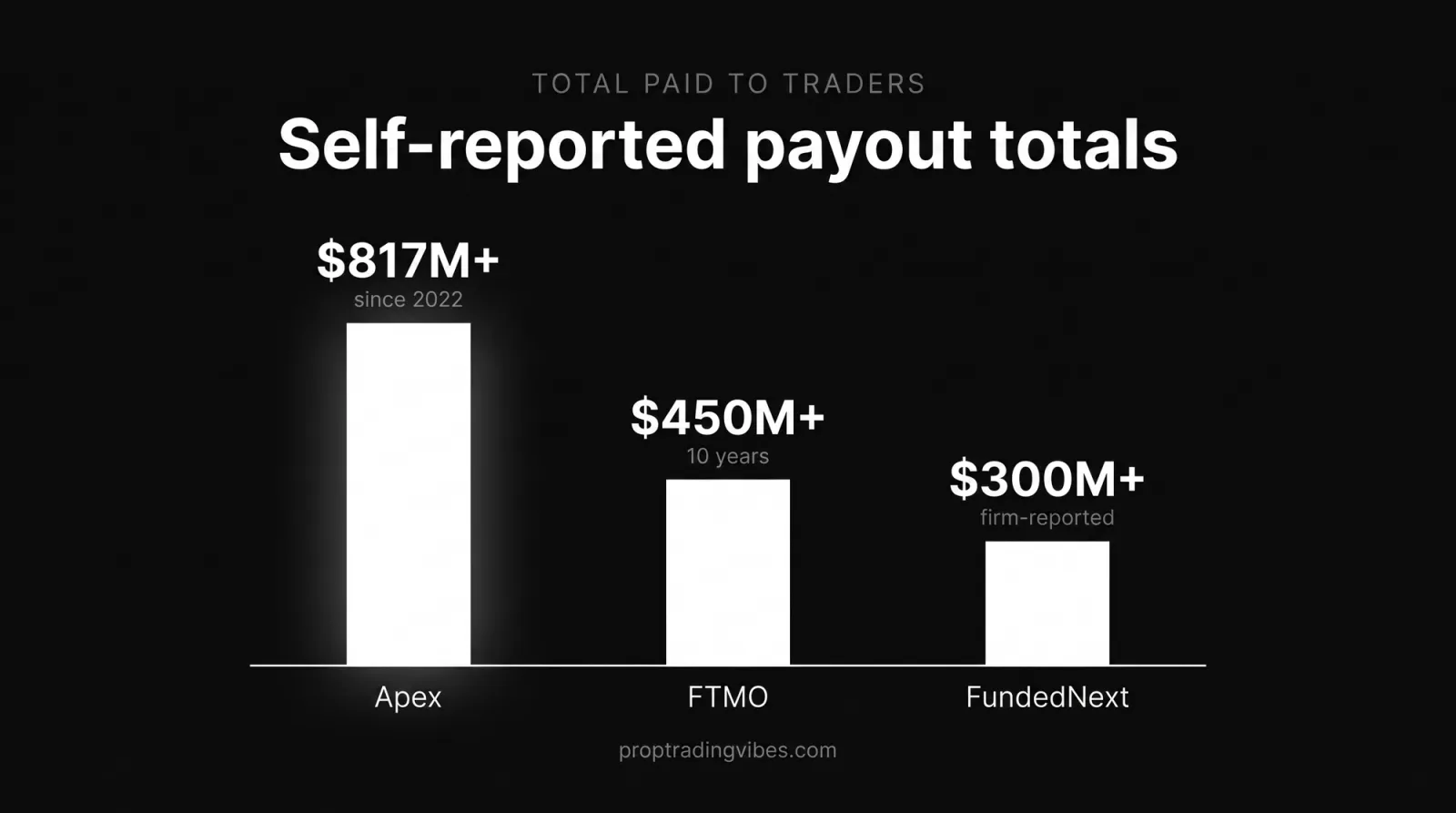
That low success rate is also why the leading firms can advertise enormous total payouts: FTMO over $650 million across a decade, Apex Trader Funding more than $800 million since 2022 (homepage counter: $817M, July 2026), and FundedNext over $284 million, each per the firm's own payouts reporting. Those are real, large numbers, and they are self-reported, not independently audited. They prove the firms pay; they do not promise you will be one of the traders who gets paid.
The honest answer is that a funded account is worth it when the math works for your situation. If you are consistently profitable on a demo and your only barrier is capital, a cheap evaluation is one of the best-value products in trading. If you are still searching for an edge, a funded account is an expensive way to discover that, and a free demo answers the same question for nothing.
How to choose your funded trading account
Choose a funded account by market, plan and strategy. For futures payout speed, compare Lucid Trading’s current programs and the VIBES checkout. If you are new to funded trading, shortlist MFFU only after choosing a specific plan: Rapid EOD 50K and Builder 25K have different daily-loss and payout-consistency rules. For forex, assess FTMO’s current product. If parallel accounts matter, compare Apex’s current PA rules and purchase path.
Before you buy anything, read three things on the firm's own site: the drawdown mechanic, whether the consistency rule applies on funded or only on evaluation, and the payout conditions. Those three rules, not the funding number or the marketing, decide whether you keep the account and get paid. This guide focuses on the funded-account buyer's path; for the broader all-categories ranking see the best prop firms 2026 pillar, and if you want to skip the evaluation entirely, compare the best instant-funding prop firms.
The bottom line
The best funded account is the one whose rules you can follow through the payout stage. Lucid Trading remains my tested futures pick, and VIBES applies a 40% discount to its eligible current programs; the final amount is set at checkout. MFFU is a plan-specific beginner shortlist, not a blanket no-DLL choice: Rapid EOD 50K has no sim-funded daily limit, while Builder 25K has a $600 soft pause and 50% sim-funded payout consistency. For forex, compare FTMO’s documented product path.
Skip the funded-account hunt entirely if you are not yet consistently profitable on a free demo. A funded account is a skill contest with a real cash reward, not a shortcut to income, and the cheapest, most forgiving account you can actually clear beats any flashy one you cannot. If you are ready, start small, read the drawdown rule first, and pick the firm that matches your market. For the wider field beyond funded-account mechanics, the best prop firms 2026 pillar ranks every category.
Frequently Asked Questions
What is the best funded trading account in 2026?
It depends on your market and the exact account. Lucid Trading is my tested futures pick, with VIBES currently applying 40% to eligible programs; confirm the final price at checkout. FTMO is a forex comparison point. MFFU can suit a first futures account, but Rapid EOD 50K and Builder 25K have different daily-loss and payout-consistency rules. Read the plan guide before treating either as beginner-friendly.
Are funded trading accounts a scam?
No, but the simulated-account model is widely misunderstood. At nearly every retail futures and forex firm in 2026, including Lucid Trading, Apex and FTMO, the funded account is a simulated environment, not a live brokerage account with your own capital, and the payouts are still real cash. The genuine risks are different: rotating third-party promo codes, firms with no payout track record, and progressive consistency rules on instant funding. Stick to firms with a long, self-reported payout history and read the drawdown rule before you buy.
How much does a funded trading account cost in 2026?
There is no reliable universal starting price for a funded account. Current checkout totals depend on the firm, plan, size, promotion, reset path and any activation charge. Lucid offers VIBES on eligible programs, while MFFU separates new one-time purchases from legacy subscriptions. Compare the same account size and all required payments at checkout.
What is the most important rule on a funded trading account?
The drawdown mechanic is the single most important rule on any funded trading account, because most traders lose accounts by hitting a loss limit, not by failing to make money. Lucid Trading uses EOD trailing on its core accounts, where the limit only moves up at the daily close and never intraday, which is more forgiving than intraday trailing; the exception is LucidDaily, whose funded accounts trail intraday. Apex 4.0 also defaults to EOD trailing. Always read whether the drawdown is EOD-trailing, intraday-trailing or static before you buy.
Which funded account has the fastest payouts?
Lucid Trading reports fast payout processing, but eligibility and transfer are separate steps. MFFU Rapid and Rapid EOD can become eligible for frequent requests once the plan’s buffer and minimums are met; timing differs by product. A payout headline matters less than the drawdown and withdrawal rules you can satisfy consistently.
What percentage of funded traders actually get paid?
Across the industry, only about 7% of all funded-account buyers ever receive a payout, per figures The Funded Trader's CEO shared in March 2025 and reported by Finance Magnates. Among the smaller group who actually clear the evaluation and reach the funded stage, roughly 45% go on to take a withdrawal, so even passing the challenge is not the same as getting paid. That is why the rules and cost of a funded account matter more than its marketing.
What is the best forex funded account?
FTMO is PTV's pick for the best forex funded account. It is one of the longest-running firms in the sector, has paid out more than $650 million across ten years per Finance Magnates, and its 1-Step Challenge pays a 90% profit split from day one with a 3% daily loss and 10% trailing max loss. FundedNext is a strong forex alternative with over $284 million paid out and both 1-Step and 2-Step Stellar models.
Can I run more than one funded account at once?
Several firms allow multiple accounts, but limits differ by plan and stage. Apex Trader Funding, Lucid Trading, MyFundedFutures and FundedNext each publish their own caps. More accounts increase purchase, reset and rule-management exposure, so I would first prove that one account fits the strategy.
Does Lucid Trading have a consistency rule?
Tradeify 247 evaluation-funded paths do not use a best-day consistency cap, while Instant applies a 20% payout consistency rule. Keep those populations separate.
What is the cheapest way to get funded in 2026?
A discounted evaluation can lower the entry fee, but it does not settle the total path cost. Check the current purchase price, reset exposure, activation charge and payout rules before choosing. VIBES currently takes 40% off eligible Lucid programs; the final amount is the checkout amount. An instant account skips evaluation but can cost more upfront, depending on the product.
Is Apex Trader Funding still worth it after the 4.0 update?
Yes. Apex Trader Funding's 4.0 overhaul, launched March 1 2026, pays a 100% profit split on approved payouts, removed six older rules including the 5:1 risk-reward and one-direction rules, and defaults to EOD trailing. Apex allows up to 20 copy-tradeable funded accounts and has paid out more than $800 million to traders per its own payouts reporting. PTV has no Apex affiliate code, so buy on Apex's own 80% to 90% promo cycles.