
Table of contents
September 2026 rollover at a glance
- CME’s customary September 2026 roll date for U.S. equity-index futures is September 14; September contracts expire on September 18.
- ES, NQ, MES and MNQ switch from September U26 to December Z26. Confirm your platform’s symbol format.
- Compare actual volume and spreads. CME’s calendar date, your chart’s rollover and the liquidity crossover can differ.
- If you are flat, select the appropriate expiry for your next trade. A chart switch does not verify a position roll or an order change.
Futures contract rollover means closing a position in one expiry month and opening it in a later month. For ES, NQ and their Micro E-mini equivalents, the September 2026 roll moves trading from the U contract to the December Z contract. If you finish every session flat, your task is to select the right contract for your next trade.
When is the next futures rollover?
As of September 9, 2026, CME lists Monday, September 14 as the customary roll date for U.S. equity-index futures. The September contracts expire on Friday, September 18. The next quarterly roll is December 14, with December expiration on December 18. These dates come from CME's equity-index roll calendar.
| Quarterly cycle | CME customary roll date | Expiration | Contract change |
|---|---|---|---|
| September 2026 | September 14, 2026 | September 18, 2026 | September U26 to December Z26 |
| December 2026 | December 14, 2026 | December 18, 2026 | December Z26 to March H27 |
CME's customary date is a reference for the lead contract, not a mandatory deadline for every trader. You can roll earlier. Your broker or prop firm may also set an earlier cutoff for the expiring contract.
CME date, volume crossover and platform rollover
These describe different events:
- CME customary roll date: The published calendar reference for changing the lead month.
- Liquidity crossover: The point when the later contract attracts more trading activity. Compare actual volume and spreads on both contracts.
- Chart rollover: Your platform's rule for switching a continuous chart. This can use a calendar date or another method.
- Expiration: The contract's last trading day. Check the product's final trading time and any earlier account deadline.
A Thursday roll convention may appear in a platform or trading routine. For September 2026, Thursday is September 10. That does not make it CME's published roll date or prove that volume will cross on that day.
Which ES, NQ, MES and MNQ symbols should you use?
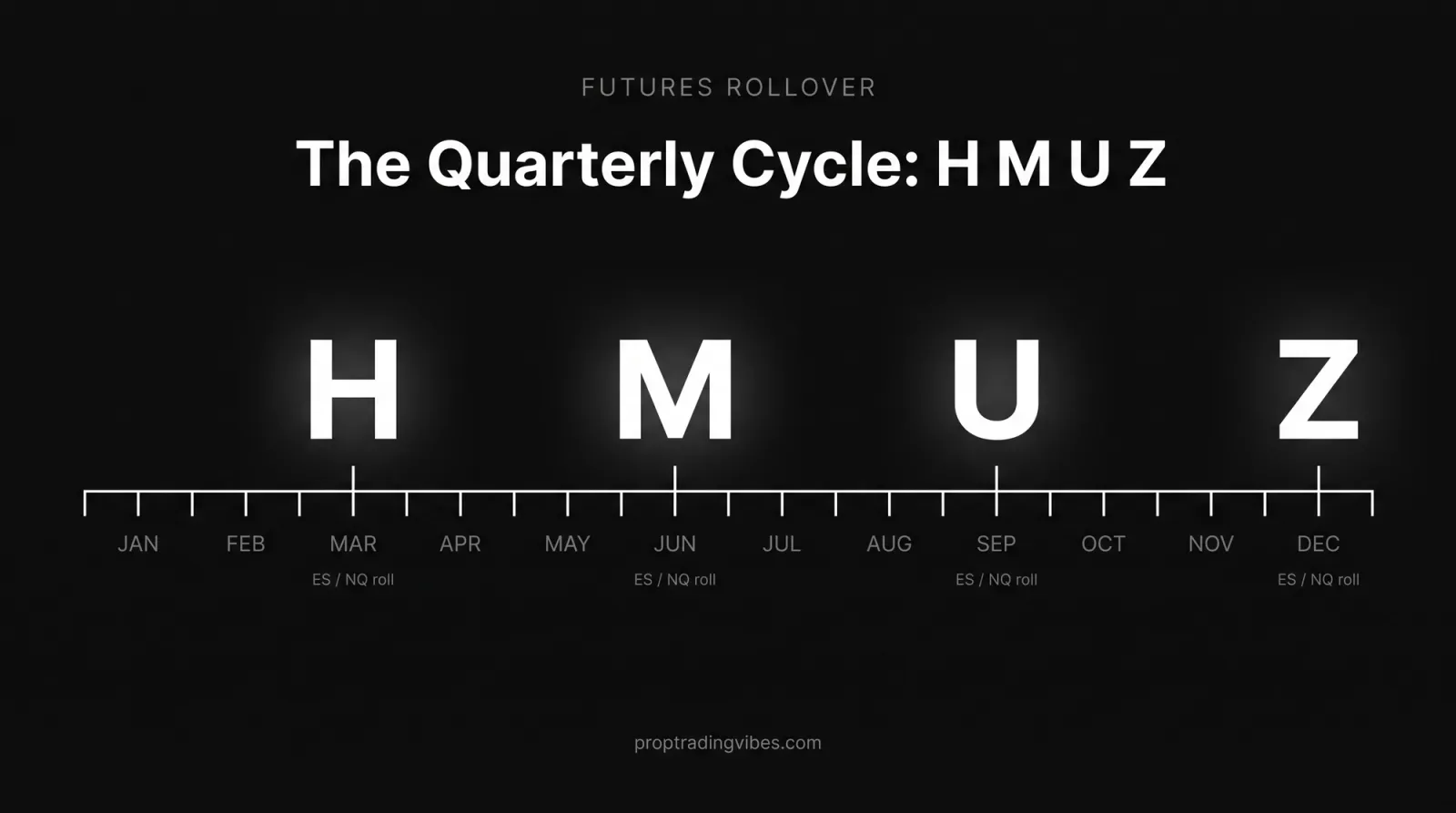
The September-to-December switch keeps the product the same and changes its expiry month. CME's month codes are H for March, M for June, U for September and Z for December.
| Product | September 2026 | December 2026 |
|---|---|---|
| E-mini S&P 500 | ESU26 | ESZ26 |
| E-mini Nasdaq-100 | NQU26 | NQZ26 |
| Micro E-mini S&P 500 | MESU26 | MESZ26 |
| Micro E-mini Nasdaq-100 | MNQU26 | MNQZ26 |
Platforms format symbols differently. You may see ESZ6, ESZ26 or an instrument picker showing ES December 2026. Confirm the product and expiry in the order ticket. Switching from ES to MES changes contract size as well as the instrument; it is not an equivalent one-for-one roll. Use the contract specifications guide if you need to check tick and point values.
The table covers these quarterly equity-index futures. Do not apply it to crude oil or gold; their expiry, active-month and delivery schedules need separate checks.
How to switch contracts before your next trade
Use this checklist during roll week. It separates the preparation a flat day trader needs from the execution required to carry an open position forward.
Compare September and December activity
Open both expiry months for the same product. Compare volume over the same session, the bid-ask spread and available depth. CME's rollover lesson describes monitoring volume in both contracts when deciding when to switch.
Open interest can add context, but it is not a live execution signal. A larger number of outstanding positions does not guarantee a tighter spread when you place an order.
Check your account's contract restrictions
Confirm that the December contract is enabled and check any rollover notice from your broker or prop firm. Daily flattening rules, permitted products and expiry cutoffs still apply. A simulated account does not establish which instruments a platform will automatically select.
Resolve positions and working orders in the old contract
If you are flat, there is no position to transfer. Check for working entry orders left on the September contract and cancel those you no longer intend to execute.
If you have an open position, decide whether to close it or carry the exposure into December. Keep its protective orders in place until the position is closed or otherwise protected. After the close, verify that any remaining September orders have been canceled. An order in the old contract can still execute while that market remains open; lower volume does not disable it.
Switch the chart and execution windows together
Select the intended expiry in the chart, DOM and order ticket. Check linked windows, watchlists, alerts and any trade copier you use. A chart labeled with the December contract does not establish which contract a separate order-entry window will trade.
Recheck levels and quantity
Read the contract name in the order ticket before submitting the next trade. Confirm account, size and any attached stop or target. Review price levels against the new contract rather than copying them blindly from September.
How to roll an open futures position
To keep the same directional exposure, close the old expiry and open the same product, direction and quantity in the new expiry. For example, rolling one long ESU26 means selling one ESU26 to close and buying one ESZ26 to open. A short position uses the opposite transactions. CME explains this mechanism in its contract-roll guide.
| Method | Execution | What to check |
|---|---|---|
| Close and reopen | Close September, then open December as separate orders | Price can move between fills; confirm each fill and resulting position |
| Calendar spread | Submit the closing and opening legs together at a spread price | Your account must support the spread; check leg direction, quantity and execution costs |
CME's spread lesson explains how a spread avoids the time gap between separately executed legs. It does not guarantee a cost-free fill. Bid-ask costs, fees and execution conditions still matter, and support varies by platform and account.
Closing the old position realizes its profit or loss. Opening December creates a new entry price. On a prop account, check how that realized result affects the firm's daily rules before placing the replacement trade.
Why does the chart gap at rollover?
September and December are separate contracts and can trade at different prices at the same time. Switching a continuous series between them can produce a visible jump. Check which contract the chart displays before treating that jump as a move within one contract.
A back-adjusted chart changes historical prices to account for the difference at its roll point. That can help you study a longer series, but adjusted historical levels may differ from the prices that actually traded in the original contract. Check your chart settings and rebuild execution levels against the contract you will trade.
Does rollover change CME trading hours?
Changing expiry months does not create a new regular session schedule for the same product. Rollover, the daily maintenance break and holiday hours are separate calendar checks. Use the CME trading hours guide for session times, then confirm the product and date against CME's trading-hours calendar.
The expiring contract has its own final trading cutoff, and your prop firm may require positions closed earlier. Do not assume September remains tradable until the usual afternoon close on September 18.
Frequently Asked Questions
Does my platform roll an open position automatically?
A continuous chart can switch expiry months without changing an open position. Check your platform's documented behavior and your actual position list. Do not assume a change to the displayed symbol has closed September or opened December.
Can I still trade the September contract after September 14?
CME's customary roll date is not the expiration date. September's U.S. equity-index contracts expire on September 18, 2026, but access depends on your broker or prop firm and its cutoff. Compare liquidity before placing a trade in the old expiry.
Should a flat day trader open a December position just to roll?
No. If you have no open position, there is nothing to roll forward. Select the appropriate expiry for your next planned trade and check for leftover orders in the old contract.
Will old stops and targets move to December?
Do not assume they will. Check the expiry attached to each working order. Orders on September and orders on December belong to different instruments, and a chart switch alone does not verify an order change.
The bottom line
September 2026 rollover dates for ES, NQ and Micro E-mini futures, with contract symbols and a checklist for switching charts, working orders and open positions. Includes the December roll dates and CME sources.
