
Table of contents
Tradeify 247 evaluation-funded paths have no best-day consistency cap; Instant has a 20% payout consistency rule.
A prop firm without a consistency rule is a firm that never caps how much of your total profit can come from a single trading day when you request a payout. At most futures prop firms the consistency rule limits your single best day to somewhere between 20% and 40% of total profit, so a firm that drops it lets one big session be any share of your total at withdrawal.
That distinction matters more than the marketing suggests. The consistency rule is the quietest payout gate in the industry. It does not fail your account and it does not show up in the headline pricing, but it decides whether the cash you earned actually lands in your bank when you ask for it.
As of June 2026, only a handful of firms genuinely apply no consistency rule on the side that counts, and several of the ones people assume are rule-free actually keep it on the evaluation. This guide defines the rule, breaks down its three variants, names the firms that drop it, and walks through a real example of a consistency rule blocking a payout.
What is a consistency rule at a prop firm?
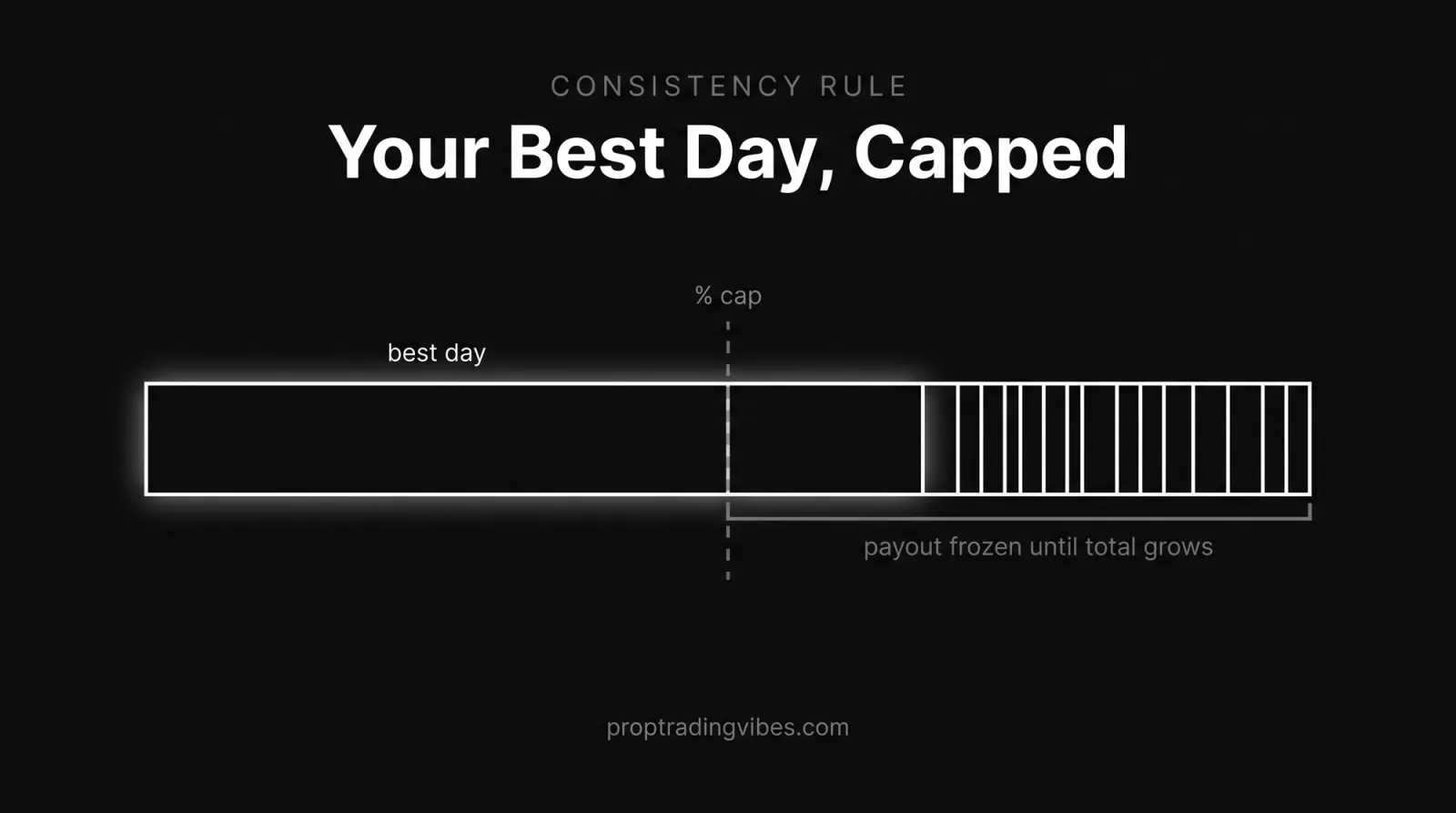
A consistency rule caps your single biggest trading day as a percentage of total account profit at the moment you request a payout. The point is to prove your profit came from a repeatable process, not one lucky session. Put simply, no single day's profit may exceed a defined percentage of your total profit over the measured period.
The threshold sits between 20% and 50% at most futures firms. TradeDay and Earn2Trade use 30%, MyFundedFutures and Apex Trader Funding use 50%, and many forex challenges use 20%. A 50% rule is the most forgiving in common use, a 20% rule is the strictest.
The rule almost never fails your account. It is a soft gate. If your best day breaks the threshold, the firm holds the payout while you keep trading, and additional profitable days dilute the percentage back under the limit. A breach only delays the payout request until you meet the requirement; it does not terminate the account.
What are the three variants of the consistency rule?
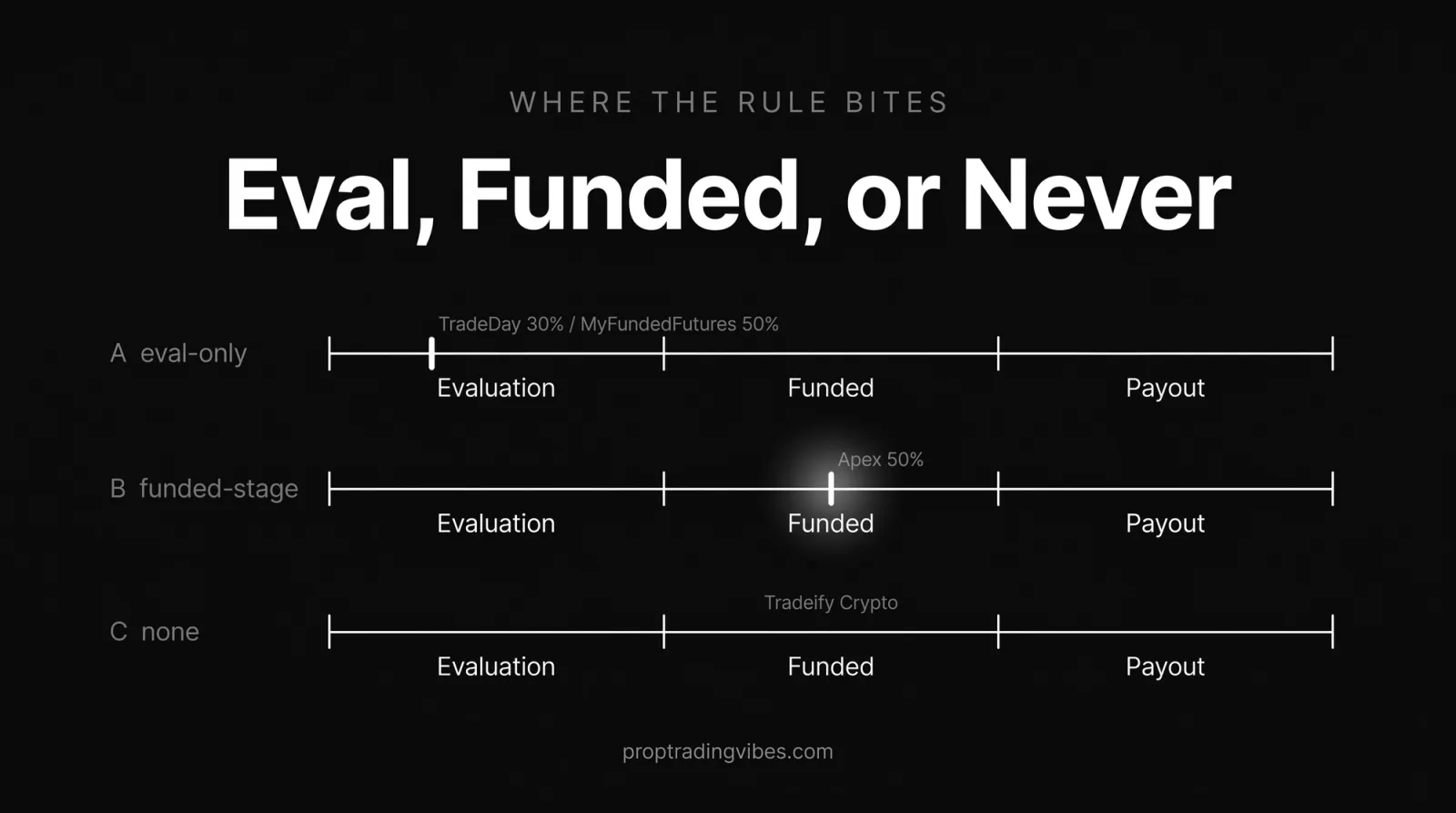
There are three variants of the consistency rule, defined by which stage they apply to: evaluation-only, funded-stage, and payout-gating. Knowing which one a firm uses is the entire decision, because a 30% rule you never see on a funded account is irrelevant to your withdrawals.
Evaluation-only consistency rule
An evaluation-only consistency rule applies during the challenge phase and disappears the moment you are funded. TradeDay Quick Pay (30%) and MyFundedFutures (50%) both work this way, so neither gates your funded payouts at all. The rule exists to filter out one-trade gamblers before they reach real capital, then steps aside.
This is the friendliest version for a trader with a lumpy edge. You pass the eval under the cap, get funded, and from then on your single best day can be any size of total profit when you withdraw.
Funded-stage consistency rule
A funded-stage consistency rule applies to the live funded account and directly gates withdrawals. Apex Trader Funding runs its 50% rule on the funded payout account (the PA) under the 4.0 ruleset, with legacy pre-4.0 accounts at 30%. This is the version that actually controls your cash, because it sits on the side where you are pulling money out.
A funded-stage rule is not necessarily bad, 50% is generous, but you have to plan payout timing around it. If your week is one huge day and several flat ones, the math can lock your withdrawal until you trade more.
Payout-gating consistency rule
A payout-gating consistency rule is the funded-stage variant described by its effect: it sits between you and your money at the withdrawal request. Every funded-stage rule is a payout gate. The distinction worth flagging is that the calculation resets after each withdrawal. Once you take a payout the balance drops and that best day no longer counts, so only new profit earned after the payout feeds the next check.
Which prop firms have no consistency rule?
Do not call Tradeify 247 universally consistency-free. The 1-Step/2-Step evaluation-funded population differs from Instant.
Tradeify 247: no best-day cap on evaluation-funded paths; 20% payout consistency on Instant.
Two clarifications matter. Lucid Trading splits the rule by product: Flex and Daily use 50% in evaluation only, Pro uses 40% on funded payouts, and Direct uses 20% on funded payouts. Bulenox uses a 40% best-day calculation only for Master payout requests; exceeding it delays that request but is not an account violation. Always confirm live terms because thresholds and stages change.
Does Tradeify 247 have a consistency rule?
Tradeify 247 Instant applies a 20% payout consistency rule.
The no-consistency statement is limited to the evaluation-funded paths.
Does Lucid Trading have a consistency rule?
Lucid Trading does apply consistency rules, but where they sit depends on the product. LucidFlex runs a 50% rule in the evaluation only, with no consistency rule once funded. LucidPro is the reverse: no rule in the eval, then a 40% check per funded payout cycle. LucidDirect carries a 20% rule on funded payouts, the strictest in the lineup. Lucid is PTV's flagship firm and the one I lean on hardest. I've run LucidFlex and LucidPro across repeated payout cycles, with payouts processing in about 15 minutes on average and the drawdown running EOD-trailing that only ratchets up, never down. The newer LucidDaily plan follows the Flex pattern, a 50% rule in the evaluation only and no consistency rule once funded; the LucidDaily account guide covers it in detail.
The combination of rule-free funded payouts on Flex and Daily plus fast payouts is why Lucid stays a top pick even though it is not rule-free across the board. The code VIBES is PTV's best deal on the product shown here: LucidFlex 25K lists at $89 and costs $53.40 with code VIBES. Full detail is on the Lucid Trading review.
How does the Bulenox 40% Master payout calculation work?
Bulenox compares the best trading day with total profit when a Master payout is requested. If the best day exceeds 40%, the request cannot be processed yet, but the Help Center says the account remains active and trading can continue. I have tested both options and multiple sizes, and all of my Bulenox payout requests cleared; that is personal experience, not a promise of another trader's outcome.
The worked example below shows the ratio without turning an ineligible request into a breach or denial. No current primary source verifies a PTV Bulenox coupon. See the Bulenox review for the full Qualification to Master to Funded path.
Which firms keep the consistency rule eval-only?
MyFundedFutures and TradeDay Quick Pay keep the consistency rule on the evaluation only, so funded payouts at both are never gated by your best-day percentage. This is the sweet spot for many futures traders: a sane filter during the challenge, then total freedom once funded.
How does the MyFundedFutures consistency rule work?
The MyFundedFutures consistency rule is 50% on the evaluation only, with no consistency rule on funded accounts. The 50% threshold is the most lenient eval rule among major futures firms, meaning your best day during the challenge can be up to half of total profit. MyFundedFutures also runs no daily loss limit on sim-funded accounts, which pairs well with the absent funded consistency rule. I've traded MyFundedFutures for three years with multiple payouts over that time, and it is one of my top recommendations.
How does the TradeDay consistency rule work?
TradeDay Quick Pay uses 30% consistency in the evaluation and none when funded. TradeDay Fast Pass uses 45% in evaluation and on Funded Sim accounts opened on or after July 26, 2026. The 30% eval threshold is stricter than MyFundedFutures' 50%, so during the challenge your best day cannot exceed 30% of total profit. Once funded, the rule is gone and Quick Pay payout eligibility starts after one funded day from a positive balance, with a $250 minimum. TradeDay’s current account and payout claims here are source-based; I do not publish an exact personal TradeDay chronology without a reconciled record.
How does a consistency rule block a payout?
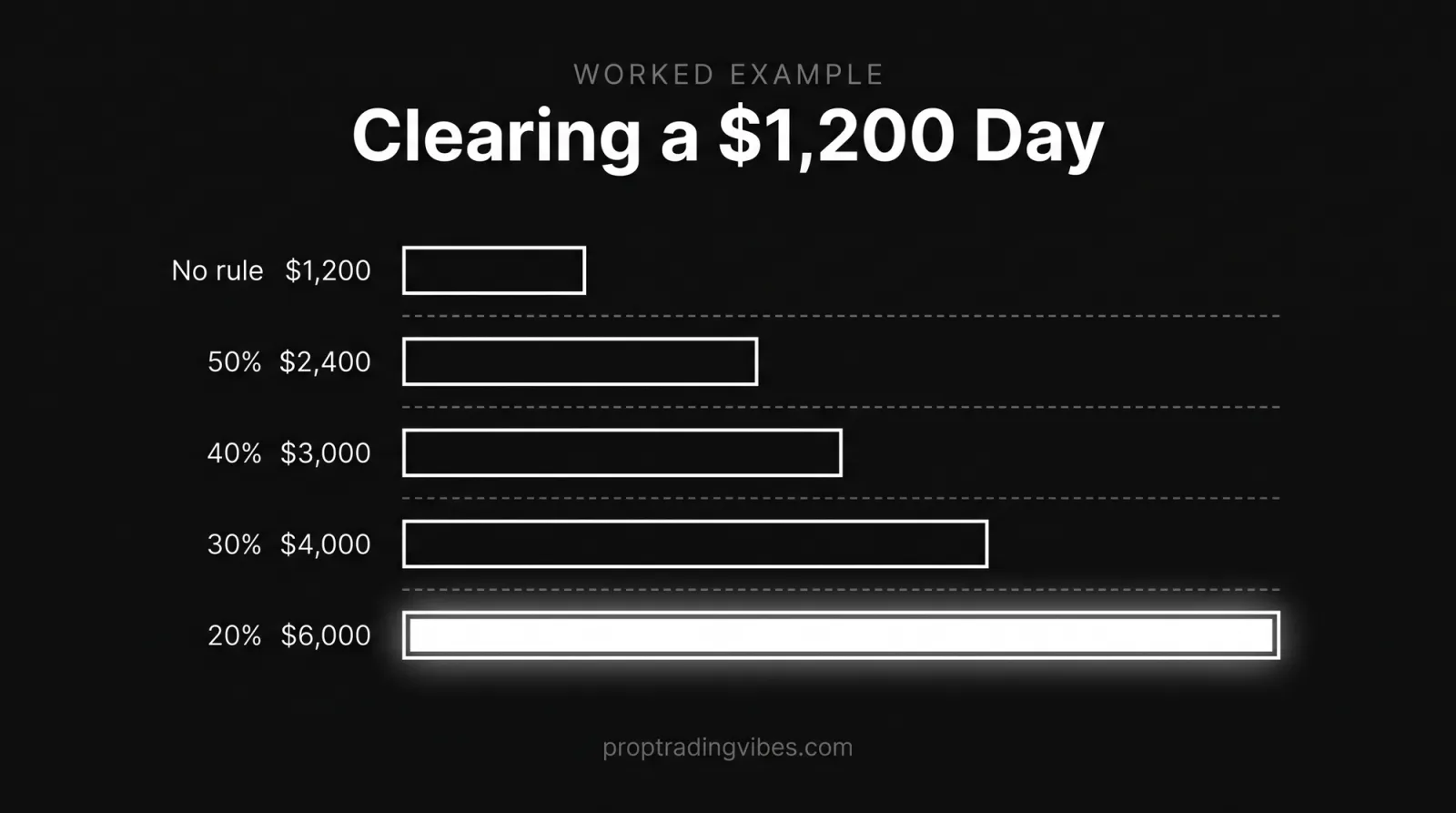
A consistency rule blocks a payout when your single best day exceeds the threshold percentage of total profit, freezing the withdrawal until more profitable days dilute it. The math is simple: divide your biggest day by the consistency percentage to find the total profit you need to be eligible. In other words, biggest end-of-day profit divided by the required consistency percentage equals the total balance you need.
Suppose a Bulenox Master account has a $1,200 best day and $2,500 total profit. The ratio is 48%, above the 40% request threshold. The payout request cannot be processed yet; total profit must reach $3,000 for $1,200 to equal 40%. The Help Center says this is not an account violation.
To clear it, you need your $1,200 day to drop to 40% or less of total. That means total profit has to reach $3,000 ($1,200 divided by 0.40). You are $500 short, so you keep trading smaller winning days until total profit crosses $3,000, then the same payout request goes through. Nothing failed, the cash was simply gated until the distribution evened out.
Worked example: the same day under different rules
The same $1,200 best day passes or fails depending entirely on the firm's threshold and stage. The table shows the total profit you would need to clear each common rule.
Example scope: 1-Step and 2-Step evaluation-funded accounts have no best-day cap; Instant does.
The lesson is that the threshold and the stage together decide your outcome. A trader with a concentrated edge clears the 50% firms easily, struggles under 30%, and should avoid 20% rules unless their profit spreads naturally across many sessions.
Who should pick a prop firm without a consistency rule?
A prop firm without a consistency rule is the right pick for traders whose profit concentrates on a few sessions, and the wrong priority for traders who already grind steady daily wins. The rule only triggers when one day dominates your total, so its absence is a real edge for some profiles and a non-issue for others.
Tradeify 247 is not consistency-free across every path.
Traders who scale into many small winners across the week rarely brush the threshold even at 30%. For them, payout speed, drawdown type, and profit split matter far more than the consistency rule. A 50% eval-only rule like MyFundedFutures' or a 30% eval-only rule like TradeDay Quick Pay's will not gate a funded withdrawal regardless of style.
The bottom line
Instant uses 20% payout consistency.
Evaluation-funded and Instant must be evaluated separately.
Frequently Asked Questions
What is a prop firm without a consistency rule?
Tradeify 247 Instant has a 20% payout consistency rule.
Which prop firms have no consistency rule?
Tradeify 247 evaluation-funded paths do not use that best-day cap.
Does the consistency rule fail my account?
No. The consistency rule does not fail your account, it gates the payout. If your best day exceeds the threshold, the firm holds the withdrawal until you trade more profitable days that pull the percentage back under the limit. The account stays active the whole time. This is true across TradeDay, MyFundedFutures, Apex Trader Funding, and the rest.
What percentage is a typical consistency rule?
Most futures prop firms set the consistency rule between 20% and 50%. TradeDay Quick Pay uses 30% in evaluation, MyFundedFutures and Apex Trader Funding use 50%, and several forex firms use 20%. A 50% rule is the most permissive in common use, a 20% rule is the strictest.
Is the consistency rule on the evaluation or the funded account?
The applicable Tradeify 247 consistency answer depends on the path.
Does Lucid Trading have a consistency rule?
Yes, but it depends on the product. LucidFlex and LucidDaily run a 50% rule in the evaluation only, with no consistency rule once funded. LucidPro has no eval rule but applies a 40% check per funded payout cycle, and LucidDirect carries a 20% rule on funded payouts. I've run LucidFlex and LucidPro across repeated payout cycles with payouts processing in about 15 minutes on average. The code VIBES is PTV's best deal on Lucid accounts.
Does MyFundedFutures have a consistency rule?
MyFundedFutures applies a 50% consistency rule on the evaluation only. There is no consistency rule on funded MyFundedFutures accounts, so your biggest day is uncapped at payout. The 50% figure is the most lenient eval threshold among major futures firms, and I've traded MyFundedFutures for three years with multiple payouts over that time.
Does TradeDay have a consistency rule?
TradeDay Quick Pay applies a 30% consistency rule in evaluation only and none when funded. Fast Pass uses 45% in evaluation and on Funded Sim accounts opened on or after July 26, 2026, so this no-funded-consistency answer applies only to Quick Pay. Quick Pay's 30% eval rule is stricter than MyFundedFutures' 50%, but it disappears when Quick Pay is funded.
Do not generalize evaluation-funded rules to Instant.
Tradeify 247 Instant: 20% payout consistency.
Does Apex Trader Funding have a consistency rule?
Apex Trader Funding applies a 50% consistency rule on the funded payout account (PA) under the 4.0 ruleset. Legacy pre-4.0 accounts used 30%. Apex is one of the firms that keeps the rule on the funded side rather than the evaluation, so plan your payout cadence around it. Apex pays 100% profit split on approved payouts post-4.0.
How do I calculate if I pass the consistency rule?
Divide your single biggest day by the consistency percentage to find the total profit you need. For example, a $1,000 best day under a 50% rule needs $2,000 total profit ($1,000 divided by 0.50). Under a 30% rule the same day needs $3,333 total. If your current total is below that, the payout waits until more winning days raise it.
Does the consistency rule reset after a payout?
Yes, at most firms the consistency calculation resets to zero after each withdrawal. Once you take a payout your balance drops and the prior best day no longer counts, so only new profits earned after the payout factor into the next consistency check. This applies at firms that gate funded payouts, such as Apex Trader Funding.
Is a prop firm with no consistency rule better?
Tradeify 247 1-Step/2-Step funded: no best-day cap in the current owner.
Can a consistency rule make my funded account hard to withdraw from?
Tradeify 247 is route-specific, not universally consistency-free.