
Table of contents
Table of contents
Quick Answer, best prop firms for day trading futures in 2026:
- Apex Trader Funding is the top scaling pick for futures day traders, with up to 20 parallel funded accounts and biweekly Wise payouts.
- Lucid Trading is the fastest-payout option, processing withdrawals in roughly 15 minutes, making it a standout for high-frequency day traders who want cash moving quickly.
- TradeDay Quick Pay can be Intraday or EOD during evaluation. Every Quick Pay Funded Sim account then uses intraday trailing; Fast Pass remains EOD.
- Bulenox fits day traders comparing its two drawdown options and the weekly Master payout cycle. The 90/10 split applies after the first $10,000 on Master, not as a generic funded-stage term.
What Makes a Prop Firm Good for Day Trading
Five things separate a day-trader-friendly firm from a generic evaluation factory: drawdown type, daily loss limit, platform execution speed, payout frequency, and scaling path. If any one of those five is broken, the firm punishes how you actually hold positions.
Most firms market themselves as day-trading-friendly. The filter is whether the rules survive contact with multiple entries per session, scaling in and out, and the occasional news-driven volatility spike. Firms that combine Intraday Trailing drawdowns with low daily loss limits and no parallel-account support leave active traders in too small a sandbox.
Drawdown Type: The Variable That Decides Everything
Three types exist in 2026. Each one hits differently for an intraday trader.
| Drawdown Type | How It Works | Best Fit |
|---|---|---|
| EOD Trailing | Updates only at session close; intraday highs don't lock in losses | Scalpers who fade before close |
| Intraday Trailing | Follows your highest balance tick-by-tick during the session | Trend-day traders who hold winners into close |
| Static | Fixed dollar floor, never changes with profit | Traders who want certainty over flexibility |
Pick the type that matches how you exit. The mismatch between drawdown type and trading style is the most common reason evaluations fail, not skill.
Daily Loss Limit
Most futures firms set the daily loss between 2% and 4% of account size. Apex Trader Funding has no daily loss limit on funded accounts after the 4.0 rule update, which is rare and useful. A single bad opening drive on ES can eat through a 2% daily loss cap in three minutes on a $50K account, that's $1,000 gone before the session finds direction.
Platform Execution Speed
NinjaTrader, Tradovate, and TradingView via Rithmic dominate the futures side. The difference between Rithmic-direct and Rithmic-rebroadcast runs around 80 milliseconds at the open. On a scalp, that gap is a full tick. Test the firm's actual routing before paying.
Apex Trader Funding: Best for Scaling Multiple Accounts
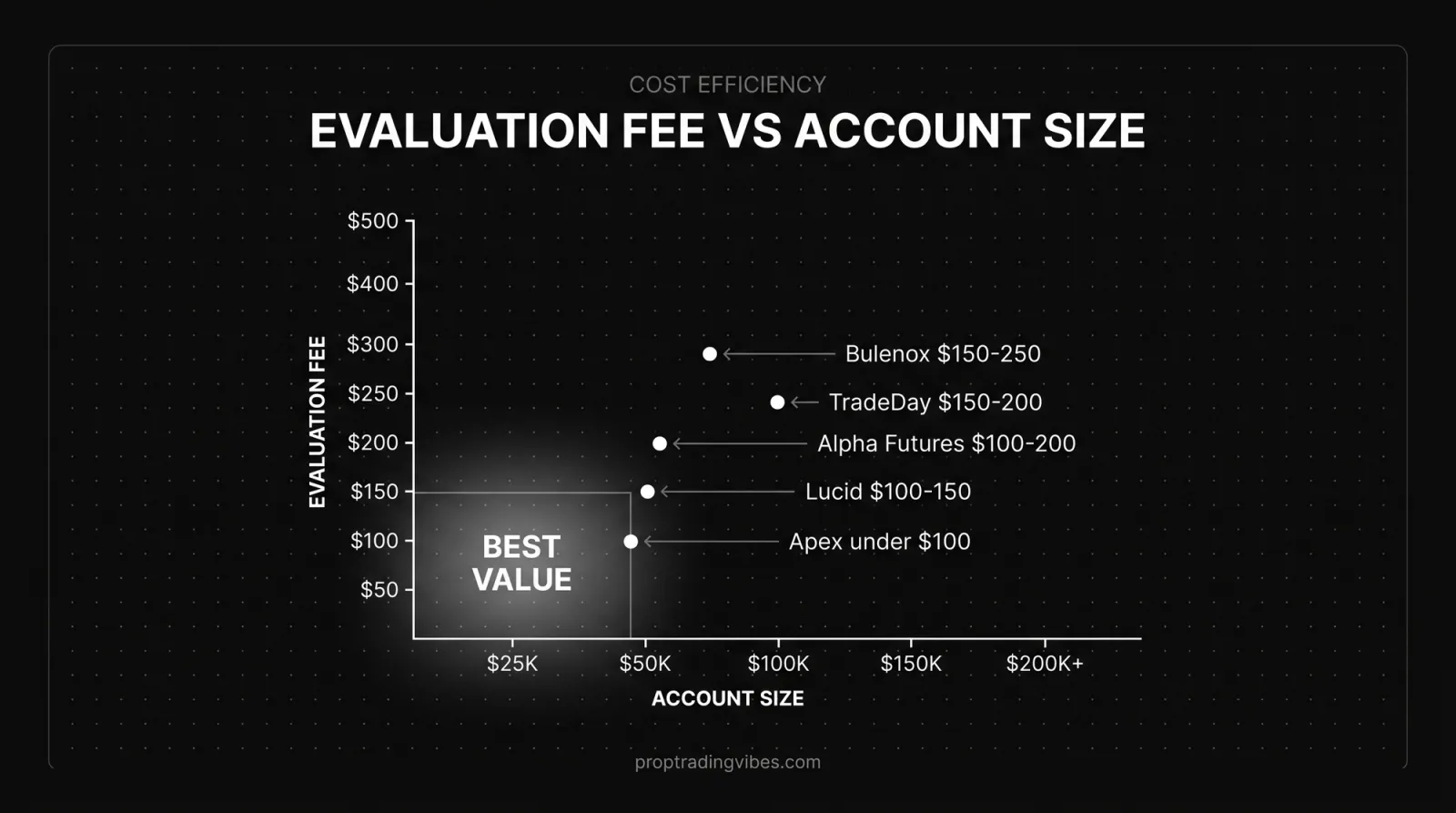
Apex is the firm to pick if your growth plan is stacking accounts rather than hoping a single seat scales linearly. It's futures-only, runs Intraday Trailing drawdown during evaluation, and supports NinjaTrader, Tradovate, and TradingView. The 4.0 verification update in early 2026 tightened consistency requirements but kept the parallel-account model intact: up to 20 funded accounts, trade copier supported across all of them.
The scaling math is what makes Apex sit at the top of this list. Ten $50K accounts mean a single drawdown hit doesn't end your trading day. The other nine keep producing while you reset the failed account. Evaluation fees with discount codes frequently drop below $100, so the cost-per-funded-dollar is lower than any other futures firm tested here.
Apex has no PTV affiliate program. Verify current discount codes directly on the Apex site. Their rules page is the source of truth on consistency and daily-loss parameters.
Who Should Pick Apex
- Futures-only traders who want to scale to 5+ simultaneous accounts
- Day traders comfortable with Intraday Trailing drawdown
- Anyone whose growth plan involves trade-copying across multiple funded seats
For a full breakdown of evaluation costs and account tiers, see the funded trading account guide.
Lucid Trading: Fastest Payouts in the Market
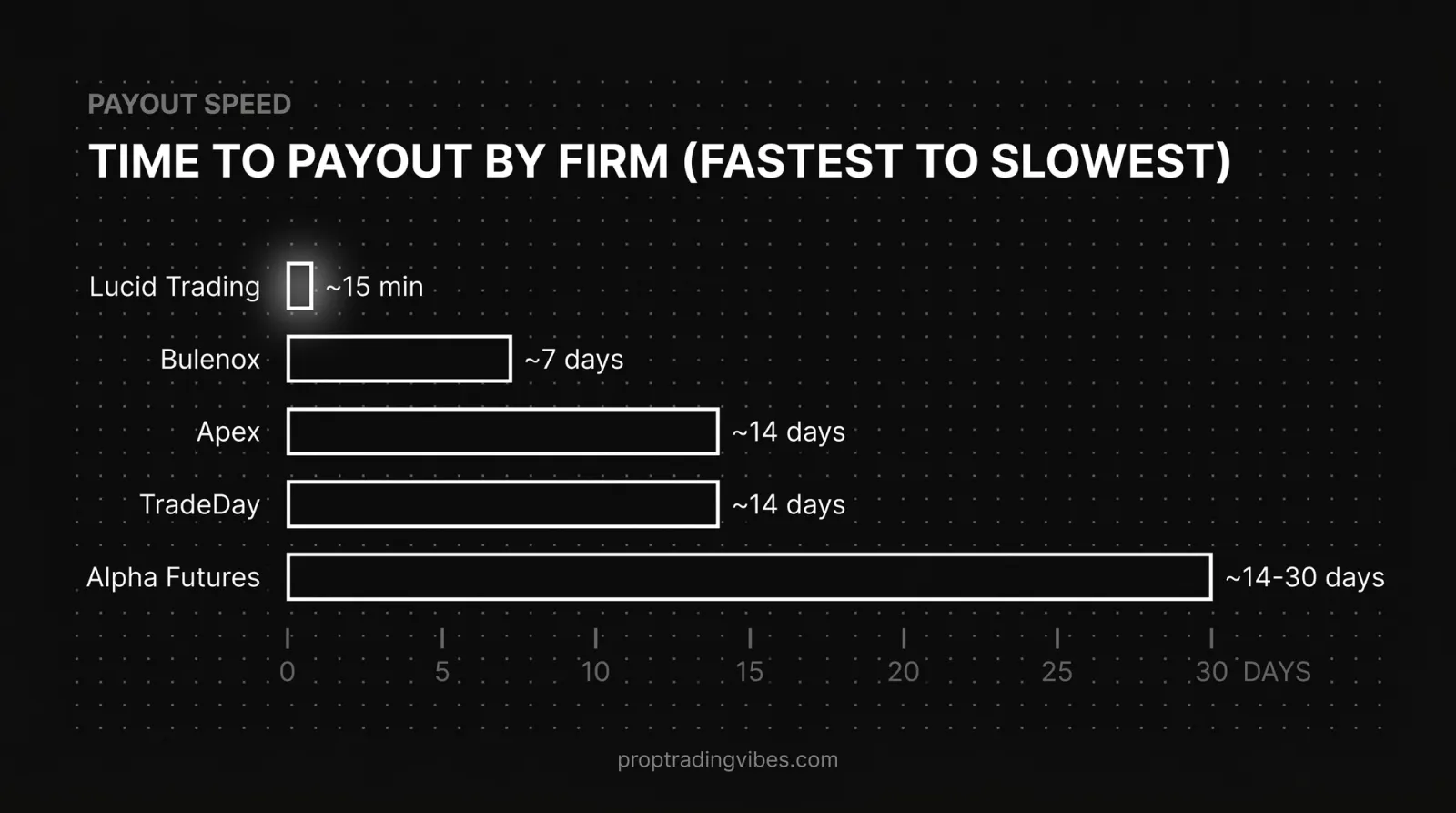
Lucid Trading processes payouts in roughly 15 minutes. For a day trader who wants capital recycling quickly, no other firm in this list comes close on speed. Paul, who runs this site, has received payouts from Lucid across 30+ cycles on LucidFlex and LucidPro, making it the most personally tested firm on this page.
For day traders focused on withdrawal frequency, Lucid's newest account type is worth a look: LucidDaily, launched July 2026, allows payout requests every eligible day once funded. The LucidDaily breakdown covers the rules.
The drawdown model is EOD Trailing, locks-up-only mechanic: the floor only moves at session close. That means an intraday spike to a new equity high doesn't tighten your buffer until that session ends. For scalpers who routinely peak intraday and give back a portion before close, this is structurally better than any Intraday Trailing variant.
Use code `VIBES` for 40% off eligible evaluations; verify the selected account at checkout.
Lucid vs. Apex for Day Traders
| Lucid Trading | Apex Trader Funding | |
|---|---|---|
| Drawdown | EOD Trailing (LucidDaily: intraday) | Intraday Trailing |
| Payout speed | ~15 minutes | ACH (US) / Plane (international) |
| Max parallel accounts | Multiple | Up to 20 |
| No daily loss limit | No | No (DLL applies in PA, pauses trading only) |
| Discount code | VIBES (40% off) | Varies |
TradeDay: Quick Pay vs Fast Pass Drawdown Choice
TradeDay supports CQG through Tradovate, NinjaTrader, TradingView and Jigsaw, plus Rithmic through R|Trader Pro, Quantower, ATAS, MotiveWave, Bookmap, Jigsaw-Rithmic, Sierra Chart, EdgeProX, Finamark, Volfix, WealthCharts, MultiCharts and Overcharts.
| Account Type | Drawdown Option |
|---|---|
| Standard | EOD Trailing |
| Intraday | Intraday Trailing |
| Flat | Static |
I confirmed on August 25, 2026 that I have traded TradeDay since December 2024 and currently has three funded 50K accounts. This does not prove a universal payout or policy outcome.
Who Should Pick TradeDay
- Traders who want to choose drawdown type explicitly rather than accept the firm's default
- Anyone who runs different strategies at different times and wants the right drawdown per strategy
- Jigsaw Trader users who need a futures firm supporting DOM-based execution
Bulenox: Best for Comparing Two Drawdown Options
Bulenox Option 1 uses real-time trailing drawdown including unrealized P&L and commission. Option 2 uses end-of-day drawdown, scaling, and a daily-loss limit. Eligible Master payout requests are processed weekly on Wednesdays after at least 10 individual trading days and a $1,000 minimum request.
Bulenox Option 1 and Option 2 must be compared against the current rules; no exact personal pass-time claim is asserted without a reconciled record. The 40% rule applies: no single day can account for more than 40% of total profits at payout. Funded balance caps were activated in April 2025 and remain in effect.
Payouts run at 90% with the $2.75M scalar cap on the biggest accounts. For a day trader averaging 5-10 NQ trades per session, the 90% split on a $100K account is materially different from the 80% most firms offer.
The 40% best-day calculation is the key Bulenox constraint: it applies to Master payout requests. A request above the threshold cannot be processed yet, but the Help Center says this is not an account violation and trading can continue.
Drawdown Rules That Actually Matter for Day Traders
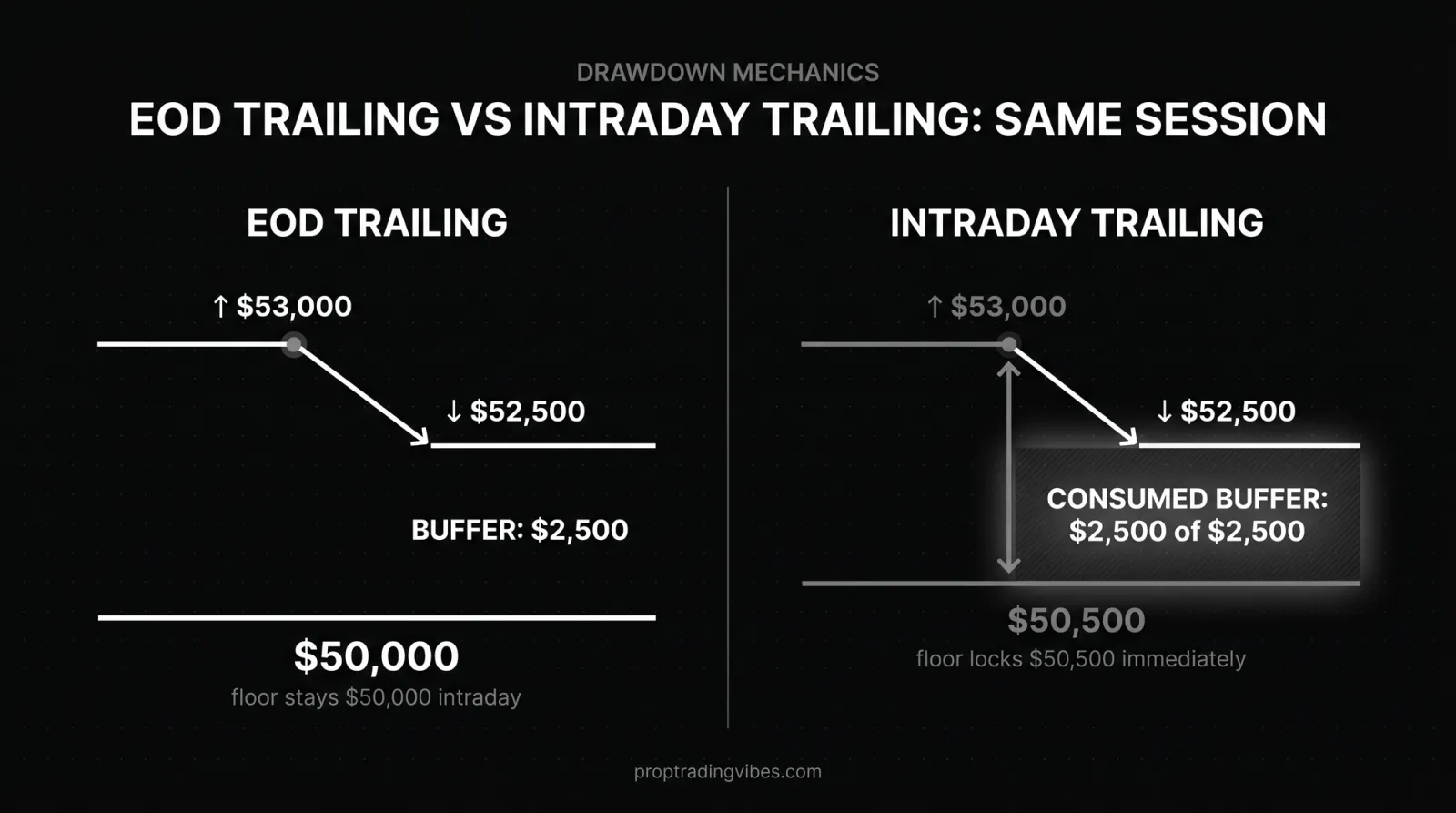
This section runs the numbers on what each drawdown type costs in real dollars on a $50K account.
EOD Trailing Example
Account size: $50K. Trailing drawdown: $2,500. You book $3,000 intraday before giving back $500 by close. Net equity at close: $52,500. The new floor moves to $50,000 (net equity minus $2,500). You didn't lose your buffer to the intraday spike.
On an Intraday Trailing firm, the $3,000 peak would have moved the floor to $500, not $50,000. A $500 drawdown the next morning ends the account.
Intraday Trailing Example
Same $50K account. You're up $1,800 at 10:15 AM. The floor moves to $48,200 (starting $50K minus $2,500 buffer, adjusted for the $1,800 peak). If the session reverses and you give back $1,800 to break even, you've still consumed $1,800 of your buffer. Close flat and the floor doesn't reset.
Static Drawdown Example
$50K account, $2,500 static drawdown. The floor is $47,500 forever. No trailing, no adjustment. A profitable trader builds equity against a fixed floor. The risk: a big losing day early erodes the buffer permanently.
For more on how prop firm rules affect day traders, the prop firm rules explained guide covers evaluation mechanics in full detail.
How to Choose Between These Four Firms
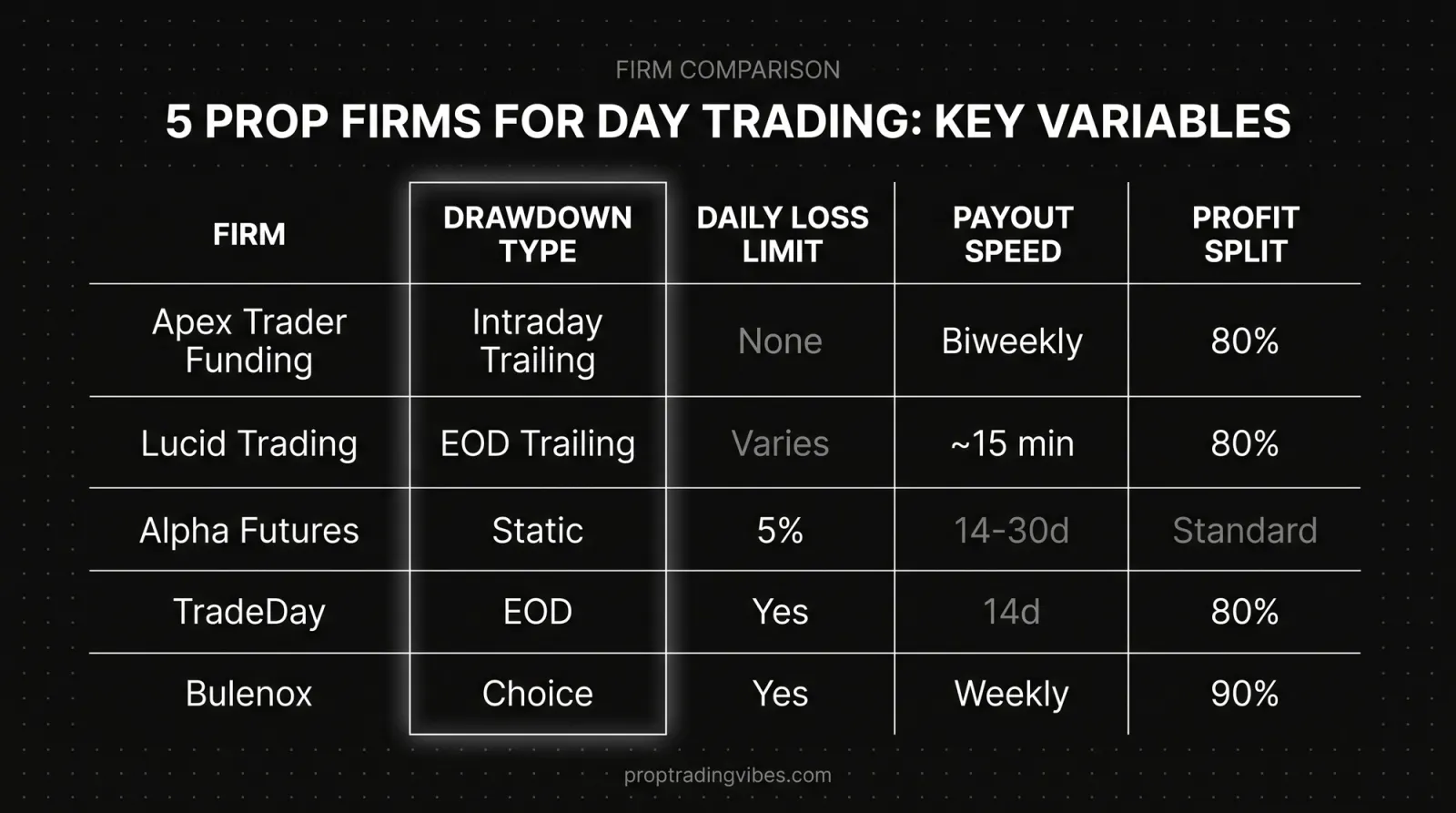
Start with asset class. Futures only: Apex, Lucid, TradeDay, or Bulenox. Multi-asset or crypto: skip this list and look at E8 Markets or Tradeify.
Within futures, the decision comes down to two variables:
Quick Pay EOD describes the evaluation only. Quick Pay Funded Sim always uses intraday trailing; Fast Pass uses EOD.
Priority: Scaling speed (Apex), payout speed (Lucid), drawdown flexibility (TradeDay), profit split.
You can also run two firms simultaneously. Apex and Lucid don't overlap significantly in their structural advantages: Apex gives you parallel account depth, Lucid gives you fast capital recycling on a single seat. Stack them if your capital allows.
Traders in specific markets may find different starting points useful. The prop trading Germany overview covers regional firm access and tax considerations for European day traders.
Common Mistakes Day Traders Make Picking a Prop Firm
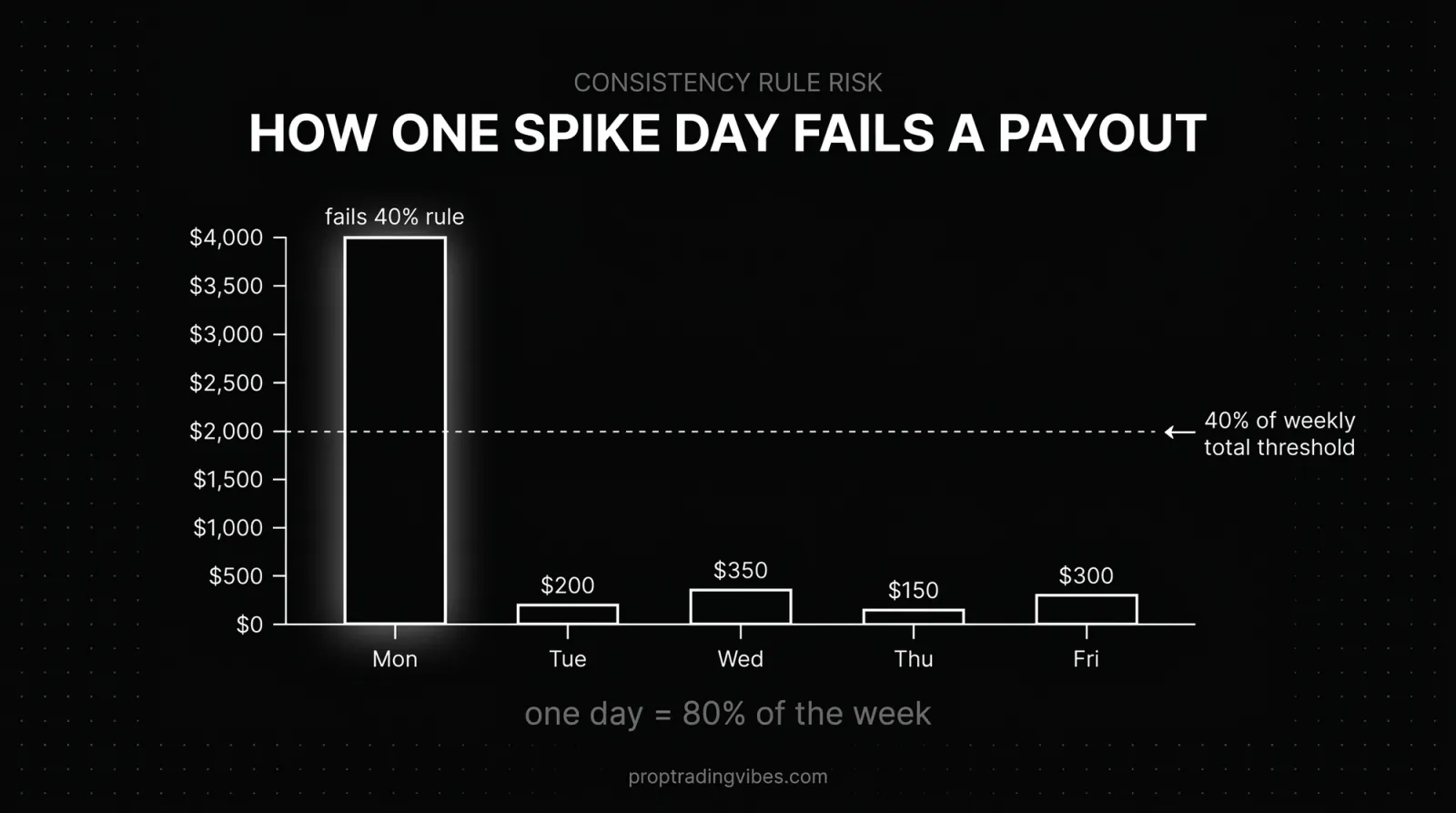
Buying account size they don't need. A scalper running 2 contracts on NQ doesn't need a $250K evaluation. The $50K seat is enough. Larger accounts scale the profit targets up proportionally, meaning you pay more to pass the same evaluation at 2-contract size.
Ignoring consistency rules. Most 2026 prop firms cap your single best day as a percentage of total profit. Book $4,000 on Tuesday and $200/day for the rest of the week, and you fail consistency at $4,200 total even though you're green. Read the consistency rule before paying the eval fee.
Buying on sale without a plan to start. If a $400 evaluation costs $80 on discount and you fail it three months later when ready to trade, the next attempt costs $400. Buy when you're ready to start the evaluation, not when the promo code arrives.
Mixing strategies on one account. Day trading the open and swing trading overnight on the same funded account creates rule conflicts on firms with overnight position restrictions. Use separate accounts or separate firms for separate strategies.
Not reading the payout mechanics. Some firms hold the first payout for 30 days. Some require a minimum number of trading days before requesting. Some pay only the realized equity above a buffer amount. The payout page, not the marketing page, is what matters.
Frequently Asked Questions
What is the best prop firm for day trading futures in 2026?
Apex Trader Funding is the top pick for futures day traders who want to scale across multiple accounts, with no daily loss limit on funded seats and support for up to 20 parallel accounts. Lucid Trading is the best pick for traders who prioritize payout speed, processing withdrawals in roughly 15 minutes, with EOD Trailing drawdown on its core account types (the LucidDaily account trails intraday once funded).
Which prop firm has the best drawdown for scalpers?
EOD Trailing drawdown is the friendliest type for scalpers who book intraday peaks that fade before the close. Lucid Trading runs EOD Trailing on its main futures program. The drawdown floor only updates at session close, so an intraday equity spike doesn't immediately tighten your buffer.
Do I need to pay a monthly fee to day trade with a prop firm?
Not always. Apex Trader Funding and Lucid Trading sell one-time evaluation products, while Bulenox Qualification is a recurring 30-day subscription. Compare the exact product and any post-pass activation fee instead of treating every firm as one-time.
Can I run multiple funded accounts at the same prop firm?
Yes. Apex Trader Funding supports up to 20 parallel funded accounts and allows trade copiers across all of them. Lucid Trading supports multiple concurrent accounts as well.
How long does it take to get funded as a day trader?
Apex Trader Funding's one-step evaluation can be passed in 5 to 10 trading days by a disciplined day trader hitting the profit target without violating the trailing drawdown. TradeDay Quick Pay requires at least 5 trading days; the current Fast Pass objectives page lists 3 minimum days. Actual completion time depends on the profit target and consistency objective.
What is the difference between EOD Trailing and Intraday Trailing drawdown?
EOD Trailing only updates the drawdown floor at session close. Intraday Trailing updates the floor tick-by-tick as your equity rises during the session. On a $50K account with a $2,500 trailing limit, booking $1,800 intraday and giving it back to break even costs you $1,800 of buffer on Intraday Trailing but zero buffer on EOD Trailing if you close flat.
Which prop firm pays out the fastest for day traders?
Lucid Trading processes payouts in approximately 15 minutes. Apex Trader Funding runs biweekly Wise transfers, typically processed within the same week as the request. Bulenox processes eligible Master requests weekly on Wednesdays after at least 10 individual trading days; these are not published as Funded-stage terms.
Is Apex Trader Funding still good after the 4.0 rule update?
Yes. The 4.0 update tightened consistency requirements but kept the parallel-account model, no daily loss limit on funded accounts, and biweekly Wise payout structure intact. Apex remains the strongest scaling option for futures day traders in 2026.
Is end-of-day drawdown better for day traders?
It is often easier to model than an intraday trailing threshold, but the starting buffer, lock point and payout effect still determine the practical risk.
When should a day trader recheck a prop firm’s rules?
Recheck the official rules before purchase and before every payout request. Fees, platform access and payout conditions can change after an article is published.
The bottom line
A tested, current ranking of the best prop firms for day trading futures in 2026, covering drawdown types, platform requirements, payout speed, and scaling math.
