
Table of contents
Quick Answer, Futures Market Hours
- CME Globex runs Sunday 5:00 PM CT through Friday 4:00 PM CT, nearly 24 hours a day, five days a week.
- A daily maintenance break runs from 4:00 PM to 5:00 PM CT Monday through Thursday. Zero trading during this window.
- Regular Trading Hours (RTH) for equity index futures (ES, NQ, YM) are 8:30 AM to 3:15 PM CT.
- Most prop firms require flat positions before 3:10–3:59 PM CT. Missing this cutoff can blow your account.
- All CME session times are Central Time. Convert carefully before setting alarms or automated orders.
What Are the Standard Futures Trading Sessions?
Futures don't open and close like stocks. They run across three overlapping sessions on the CME Globex electronic platform:
Overnight/Globex Session (5:00 PM to 8:30 AM CT, Sunday through Thursday evenings into the next morning). This is the extended window where Asian and European markets drive price. Volume is thinner, spreads are wider, and the 5:00 PM reopen can gap from the prior day's close.
Regular Trading Hours (8:30 AM to 3:15 PM CT for equity index futures). This is where the bulk of volume lives. The cash equity market overlap runs 8:30 AM to 3:00 PM CT, which is where you get the tightest spreads and fastest fills.
Post-Market/Settlement (3:15 PM to 4:00 PM CT). Light activity after the equity close. The official daily settlement price is set during this window.
Daily Maintenance Break (4:00 PM to 5:00 PM CT, Monday through Thursday). No trading. The exchange resets, and a new calendar day begins at 5:00 PM.
These session boundaries apply to CME Group products on Globex. If you're trading on a prop firm account, 95%+ of your activity is CME-based. Understanding CME trading hours in detail is worth bookmarking separately.
Exact Hours for Every Major Futures Contract
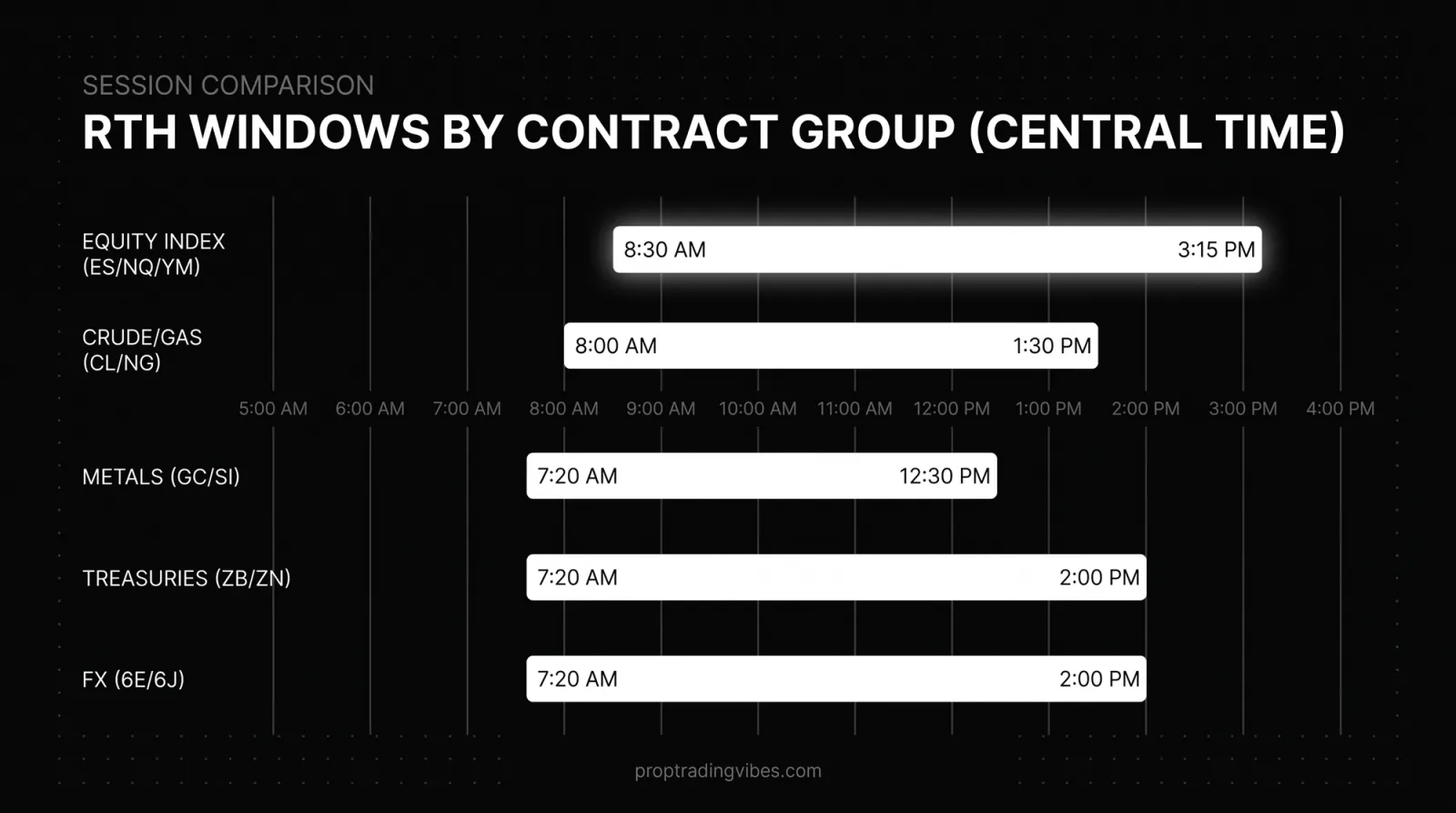
As of June 2026, here are the Globex trading hours for every major product. All times are Central Time (CT). Globex electronic hours are identical for most products. The differences show up in RTH.
| Symbol | Product | Exchange | Globex Hours (CT) | RTH (CT) | Daily Break (CT) |
|---|---|---|---|---|---|
| ES | E-mini S&P 500 | CME | Sun 5:00 PM – Fri 4:00 PM | 8:30 AM – 3:15 PM | 4:00 PM – 5:00 PM |
| NQ | E-mini Nasdaq 100 | CME | Sun 5:00 PM – Fri 4:00 PM | 8:30 AM – 3:15 PM | 4:00 PM – 5:00 PM |
| YM | E-mini Dow | CBOT | Sun 5:00 PM – Fri 4:00 PM | 8:30 AM – 3:15 PM | 4:00 PM – 5:00 PM |
| RTY | E-mini Russell 2000 | CME | Sun 5:00 PM – Fri 4:00 PM | 8:30 AM – 3:15 PM | 4:00 PM – 5:00 PM |
| MES | Micro E-mini S&P 500 | CME | Sun 5:00 PM – Fri 4:00 PM | 8:30 AM – 3:15 PM | 4:00 PM – 5:00 PM |
| MNQ | Micro E-mini Nasdaq | CME | Sun 5:00 PM – Fri 4:00 PM | 8:30 AM – 3:15 PM | 4:00 PM – 5:00 PM |
| GC | Gold | COMEX | Sun 5:00 PM – Fri 4:00 PM | 7:20 AM – 12:30 PM | 4:00 PM – 5:00 PM |
| SI | Silver | COMEX | Sun 5:00 PM – Fri 4:00 PM | 7:25 AM – 12:25 PM | 4:00 PM – 5:00 PM |
| CL | Crude Oil (WTI) | NYMEX | Sun 5:00 PM – Fri 4:00 PM | 8:00 AM – 1:30 PM | 4:00 PM – 5:00 PM |
| NG | Natural Gas | NYMEX | Sun 5:00 PM – Fri 4:00 PM | 8:00 AM – 1:30 PM | 4:00 PM – 5:00 PM |
| ZB | 30-Year Treasury Bond | CBOT | Sun 5:00 PM – Fri 4:00 PM | 7:20 AM – 2:00 PM | 4:00 PM – 5:00 PM |
| ZN | 10-Year Treasury Note | CBOT | Sun 5:00 PM – Fri 4:00 PM | 7:20 AM – 2:00 PM | 4:00 PM – 5:00 PM |
| 6E | Euro FX | CME | Sun 5:00 PM – Fri 4:00 PM | 7:20 AM – 2:00 PM | 4:00 PM – 5:00 PM |
| 6J | Japanese Yen | CME | Sun 5:00 PM – Fri 4:00 PM | 7:20 AM – 2:00 PM | 4:00 PM – 5:00 PM |
A few things jump out of this table. Equity index futures share the same RTH: 8:30 AM to 3:15 PM CT. Commodities and currencies close their RTH windows earlier, between noon and 1:30 PM CT. If you're running a mixed portfolio across product groups, your effective trading day is shorter than you think. See contract specifications for tick values and margin details by symbol.
Micro Contracts Follow Full-Size Schedules
MES, MNQ, MYM (Micro Dow), and M2K (Micro Russell) all trade the same hours as their full-size counterparts. If you're newer to futures and using micro futures to size down on a prop firm evaluation, the hour rules are identical. No concession for smaller contracts.
How Global Sessions Overlap
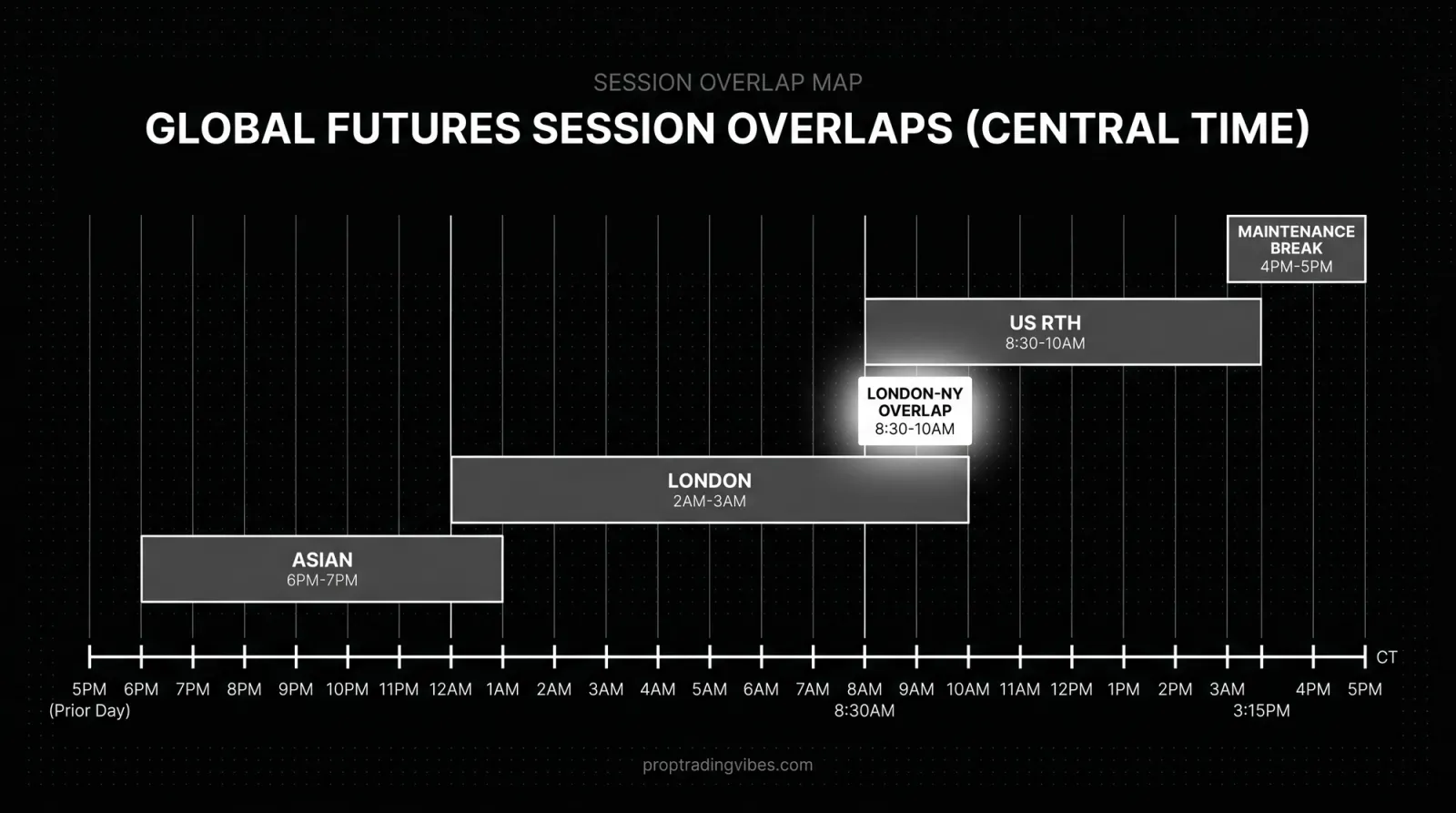
Price action during the overnight session is driven by Asian and European participants. Knowing when each region is active tells you when volume spikes and when it dries up.
Session Overlap Reference Table
| Session | CT (Chicago) | ET (New York) | GMT/UTC |
|---|---|---|---|
| Asian Session | 6:00 PM – 2:00 AM | 7:00 PM – 3:00 AM | 12:00 AM – 8:00 AM |
| London Session | 2:00 AM – 10:00 AM | 3:00 AM – 11:00 AM | 8:00 AM – 4:00 PM |
| London/NY Overlap | 8:30 AM – 10:00 AM | 9:30 AM – 11:00 AM | 2:30 PM – 4:00 PM |
| US RTH (Equities) | 8:30 AM – 3:15 PM | 9:30 AM – 4:15 PM | 2:30 PM – 9:15 PM |
| Daily Maintenance | 4:00 PM – 5:00 PM | 5:00 PM – 6:00 PM | 10:00 PM – 11:00 PM |
The London/New York overlap (8:30 to 10:00 AM CT) is the most liquid window for equity index futures. Tighter spreads, faster fills, more predictable order flow.
Which Contracts Benefit from Which Session
The Asian session is generally quiet for ES and NQ, but it drives meaningful moves in gold futures, crude oil, and currency pairs (6E, 6J) when Asian macro data drops. If you want to understand futures vs forex from a session-overlap perspective, the currency futures windows are the clearest illustration.
DAX futures (traded on Eurex, not CME) are active starting around 2:00 AM CT when European equities open. For prop firm traders focused on CME products, DAX hours are mostly a correlation signal rather than a direct trading opportunity.
Volume and Liquidity by Session
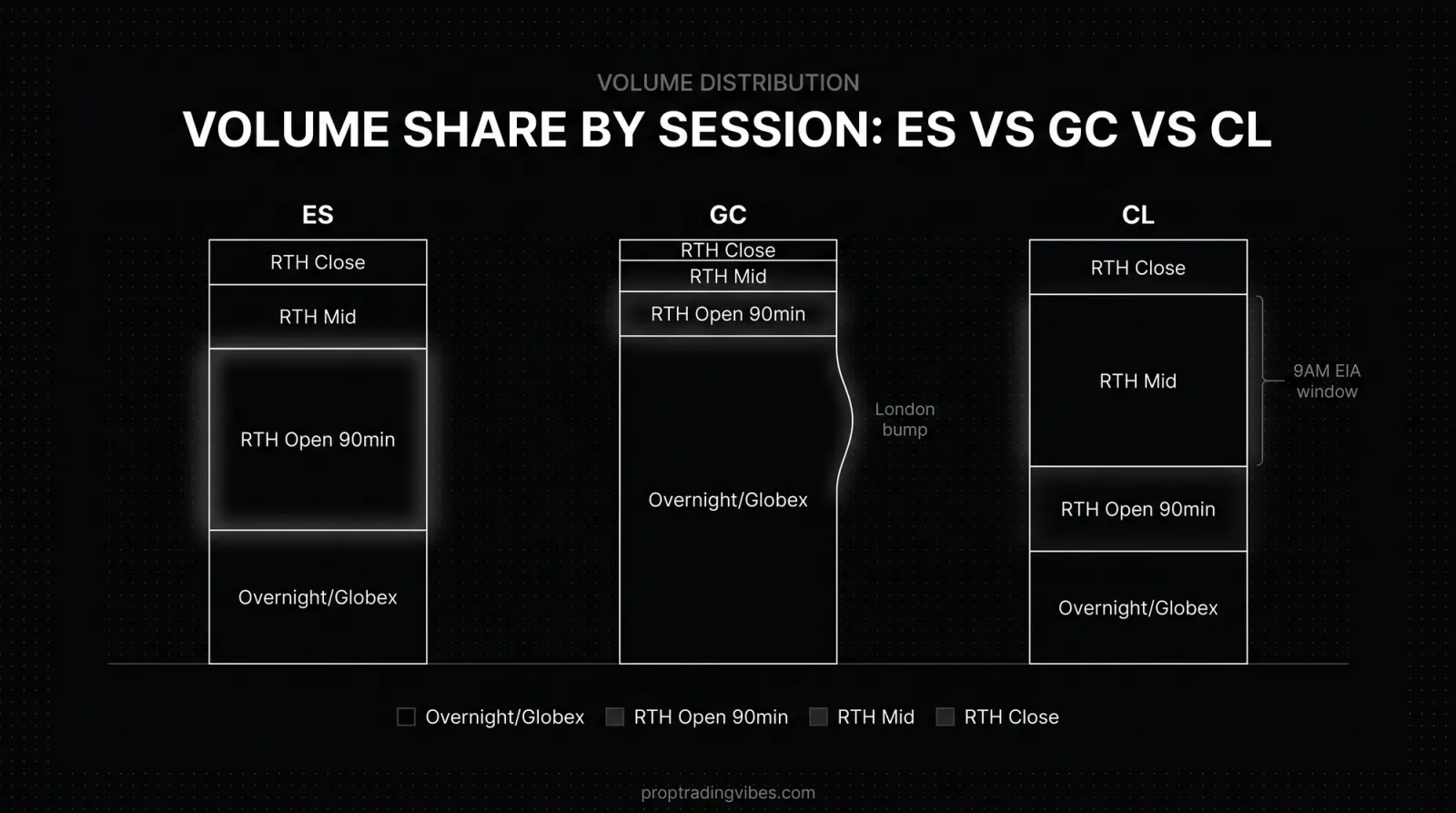
Not all hours are equal. For equity index futures (ES, NQ, YM, RTY), roughly 70% of daily volume trades during RTH. Two windows dominate:
- First 90 minutes of RTH (8:30 to 10:00 AM CT): highest volume, sharpest moves, most news-driven price discovery.
- Final 45 minutes before the 3:15 PM close: institutions rebalancing positions into settlement.
For commodities, volume distribution is different:
- Crude oil (CL): heaviest activity around the 9:00 AM CT EIA weekly inventory report.
- Gold (GC): European session bump between 3:00 AM and 5:00 AM CT when London is fully active.
- Treasury bonds (ZB, ZN): spike on economic data releases at 7:30 AM CT and FOMC announcements at 1:00 PM CT.
Trading during low-volume hours isn't automatically wrong. But wider stops are necessary, fills are slower, and random price swings can eat a drawdown limit before a clean setup forms. On a prop firm account with tight EOD Trailing or Intraday Trailing drawdown, that extra slippage during the Asia session adds up fast. Read the best time to trade futures breakdown for a deeper look at volume profiles by hour.
Futures Market Hours and Prop Firm Rules
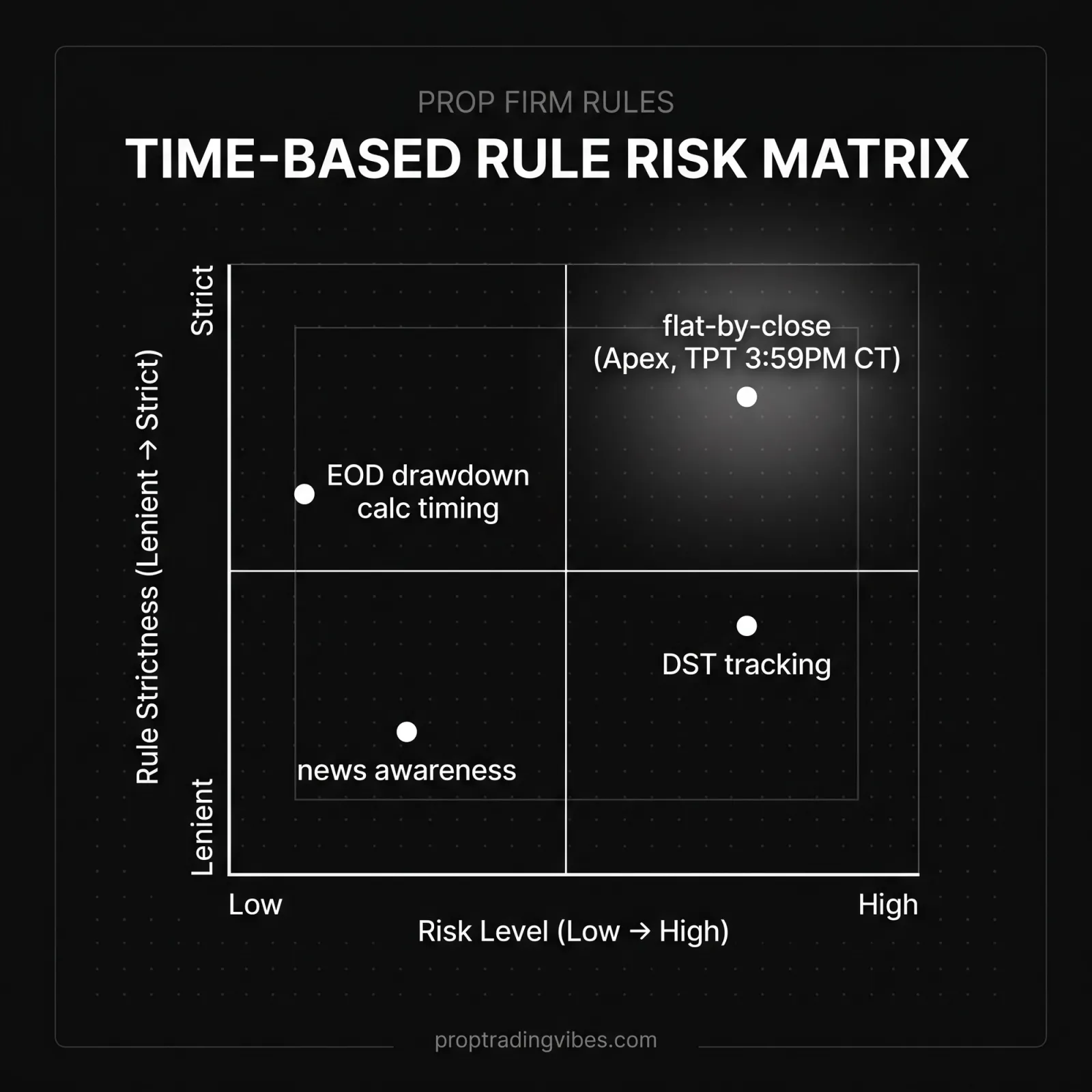
Session timing is where knowledge becomes survival for prop firm traders. Most funded firms have rules tied directly to market hours. Missing them doesn't just cost you a trade. It costs you the account.
Flat-by-Close Requirements
Firms like Apex Trader Funding and Take Profit Trader require all positions closed before the 4:00 PM CT daily maintenance break. Some firms cut it earlier: 3:10 PM or 3:59 PM CT. Auto-liquidation or account violations are the consequence of missing this deadline.
A common trap: you're in a winning NQ trade at 3:55 PM CT, the trade is running, and you think you'll catch a few more ticks before closing. The firm's system auto-liquidates at 3:59 PM and flags the account. Not a loss of the account necessarily, but a warning. Second occurrence is often termination. Check your firm's exact cutoff and set an alarm for 10 minutes before.
No Overnight Holding
Most prop firms prohibit holding through the 4:00–5:00 PM maintenance break. If you want to swing trade or hold overnight, you need a firm that explicitly allows it. Lucid Trading requires all positions closed by 4:45 PM ET and does not permit overnight holding.
News Trading Blackouts
Some firms restrict trading around high-impact events. If NFP drops at 7:30 AM CT on a Friday, your firm may require flat two minutes before and two minutes after. This directly ties session knowledge to trade execution. Know the economic calendar and know your firm's news rules.
EOD Drawdown Calculations
With EOD Trailing drawdown, your floor gets calculated at market close, not intraday. Knowing your firm's definition of "close" matters. Most use 4:00 PM CT. Firms using Static drawdown calculate once and it doesn't move. Intraday Trailing drawdown is the most aggressive: it moves in real time as your account equity rises. Session timing affects risk management differently depending on which type your account uses. Explore prop firm account types for a full breakdown of how drawdown structures interact with trading windows.
Quick Reference: Common Time-Based Prop Firm Rules
| Rule | Typical Requirement | Consequence If Missed | CT Reference |
|---|---|---|---|
| Flat by close | All positions closed before cutoff | Auto-liq or account violation | 3:10 PM – 3:59 PM |
| No overnight | No positions through maintenance break | Violation | 4:00 PM cutoff |
| News blackout | Flat 2 min before/after high-impact release | Trade invalidated | Varies by event |
| EOD drawdown calc | Floor set at daily close | Drawdown miscalculation if you ignore timing | 4:00 PM settlement |
Browse the top Topstep alternatives if you're comparing firm rules across providers.
Sundays, Holidays, and Market Closures
The Sunday Open
The futures market opens each week at Sunday 5:00 PM CT. Before that, there's no trading. The Sunday open often gaps from Friday's close, especially after weekend macro news. Spreads are wide, volume is thin, and the asymmetric risk is high. Trading the Sunday open on an active prop firm evaluation is almost always a bad risk-adjusted decision.
2026 CME Holiday Schedule
CME Group publishes an annual calendar. In 2026, the major closures and early closes are:
- New Year's Day (Jan 1): Closed
- Martin Luther King Jr. Day (Jan 19): Early close
- Presidents' Day (Feb 16): Early close
- Good Friday (Apr 3): Closed
- Memorial Day (May 25): Early close
- Independence Day (Jul 3): Early close (Jul 4 full close)
- Labor Day (Sep 7): Early close
- Thanksgiving (Nov 26): Early close
- Christmas (Dec 25): Closed
On early-close days, futures typically halt between 12:00 PM and 1:15 PM CT depending on the product. Always check the CME holiday calendar before trading around a holiday. Thinner volume, earlier cutoffs, and wider spreads are common in the days before and after major holidays too. A full breakdown lives in the CME trading hours guide.
Daylight Saving Time and Futures Hours
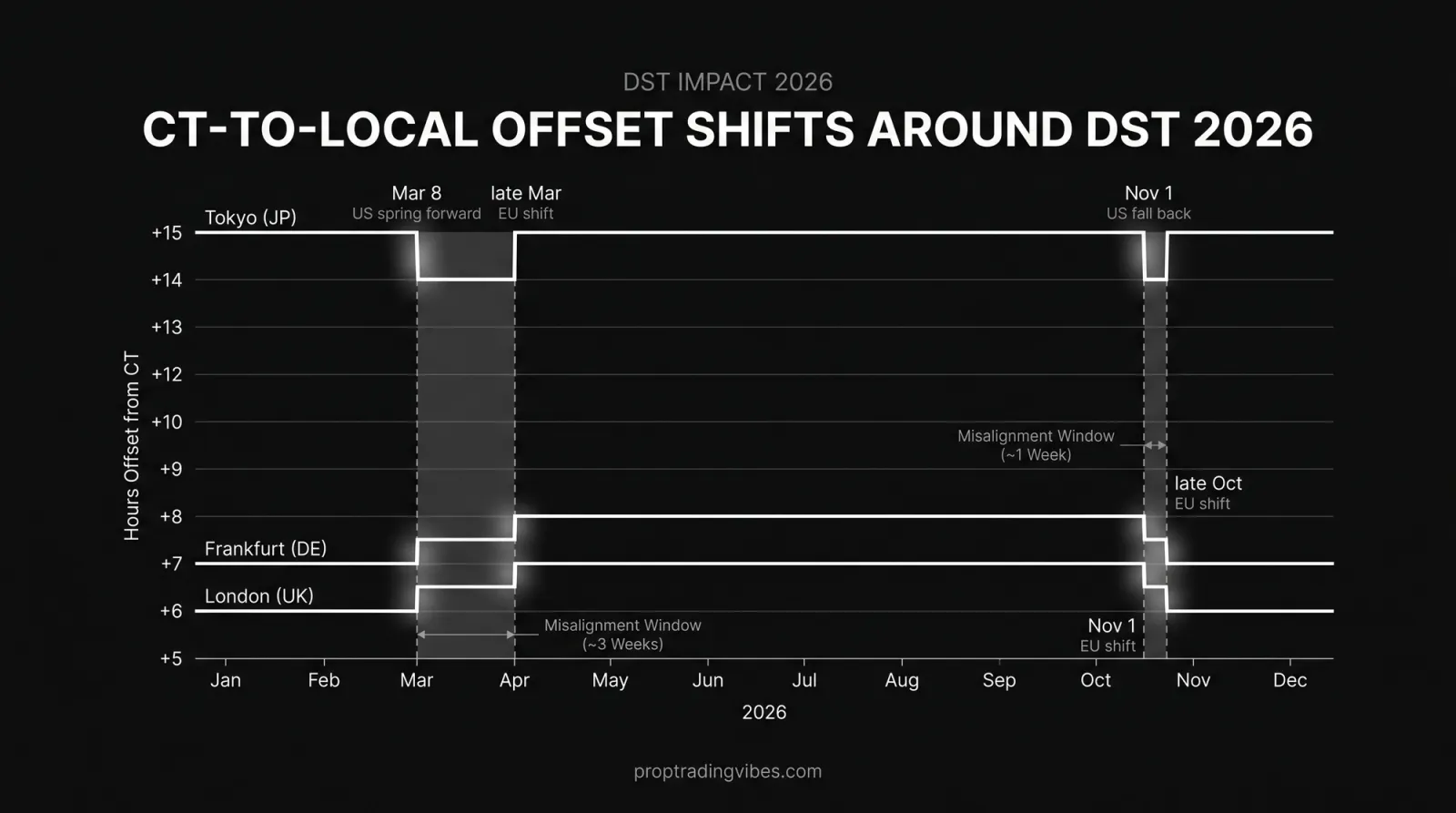
Twice a year, the clock shift trips up traders who haven't accounted for it. CME Globex hours don't change. They're always expressed in Central Time. But if you're trading from Europe, the UK, Asia, or anywhere outside the U.S., the relative offset between your local time and CT shifts temporarily.
The Two Problem Windows in 2026
The U.S. springs forward on the second Sunday of March (March 8, 2026) and falls back on the first Sunday of November (November 1, 2026). The EU adjusts on different dates: late March and late October.
For roughly three weeks in March and one week in November, the offset between U.S. and European time zones is one hour off from normal. If you're trading from London:
- Normal: RTH open hits at 2:30 PM GMT.
- During the DST gap: RTH open hits at 1:30 PM GMT.
If you've set alerts based on clock time and didn't account for the transition, you miss the open. The fix: always reference CT directly rather than converting to a fixed local time. Use a live timezone converter and re-verify your alarms around each transition.
Pre-Market vs. After-Hours vs. RTH
Pre-market (5:00 PM to 8:30 AM CT) and post-market (3:15 PM to 4:00 PM CT) sessions behave differently from RTH in three ways:
Spreads are wider. On ES during RTH, the bid-ask spread is typically 0.25 points (one tick). During the overnight session, particularly between midnight and 3:00 AM CT during the Asia-to-Europe handoff, spreads can widen to 0.50 or 0.75 points. That's real money on a $50K account if you're scaling.
Liquidity is thinner. A market order that fills instantly during RTH might slip a tick or two overnight. Limit orders are safer during extended hours.
Gap risk is real. The 5:00 PM weeknight reopen can gap several points on ES after afternoon macro news. Sunday opens are the worst: 10+ point gaps on ES aren't unusual after a geopolitically active weekend. Even on quiet weeknights, a 3-5 point gap is possible after a surprise Fed headline.
For prop firm accounts, the math rarely favors overnight trading. Your drawdown cushion is finite. Unless you have a specific edge in Asian session commodity breakouts or European currency setups, RTH is where the risk-adjusted edge lives. Beginners especially should read the futures trading for beginners guide before extending into overnight sessions.
Frequently Asked Questions
What time does the futures market open on Sunday?
The futures market opens on Sunday at 5:00 PM Central Time on CME Globex. This marks the start of the trading week for all CME Group products including equity index futures (ES, NQ), commodities (GC, CL), and treasury futures (ZB, ZN). The Sunday open frequently gaps from Friday's closing price, particularly after weekend news events.
What is the daily maintenance break for futures?
The CME Globex maintenance break runs from 4:00 PM to 5:00 PM Central Time, Monday through Thursday. No trading occurs during this window. The exchange resets systems and marks the boundary between one trading day and the next. Most prop firms require all positions closed before this window begins.
What are Regular Trading Hours for ES futures?
ES futures RTH runs from 8:30 AM to 3:15 PM Central Time. This window overlaps with the U.S. cash equity market and accounts for roughly 70% of daily ES volume. The Micro E-mini S&P 500 (MES) follows the exact same RTH schedule. More detail in the ES futures trading guide.
Can you trade futures 24 hours a day?
Futures trade nearly 24 hours on weekdays via CME Globex, from 5:00 PM CT Sunday through 4:00 PM CT Friday. The only daily interruption is the one-hour maintenance break from 4:00 PM to 5:00 PM CT. Weekends and specific CME holidays are fully closed.
What are the best hours to trade futures?
It depends on the product. For ES, NQ, and YM, the 8:30 to 11:00 AM CT window is where you find the highest volume, tightest spreads, and cleanest order flow. For CL, the 9:00 AM CT EIA report window is the most active. For GC, the London session overlap from 3:00 AM to 5:00 AM CT drives significant volume. See best time to trade futures for a full breakdown.
Do prop firms allow overnight futures trading?
Most prop firms prohibit overnight positions, requiring flat before the 4:00 PM CT maintenance break. A small number of firms allow overnight holding on specific account tiers. Always confirm your firm's exact rules before holding into the close. Holding through the maintenance break on a firm that prohibits it typically results in an account violation on the first offense.
What time zone do CME futures markets use?
CME Globex uses Central Time (CT), reflecting the CME Group's Chicago headquarters. Central Standard Time is UTC-6, and Central Daylight Time (during summer months) is UTC-5. All official session times, RTH windows, and maintenance breaks are expressed in CT. Always reference CT when setting trade alerts or automated order triggers.
How does daylight saving time affect futures trading hours?
CME Globex hours are always in Central Time, so the sessions themselves don't change. What changes is how those times map to your local clock if you're outside the U.S. The U.S. and EU shift clocks on different dates, creating a temporary offset of one hour for roughly three weeks in March and one week in November. Verify your local-time conversions around both transitions.
Do futures keep normal hours on US holidays?
Not always. Exchanges may close early or run modified sessions. Check the current exchange holiday calendar before placing a trade.
Why do futures session times shift on my local clock?
The exchange schedule is tied to its reference time zone. Different daylight-saving transition dates can temporarily change the local-time conversion.
The bottom line
CME Globex runs Sunday 5:00 PM to Friday 4:00 PM Central Time with a one-hour maintenance break daily. This guide covers exact RTH windows for every major contract, global session overlaps, prop firm time-based rules, holiday schedules, and the DST traps that catch traders off guard.

Where to go next
The most useful next decision from this page.