
Table of contents
Quick Answer, Gold Futures Trading
- • Gold futures (GC) are standardized contracts to buy or sell 100 troy ounces of gold, traded on COMEX under the CME Group.
- • The standard GC contract has a tick size of 0.10 worth $10 per tick. The micro version (MGC) covers 10 ounces with a $1 tick value.
- • Initial margin on GC sits around $11,000 to $13,000 (verify with your broker). Day-trading margin at most prop firms is a fraction of that.
- • Gold futures trade Sunday 18:00 ET through Friday 17:00 ET with a 60 minute daily break (17:00 to 18:00 ET).
- • Most retail and prop traders never take physical delivery. They roll or close positions before First Notice Day.
Gold futures (GC) are standardized contracts on 100 troy ounces of gold traded on COMEX under the CME Group. Each contract has a tick size of 0.10 worth $10 per tick. The micro version, MGC, covers 10 ounces with a $1 tick value.
That's the entire product in three sentences. Everything below is what those specs mean in practice, how gold prices actually move, and what I've learned trading GC and MGC at prop firms across FOMC weeks and CPI prints.
I'm Paul. I trade futures at prop firms full time. Gold isn't my primary product, but I trade it during FOMC weeks, dollar reversals, and any time the equity index correlation breaks. If you've been trading GLD or spot gold (XAUUSD), here's what changes with futures.
What Are Gold Futures?
Gold futures are exchange-traded contracts that obligate the buyer to purchase, and the seller to deliver, a specified amount of gold at a set price on a defined future date. The standard contract on COMEX is GC, sized at 100 troy ounces with a tick size of 0.10 ($10 per tick). The micro version, MGC, is sized at 10 troy ounces with a $1 tick value.
The word "futures" matters. You are not buying physical gold when you buy a GC contract. In practice, 99 percent of retail and prop traders never see physical delivery. They close or roll the position before First Notice Day, the last business day of the month before the contract month.
Gold futures live on COMEX, the metals division of the CME Group. The exchange handles clearing, margin, and settlement; the product is identical no matter which broker or prop firm you trade through. For how gold stacks up against ES, NQ, and CL as a day-trading product, see the best futures contracts to trade.
Gold Futures Contract Specifications
The GC gold futures contract covers 100 troy ounces with a tick size of 0.10 worth $10 per tick. MGC covers 10 troy ounces with a $1 tick value. Full specs as of April 2026 below. CME Group is the source of truth; verify on cmegroup.com before trading.
| Specification | GC | MGC |
|---|---|---|
| Underlying | Gold | Gold |
| Contract size | 100 troy ounces | 10 troy ounces |
| Price quotation | US dollars per troy ounce | US dollars per troy ounce |
| Tick size | 0.10 | 0.10 |
| Tick value | $10 | $1 |
| Trading venue | CME Globex (electronic) | CME Globex (electronic) |
| Trading hours | Sunday 18:00 ET to Friday 17:00 ET, 60 min daily break 17:00 to 18:00 ET | Same as GC |
| Active months | G (Feb), J (Apr), M (Jun), Q (Aug), V (Oct), Z (Dec) | Same as GC |
| Settlement type | Physical delivery | Physical delivery |
| First Notice Day | Last business day of month before contract month | Same as GC |
| Last Trade Day | Third-to-last business day of the contract month | Same as GC |
| Daily price limit | $400 above/below previous settle (subject to expansion) | Same as GC |
| Initial margin | Approx $11,000 to $13,000 (verify with broker) | Approx 1/10 of GC |
The most active contract is the front-month from the bi-monthly cycle. As of late April 2026, June (M) is front-month with December (Z) holding the highest total open interest. Volume rolls to the next active contract about 5 to 7 business days before First Notice Day.
The same spec logic applies to every CME product. My futures contract specifications guide covers the full lineup in one table.
GC vs MGC: Which Gold Contract Should You Trade?
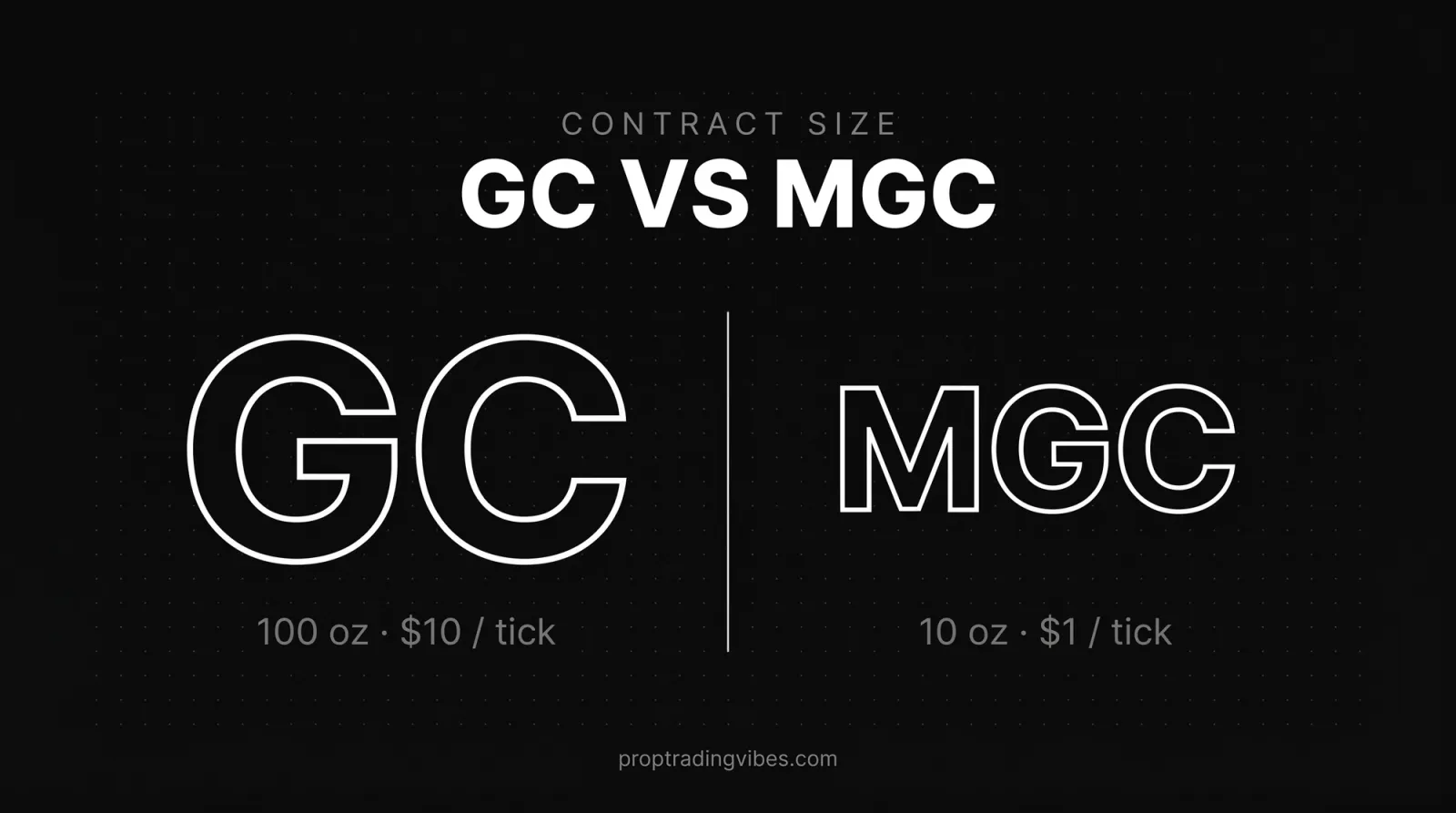
Pick MGC if your account is under $50,000 or you want to risk $50 to $200 per trade. Pick GC if your account is $100,000 or larger and you want $500 to $2,000 of risk per trade.
The two contracts share identical price action. They tick at the same prices and respond to the same news. The only difference is the dollar value per tick: $10 on GC, $1 on MGC.
For prop firm traders, that difference decides everything. Should you trade MGC or GC on a Topstep-style $50K account? MGC, until you're consistently profitable. A 100 tick stop on MGC costs $100. The same stop on GC costs $1,000, which against Topstep's $2,000 Maximum Loss Limit on the 50K is half your buffer in a single trade.
That math holds across Topstep, Apex, and every other futures prop firm. Start on the micro, prove the strategy, then size up to 1 or 2 GC contracts. Micros aren't just a gold thing either; MES, MNQ, and MCL follow the same one-tenth logic, covered in my micro futures trading guide.
How to Trade Gold Futures
To trade gold futures, you need a futures brokerage account or a funded prop firm account, live COMEX data, and a sizing plan defined before entry. The steps:
- Get access. Open an account with a futures broker (NinjaTrader, Tradovate, AMP) or pass a prop firm evaluation that allows GC and MGC. "Buying gold futures" means buying a GC or MGC contract through this account. No vault, no physical gold.
- Load the front-month contract. Trade the active month from the bi-monthly cycle. Your platform usually flags the front-month automatically.
- Put the context on screen. DXY, the US 10-year yield, and SPX next to the GC chart.
- Size the position before entry. Define your stop in ticks first, then size so a stop-out costs no more than 1 percent of account equity.
- Trade the liquid window. The US morning session has the deepest liquidity and cleanest fills. Thin overnight hours punish market orders.
- Manage expiry. Roll or close 5 to 7 business days before the last trading day of the contract month.
That's the mechanical side. The harder part is knowing what actually moves the price.
What Moves Gold Prices
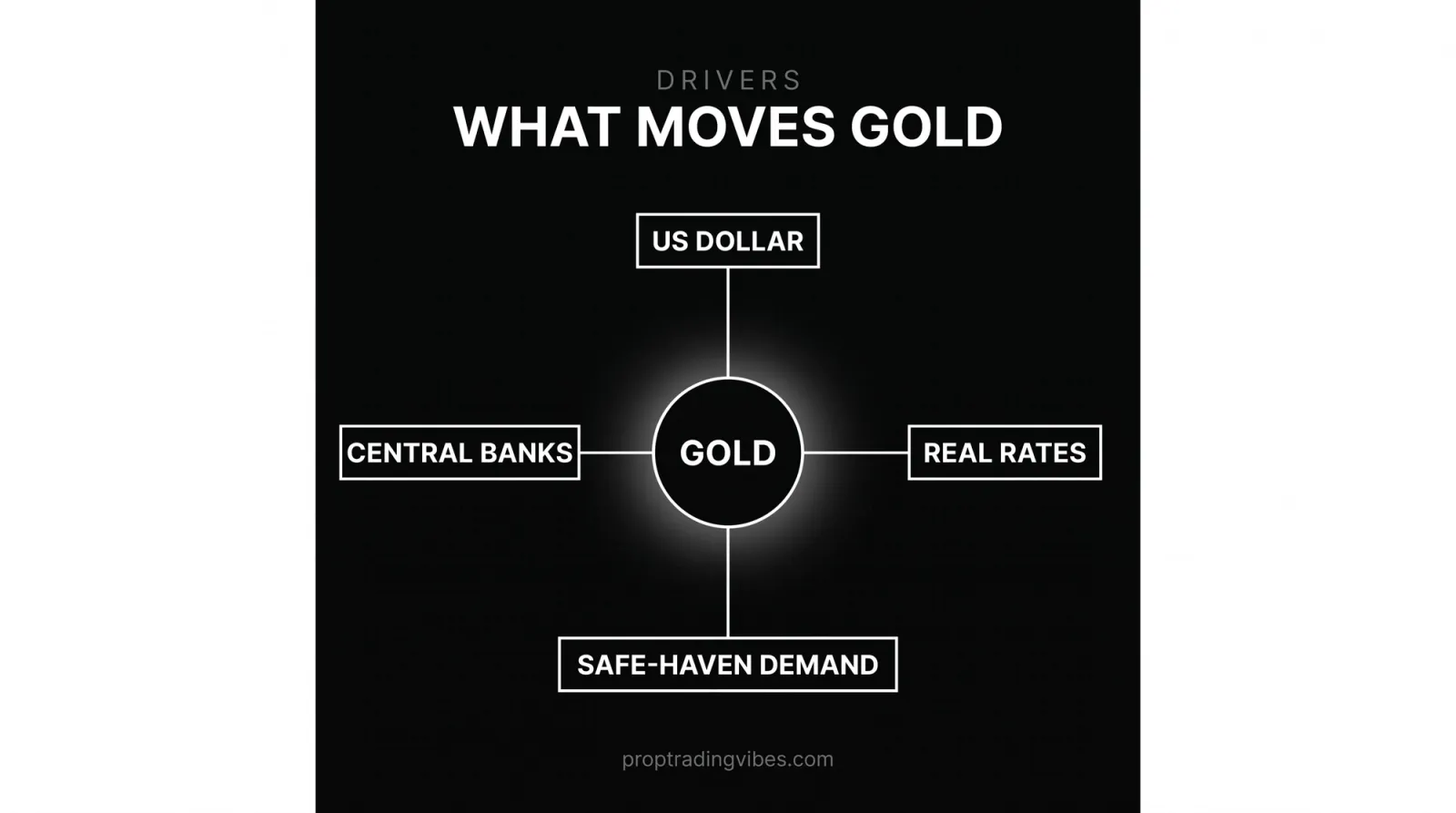
Gold prices move in response to four primary drivers: the US Dollar Index, real yields on US Treasuries, risk sentiment, and geopolitical events. The first two account for most day-to-day variance.
DXY inverse correlation. Gold is priced in US dollars globally. When the dollar strengthens, gold becomes more expensive in every other currency and the price tends to fall. When the dollar weakens, gold tends to rise. Not perfect, but it holds often enough that I keep DXY on my chart whenever I trade GC.
Real yields. Gold pays no interest. When real yields rise, the opportunity cost of holding gold rises with them, which usually pressures the price. Lower or negative real yields usually support it. The 10-year TIPS yield is the cleanest single measure to watch.
Risk sentiment. During acute risk-off events (banking crises, war headlines, sudden equity selloffs), gold often rallies alongside Treasuries. During slow grinding risk-off where the dollar also rallies, gold can fall as the dollar effect dominates. Read both signals together.
Geopolitics. Wars, sanctions, and central bank gold buying programs (China, India, Turkey, Russia have all been steady buyers) create floor-supporting demand on the multi-month chart.
Most of the time you're trading correlation, not absolute price.
Best Times to Trade Gold Futures
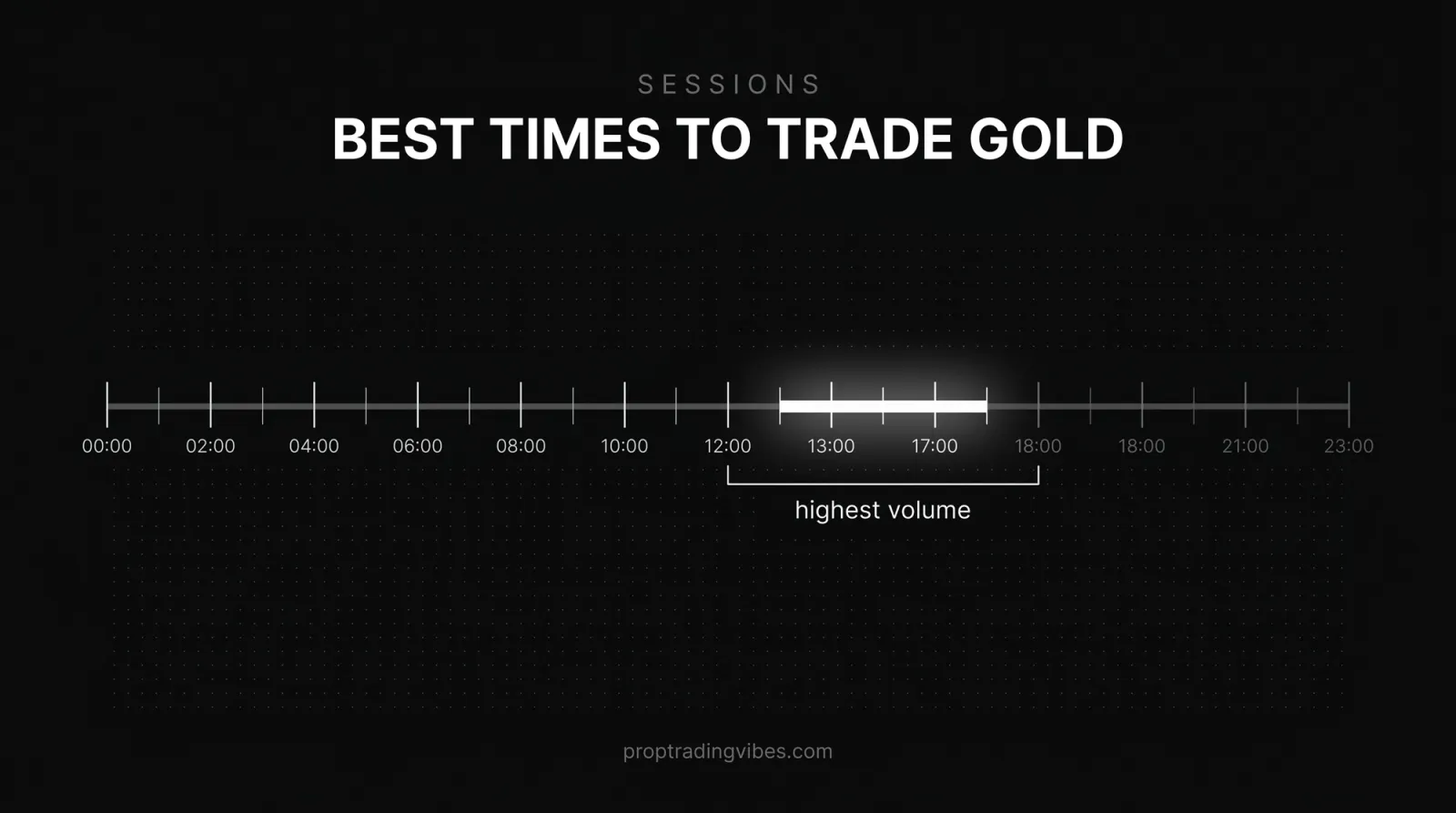
The US morning session, roughly 08:20 ET to 11:00 ET, has the highest gold futures volume and the cleanest price action. If you only trade one window, trade this one.
Asia open (18:00 to 22:00 ET). Evenings often gap or trend off the weekend or US close. Liquidity is thinner and spreads widen slightly, so size smaller.
London open (03:00 ET). European liquidity comes online and gold often respects pre-London ranges. Decent window for breakout setups.
US session (08:20 to 11:00 ET). The COMEX pit opens at 08:20 ET and the London PM gold fix happens at 10:00 ET (15:00 GMT). Combined US and European institutional flow makes this the deepest liquidity of the day.
FOMC days (14:00 ET). Rate decisions release at 14:00 ET, press conference at 14:30. Gold can move 30 to 80 ticks in minutes on hawkish or dovish surprises. I size down or stay flat through the release.
US CPI release (08:30 ET). A hot CPI usually pressures gold via the real yield channel; a cool CPI usually lifts it. The first 90 seconds after release are spread-widened chaos.
Quiet windows to avoid. Friday afternoon after 14:00 ET, the daily 17:00 to 18:00 ET break, and the post-Christmas week.
The full session map across all products is in my CME trading hours guide, and futures market hours covers how the overnight sessions connect. If you trade more than gold, the session-by-session ranking in best time to trade futures applies the same logic to ES, NQ, and CL.
Gold Futures Margin and Leverage
Initial margin on GC sits around $11,000 to $13,000 per contract as of 2026, depending on the CME requirement and your broker's house margin. Day-trading margin at retail futures brokers is typically $500 to $1,500 per contract for GC. Prop firm day-trading margin is usually similar or slightly tighter.
| Margin type | GC | MGC |
|---|---|---|
| Initial margin (overnight) | Approx $11,000 to $13,000 | Approx $1,100 to $1,300 |
| Day-trading margin (retail brokers) | $500 to $1,500 | Roughly $50 to $150 |
Initial margin is what you need to hold a position overnight. Day-trading margin applies only during the official day-trading hours defined by your broker (often 09:00 ET to 16:50 ET). Hold past that window without full initial margin in the account and your broker will force-close the position.
Verify the day-trading margin with your broker or prop firm before placing a trade. CME requirements change quarterly, brokers can set house margin above CME minimums, and the number jumps during volatile periods.
Trading Gold Futures at a Prop Firm
Gold futures work well at prop firms when you respect the trailing drawdown, the news rules, and the position sizing. They blow up accounts when traders treat GC like ES or NQ and ignore that gold can run 50 ticks against you in three minutes during FOMC.
Trailing drawdown is the single biggest risk. Apex's trailing drawdown follows your unrealized peak intraday on most evaluation accounts. Up 30 ticks on a GC contract ($300), the drawdown trails to that high; give back the 30 ticks and you've locked in a $300 hit toward your max.
News rules matter. Many prop firms restrict trading 2 to 5 minutes around high-impact news on funded accounts. FOMC, NFP, and CPI all qualify. Holding GC through 14:00 ET on FOMC day at a strict-news firm can void the trade or close the account. Read the funded account rules, not just the evaluation rules.
Position sizing. A 100 tick stop ($1,000) on a $50K account with a $2,500 trailing drawdown is 40 percent of the buffer. A $50,000 Apex account in 2026 typically allows up to 10 GC contracts max, but trading 10 GC there is one bad bar away from a blowup. Use 1 to 2 GC max, or trade MGC. If your strategy needs 200 to 400 tick stops, MGC is the only sane vehicle.
What works: GC during the US morning with stops under 100 ticks, MGC during FOMC weeks, swinging directional moves when DXY and real yields align. What doesn't: holding GC overnight on a strict trailing-drawdown account, fading FOMC without a defined stop, scaling into losers during news. The full framework is in risk management in prop trading.
3 GC Strategies That Work
These are the three highest-confidence setups I've personally traded on GC and MGC. Generic structures, no specific entry prices, because exact levels change daily.
Trend following on the US session
Identify the daily trend on the 4-hour or daily chart, then wait for the 08:20 ET US open. Trade in the trend direction on a pullback to the prior day's high (uptrend) or low (downtrend) on the 5-minute chart. Stop just past the wick of the entry candle; target 1.5x the stop distance.
Gold trends well during clear macro regimes, and the US session continues the overnight move. Skip the setup if DXY has been flat for 3+ sessions.
Range fade during Asia and early Europe
Identify a clear overnight range on the 15-minute chart. Wait for a test of the range high or low without volume confirmation, then fade back into the range. Stop 10 to 20 ticks past the breakout point; target the opposite end or the midpoint.
Asia and pre-London gold is often consolidation, so fading a low-volume break is high probability with tight stops. It fails on news-driven Asian sessions (China data, BoJ decisions). Check the calendar first.
News play around CPI and FOMC
Stay flat through the release. After the initial spike (usually 30 to 90 seconds), wait for price to retest the pre-release level. If gold rejects the retest with a strong reversal candle, enter on the next 5-minute close. Stop past the spike extreme; target 2x to 3x the stop.
The spike is algo-driven and overshoots; the retest separates real positioning from noise. It fails when the news is decisively one-sided and the spike never retests. Better to miss the trade than to chase.
Common Gold Futures Mistakes
The same mistakes repeat in every prop firm Discord:
- Oversizing on GC instead of starting on MGC. The $10 tick value feels small on paper and enormous 50 ticks underwater on a $50K account.
- Ignoring the DXY chart. The dollar leads, gold reacts. If DXY is breaking out and gold is sideways, the gold move is coming.
- Holding through FOMC without a plan. A 30 to 80 tick move in three minutes is a coin flip with a tight drawdown clock, not a trade.
- Treating MGC as a toy. Identical price action, one tenth the dollar risk. The right size for testing strategies and FOMC weeks.
- Confusing spot gold and gold futures. Spot (XAUUSD) trades OTC with a slightly lower price and different mechanics (rollover swaps, not contract expiry).
- Not respecting First Notice Day. A long GC held into First Notice Day risks a delivery notice. Roll or close 5 to 7 business days before the last trading day of the contract month.
The bottom line
Gold futures suit traders who already understand futures mechanics and want a macro-driven, volatility-rich asset. GC is sized for $100K+ accounts. MGC is sized for $25K to $50K prop accounts and for anyone learning the product.
Start on MGC during the US morning session. Keep stops under 100 ticks. Watch DXY on a second screen. Roll or close before First Notice Day. Do those four things consistently and gold becomes a reliable addition to a futures rotation. Skip them and gold becomes the fastest way to test your trailing drawdown.
Frequently Asked Questions
What is the gold futures tick value?
The GC gold futures tick value is $10 per tick at a tick size of 0.10. The micro gold contract (MGC) has a $1 tick value at the same tick size. A 50 tick move is worth $500 on GC and $50 on MGC.
What is the tick size of gold futures?
Both GC and MGC have a tick size of 0.10, quoted in US dollars per troy ounce. The dollar value differs: each tick is worth $10 on GC and $1 on MGC.
What is the gold futures contract size?
The standard GC gold futures contract covers 100 troy ounces of gold. The micro version, MGC, covers 10 troy ounces, exactly one tenth of GC. Both trade on COMEX and settle physically.
When do gold futures trade?
Gold futures trade nearly 24 hours from Sunday 18:00 ET through Friday 17:00 ET, with a 60 minute daily break from 17:00 to 18:00 ET. The most active window is the US morning, roughly 08:20 ET through 11:00 ET.
What is the margin on micro gold futures (MGC)?
Approximate initial margin on MGC is $1,100 to $1,300 per contract, one tenth of GC's $11,000 to $13,000. Day-trading margin at retail brokers is roughly $50 to $150. Verify with your broker, since CME requirements change quarterly.
Can you trade gold futures at a prop firm?
Yes. Apex Trader Funding, Topstep, TakeProfitTrader, and most major futures prop firms allow GC and MGC. Some restrict trading around high-impact news or limit overnight holds on funded accounts, so check the rules first.
Should I trade MGC or GC on Topstep?
Trade MGC on a Topstep-style $50K funded account until you're consistently profitable. A 100 tick stop costs $100 on MGC versus $1,000 on GC, and $1,000 is half of Topstep's $2,000 Maximum Loss Limit on the 50K. Move up to 1 or 2 GC contracts once the account can absorb a full stop.
How do I buy gold futures?
Open a futures brokerage account or pass a prop firm evaluation that allows GC, then buy the front-month GC or MGC contract through your platform. Start on MGC to keep tick risk at $1 and size so a stop-out costs no more than 1 percent of equity.
What is First Notice Day on gold futures?
First Notice Day is the first day a long position holder can be assigned physical delivery of gold. For GC, it falls on the last business day of the month before the contract month. Traders close or roll positions several days earlier to avoid delivery obligations.
Which gold futures contract is most active?
The active gold futures months follow the bi-monthly cycle: February (G), April (J), June (M), August (Q), October (V), and December (Z). December (Z) typically carries the highest open interest, and front-month liquidity rolls about a week before First Notice Day.

Where to go next
The most useful next decision from this page.