
Table of contents
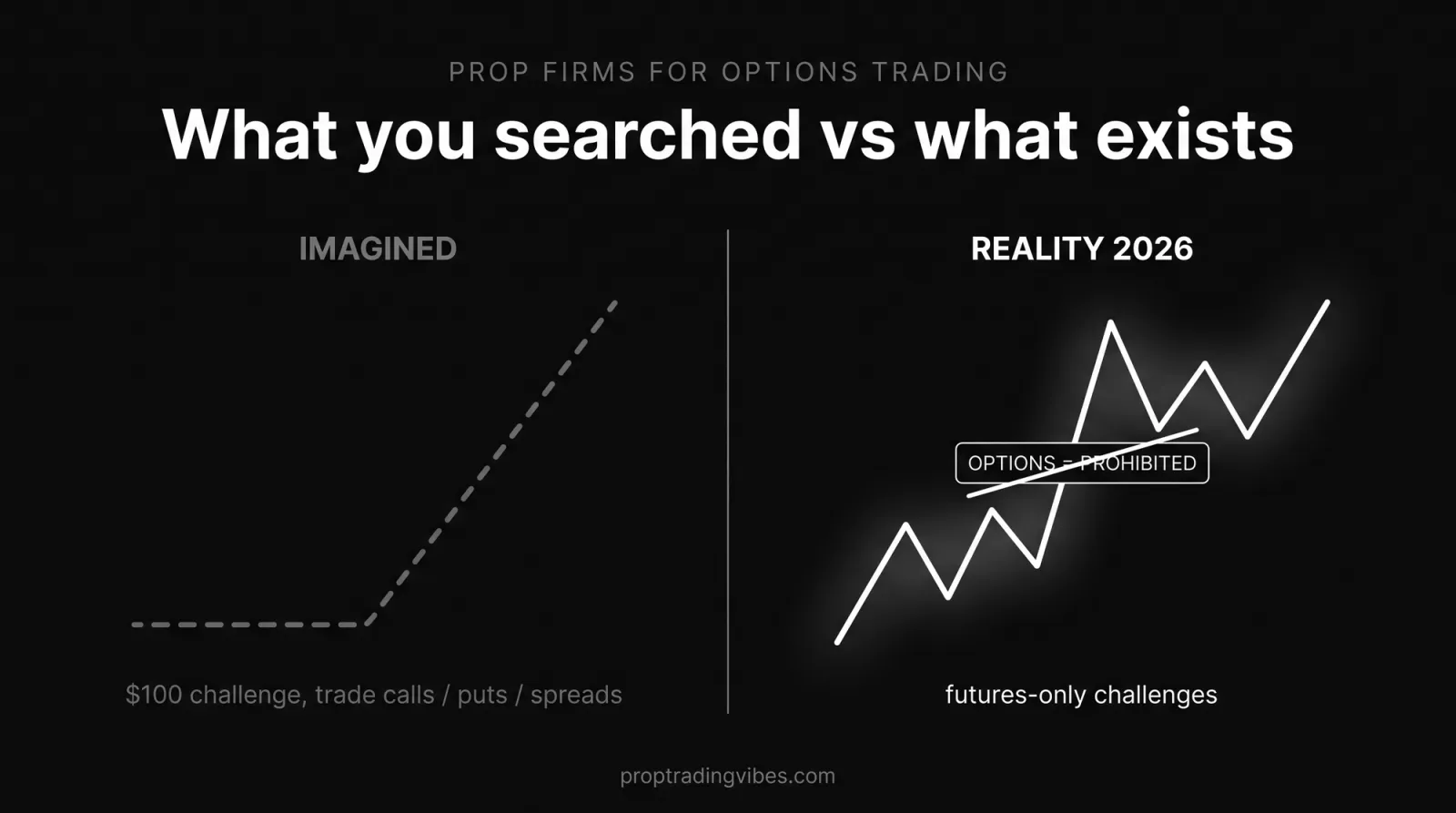
Quick Answer, Best prop firms for options trading in 2026
- • Almost no retail prop challenge funds true options trading, on stocks or on futures.
- • The big futures firms (Topstep, Apex, Elite Trader Funding, TakeProfitTrader, Tradeify) are futures-only and explicitly ban options.
- • Genuine equity-options seats exist at desk-based shops like T3 Trading Group, SMB Capital and Maverick Trading, not the cheap online challenge most traders are searching for.
- • Options on futures are a real CME instrument, but the simulated platforms these firms use do not list them.
- • If you want a fundable futures product close to options-style risk, micro futures are the realistic path.
A prop firm for options trading is, in 2026, almost a contradiction. I get asked for one constantly, and the honest headline answer to "what is the best prop firm for options trading" is that the funded-challenge industry you are picturing, the cheap online evaluation with a $100 reset and a trailing drawdown, does not fund options. Not options on stocks, and in nearly every case not options on futures either.
That is not an SEO dodge. It is what the firms say on their own help pages. Topstep, Apex Trader Funding, Elite Trader Funding and TakeProfitTrader all list options as a prohibited product. The retail prop world is futures-first, and options sit outside the model.
At Proptradingvibes I test these firms with real capital across futures, and I have never once been able to put on an options trade inside a funded account. So this guide does three things. It explains why the gap exists, it shows exactly where the big firms stand on options (with their own rules as the source), and it gives you the realistic alternatives, including the handful of genuine desk-based options shops, so you do not waste an evaluation fee chasing a product that is not on the menu.
Can you actually trade options on a funded prop firm account?
In almost every case, no. The retail prop firm model funds outright futures, not options. The major online firms, the ones that show up when you search for a funded account, do not permit options trading of any kind on their accounts.
This applies to both flavors of options people mean when they search:
- Equity options (calls and puts on individual stocks or ETFs) are essentially absent from the online funded-challenge industry.
- Options on futures (option contracts that settle into a futures position) are a real, regulated CME instrument, but the simulated platforms these firms run do not list them for funded traders.
So when someone asks me for the "best prop firm for options trading," the genuinely useful answer is to separate two very different things: the cheap online futures challenge (no options), and the much smaller, desk-based equity-options prop world (a different model entirely, with real names like T3 Trading Group, SMB Capital and Maverick Trading, covered further down). Conflating the two is exactly why the search rarely returns a straight answer.
Why do prop firms ban options trading?
Prop firms ban options trading for two practical reasons: their platforms do not list options, and options risk does not fit cleanly inside a trailing-drawdown evaluation.
The first reason is mechanical. The big futures firms run on Tradovate, NinjaTrader, Rithmic and TradingView's futures panels. Those platforms are built to route outright futures orders to CME, COMEX, NYMEX and CBOT. Options on futures exist on those exchanges, but the prop-routing setups these firms use simply do not surface them to a funded account. No listing, no trade.
The second reason is risk math. A prop firm's whole business depends on a clean, enforceable trailing drawdown. Selling options can create open-ended or non-linear risk that is hard to police in real time inside an evaluation. A short option position can sit quietly and then move violently against the account in a way that a simple max-loss line was never designed to catch. Rather than rebuild their risk engine around options Greeks, firms restrict accounts to outright futures, where one contract equals a known, fixed risk per tick.
The result is an industry that is futures-first by design. That is also why the same firms are excellent at what they do offer. If you want to understand the underlying business, how prop firms make money explains why the evaluation model leans so hard on simple, enforceable rules.
What are options on futures, and why aren't they fundable?
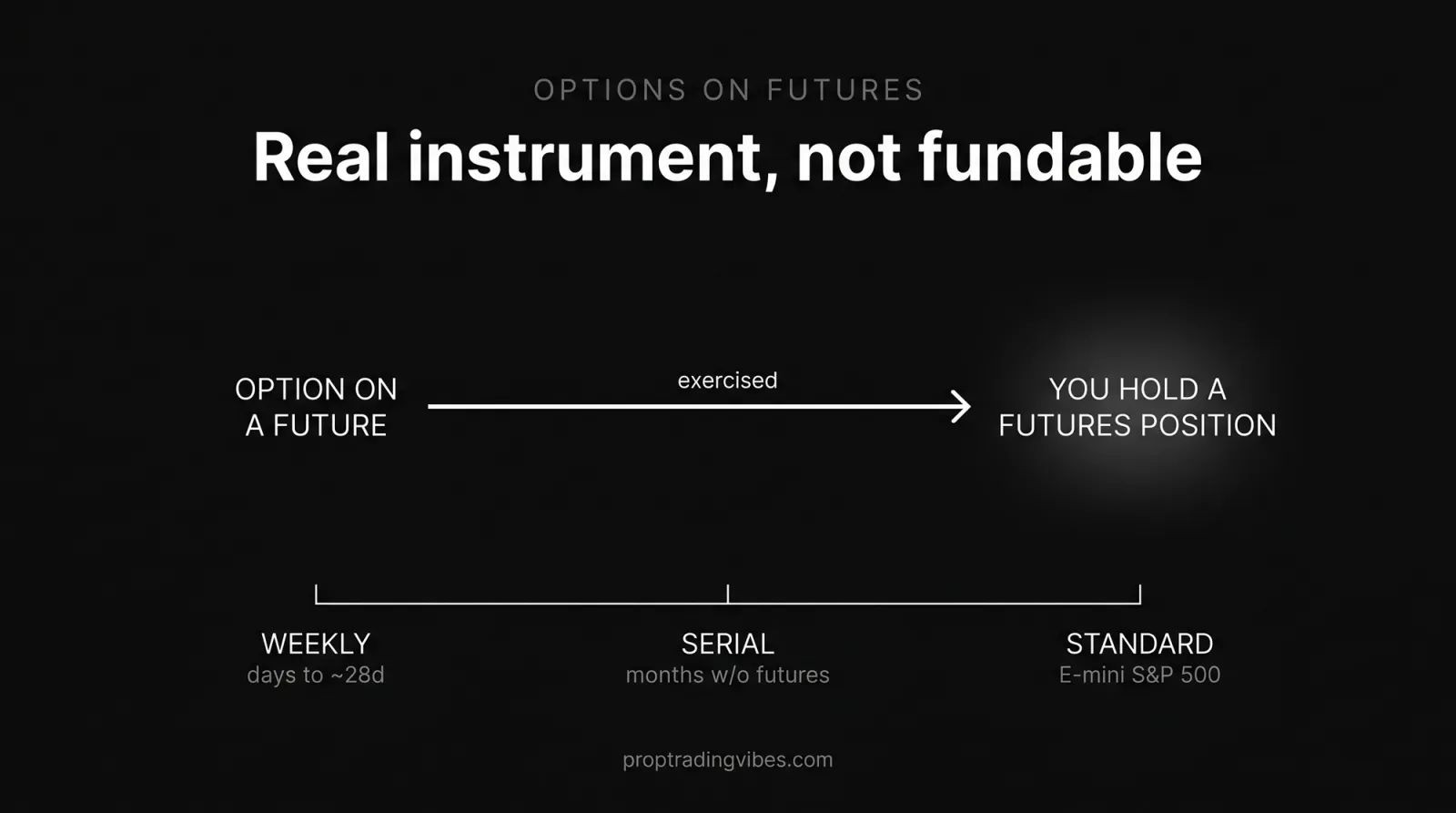
Options on futures are option contracts where exercising the option results in a futures position rather than a stock position. According to CME Group, exercising one of these options leaves the buyer with an underlying futures market position, and the exchange lists several styles to choose from.
As of June 2026, CME Group documents three relevant flavors:
- Weekly options with very short durations, from around 28 days down to a few days, with a contract expiring most Fridays. Traders use them around scheduled events like FOMC meetings and the Friday jobs report.
- Serial options, listed on agricultural futures, that provide an option to trade in a month when no futures contract is listed and that exercise into the nearby futures contract.
- Exercise styles that differ by product. Grain and oilseed options are American-style (exercisable any business day before expiry), while E-mini S&P 500 options can be European-style (exercisable only at expiry).
None of that is exotic. These are mainstream, liquid, regulated instruments. The problem for a funded trader is purely access: the prop firms that dominate the funded-account market do not list options on futures inside their evaluation platforms. So even though the instrument is real and tradable in a normal brokerage account, it is not fundable through the retail prop challenge route.
Where do the big prop firms actually stand on options?
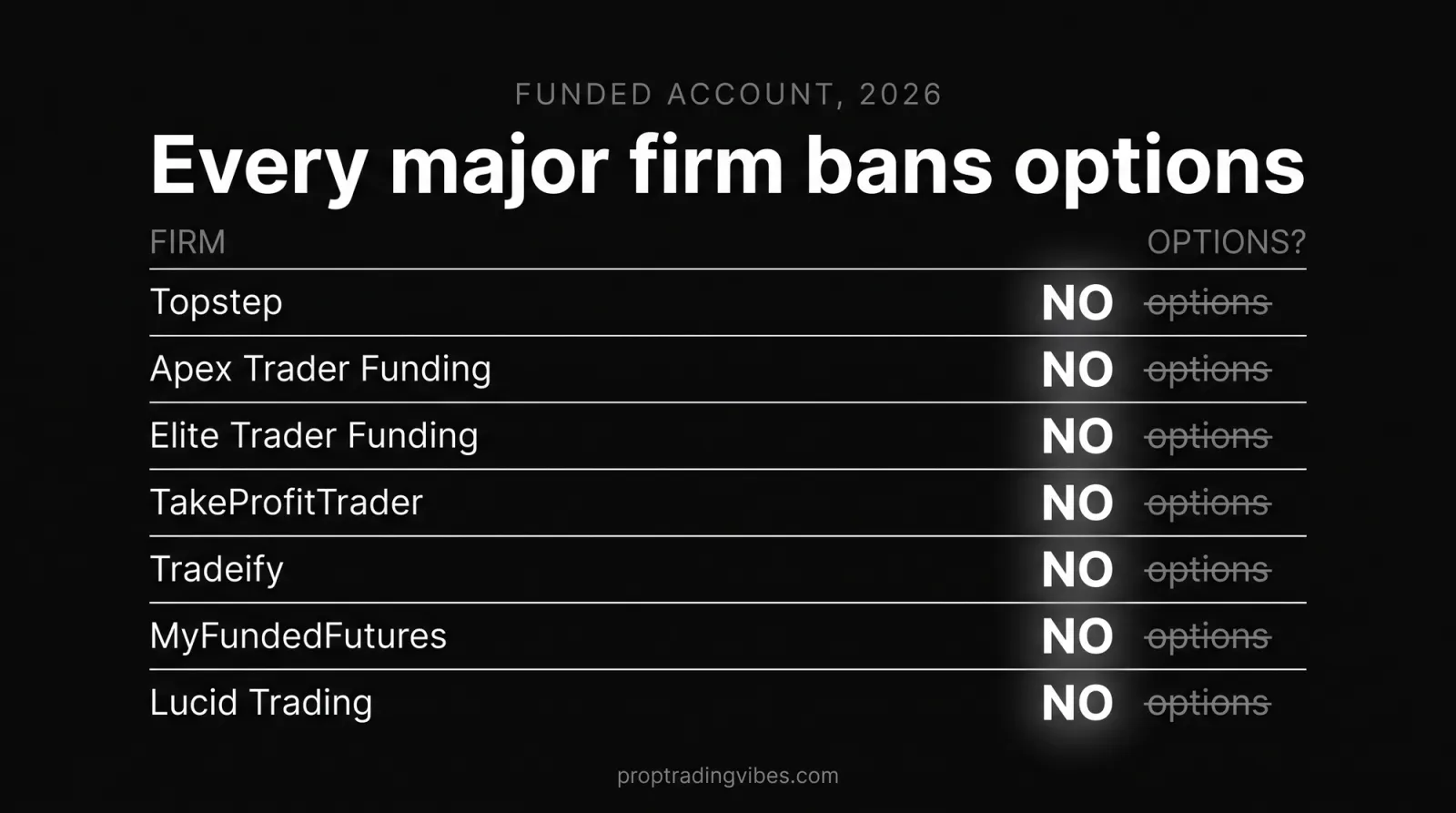
Every major online futures prop firm is futures-only and prohibits options. Below is where the most-searched firms stand in 2026, sourced from their own help pages and product rules, not from third-party lists.
| Firm | Options on funded account? | Tradable products | Source basis |
|---|---|---|---|
| Topstep | No | Futures only (CME, COMEX, NYMEX, CBOT) | Topstep help center: stocks, options, forex, spot crypto prohibited |
| Apex Trader Funding | No | Equity, currency, ag, energy, micro futures | Apex product menu and prohibited-activities rules |
| Elite Trader Funding | No | US futures only | ETF: US futures only, no stocks/options/forex |
| TakeProfitTrader | No | CME equity index, energy, metals futures + micros | TPT permitted-products page: options not permitted |
| Tradeify | No | CME futures universe (ES, NQ, CL, GC, etc.) | Tradeify help center: supported products are futures |
| MyFundedFutures | No | CME futures | Futures-only program |
| Lucid Trading | No | CME futures | Futures-only program |
The pattern is total. Not one of these firms carves out an options product, an options account type, or an options-permitted platform. When a list elsewhere claims a firm "offers options on futures," check that firm's own help center before believing it, because the primary sources here say the opposite.
Worth stating plainly, because aggregator lists muddy it: a firm offering "76 futures contracts" or "every CME product" is still not offering options. Those phrases describe the breadth of the outright futures menu, not the addition of an options product. Breadth of futures and presence of options are two different claims, and only the first one is true at these firms.
Topstep: futures-only, options explicitly prohibited
Topstep is a futures-only funded program. Its help center states that traders may trade futures products listed on CME, COMEX, NYMEX and CBOT, and that stocks, options, forex and spot cryptocurrency are prohibited. In my own testing it is one of the best-run futures firms in the market. It is simply not an options firm, and it does not pretend to be.
Apex Trader Funding: futures-only across every platform
Apex Trader Funding is futures-only. Its product menu spans a broad range of futures (equity index, currency, agricultural, energy and their micros) with no options product on any account type. I have run multiple Apex accounts in parallel and options on futures have never been part of that list.
Elite Trader Funding and TakeProfitTrader: same answer, stated outright
Elite Trader Funding limits trading to US futures instruments, with no stocks, options or forex. TakeProfitTrader is just as explicit: its permitted-products page lists equity index, energy and metals futures plus their micros, and states that stocks, forex, cryptocurrency and options are not permitted on any account type. Two different firms, identical conclusion.
Are there any real prop firms for stock options traders?
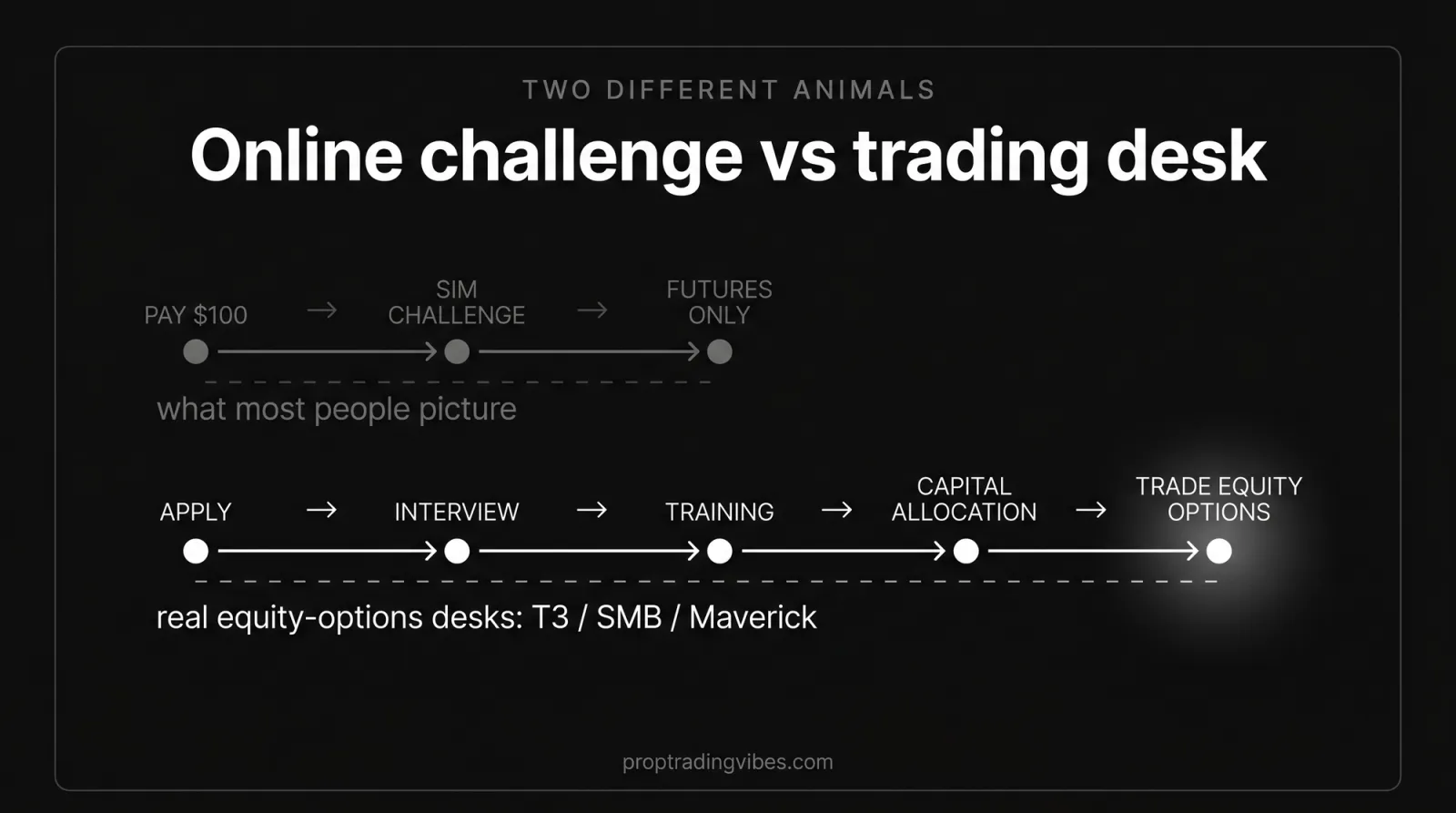
Yes, but they belong to a different category than the online futures challenge. A small number of equity-options prop firms exist, and they run a traditional desk-based or capital-allocation model rather than a cheap, reset-able online evaluation. The names that come up again and again among traders who actually trade equity options on someone else's book are:
- T3 Trading Group (New York). A registered broker-dealer that brings on traders as registered representatives, typically expecting you to be Series-licensed and to trade equities and equity options from a firm capital allocation. This is a desk seat, not a download-and-trade challenge.
- SMB Capital (New York). A proprietary desk known for its training program; new traders go through structured education before trading firm capital in equities and options. It is selective and commitment-heavy.
- Maverick Trading (remote-friendly). Runs an application and training track and allocates capital to traders across stocks and equity options, with a profit-share arrangement rather than a fixed monthly fee.
In that model you typically apply, sometimes interview, often complete a structured training program, and then receive an allocation of the firm's capital to trade equity and index options, including spreads and multi-leg strategies. The economics are different too: instead of paying a small monthly fee for a simulated challenge, you are usually entering a profit-share relationship on a real desk. None of these are challenge firms, and I would not lump them in with the futures-evaluation world. Confirm current requirements directly with each firm before applying, since licensing and onboarding terms change.
This route is legitimate, and for a committed options trader it is the realistic path to trading options on someone else's capital. But it is not what most people mean when they type "best prop firm for options trading" into Google expecting a $100 challenge. If that desk-based commitment is not what you want, the honest takeaway is that the futures-challenge industry will not fund your options trading, full stop.
What should you trade instead at a futures prop firm?
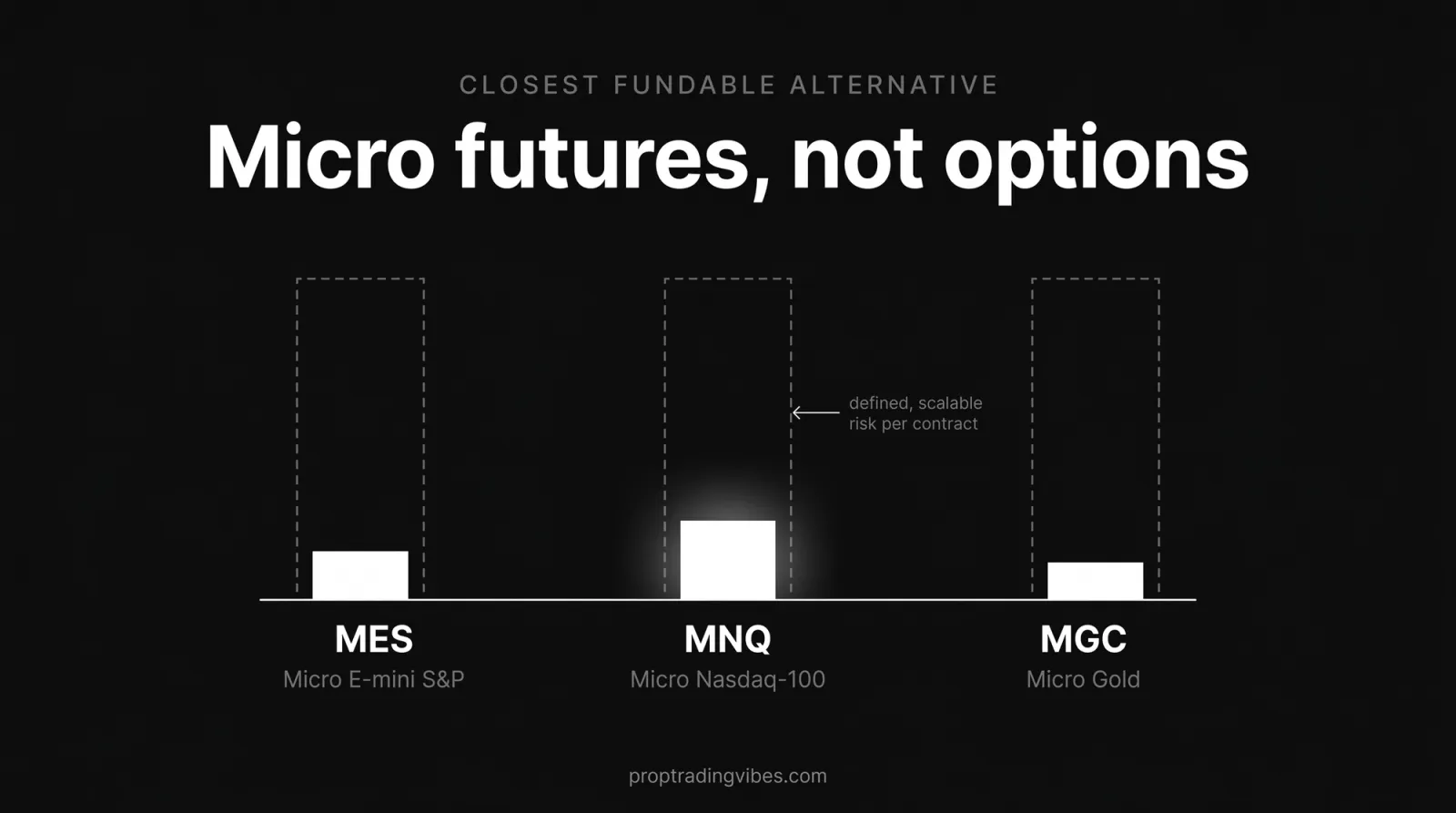
If you came for options but you are open to a fundable alternative, micro futures are the closest realistic product. Micros are smaller-denomination versions of the standard contracts, and they let you scale risk in a way that fits inside an evaluation.
Micro contracts like MES (Micro E-mini S&P 500), MNQ (Micro E-mini Nasdaq-100) and MGC (Micro Gold) carry a fraction of the tick value of their full-size siblings. That gives you defined, granular risk per contract, which is the property options traders usually want from a long call or a defined-risk spread: a known maximum loss and the ability to size precisely. Micros do not replicate an options payoff curve, and they do not give you premium decay to sell. But they are permitted, liquid, and fundable, which options are not.
If micros are new to you, micro futures trading walks through tick values and sizing, and gold futures trading covers MGC specifically for traders who like metals exposure. For the broader picture of which firm fits your style, best prop firms for day trading and best prop firms for swing trading split the field by holding period.
How to choose a futures firm when options are off the table
Once you accept that options are not fundable through the online prop route, the real decision becomes which futures firm fits your style. The criteria that matter shift from "do they have options" to drawdown type, payout speed, consistency rules and cost.
A few practical filters as of June 2026:
- Drawdown mechanic. End-of-day trailing drawdown is more forgiving than intraday trailing for many traders. This single rule changes how much room you have to be wrong.
- Consistency rules. Some firms run no consistency rule, others enforce one. If that matters to you, the prop firms without a consistency rule breakdown filters the field.
- Speed to funding. If you would rather skip the evaluation entirely, instant funding prop firms covers the firms that fund you directly.
- Cost. Evaluation fees and resets add up. The cheapest prop firms guide ranks by real out-of-pocket cost.
If you are weighing futures against the forex-challenge world (another place where people sometimes look for options-like flexibility), futures vs forex lays out the trade-offs. And if any of this is new, start with what is prop trading for the model end to end.
The bottom line
The best prop firm for options trading, in the sense most people mean, does not exist in 2026. The big online futures firms, Topstep, Apex Trader Funding, Elite Trader Funding, TakeProfitTrader and Tradeify, are futures-only and ban options outright on their own help pages. Options on futures are a real CME instrument, but the simulated platforms these firms run do not list them, and equity options never enter the funded-challenge model at all.
I built this guide for the trader who wants the truth instead of a recycled list claiming firms "offer options on futures" when their rulebooks say otherwise. If you genuinely need to trade options, pursue a desk-based equity-options firm like T3 Trading Group, SMB Capital or Maverick Trading, a different and more demanding route. If you are flexible, the honest move is to pick a strong futures firm and use micro futures for defined, scalable risk. Start with best prop firms for day trading to match a firm to your style, and treat any site promising a cheap "options prop challenge" with deep skepticism until you read the firm's own permitted-products page.
Frequently Asked Questions
Can you trade options on a funded prop firm account?
In almost all cases, no. The big retail prop firms (Topstep, Apex Trader Funding, Elite Trader Funding, TakeProfitTrader, Tradeify) are futures-only and explicitly prohibit options, including options on futures. A small number of desk-based equity-options firms exist, but they do not use the cheap online challenge model most traders are searching for.
Does any major prop firm offer options trading in 2026?
None of the major online futures prop firms offer options trading in 2026. Topstep, Apex Trader Funding, Elite Trader Funding and TakeProfitTrader all state on their own help pages that options are not a permitted product. The funded-account challenge industry is built almost entirely around outright futures.
Why do prop firms ban options trading?
Prop firms ban options trading mostly because their simulated platforms (Tradovate, NinjaTrader, Rithmic, TradingView panels) do not list options on futures, and because options risk is hard to model inside a trailing-drawdown evaluation. Selling options can create open-ended risk that breaks the firm's risk math, so they restrict accounts to outright futures.
What are options on futures?
Options on futures are option contracts where exercising results in a futures position rather than a stock position. CME Group lists weekly, serial and standard options on contracts like the E-mini S&P 500. They are a real, regulated instrument, but the prop platforms used by firms like Topstep and Apex do not make them available to funded traders.
Is Topstep a prop firm for options trading?
No. Topstep is a futures-only program. Its own help center states traders may trade CME, COMEX, NYMEX and CBOT futures only, and that stocks, options, forex and spot crypto are prohibited. Topstep is one of the strongest futures props, but it does not support options trading.
Can you trade options on futures at Apex Trader Funding?
No. Apex Trader Funding is futures-only. Its product menu covers a broad range of futures (equity index, currency, agricultural, energy and their micros) with no options product. Options on futures are not available on any Apex account type.
Does TakeProfitTrader allow options trading?
No. TakeProfitTrader is a CME futures firm. Its permitted-products list covers equity index, energy and metals futures plus their micros, and it explicitly states that stocks, forex, cryptocurrency and options are not permitted on any account type.
What is the difference between equity options and options on futures?
Equity options are contracts on individual stocks or ETFs, settled into a stock position. Options on futures are contracts on a futures product, settled into a futures position. Retail prop firms support neither, but equity-options prop firms (a separate desk-based category) focus on the former, while options on futures remain a CME instrument that funded-account platforms do not list.
Are there real prop firms for stock options traders?
A few equity-options prop firms exist, such as T3 Trading Group, SMB Capital and Maverick Trading, but they operate a traditional desk or capital-allocation model, often with an interview, training program or profit-share desk seat (and sometimes a securities license), rather than a $100 online challenge. If you specifically want to trade equity options on someone else's capital, that desk-based route is the realistic one, not the futures-challenge industry. Confirm current requirements with each firm directly.
What can I trade instead of options at a futures prop firm?
Instead of options, the closest fundable product at a futures prop firm is micro futures. Micros like MES, MNQ and MGC let you size positions at a fraction of the full contract, giving you defined, scalable risk that fits inside an evaluation. They do not replicate options payoffs, but they are the realistic path to funded directional and hedged futures exposure.
Why does 'best prop firm for options trading' rarely return a real answer?
The phrase rarely returns a real answer because the product mostly does not exist in the retail prop industry. The funded-challenge model is futures-first, so search results fill up with firms that fund futures, not options. The honest answer is to choose a strong futures firm or pursue a dedicated options desk.
Can you sell options or run spreads on a prop firm account?
No retail futures prop firm lets you sell options or run multi-leg spreads, because options are not a permitted product on their platforms. Spread and premium-selling strategies belong to equity-options desks or your own brokerage account, not to the online futures-challenge firms like Topstep, Apex or Tradeify.
Should I pick a futures prop firm if I really want to trade options?
If you genuinely want to trade options, a futures prop firm is the wrong tool, because none of them permit options. Either pursue a dedicated equity-options desk that allocates capital to options traders, or accept that the funded-challenge route means trading outright futures and micros instead of options.
