
Table of contents
Quick Answer, How to get a funded account, 2026
- • Pick a prop firm, pay the evaluation fee, hit the profit target without breaking the drawdown or daily loss limit, then convert the pass into a funded account that pays a profit split
- • Evaluation cost in 2026 runs from about $70 one-time at Lucid Trading to a one-time $390-$1,490 across Apex Trader Funding's 25K-150K accounts; the fee is your only financial risk
- • Instant funding skips the test for a higher upfront price, LucidDirect 25K lists at $329 and code VIBES applies at checkout; the account is funded immediately, no evaluation
- • The three rules that decide everything: drawdown type (EOD, intraday, static), daily loss limit, and consistency rule, learn them before you buy
- • Industry data on 300,000 accounts shows ~14% pass the challenge and ~7% ever reach a payout, so disciplined risk beats a fancy strategy
A funded trading account is a trading account where a proprietary trading (prop) firm puts up the capital, you trade it under the firm's rules, and you keep a profit split on the gains. You get one by passing a paid evaluation at a prop firm, or by buying instant funding that skips the test. The firm provides the buying power, you provide the trading, and your only out-of-pocket cost is the evaluation fee.
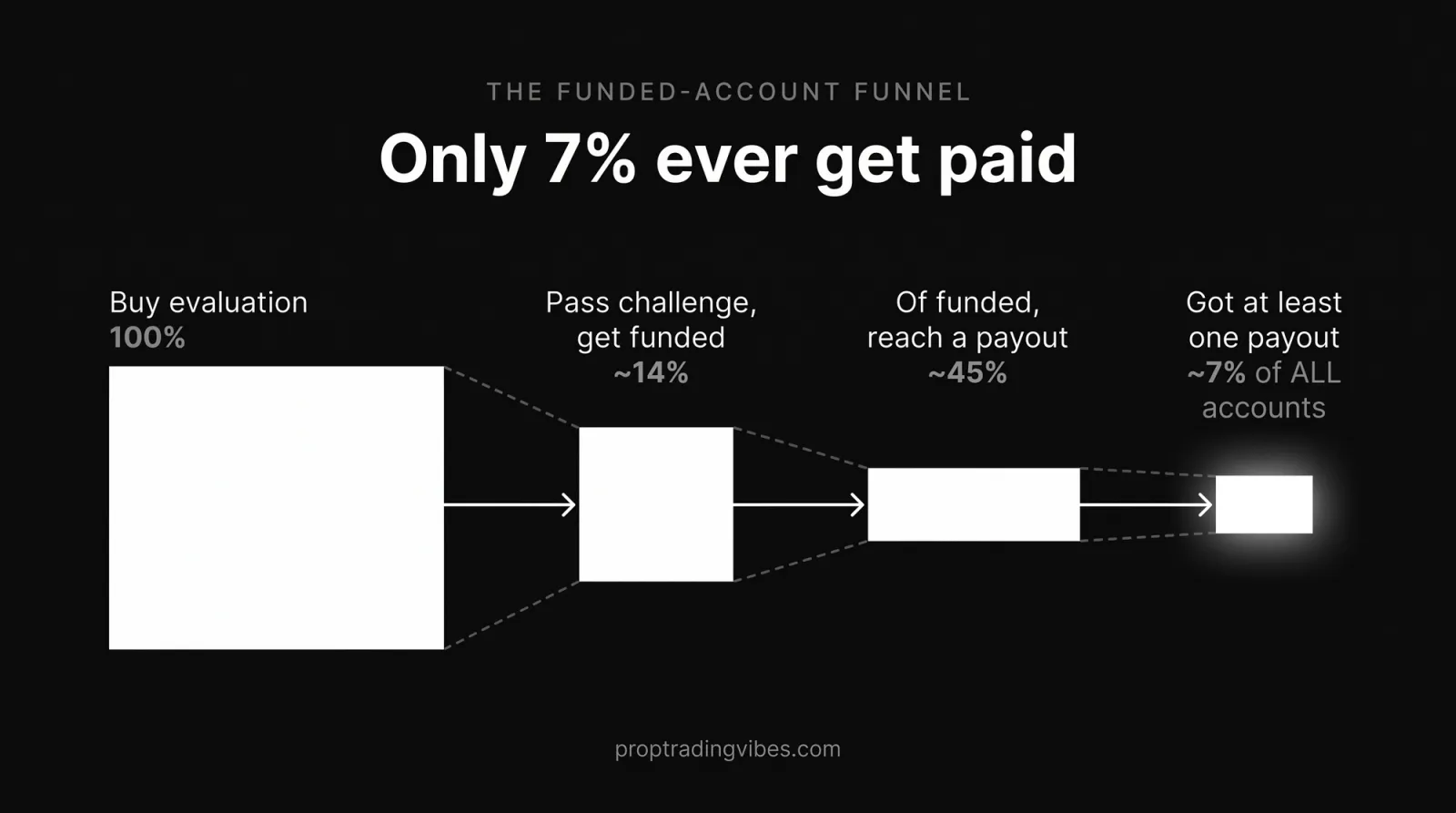
That is the whole arrangement in one paragraph. The rest of this guide is about doing it well, because the gap between buying an account and getting paid from one is wide. A study of 300,000 prop accounts across 10 firms, reported by Finance Magnates, found that roughly 14% of traders pass the challenge and only about 7% ever reach a payout. The firm you pick and the rules you respect decide which side of that number you land on.
This is a how-to, not a sales page. I have run funded accounts at Lucid Trading, Apex Trader Funding and MyFundedFutures across multiple years and real payout cycles, so the examples below are firms I actually trade, used here to show how the steps play out in practice. If you want the wider field first, our best prop firms for 2026 breakdown ranks the current options.
What is a funded trading account, exactly?
One detail trips up most beginners: as of June 2026, at most retail futures prop firms the account itself is simulated. You trade on a demo-style server with firm-set risk parameters, not a live brokerage account holding your own money, yet the payouts are real cash. Lucid Trading, Apex Trader Funding and MyFundedFutures all run this sim-funded model and pay genuine profit splits on simulated performance.
The trade-off is simple. You give up 100% of the upside in return for limited downside. Instead of risking a trading balance, you risk only the evaluation fee. In return you keep a profit split, typically 80% to 100% in 2026, on a much larger account than you could safely fund yourself.
You do not deposit trading capital at any point. If you blow the account, you lose the fee you paid, not money sitting in a balance. That asymmetry is the entire appeal of the model and the reason the evaluation business exists.
How do you actually get a funded account, step by step?
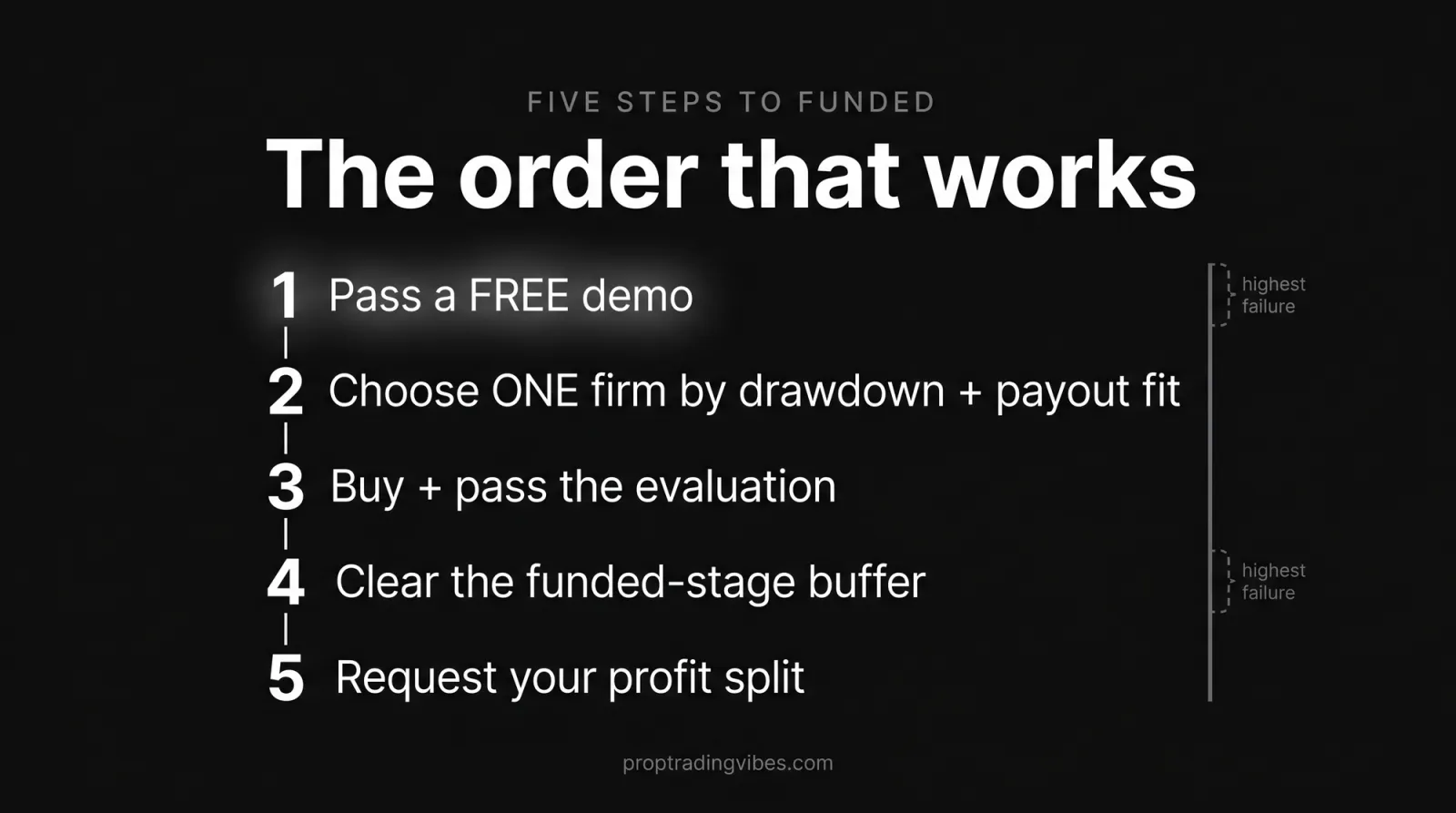
You get a funded account by following five steps in order: get profitable on a demo, choose a firm, buy and pass the evaluation, respect the rules through the funded stage, then request your payout. Skipping the first step is the most common reason traders lose the fee.
Step one: get consistently profitable on a free demo
Before you pay anyone, prove you can trade inside hard rules on a free simulator. Every major platform offers a free demo, and most prop firms run on platforms like Tradovate, NinjaTrader and TradingView that you can practice on at no cost. If you cannot hit a modest profit target on a demo without blowing a daily loss limit, a paid evaluation at Apex Trader Funding or MyFundedFutures will just convert that habit into a lost fee.
This step costs nothing and filters out the single biggest failure mode. The data is blunt: most accounts die in the evaluation, not because of strategy, but because of oversizing and drawdown breaches.
Step two: choose one firm that fits your style
Pick the firm whose drawdown type, daily loss limit, and payout rules match how you actually trade, not the firm with the loudest discount. A scalper who closes flat every day wants a different drawdown mechanic than a swing trader. The comparison table further down breaks out the three firms I use by these exact factors.
Pick one. Spreading a small budget across three firms at once means three half-attention evaluations instead of one focused pass.
Step three: buy and pass the evaluation
Pay the evaluation fee, then hit the profit target without breaching the drawdown or daily loss limit. As of June 2026, Apex Trader Funding's evaluations run a one-time $390 (25K) to $1,490 (150K), and Lucid Trading starts from about $70 one-time. Trade the evaluation exactly like your demo, same size, same rules. Most firms set a minimum number of trading days, so there is no prize for finishing in a day, only added breach risk.
Step four: respect the rules through the funded stage
Passing is not getting paid. After you pass, you enter the funded stage, which often carries its own buffer requirement and minimum trading days before the first withdrawal. As of June 2026, MyFundedFutures requires clearing a buffer (for example $2,100 on the 50K) before payout. This is where many funded accounts quietly die, traders treat the pass as the finish line and stop following the rules that got them there.
Step five: request your payout
Once you clear the funded-stage requirements, request your profit split. Lucid Trading processes payouts in roughly 15 minutes on average. MyFundedFutures offers daily payouts on its Rapid plan and 48-hour payouts on Builder. The money lands via the firm's processor, and from there the cycle repeats.
How much does it cost to get a funded account in 2026?
Getting a funded account costs only the evaluation fee, which in 2026 ranges from about $70 one-time to a few hundred dollars one-time, depending on firm, account size, and whether you choose instant funding. You never deposit trading capital, so the fee is your entire financial exposure.
As of June 2026, here is the entry math at the three firms I use:
- Lucid Trading: evaluation accounts from about $87.60 one-time with code VIBES. Instant funding via LucidDirect from a $329 list price for 25K; code VIBES applies at checkout.
Lucid also added LucidDaily in July 2026, an evaluation account built around payout requests every eligible day once funded; the LucidDaily breakdown covers its rules and pricing.
- Apex Trader Funding: one-time evaluation fees of roughly $390 (25K), $490 (50K), $790 (100K), $1,490 (150K) on EOD plans, plus the size-based Standard PA price due within 7 days of passing. Apex runs frequent public 80-90% off promo cycles, so the real cost depends heavily on the week you buy.
- MyFundedFutures: evaluation pricing varies by plan, with public promo codes that rotate frequently. I do not push an MFFU code because the firm's own codes change too often to rely on.
There is also a hidden cost most beginners underestimate: resets and retries. With only about 14% passing the challenge, most traders need more than one attempt, so the real spend is often a few evaluation fees rather than a single one. Budget for more than one attempt rather than betting your whole budget on a flawless first run.
Can you get a funded account for free or without an evaluation?
There are two shortcuts: instant funding, which removes the test, and free-challenge promotions, which remove the upfront cost for a window. Neither removes the rules you have to trade under once you are in.
Instant funding: pay more, skip the test
Instant funding funds you immediately with no profit-target evaluation, in exchange for a higher one-time price. Lucid Trading's LucidDirect is a straight-to-funded tier with no evaluation, priced from a $329 list price for 25K; code VIBES applies at checkout. You still trade under an EOD drawdown limit and a 20% consistency rule, and there is a minimum of 5 trading days before payout. Instant funding suits traders who are already consistent and would rather skip the eval grind than save money. For the full field, see our guide to the best instant funding prop firm options.
Free and near-free routes
Genuinely free funded accounts are rare and usually arrive through giveaways, referral rewards, or limited promotions rather than as a standing product. The practical near-free route is buying an evaluation on a heavy promo. Apex Trader Funding's recurring 80-90% off cycles can drop a $197 account well under $50 in the right week. Treat any firm advertising permanent fully free funding with no payout history with caution, and favor firms with verifiable records.
Which firms can you get a funded account with, and how do they compare?
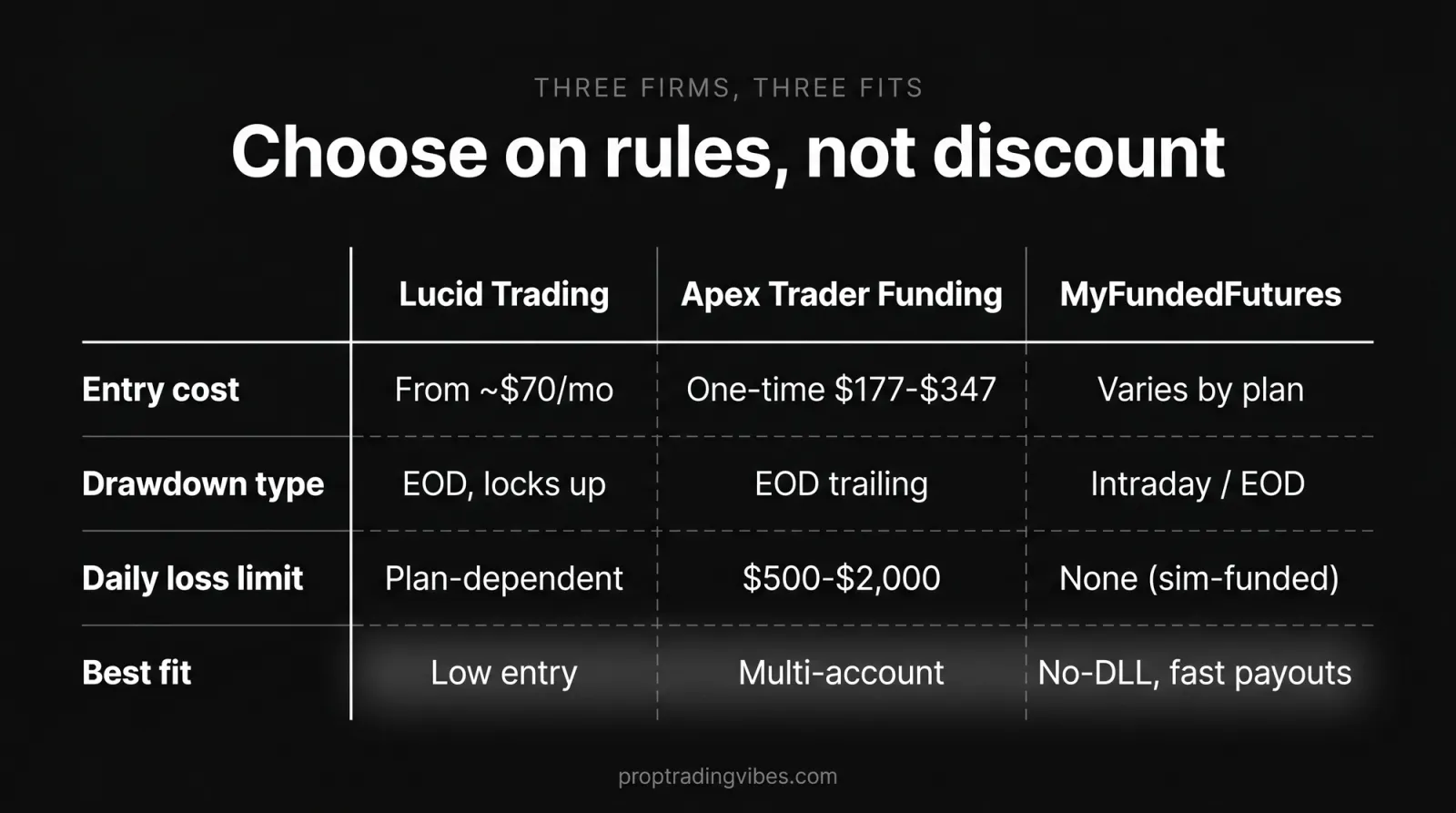
Lucid Trading, Apex Trader Funding, and MyFundedFutures suit different workflows; each recommendation is tied to its current rules and evidence. The table below compares them on the factors that actually decide whether you get and keep an account, all figures as of June 2026.
| Factor | Lucid Trading | Apex Trader Funding | MyFundedFutures |
|---|---|---|---|
| Entry cost | From $53.40 one-time (code VIBES) | $390-$1,490 one-time (25K-150K), up to 90% off promos | Varies by plan, rotating codes |
| Instant funding option | Yes, LucidDirect from $329 list price; code VIBES applies at checkout (25K) | No | No |
| Drawdown type | EOD trailing, locks up at start balance | EOD trailing (intraday option) | Intraday/EOD by plan |
| Daily loss limit | Plan-dependent | $500-$2,000 by size | None on sim-funded plans |
| Consistency rule | 20% all products | 50% on funded | 50% on Builder sim-funded only (none on Rapid/Pro) |
| Profit split | 90% Flex and Pro | 100% on approved payouts | 80% (Builder/Pro) to 90% (Rapid) |
| Payout speed | ~15 min average | Standard processing | Daily (Rapid) / 48h (Builder) |
| Parallel accounts | Up to 5 (LucidDirect) | Up to 20 copy-tradeable | Plan-dependent |
| Best fit | Low entry, forgiving drawdown | Multi-account copy traders | No-DLL, fast payouts |
Apex Trader Funding's edge is running up to 20 copy-tradeable accounts in parallel, which is why high-volume traders gravitate to it. Lucid Trading is my most-used firm, with the lowest entry, an instant-funding path, and a drawdown that locks up at your starting balance so the account becomes un-breachable below where you began. MyFundedFutures removes the daily loss limit on its sim-funded plans, which takes one of the most common funded-stage failure points off the table.
If none of these fit, the principle still holds: choose on drawdown type, daily loss limit, consistency rule, and payout speed, never on the size of the discount banner.
What are the rules that decide whether you keep the account?
The three rules that make or break a funded account are the drawdown limit, the daily loss limit, and the consistency rule. Learn all three for your chosen firm before you pay, because each one can close the account instantly when breached.
Drawdown: how far the account can fall
Drawdown is the maximum your account can drop before it is breached and closed. There are three common types. End-of-day (EOD) trailing only moves up on the daily close, intraday trailing tracks your highest unrealized peak tick by tick, and static never moves. Lucid Trading uses EOD trailing on its core account types that locks up at the starting balance, so once the trail reaches where you began, the account cannot be breached below that line; the exception is LucidDaily (added July 2026), which trails intraday once funded. EOD-and-lock mechanics are far more forgiving than intraday trailing for traders who let winners run.
Daily loss limit: the most you can lose in a day
A daily loss limit caps how much you can lose in a single session before the account is suspended for that day. It is separate from the overall drawdown. As of June 2026, Apex Trader Funding's EOD daily loss limits run from $500 on the 25K to $2,000 on the 150K. MyFundedFutures runs no daily loss limit on its sim-funded plans, which is one of its selling points and removes a common breach.
Consistency: how much one day can carry
A consistency rule caps how much of your total profit can come from a single day or trade, to stop one lucky session from carrying an entire payout. As of June 2026, Apex Trader Funding applies a 50% consistency rule on funded accounts, Lucid Trading's rules vary by product, with a 50% rule on the LucidFlex and LucidDaily evaluations only, and MyFundedFutures applies 50% on the evaluation only with none on the funded account. Plan your payouts around this number, or your withdrawal gets held until your profit is spread out enough. If the rule does not fit your style at all, our roundup of a prop firm without a consistency rule covers the alternatives.
How long does it take to get funded?
There is no fixed timeline, but most firms set a minimum number of trading days rather than a maximum, so the limiting factor is discipline, not speed. As of June 2026, MyFundedFutures advertises a possible one-day pass on its Builder plan, while traditional evaluations typically take a few weeks of steady trading to clear the profit target safely.
The faster path is counterintuitive: smaller size, hit the target steadily, respect the minimum days, then clear the funded-stage buffer. Traders who try to finish the evaluation in a session by sizing up are the ones who breach the drawdown and start over. Apex Trader Funding's funded stage and MyFundedFutures' buffer requirement both gate the first payout behind minimum activity, so even a fast pass does not mean a fast first withdrawal.
What mistakes stop traders from getting funded?
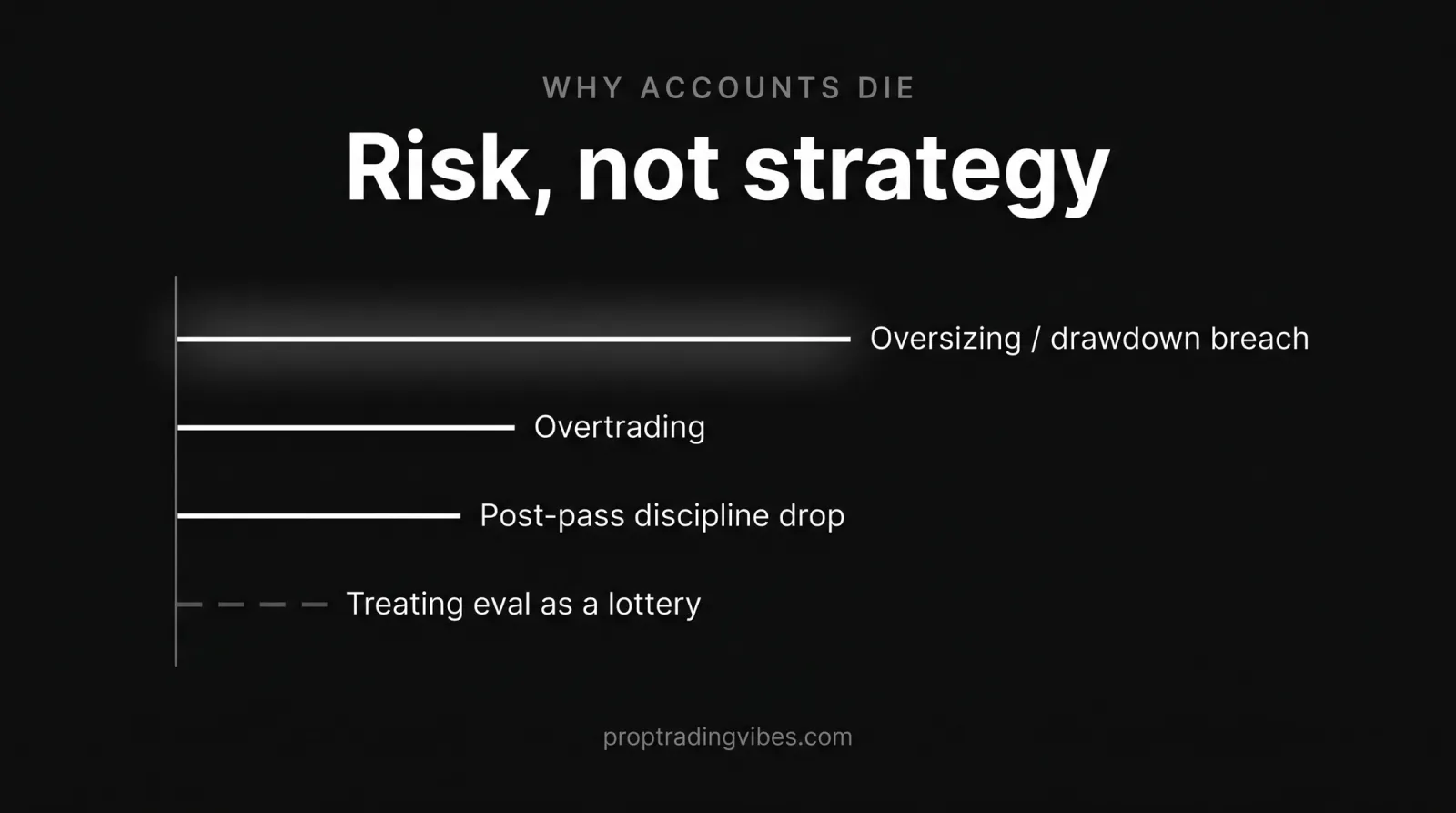
The mistakes that kill accounts are oversizing, overtrading, treating the evaluation as a lottery ticket, and stopping the disciplined behavior right after passing. None of them are strategy problems.
Oversizing and overtrading are the headline causes of failure, and they show up as drawdown and daily-loss breaches rather than bad analysis. The pattern is consistent: traders who size small enough to survive a losing streak clear the target steadily, while those who size up to finish fast breach the drawdown and start over. The market rewards the patient version of the same trader.
The subtler killer is the post-pass collapse. Passing the evaluation feels like the finish line, so traders relax exactly when the funded-stage rules and buffer requirements demand the most discipline. Of the roughly 14% who pass, fewer than half ever reach a payout. Treat the funded stage as a second evaluation, not a victory lap.
The bottom line
Getting a funded trading account in 2026 is mechanically simple: pay an evaluation fee at a firm like Lucid Trading, Apex Trader Funding or MyFundedFutures, hit the profit target without breaking the drawdown or daily loss limit, clear the funded-stage buffer, and request your profit split. The fee is your only financial risk, and instant-funding routes like LucidDirect skip the test entirely for a higher upfront price. Still deciding where to start? Compare the field in our best prop firms for 2026 guide.
This path is right for traders who are already consistent on a free demo and want size without risking their own capital, the asymmetry of a sub-$200 fee against a funded account is hard to beat. It is the wrong path for anyone who cannot pass a free demo, who treats the evaluation as a gamble, or who blows daily loss limits, because the data is unforgiving: about 14% pass the challenge and only 7% ever get paid. If you are not yet consistent, the cheapest move is not a discounted evaluation, it is more time on a demo before you spend a dollar.
Frequently Asked Questions
How do I get a funded trading account as a beginner?
Start by getting consistently profitable on a free demo for at least a few weeks, then pick one prop firm whose rules match your style, pay the evaluation fee, and trade the test the same way you traded the demo. At firms like Lucid Trading and MyFundedFutures you pass by hitting a profit target without breaching the drawdown or daily loss limit, then the firm converts your account to funded and you keep a profit split. The single biggest beginner mistake is buying an account before you can pass a free demo first.
How much does it cost to get a funded trading account in 2026?
Entry cost is the evaluation fee, nothing more, since you never deposit trading capital. As of June 2026 that runs from about $70 one-time at Lucid Trading to a one-time fee of roughly $390 (25K) to $1,490 (150K) at Apex Trader Funding. Instant funding costs more upfront because it skips the test, Lucid Trading's LucidDirect 25K lists at $329; code VIBES applies at checkout. If you fail you lose the fee, not a balance, which is the whole point of the model.
Can you get a funded account without passing an evaluation?
Yes, through instant funding, where you pay a higher one-time price and the firm funds you immediately with no profit-target test. Lucid Trading's LucidDirect is a straight-to-funded tier with no evaluation, priced from a $329 list price for 25K; code VIBES applies at checkout. You still trade under a drawdown limit and a consistency rule, so instant funding removes the test, not the rules. It suits traders who are already consistent and want to skip the eval grind.
How long does it take to pass a prop firm evaluation?
There is no fixed timeline, but most firms set a minimum number of trading days rather than a maximum, so rushing only raises your breach risk. Some 2026 plans are built for speed, MyFundedFutures advertises a possible one-day pass on its Builder plan, while traditional evaluations often take a few weeks of disciplined trading. The faster path is sizing small and hitting the target steadily, not taking oversized trades to finish in a day.
What is the easiest funded account to get?
The easiest route depends on your discipline, not on a magic firm. Instant-funding tiers like Lucid Trading's LucidDirect are easiest to obtain because there is no test, you simply pay and trade. Among evaluation accounts, firms with no daily loss limit such as MyFundedFutures remove one common failure point on the funded side. But no account is easy to keep, industry data shows only about 7% of traders ever reach a payout, so the real difficulty is staying inside the rules.
What percentage of traders pass prop firm challenges?
Roughly 14% of traders pass the challenge and obtain a funded account, according to a study of 300,000 accounts across 10 firms reported by Finance Magnates. Of those who pass, about 45% reach a payout, meaning only around 7% of all traders ever get paid. The takeaway is that the evaluation, not the strategy, is where most accounts die.
Do you trade real money in a funded account?
At most retail futures prop firms in 2026 the funded account itself is simulated, you trade firm-defined risk parameters on a demo-style server, not a live brokerage account holding your own cash. The payouts, however, are real money. Lucid Trading, Apex Trader Funding and MyFundedFutures all run sim-funded models and pay real cash profit splits on simulated performance, so the account is sim but the money you withdraw is genuine.
What rules do I need to follow to keep a funded account?
The three that matter most are the drawdown limit, the daily loss limit, and the consistency rule. As of June 2026, Lucid Trading uses EOD trailing drawdown that locks up at the starting balance on its core account types (LucidDaily trails intraday once funded), with consistency rules that vary by product. Apex Trader Funding applies a 50% consistency rule and daily loss limits from $500 to $2,000 by account size. MyFundedFutures runs no daily loss limit on its sim-funded plans, with a 50% consistency rule on the evaluation only. Breaching any hard limit closes the account.
How do I get paid from a funded account?
Once you clear the funded-stage requirements (usually a minimum number of trading days and a profit buffer), you request a payout and the firm pays your profit split. Lucid Trading processes payouts in roughly 15 minutes on average. MyFundedFutures offers daily payouts on Rapid and 48-hour payouts on Builder. Profit splits in 2026 run 80% to 100% for the trader, Apex Trader Funding pays 100% on approved payouts on its post-4.0 accounts.
Is getting a funded account worth it?
It is worth it for disciplined traders who are already consistent on a demo and want to trade size without risking their own capital, since the only money at stake is the evaluation fee. It is a poor fit for anyone who treats the evaluation as a lottery ticket or who blows daily loss limits on their own demo. The asymmetry is the appeal: a $390 Apex Trader Funding fee can lead to a funded account, but only if you can already trade inside hard rules.
Which prop firm is best to get funded with in 2026?
There is no single best firm, the right one depends on your style. Lucid Trading is PTV’s most documented firm; current entry price, instant-funding, and drawdown claims are maintained in the dedicated review. Apex Trader Funding suits multi-account copy traders who run many parallel accounts. MyFundedFutures fits traders who want no daily loss limit and fast payouts. Match the firm's drawdown type and payout rules to how you actually trade before you pay.
Can you get a free funded trading account?
Genuinely free funded accounts are rare and usually come through occasional promotions, giveaways, or referral rewards rather than as a standing product. The closest practical thing to free is buying an evaluation on a heavy promo, Apex Trader Funding regularly runs public 80-90% off cycles, so a $197 account can drop well below $50 in the right week. Be skeptical of any firm advertising fully free funding with no track record, and favor firms with verifiable payout histories.
What happens if I fail the evaluation?
If you breach a rule or fail to hit the target, the evaluation ends and you lose the fee, not a deposited balance. Most firms sell a reset so you can retry the same account for a smaller fee instead of buying a new one. Plan on the realistic chance of more than one attempt, since the pass rates above mean many traders need a retry, so budget for resets rather than betting everything on a flawless first run.
